
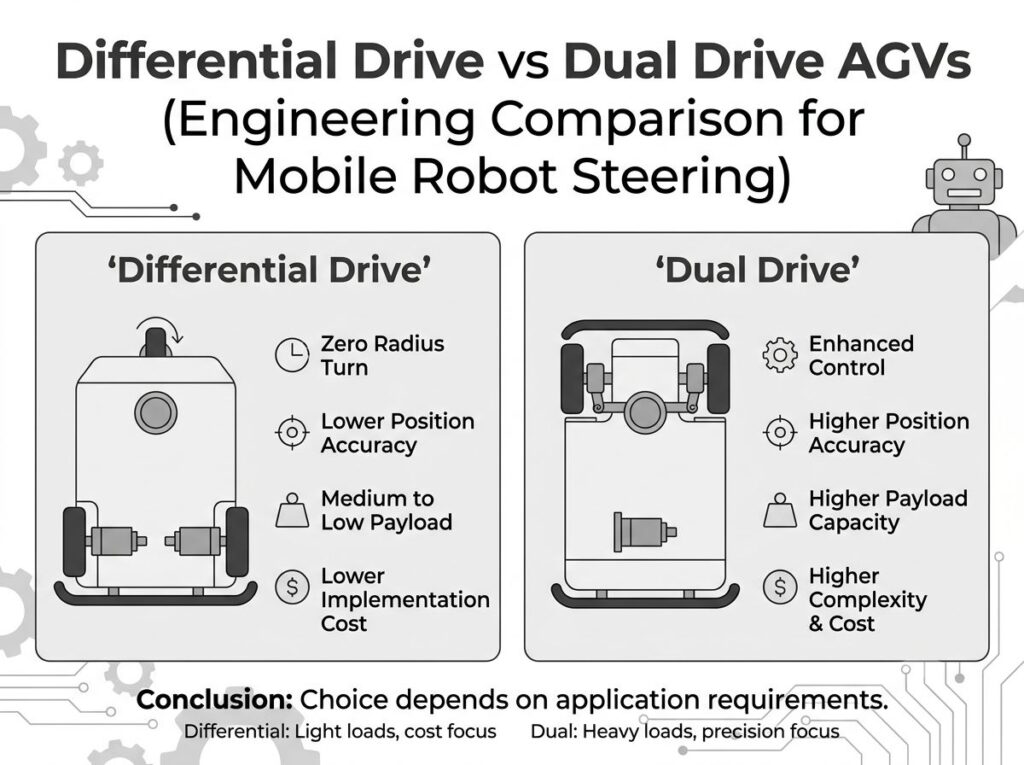
AGV a trazione differenziale e AGV a doppia trazione: Confronto ingegneristico per la guida di robot mobili
A specification-level comparison of differential drive (dual motor) and dual steering-wheel AGVs — covering steering kinematics, coppia del motore, standard di efficienza, and a payload-based selection framework for AGV and AMR engineers.
Risposta rapida
UN differential drive AGV uses two fixed drive wheels, each with its own motor, and steers by creating a speed difference between them — it follows curved paths and can pivot in place but cannot move sideways. UN dual drive AGV (two steering wheels / dual omnidirectional drive) uses two integrated steer-drive modules that actively rotate the wheel for traction, enabling true omnidirectional motion including lateral translation. Scegliere differential drive for cost-sensitive, open-route transport up to ~1 ton; choose dual drive for narrow aisles, high-density docking, or 1–3 ton loads where omnidirectional precision justifies the higher cost. Both architectures share the same BLDC/servo motor base and should target IEC 60034-30-1 IE3/IE4 efficiency.
Contenuto della pagina
AlternaWhat Is a Differential Drive and a Dual Drive AGV?
AGV steering architecture determines how the vehicle generates motion and how precisely it can follow a path. The two most common battery-powered AGV drive layouts are the differential drive (sometimes called “dual motor AGV”) e il dual drive (dual steering-wheel) configurazione.
Differential Drive AGV (Dual Motor AGV)
A differential drive AGV carries two independently controlled drive wheels (left and right) mounted along the vehicle centerline, supported by one or more passive caster wheels. Each drive wheel has its own BLDC or servo motor plus gearbox. Steering is produced entirely by the speed difference between the two wheels — there is no dedicated steering motor or steerable wheel.
- Kinematics: linear velocity
v = (vL + vR) / 2; velocità angolareω = (vR − vL) / L, DoveLis the wheelbase. - Zero-radius turn: when
vL = −vR, the AGV spins about its center. - Limite: the trajectory is always an arc — pure lateral (sideways) motion is impossible.
Dual Drive AGV (Dual Steering Wheel / Omnidirezionale)
A dual drive AGV mounts two integrated steer-drive modules (typically front-and-rear, or diagonal). Each module combines a drive motor, a steering motor, a reduction gearbox, and an encoder in one compact unit. Because the wheel orientation is actively controlled, the AGV achieves omnidirectional motion: forward, reverse, in-place rotation, E lateral translation.
- Controllo: dual closed-loop — steering angle feedback + wheel speed feedback.
- Vantaggio: true lateral movement and higher docking precision in dense aisles.
- Trade-off: higher component count (4 motors vs 2), greater cost, and stricter floor-flatness requirements.
| Aspect | Azionamento differenziale (Dual Motor) | Dual Drive (Dual Steering Wheel) |
|---|---|---|
| Drive actuators | 2 drive wheels, 2 motori | 2 steer-drive modules, 4 motori (2 guidare + 2 steer) |
| Steering method | Speed difference between wheels | Active wheel orientation |
| Lateral (sideways) motion | Not possible | Supported |
| In-place rotation | SÌ (zero radius) | SÌ (zero radius) |
| Carico utile tipico | ≤ 1,000 kg | 1,000 – 3,000 kg |
| Positioning precision | Medio (error accumulates over distance) | Alto (dual closed-loop) |
| Control complexity | Basso | Alto |
| Costo relativo | Basso | Alto |
| Best floor condition | Smooth, sealed | Very flat, suspended modules preferred |
How Differential and Dual Drive AGVs Work — Step by Step
Differential Drive Power Flow
- Battery release: IL 24/48 V DC pack delivers current to the two motor controllers.
- Independent commutation: each controller performs FOC on its own BLDC/servo motor based on encoder/Hall feedback.
- Speed difference generation: the motion controller commands
vLEvR; unequal speeds create the turn. - Gearbox torque multiplication: each planetary reducer scales motor torque to wheel torque.
- Wheel-to-floor traction: both wheels push against the floor; the net force vector curves the path.
- Odometry feedback: wheel encoders feed dead-reckoning; drift is corrected by lidar/QR navigation.
Dual Drive Power Flow
- Battery release: DC bus feeds four axes (2 guidare + 2 sterzo).
- Steering orientation: steering motors rotate each module to the target angle via a high-resolution encoder.
- Drive commutation: drive motors produce traction along the oriented wheel axis.
- Vector synthesis: the controller solves inverse kinematics to combine the two module forces into the desired body motion (including lateral).
- Riduttore + wheel traction: same as differential, but forces can be decomposed in any direction.
- Dual closed-loop correction: steering-angle and wheel-speed loops keep the body on the planned trajectory.
Tabella di confronto delle funzionalità
| Parametro | Differential Drive AGV | Dual Drive AGV |
|---|---|---|
| Number of motors | 2 (one per wheel) | 4 (2 guidare + 2 steer) |
| Steering authority | Indirect (via speed Δ) | Diretto (wheel angle) |
| Min. turning radius | 0 (pivot) | 0 (pivot) |
| Lateral translation | NO | SÌ |
| Path following on uneven floor | Sensitive to slip/drift | Stable (active correction) |
| Encoder requirement | 1,000–2,500 PPR / 17-bit | 17–24 bit absolute + steering encoder |
| Thermal duty (CEI) | S3 / S4 | S3 / S4 |
| Efficienza del sistema (end-to-end) | 80–88% | 78–86% (more losses) |
| Maintenance points | Fewer (2 modules) | More (4 motori + steering gears) |
| Typical applications | Light AMR, Kiva-style, robot di servizio | High-density warehouse, heavy latent AGV, parking robots |
Dati di ingegneria: Efficienza, Limiti di temperatura, e formule di coppia
CEI 60034-1 Duty Cycle Mapping
AGV drive motors operate in intermittent, start-stop profiles — never continuous S1. Select the duty type that matches the task:
| IEC Duty | Profile | Rilevanza dell'AGV |
|---|---|---|
| S1 | Continuo, constant load | Rare (conveyor loops only) |
| S3 | Periodico intermittente, starting neglected | Common pick-and-place AMR (S3-40%) |
| S4 | Intermittent with starting | Frequent start/stop transport |
| S5 | Intermittente con la frenata | Posizionamento rapido, frenata rigenerativa |
| S6 | Continuous with load/unload | Continuous roam with idle waits |
CEI 60034-30-1 / NON MG 1 Classi di efficienza
| Classe CEI | Equivalente NEMA | Typical AGV drive efficiency |
|---|---|---|
| IE1 | Standard | Phased out — not recommended |
| IE2 | Alta efficienza | Legacy brushed only |
| IE3 | Premio | Minimum for new BLDC/servo drives |
| IE4 | Super Premium | Target for 2027+ conformità |
| IE5 | — | Emergente (VFD-assisted) |
Core Torque Formulas
Per a differential drive with two drive wheels sharing the load, the torque per motor is:
Dove F_traction = total resistance (rolling + slope + accelerazione), r_wheel = wheel radius, η = gearbox efficiency (~0.9/stage). Per a dual drive module, each steer-drive carries roughly half the body load but must also react steering torque:
Turning-radius kinematics for differential drive:
For a dual steering wheel, the minimum radius is set by module geometry:
Worked example: UN 500 kg AGV (total mass) su a 3% slope at 1.5 m/s with 0.2 m wheels. F_rolling = 0.015 × 500 × 9.81 = 73.6 N; F_slope = 500 × 9.81 × peccato(1.72°) = 147.6 N; F_acc = 500 × 0.5 = 250 N. F_traction = 471 N. Per differential motor: T = (471 × 0.1) / (2 × 0.9) = 26.2 N·m peak — comfortably within a Maxon MW500 (23.7 N·m continuo, 70 N·m picco a 48 v).
Manufacturer Reference Data
| Supplier | Prodotto / family | Key spec for AGV drive |
|---|---|---|
| Maxon | MW500 wheel drive | ≤500 kg payload; 11.4–23,7 N·m cont.; 30–48 V; IP54; 1024 codificatore cpt |
| Maxon | IDX 56 | 471–794 milioni di Nm; 24/48 v; IP65; regolatore EPOS4 integrato |
| Faulhaber | DualGear (BX4 + GPT) | Ø32mm; 1.1 N·m cont. / 7 N·m max; Gioco ≤0,6°; −30 to 120 °C |
| Yaskawa | Sigma-7 SGM7D | 1.3–240 Nm; 3.1 kHz speed loop; 24-codificatore di bit; 350% sovraccarico 3–5 s; CENTO SIL3 |
| SKF | E2 deep-groove bearing | 30–Attrito inferiore del 50% rispetto allo standard; extends motor life & efficienza |
Best Applications for Each Drive Type
| Scenario | Recommended drive | Motivo |
|---|---|---|
| Goods-to-person picking (Kiva-style) | Differenziale | Fixed routes, light load, guidato dai costi |
| Restaurant / hotel service robots | Differenziale | Low load, open areas, sensibile al budget |
| Narrow-aisle high-density warehouse | Dual drive | Lateral translation + in-place rotation |
| Heavy latent AGV (1–3 t) | Dual drive | Higher payload, precise docking |
| Parking robots | Dual drive | Omnidirezionale, tight maneuvering |
| Long-haul line-side transport | Differenziale | Stable at speed, simpler, cheaper |
Step-by-Step Selection Process
- Define the payload and total mass (vehicle + carico). Above 1 T, bias toward dual drive.
- Map the route geometry. Fixed open paths → differential; narrow aisles / lateral docking → dual drive.
- Calculate traction force (rolling + slope + accelerazione) per the formulas above.
- Solve motor torque. Differenziale: divide by 2 motori; dual drive: divide by 2 modules + steering torque.
- Select gearbox ratio to land motor speed in the 2,000–4,000 RPM sweet spot at target wheel RPM.
- Verify duty cycle against IEC S3/S4 and thermal class (typically F, 155 °C).
- Confirm feedback & sicurezza. Differential needs 1,000+ PPR encoders; dual drive needs 17–24 bit absolute + steering encoder + STO (SIL3).
Errori comuni di ingegneria
| Errore | Conseguenza | Approccio corretto |
|---|---|---|
| Sizing motor on peak torque only | Thermal trip under continuous load | Verify continuous torque vs RMS over the duty cycle |
| Using differential drive on uneven floors | Wheel slip, odometry drift | Specify suspended modules or move to dual drive |
| Underestimating steering torque in dual drive | Sluggish orientation, docking error | Add T_steer term; size steering motor separately |
| Ignoring gearbox backlash | Position jitter at low speed | Use planetary ≤15 arc-min; Faulhaber DualGear ≤0.6° |
| Mismatched encoder resolution | Poor speed regulation | Differential ≥1,000 PPR; dual drive ≥17 bit absolute |
| Skipping efficiency class check | Non-compliant with IE3/IE4 rules | Target IEC 60034-30-1 IE3 minimo, IE4 preferred |
| Over-specifying for light carts | Wasted cost | Differenziale + BLDC suffices under 300 kg |
| No regenerative braking design | Wasted battery, Calore | Use S5 duty profile with energy recovery |
Tabella per la risoluzione dei problemi
| Problema | Causa | Soluzione | Applies to |
|---|---|---|---|
| L'AGV devia dal percorso | Wheel slip / floor unevenness | Add suspension; recalibrate encoder; switch to dual drive | Differenziale |
| Motor overheats in service | Continuous torque > valutato | Re-size motor or improve cooling; check S3/S4 rating | Both |
| Poor docking accuracy | Bassa risoluzione dell'encoder | Upgrade to 17–24 bit absolute encoder | Dual drive |
| One wheel lifts (4-wheel) | Chassis flex / floor | Add floating suspension to steer modules | Dual drive |
| Excessive noise at low speed | Gearbox backlash | Use low-backlash planetary; check Faulhaber DualGear | Both |
| Steering lags command | Undersized steering motor | Increase steering torque; raise loop bandwidth | Dual drive |
| La batteria si scarica velocemente | Low-efficiency motors | Move to IE3/IE4 BLDC; enable regen | Both |
| Can’t translate sideways | Differential architecture limit | Re-architect to dual steering wheel | Differenziale |
| Rottura prematura del cuscinetto | Contamination / sovraccarico | Use SKF E2 sealed bearings; verify load rating | Both |
| Position error accumulates | Open-loop odometry only | Fuse lidar/QR; close steering loop | Differenziale |
Domande frequenti
What is the main difference between differential drive and dual drive AGVs?
A differential drive AGV uses two fixed drive wheels and steers by a speed difference between them, following curved paths with no lateral movement. A dual drive AGV uses two integrated steer-drive modules that actively orient the wheel, enabling true omnidirectional motion including lateral translation.
Is a differential drive AGV the same as a dual motor AGV?
SÌ. A differential drive system uses two independently controlled drive motors (one per wheel), COSÌ “dual motor AGV” E “differential drive AGV” describe the same architecture. Both wheels share traction load and the speed differential produces steering.
Which AGV drive type is better for narrow warehouse aisles?
Dual drive AGVs excel in narrow aisles because they can translate laterally and rotate in place without a turning radius. Differential drive AGVs are better for open, fixed-route transport where cost is the priority and lateral movement is not required.
How much load can a differential drive AGV handle?
Typical differential drive AGVs handle up to 1 tonnellata (1,000 kg) of payload. Above this, traction loss on uneven floors and wheel-slip sensitivity grow. For 1–3 ton loads, dual steering wheel or four-wheel steering configurations are preferred.
What motor efficiency should AGV drive motors meet?
AGV drive motors should target IEC 60034-30-1 IE3 or IE4 efficiency. BLDC drive motors reach 85–92% system efficiency; servo-grade BLDC reaches 90–95%. The duty cycle is typically IEC S3 or S4 (intermittent with starts/braking), not continuous S1.
Can a differential drive AGV achieve in-place rotation?
SÌ. When the left and right drive wheels spin at equal speed in opposite directions, the AGV rotates about its center with a theoretical turning radius of zero. This zero-radius pivot is a key advantage of differential drive for confined spaces.
Why Choose GreenSky Power for Your AGV Drive Motors?
GreenSky Power has designed and manufactured motion control solutions for AGV and AMR builders since 2011, servire i clienti OEM in oltre 50 Paesi. For differential and dual drive AGV projects, forniamo:
- Both architectures from one source — BLDC, servo, and geared motor platforms deploy in differential (dual motor) or dual steering-wheel configurations. Vedi il nostro gear motor vs direct drive guide.
- Engineering calculation support - invia messa, velocità, accelerazione, slope, and wheel diameter; we return a torque/ratio datasheet. Inizia con il nostro AGV motor selection guide.
- Conformità agli standard — tutti i motori testati secondo IEC 60034-1 with dynamometer reports; thermal class F (155 °C); IE3/IE4 efficiency.
- Low-backlash gearboxes — planetary reducers from 5 arc-min for precise differential and dual-drive systems.
- Feedback a circuito chiuso — 1,000–4,096 PPR encoders or 17–24 bit absolute, matched to your navigation requirement.
- OEM supply chain — see our OEM manufacturing guide E Europe supply program.
Related reading: Come funzionano i sistemi di azionamento AGV · Componenti di un veicolo AGV · Best Motor Types for AGVs · AGV Torque Calculation · AGV Speed & RPM Guide · AGV Efficiency & Battery Runtime · BLDC vs Servo for AGVs · Types of Warehouse AGVs · Cos'è un AGV? · AGV contro AMR.
Riferimenti
- Commissione Elettrotecnica Internazionale. CEI 60034-1:2022 — Macchine elettriche rotanti — Part 1: Valutazione e prestazioni (Edition 15). Geneva: CEI. — https://webstore.iec.ch/publication/68321
- Commissione Elettrotecnica Internazionale. CEI 60034-30-1:2014 — Classi di efficienza dei motori CA alimentati dalla rete. Geneva: CEI. — https://webstore.iec.ch/publication/6549
- Associazione Nazionale Produttori Elettrici. NON MG 1-2021 — Motori e generatori. Rosslyn, VA: NON C'È. — https://www.nema.org/standards/view/mg-1-motors-and-generators
- NOI. Dipartimento dell'Energia. 10 CFR parte 431 — Energy Efficiency Program for Commercial and Industrial Equipment: Motori elettrici. — https://www.ecfr.gov/current/title-10/chapter-II/subchapter-D/part-431
- Agenzia internazionale per l'energia. Efficienza energetica 2025 (motor systems chapter). Paris: IEA. — https://www.iea.org/reports/energy-efficiency-2025
- Gruppo SKF. Efficienza energetica (E2) cuscinetti radiali a sfere per motori elettrici (offer sheet). — https://www.skf.com/group/products/bearings-units-housings/ball-bearings/deep-groove-ball-bearings/energy-efficient-bearings
- Siemens AG. Digital transformation at the Bad Neustadt Electric Motor Factory (Gemello digitale, IT/OT convergence). — https://www.siemens.com/global/en/company/about/businesses/digital-industries/bad-neustadt.html
- Gruppo Maxon. MW500 wheel drive for AGV and AMR — product recommendation. — https://www.maxongroup.com/maxon/products/complete-systems/wheel-drive
- Faulhaber. DualGear — dual drive system for logistics (BX4 + GPT). — https://www.faulhaber.com/lp/faulhaber-dualgear/
- Yaskawa Electric Corporation. SIGMA-7 Servo Systems — Direct Drive Servomotors (SGM7D/F/E). — https://www.yaskawa.com/products/motion/drives/servo/sigma-7/