
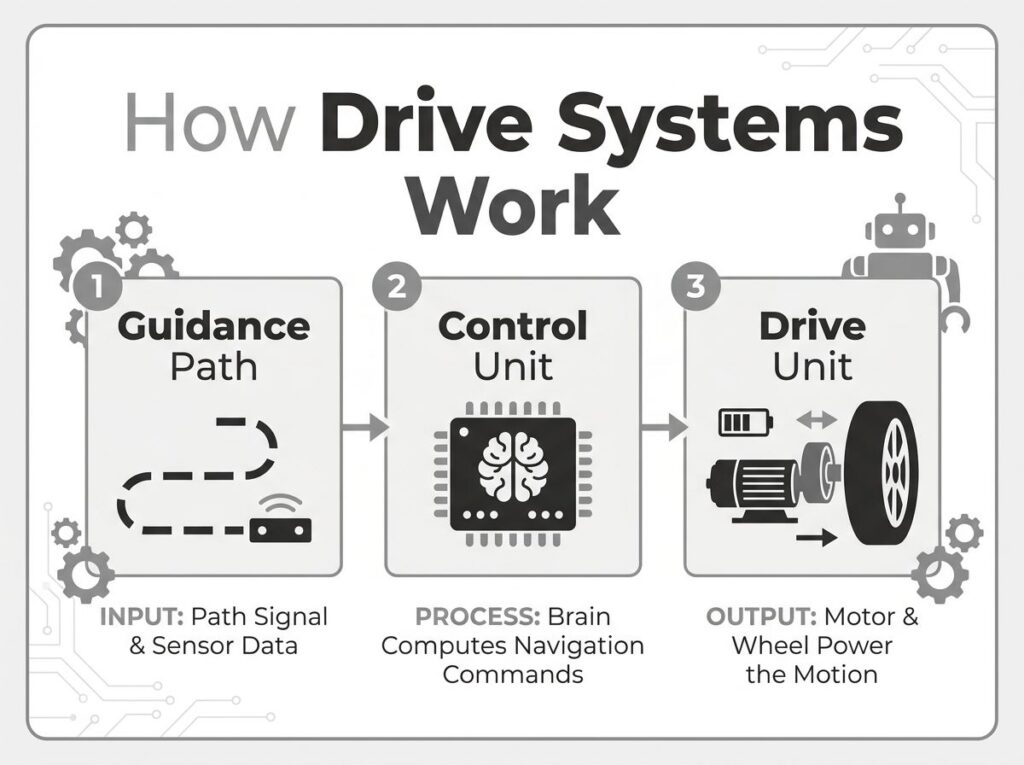
Sistema di guida AGV: Come funziona, Tipi & Guida alla trazione integrale
Risposta rapida
Contenuto della pagina
AlternaWhat Is an AGV Drive System?
UN AGV drive system is the integrated assembly of mechanical and electrical components that generates and controls vehicle motion. It is the subsystem that answers three questions for every AGV: how fast, how precisely, and how reliably can the vehicle move? While navigation software decides Dove to go, the drive system is what physically executes the motion—and its quality determines traction, precisione di posizionamento, battery life and long-term reliability.
Core components of an AGV drive system
| Component | Funzione | Typical AGV specification |
|---|---|---|
| Motore di azionamento | Converts electrical energy into rotational torque | BLDC or servo, 24–48 V DC, 50 W–1.5 kW per wheel, efficiency ≥85% |
| Riduttore / riduttore | Reduces speed, multiplies torque to wheel level | Planetario 20:1–40:1, 92–97% per stage |
| Drive wheel | Transfers motor torque to the floor as traction | PU-coated, Ø125–300 mm, IP54+ |
| Electromagnetic brake | Holds the vehicle on slopes and during power loss | 6–24 N·m holding torque, 24 V CC |
| Codificatore / feedback | Reports speed & position for closed-loop control | 1,000–4,096 PPR (il motore) or 24-bit absolute (servo) |
| Motor driver / controllore | Executes PWM/FOC commands from the navigation system | CANopen / EtherCAT, field-oriented control |
A modern AGV wheel drive typically integrates all of the above into a single modular unit, which simplifies integration and improves consistency across a fleet. Vedi il nostro complete motor selection guide for how these parts map to vehicle requirements.
How an AGV Drive System Works (Passo dopo passo)
The drive system executes a closed power-and-information loop. For a single driven wheel, power flows in six stages:
1. Battery → Controller
The battery pack (tipicamente 24/36/48 V Li-ion) feeds a DC-DC stage and the motor driver. The controller regulates voltage and current and shapes the PWM or sinusoidal output.
2. Controller → Motor
For a BLDC, the driver runs field-oriented control (Foc): it commutates the three phases based on rotor position from Hall sensors or an encoder, delivering smooth torque across the speed range. For a servo, the same principle applies with tighter bandwidth.
3. Motor → Gearbox
The high-speed, low-torque motor shaft enters the gearbox. A planetary reduction of i = 20:1–40:1 drops speed and multiplies torque. Efficiency per stage is 92–97% for planetary, versus 50–85% for worm gears—a critical difference for battery vehicles.
4. Gearbox → Drive Wheel
The output shaft turns the wheel. Tractive force at the contact patch is F = T_wheel / r, Dove R is the wheel radius.
5. Wheel → Floor
The wheel grips the floor through friction (μ). Required preload must satisfy μ · F_N ≥ F to avoid slip—this is why floor condition and wheel material matter.
6. Encoder → Controller (closed loop)
The encoder feeds wheel speed and position back to the controller for speed regulation (error typically <1%) and dead-reckoning odometry between absolute navigation fixes. This loop is what lets an AGV hold ±1–5 mm accuracy.
Read our pillar guide on “Cos'è un AGV” to see how the drive system sits inside the full vehicle architecture.
Drive Topology Comparison Table
Three drive topologies cover virtually all warehouse and factory AGVs. The table below contrasts them on the parameters engineers weight most.
| Parametro | Azionamento differenziale | Steering Drive | Omni-Directional |
|---|---|---|---|
| Steering method | Left/right speed difference | Rotating drive module (0–360°) | Mecano / omni wheel rollers |
| Turning radius | Zero (in-place spin) | Zero | Zero + lateral |
| Positioning accuracy | ±2–5 mm | ±0.1–1 mm | ±1–3 mm |
| Installation height | Basso (≥100 mm) | Più alto (≥200 mm) | Medio |
| Costo relativo | Il più basso (30–50% in meno) | 2–3× differential | Highest |
| Best AGV type | AMR, light tugger, AGC | Forklift AGV, heavy-load | Dense-shelf, cross-dock |
Integrated wheel drive unit comparison
| Unit type | Il motore + riduttore | Typical torque | Key advantage |
|---|---|---|---|
| Integrated steering wheel | BLDC + planetario, rotating module | 10–70 N·m | Steer + drive in one, compatto |
| Differential wheel pair | 2× BLDC + planetario | 5–40 N·m each | Lowest cost, controllo semplice |
| Hub / wheel motor | BLDC in wheel rim | 20–100+ N·m | Zero footprint, elevata densità di coppia |
| Mecanum module | 4× BLDC + rulli | 5–25 N·m each | True omnidirectional motion |
Dati di ingegneria: Efficienza, Cicli di lavoro & Formule di coppia
CEI 60034-1 duty cycle mapping for AGVs
CEI 60034-1:2022 defines ten duty types (S1-S10). Most AGVs operate under S3 O S4; S1 applies only to 24/7 conveyor-style vehicles. The table below maps each class to AGV reality.
| IEC class | Thermal behavior | AGV application | Torque derating |
|---|---|---|---|
| S1 | Reaches thermal equilibrium | AGV in stile trasportatore, 24/7 linea | Nessuno: nominale = continuo |
| S2 | Cools fully between runs | Batch transport, long idle | 1.5–2× S1 for short bursts |
| S3 | Nessun raffreddamento tra i cicli | Goods-to-person AMR, pick-and-place | Per fattore di servizio % (ED) |
| S4 | Starting losses included | Frequent start-stop feeder AGV | 10–20% below S1 |
| S5 | Electric braking heat added | AGV with regen braking on ramps | Braking energy must be managed |
| S6 | Continuo, load/unload alternates | Rolling mill-style continuous AGV | By load duration factor |
CEI 60034-30-1 efficiency classes & NEMA mapping
| IEC class | NEMA equivalent | Loss vs previous band | AGV relevance |
|---|---|---|---|
| IE1 | Standard | — | Avoid—wasted battery |
| IE2 | Alta efficienza | −10% loss | Solo eredità |
| IE3 | Premio (NON MG 1 Tavolo 12-12) | −10% loss | Minimo per i nuovi AGV |
| IE4 | Super Premium | −15% loss vs IE3 | EU 2023+ & US 2027 mandato |
| IE5 | — (ultra-premium) | −20% loss vs IE4 | Emergente, VSD-coupled |
NON MG 1-2021 §12.58 permits a 20% tolerance on guaranteed losses; l'UE 2024/1834 ecodesign regulation and the US DOE 10 CFR parte 431 (IE4 from 2027) set the legal floors. For AGV fleets, every efficiency band saved is extra battery runtime.
Core torque & speed formulas
| Quantità | Formula | Note |
|---|---|---|
| Wheel output torque | T_wheel = T_motor × i × η_gear | Planetary η ≈ 0.85–0.95 |
| Traction force | F = T_wheel / r | Single wheel; ×2 for dual drive |
| Max speed | V = 2π · r · n_motor / i | n in rpm, r in m |
| Coppia efficace (S3/S4) | T_rms = √(Σ T²·t / Σ t) | Must < motor continuous rating |
| Adhesion limit | μ · F_N ≥ F | Dry epoxy μ≈0.75, wet μ≈0.35 |
Worked example (per Bicontrols AGV selection method)
Coppia motore 0.4 N·m, Rapporto di cambio 30:1, gear efficiency 0.85, wheel radius 65 mm:
- Wheel torque
T_wheel = 0.4 × 30 × 0.85 ≈ 10.2 N·m - Single-wheel traction
F = 10.2 / 0.065 ≈ 157 N - Max speed
V = 2π × 0.065 × 2500 / 30 ≈ 34 m/min (0.57 m/s)
This is the order of magnitude a 300–500 kg AMR needs. Utilizza il nostro Guida al calcolo della coppia del motore AGV E how-much-torque guide for payload-specific numbers.
Manufacturer benchmark data
| Supplier | Prodotto | Key data | Fonte |
|---|---|---|---|
| Maxon | MW 500 trazione integrale | ≤500 kg/wheel, 11.4–23.7 N·m cont., 30–48 V, IP54, 1024 cpt | Maxon mobility PDF |
| Maxon | IDX 56 integrato | 471–794 milioni di Nm, IP65, 24/48 v, Foc | maxon IDX |
| Faulhaber | DualGear (BX4 + GPT) | 32 mm BLDC + 2 planetary heads, 18 N·m cont. / 25 N·m int. | Faulhaber CTE |
| Faulhaber | GPT planetary gearhead | ≤18 N·m cont. In 42 mm dia. | Faulhaber manual |
| Yaskawa | Sigma-7 SGM7D | 1.3–240 N·m, 30–360 rpm, 24-codificatore di bit, 3.1 kHz bw, 350% sovraccarico 3–5 s, CENTO SIL3 | Yaskawa BL.Sigma-7.01 |
Best Applications by Drive Type
| AGV / scenario | Recommended drive | Perché |
|---|---|---|
| Goods-to-person AMR (50–300 kg) | BLDC differenziale | Lowest cost, zero-radius, sufficient accuracy |
| Carrello elevatore / pallet AGV (>1 T) | Steering drive servo | ±0.1° heading, heavy traction, compact lift |
| Heavy transfer cart (3–5 t) | Dual steering or 4× hub | Torque distribution, no skid |
| Dense-shelf cross-dock | Omni (Mecano) | Lateral move in tight aisles |
| Conveyor / line-fed AGV | Differenziale, S1 duty | Continuo 24/7, controllo semplice |
| All'aperto / rough floor | Steering drive, IP65, larger wheel | Traction on uneven surfaces |
Match the vehicle first in our types of AGVs guide; then size the drive to the duty cycle.
7-Step AGV Drive System Selection Guide
- Definire il carico. Total mass (chassis + payload). Light ≤300 kg, medium 300–800 kg, heavy ≥750 kg. This sets motor power (100 W / 200–400 W / 750 W+).
- Fix target speed & accelerazione. Industrial AGVs run 30–60 m/min. Higher speed needs more power and better thermal management.
- Pick the topology. Differential for cost, steering for precision, omni for flexibility (see comparison table).
- Choose motor + riduttore. BLDC or servo at 24–48 V, planetario 20:1–40:1, output torque 5–200 N·m. Verify
T_rms < T_continuous. - Size the wheel & freno. Wheel Ø125–300 mm; electromagnetic brake ≥6 N·m for slope/parking hold.
- Set feedback & bus. Codificatore 1,000+ PPR (or 24-bit absolute for servo); CANopen / EtherCAT to match the controller.
- Validate thermal & conformità. Confirm IEC 60034-1 duty class and IE3/IE4 efficiency; specify IP54 (IP65 for real-world >12-month deployment).
For speed/RPM trade-offs, vedi il nostro AGV motor speed and RPM guide, and for efficiency vs battery life our efficienza & guida all'autonomia della batteria.
Errori comuni di ingegneria
| Errore | Conseguenza | Correct approach |
|---|---|---|
| Sizing on peak (catalog) torque only | Thermal trip after 15–30 min | Size on RMS torque over the duty cycle |
| Using worm gearbox to save cost | 30% energy lost as heat | Usa la planetaria (92–97% per stage) |
| Ignoring floor friction μ | Wheel slip on ramps | Verify μ·F_N ≥ F; add preload |
| Under-specifying encoder | Odometry drift, poor docking | ≥1,000 PPR or 24-bit absolute |
| No brake on slope applications | Roll-back on power loss | Spec electromagnetic holding brake |
| Mixing duty classes | Overheating under S3/S4 | Match motor to IEC 60034-1 class |
| Skipping IP rating | Bearing/winding failure | IP54 min, IP65 for real environments |
| Wrong voltage bus | Cable loss, motor heat | Match 24/36/48 V to battery |
| Neglecting inertia match | Oscillation, step loss | Keep J_load/J_motor < 10:1 (servo) |
| Buying on unit price alone | 3× downtime cost | Evaluate 5-year TCO & affidabilità |
Tabella per la risoluzione dei problemi
| Problema | Likely cause | Soluzione | Topology |
|---|---|---|---|
| AGV stalls on ramp | Insufficient continuous torque | Resize motor / lower gear ratio | All |
| Wheel slip at start | μ·F_N < F | Increase preload, softer accel ramp | All |
| Position overshoot | Risoluzione dell'encoder troppo bassa | Upgrade to 24-bit absolute | Timone / servo |
| Overheat in 20 min | RMS > continuous rating | Larger frame or better duty match | All |
| Uneven tracking | Wheel diameter mismatch | Match wheels, recalibrate | Differenziale |
| Chattering on turn | Steering encoder offset | Re-zero absolute encoder | Timone |
| La batteria si scarica velocemente | Worm gear / low IE class | Switch to planetary + IE4 | All |
| Can’t move laterally | Wrong roller angle (Mecano) | Verify 45° roller fit | Omni |
| Brake won’t hold | Brake torque < slope load | Spec higher holding torque | Timone / pesante |
| Comms drop under load | Bus noise / EMI | Shield CAN/EtherCAT, ferrite | Servo |
Domande frequenti
UN: Differential drive (two driven wheels turn by speed difference), steering drive (an integrated rotating module steers and propels), and omni-directional drive (Mecanum or omni wheels for lateral movement). Differential is cheapest; steering offers the best precision; omni is the most flexible but costliest.
UN: Most AGV wheel drives use a BLDC or low-voltage servo motor coupled to a planetary gearbox. Typical spec: 24–48 V DC, 50 W–1.5 kW per wheel, 5–200 N·m continuous torque, IP54 minimo, con a 1,000+ PPR encoder for odometry.
UN: Coppia in uscita
T_wheel = T_motor × i × η_gear. Traction force F = T_wheel / r. Required torque must cover rolling, slope and acceleration resistance plus a 1.2–1.5× safety factor. Vedi il nostro Guida al calcolo della coppia del motore AGV for the full method.UN: Most AGVs run under S3 (periodico intermittente) o S4 (intermittente con l'avvio). S1 applies to 24/7 conveyor-style AGVs. The motor’s RMS torque over the full cycle must not exceed its S1 continuous rating or it overheats.
UN: Differential is simpler and 30–50% cheaper but needs more floor space for turning. Steering drive gives ±0.1° heading control, zero turning radius and compact integration, ideal for forklift and heavy-load AGVs. Choice depends on precision, space and budget.
UN: Planetary gearboxes give the highest torque density for a given diameter (92–97% efficiency per stage), coaxial inline assembly and low backlash—critical when the motor-gearbox-wheel unit must fit a tight AGV chassis. Worm gears lose 30% of input energy to heat and are avoided for battery vehicles.
Why Choose GreenSky Power?
GreenSky Power has designed and manufactured motion solutions for AGV and AMR builders since 2011, serving OEM customers in 50+ Paesi. For your AGV drive system, forniamo:
| Capacità | What you get |
|---|---|
| Full architecture coverage | Differenziale, steering and omni wheel drive units from one supplier |
| Motor platforms | BLDC, DC servo and stepper, 12–72 V, 22–120 mm frame |
| Gearbox lineup | Planetario, verme, parallel-shaft, right-angle — matched to duty |
| Supporto ingegneristico | Send mass/speed/accel/grade/wheel dia → get a calculation sheet |
| Conformità agli standard | Tested per IEC 60034-1; dynamometer report per batch |
| Thermal class | Classe F (155 °C) standard, H (180 °C) on request |
| Efficienza | IE3 / IE4 builds to meet EU & US 2027 mandates |
| Custom design | Integrated steering wheel, motore del mozzo, QDD — built to spec |
Inizia con il nostro motor for AGV selection guide, compare gear motor vs direct drive, or review BLDC vs servo per AGV. Building for Europe? Vedi il nostro Fornitore di motori AGV per l'Europa guida, or our OEM manufacturing guide for production.
Riferimenti
- International Electrotechnical Commission — CEI 60034-1:2022 Macchine elettriche rotanti — Part 1: Valutazione e prestazioni. Duty cycle classifications S1–S10. https://webstore.iec.ch/publication/60796
- National Electrical Manufacturers Association — NON MG 1-2021 Motori e generatori (Tavolo 12-12 efficienza, §12.58 loss tolerance). https://www.nema.org/standards/view/mg-1
- NOI. Department of Energy — 10 CFR parte 431 Energy Conservation Program for Certain Industrial Equipment (IE4 compliance timeline to 2027). https://www.ecfr.gov/current/title-10/chapter-II/subchapter-U/part-431
- International Energy Agency — Efficienza energetica 2024 / 2025 (motori & motor systems = 53% dell’elettricità globale). https://www.iea.org/reports/energy-efficiency-2024
- SKF — Efficienza energetica (E2) cuscinetti radiali a sfere per motori elettrici (30–50% friction reduction). https://www.skf.com/binary/57-121274/E2-Electric-motors-offer-sheet_13279_EN.pdf
- Siemens — Digital Enterprise: Electric Motor Factory Bad Neustadt & AGV material-flow simulation (40% shorter lead time, gemello digitale). https://www.siemens.com/fi-fi/campaigns/digital-transformers-electronics-factory-bad-neustadt
- Maxon — Wheel Drive for AGV and AMR (MW 500) product recommendation. maxongroup.com MW 500 PDF
- Faulhaber — DualGear drive system (BX4 + GPT planetary) for autonomous logistics. https://ctemag.com/products/drive-system-for-smart-logistics
- Yaskawa — SIGMA-7 Direct Drive Servomotors (SGM7D, 24-codificatore di bit, 3.1 larghezza di banda kHz). yaskawa.com BL.Sigma-7.01
- IEEE — J. Zhao et al., “Discrete Switched Disturbance Rejection Controller for Robust Path Following of Autonomous Ground Vehicles,” IEEE Trans. Transportation Electrification, 2025, doi:10.1109/TTE.2025.3625914. https://doi.org/10.1109/TTE.2025.3625914
This article is part of the GreenSky Power AGV knowledge center. Related: Cos'è un AGV · Types of AGVs · AGV contro AMR · How to Choose a Motor for AGV.