
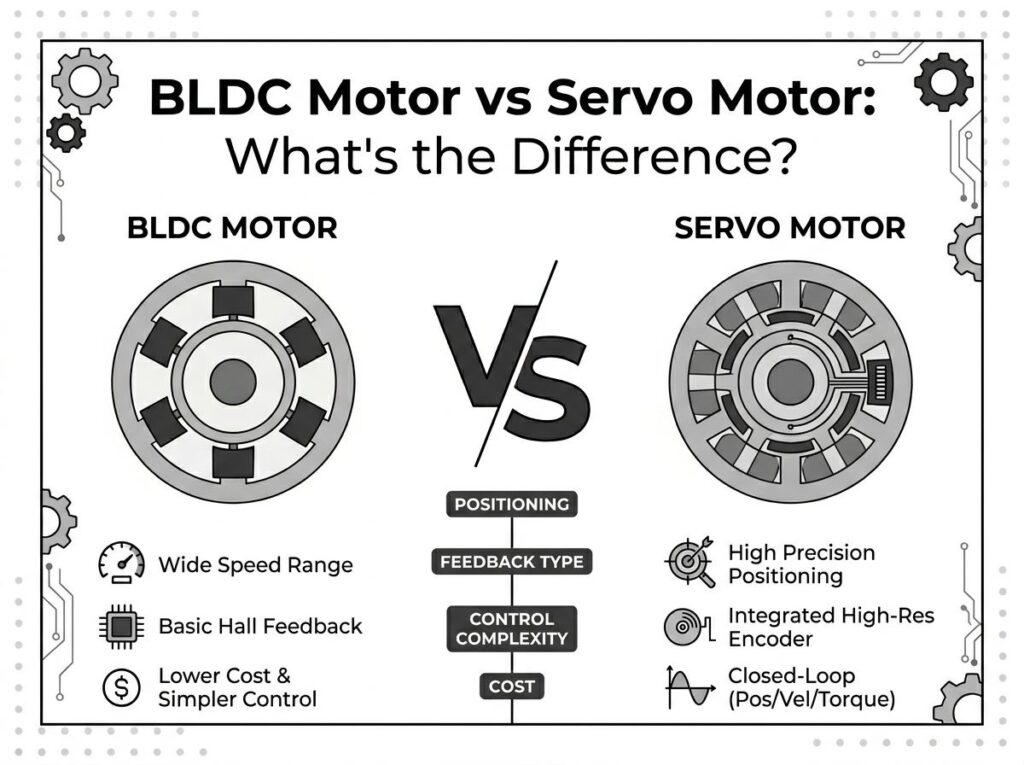
Moteur BLDC vs servomoteur: Quelle est la différence?
Le choix de la bonne technologie de moteur est l'une des décisions les plus importantes dans la conception d'équipements modernes.. Qu'il s'agisse de développer un bras robotique, un véhicule à guidage automatique (VAG), un convoyeur industriel, une tondeuse à gazon, ou une machine de fabrication de précision, les ingénieurs doivent évaluer soigneusement les exigences de performance, complexité du contrôle, précision, efficacité, et coût total du système.
Parmi les technologies les plus couramment comparées figurent le DC sans balais (BLDC) moteurs et servomoteurs. Bien que les deux soient largement utilisés dans les applications de contrôle de mouvement, ce ne sont pas des équivalents directs. En fait, L'une des idées fausses les plus répandues dans l'industrie automobile est de supposer qu'un servomoteur est simplement un autre type de moteur..
La réalité est qu'un moteur BLDC est une technologie moteur, tandis qu'un servomoteur est un système complet de contrôle de mouvement qui combine un moteur, dispositif de rétroaction, et contrôleur pour obtenir un positionnement très précis et des performances dynamiques.
Ce guide fournit une comparaison technique détaillée des moteurs BLDC et des servomoteurs., aider les fabricants OEM, ingénieurs, et les équipes d'approvisionnement déterminent quelle solution correspond le mieux aux exigences de leurs applications.
Moteur BLDC vs servomoteur
Les moteurs BLDC et les servomoteurs sont tous deux utilisés pour un contrôle de mouvement précis, mais un moteur BLDC est un type de moteur, tandis qu'un servomoteur est un système complet de contrôle de mouvement qui comprend un moteur, encodeur, et contrôleur. Les servomoteurs offrent une précision de positionnement et une réponse dynamique supérieures, alors que les moteurs BLDC offrent un coût inférieur et une mise en œuvre plus simple.
En général, les systèmes d'asservissement sont préférés pour la robotique, Équipement CNC, et automatisation de précision, tandis que les moteurs BLDC sont souvent sélectionnés pour les tondeuses à gazon, Systèmes CVC, pompes, entraînements industriels, et produits OEM sensibles aux coûts.
Qu'est-ce qu'un moteur BLDC?
Un moteur à courant continu sans balais (Moteur BLDC) est un moteur à commutation électronique qui élimine les balais et le collecteur utilisés dans les moteurs à courant continu traditionnels. Au lieu d'une commutation mécanique, les contrôleurs électroniques alimentent les enroulements du stator en fonction de la position du rotor.
Les moteurs BLDC sont devenus l'une des technologies de moteur à la croissance la plus rapide en raison de leur rendement élevé., taille compacte, longue durée de vie, et une excellente densité de puissance.
Structure du moteur BLDC
Un moteur BLDC typique se compose de:
- Rotor à aimant permanent
- Noyau de stator laminé
- Enroulements de stator multiphasés
- Capteurs à effet Hall (facultatif)
- Contrôleur électronique
- Etage inverseur de puissance
Contrairement aux moteurs brossés, aucun contact physique n'existe entre les composants électriques fixes et rotatifs.
Navette électronique
L'innovation clé derrière les moteurs BLDC est la commutation électronique.
Le contrôleur de moteur surveille en permanence la position du rotor et alimente les enroulements du stator dans une séquence qui génère un champ magnétique rotatif.. Le rotor suit ce champ et produit un mouvement de rotation.
La commutation électronique offre plusieurs avantages:
- Aucune usure des brosses
- Besoins d'entretien réduits
- Bruit électrique réduit
- Efficacité supérieure
- Durée de vie opérationnelle plus longue
Capteurs à effet Hall
De nombreux moteurs BLDC utilisent des capteurs à effet Hall pour déterminer la position du rotor.
Ces capteurs détectent les changements de champ magnétique lorsque le rotor tourne et fournissent un retour de position au contrôleur..
Les capteurs à effet Hall permettent:
- Performances de démarrage fiables
- Synchronisation de commutation précise
- Contrôle amélioré à basse vitesse
- Production de couple améliorée
Les systèmes BLDC modernes sans capteur peuvent estimer la position du rotor grâce à la détection de la force électromagnétique inverse, éliminant le besoin de capteurs Hall dans certaines applications.
Contrôleur de moteur BLDC
Le contrôleur agit comme le cerveau du système moteur.
Les fonctions incluent:
- Régulation de vitesse
- Contrôle actuel
- Gestion du couple
- Fonctions de protection
- Génération PWM
- Interfaces de communication
La simplicité du contrôle BLDC est l'une des raisons pour lesquelles ces moteurs sont largement utilisés dans les produits commerciaux nécessitant un équilibre entre performances et prix abordable..
Applications BLDC courantes
- Tondeuses à gazon électriques
- Tondeuses à gazon robotisées
- Souffleurs CVC
- Pompes à eau
- Ventilateurs industriels
- AGV
- Systèmes de tourniquets
- Vélos électriques
- Dispositifs médicaux
- Appareils grand public
Qu'est-ce qu'un servomoteur?
L'un des concepts les plus mal compris en matière de contrôle de mouvement est la définition d'un servomoteur..
Beaucoup de gens pensent qu'un servomoteur est un type de moteur spécifique. En réalité, un système d'asservissement est une solution complète de contrôle de mouvement en boucle fermée.
Architecture du système d'asservissement
Un système d'asservissement se compose de:
Système d'asservissement =
Moteur
+
Encodeur
+
Manette
Le moteur lui-même peut être:
- Moteur PMSM
- Moteur BLDC
- Moteur synchrone à courant alternatif
- Moteur à entraînement direct
La caractéristique déterminante n'est pas la technologie du moteur mais l'utilisation d'un retour d'information continu et d'un contrôle en boucle fermée..
Composants de base d'un système servo
1. Moteur
Le moteur génère un mouvement de rotation et un couple.
Les servosystèmes industriels modernes utilisent le plus souvent des moteurs PMSM en raison de leurs caractéristiques de couple fluides et de leur rendement élevé..
2. Encodeur
L'encodeur mesure en permanence:
- Position
- Vitesse
- Direction
- Déplacement angulaire
Le retour de l'encodeur permet au contrôleur d'effectuer des corrections en temps réel.
3. Servomoteur
Le servomoteur traite les signaux de retour et ajuste le courant, tension, et des modèles de commutation pour atteindre les profils de mouvement cibles.
Le lecteur assure:
- Positionnement précis
- Contrôle de vitesse stable
- Réponse dynamique du couple
- Accélération et décélération précises
Pourquoi les systèmes de servomoteurs sont différents
Contrairement aux systèmes de moteur BLDC standard qui peuvent fonctionner en boucle ouverte ou semi-fermée, les systèmes d'asservissement comparent constamment le mouvement commandé avec le mouvement réel.
Si une erreur se produit, le contrôleur compense immédiatement.
Ce mécanisme de rétroaction permet:
- Positionnement au niveau du micron
- Réponse dynamique à grande vitesse
- Répétabilité exceptionnelle
- Contrôle précis de la trajectoire
Applications typiques des servos
- Robots industriels
- Centres d'usinage CNC
- Équipement semi-conducteur
- Machines d'emballage
- Systèmes d'assemblage automatisés
- Robots médicaux
- Équipement d'inspection de précision
- Systèmes de mouvement aérospatiaux
BLDC vs servomoteur: Différences clés
Bien que les moteurs BLDC et les servosystèmes puissent parfois utiliser des technologies de moteur similaires en interne, leurs fonctions prévues et leurs niveaux de performance diffèrent considérablement.
| Fonctionnalité | Moteur BLDC | Servomoteur |
|---|---|---|
| Commentaires sur le poste | Facultatif | Requis |
| Précision | Moyen | Très élevé |
| Contrôle de vitesse | Bien | Excellent |
| Contrôle du couple | Bien | Excellent |
| Coût | Inférieur | Plus haut |
| Complexité | Inférieur | Plus haut |
| Méthode de contrôle | Boucle ouverte / Boucle semi-fermée | Boucle fermée |
| Encodeur | Facultatif | Obligatoire |
| Application typique | Tondeuses à gazon, Pompes, CVC | Robotique, CNC, Automatisation de précision |
La distinction la plus importante est que les systèmes d'asservissement donnent la priorité à la précision et au contrôle par rétroaction., tandis que les systèmes BLDC privilégient l'efficacité, simplicité, et la rentabilité.
Comparaison des principes de fonctionnement
Comprendre les principes de fonctionnement des moteurs BLDC et des servosystèmes permet de comprendre pourquoi leurs caractéristiques de performance diffèrent.
Comment fonctionnent les moteurs BLDC
Les moteurs BLDC s'appuient sur la commutation électronique pour remplacer les balais mécaniques.
Le contrôleur alimente les enroulements du stator dans une séquence prédéfinie en fonction des informations sur la position du rotor..
Principales caractéristiques de fonctionnement:
- Commutation électronique
- Retour du capteur à effet Hall (facultatif)
- Contrôle de vitesse PWM
- Fonctionnement en boucle ouverte ou semi-fermée
La plupart des applications BLDC se concentrent sur le maintien de la vitesse plutôt que sur un contrôle de position précis..
Comment fonctionnent les systèmes servo
Les systèmes servo surveillent en permanence la position réelle du moteur et la comparent à la position commandée.
Tout écart déclenche immédiatement une action corrective de la part du contrôleur.
Cette architecture en boucle fermée permet:
- Positionnement de haute précision
- Suivi précis de la trajectoire
- Réponse rapide aux changements de charge
- Contrôle supérieur du couple
L'encodeur sert de dispositif de rétroaction critique qui rend possible l'asservissement.
Boucle ouverte vs boucle fermée
| Type de contrôle | BLDC | Servomoteur |
|---|---|---|
| Fonctionnement en boucle ouverte | Commun | Non |
| Fonctionnement en boucle fermée | Facultatif | Standard |
| Dépendance aux commentaires | Faible | Haut |
| Correction de position | Limité | Continu |
Comparaison de précision de position
Pour les ingénieurs évaluant les systèmes de contrôle de mouvement, la précision de la position est souvent le facteur le plus important.
C'est là que les systèmes d'asservissement démontrent leur plus grand avantage.
Précision de la position BLDC
Les moteurs BLDC standard sont généralement conçus pour le contrôle de la vitesse et la génération de couple plutôt que pour un positionnement de précision..
Sans retour codeur, la précision de la position est intrinsèquement limitée.
Les caractéristiques typiques du BLDC incluent:
- Capacité de positionnement modérée
- Bonne régulation de vitesse
- Convient aux applications à rotation continue
- Précision de positionnement limitée
Précision de la position du servo
Les systèmes servo sont spécialement conçus pour un positionnement précis.
Les encodeurs haute résolution permettent au contrôleur de suivre le mouvement du rotor en continu et d'appliquer des corrections en temps réel.
Les avantages typiques des servos incluent:
- Précision de positionnement sous-degré
- Excellente répétabilité
- Contrôle précis de la trajectoire
- Réponse à grande vitesse
- Erreur de positionnement minimale
Cette capacité explique pourquoi la robotique, Machines CNC, équipement semi-conducteur, et les systèmes de fabrication automatisés reposent en grande partie sur la technologie servo.
Continuer à partager 2: Comparaison de couple, Comparaison du contrôle de vitesse, Comparaison d'efficacité, Comparaison des coûts, Applications robotiques, VAG & Demandes de RAM, Applications de tondeuse à gazon, Guide de sélection de l'automatisation industrielle, Pourquoi les acheteurs OEM choisissent Greensky Power, FAQ, Stratégie de lien interne, et références.
Comparaison de couple
Le couple est l'un des paramètres les plus critiques lors de l'évaluation des systèmes de contrôle de mouvement. Il détermine la capacité d’un moteur à accélérer des charges, vaincre la résistance, maintenir sa position, et effectuer des mouvements dynamiques dans diverses conditions de fonctionnement.
Dans les systèmes mécaniques, le couple peut être exprimé comme:
τ = rFsin(je)
Où:
- t = Couple (N·m)
- r = Distance du point de pivotement (m)
- F = Force appliquée (N)
- je = Angle entre la force et le bras de levier
Par exemple:
t = (3)(6)péché(90°) = 18 N·m
Seule la composante de force perpendiculaire au bras de levier contribue à la génération de couple.
Couple continu
Le couple continu représente la quantité de couple qu'un moteur peut produire indéfiniment sans surchauffer..
| Caractéristiques | Moteur BLDC | Servomoteur |
|---|---|---|
| Densité de couple continue | Haut | Très élevé |
| Gestion thermique | Bien | Excellent |
| Stabilité à long terme | Bien | Excellent |
Couple maximal
Le couple de pointe fait référence au couple maximal de courte durée qu'un moteur peut fournir.
Les servomoteurs sont spécialement conçus pour fournir un couple maximal nettement plus élevé lors de l'accélération., positionnement, et changements soudains de charge.
Ceci est particulièrement important en robotique, Équipement CNC, et systèmes d'assemblage automatisés.
Couple de stand
Le couple de décrochage est le couple produit lorsque l'arbre du moteur ne tourne pas.
Les systèmes servo offrent généralement une gestion supérieure du couple de décrochage car le retour de l'encodeur permet une régulation précise du courant tout en maintenant la position de l'arbre..
Résumé des performances de couple
| Facteur de couple | BLDC | Servomoteur |
|---|---|---|
| Couple continu | Haut | Très élevé |
| Couple maximal | Bien | Excellent |
| Contrôle du couple de décrochage | Limité | Excellent |
| Précision du couple | Modéré | Très élevé |
| Rippage de couple | Plus haut | Inférieur |
Pour les applications de contrôle de mouvement exigeantes, Les systèmes d'asservissement surpassent généralement les moteurs BLDC standard en termes de contrôle du couple et de réponse dynamique..
Comparaison du contrôle de vitesse
La régulation de la vitesse est une autre différence majeure entre les moteurs BLDC et les servosystèmes.
Contrôle de vitesse BLDC
Les moteurs BLDC utilisent généralement:
- Contrôle en boucle ouverte
- Contrôle en boucle semi-fermée
- Régulation de vitesse PWM
- Commutation du capteur à effet Hall
Les performances du contrôle de vitesse sont généralement suffisantes pour les applications où un positionnement précis n'est pas requis.
Les exemples incluent:
- Tondeuses à gazon
- Ventilateurs
- Pompes
- Systèmes CVC
- Convoyeurs
Contrôle de vitesse des servos
Les systèmes servo utilisent un contrôle complet en boucle fermée.
Le contrôleur compare en permanence:
- Vitesse commandée
- Vitesse réelle
- Conditions de charge
- Commentaires sur les positions
Les corrections en temps réel permettent une régulation de vitesse très stable, même sous des charges changeant rapidement.
Tableau de comparaison des contrôles de vitesse
| Facteur | BLDC | Servomoteur |
|---|---|---|
| Stabilité de la vitesse | Bien | Excellent |
| Réponse dynamique | Bien | Excellent |
| Compensation de charge | Limité | Automatique |
| Contrôle à basse vitesse | Modéré | Excellent |
Comparaison de l'efficacité BLDC et servo
L'efficacité affecte directement les coûts d'exploitation, durée de vie de la batterie, performances thermiques, et la fiabilité globale de l'équipement.
Les deux technologies offrent un rendement nettement supérieur à celui des moteurs à courant continu à balais.
Efficacité du moteur BLDC
- Généralement 85 à 95 %
- Faibles pertes du rotor
- Excellente utilisation de la batterie
- Densité de puissance élevée
Efficacité du servomoteur
Les systèmes d'asservissement modernes utilisent souvent des moteurs PMSM en interne, habilitant:
- 90–98% d'efficacité
- Contrôle de courant optimisé
- Pertes harmoniques réduites
- Utilisation supérieure de l'énergie
Tableau de comparaison d'efficacité
| Type de moteur | Efficacité typique |
|---|---|
| Moteur à courant continu brossé | 70–85% |
| Moteur à induction | 80–93% |
| Moteur BLDC | 85–95% |
| Système de servomoteur | 90–98% |
Pour la plupart des équipements commerciaux, L’efficacité du BLDC est déjà excellente. Cependant, les systèmes d'asservissement conservent un avantage dans les applications de précision nécessitant des performances maximales.
Comparaison des coûts BLDC et servo
Le coût est souvent le facteur décisif pour les acheteurs OEM.
Bien que les systèmes d'asservissement offrent des performances supérieures, ils nécessitent des composants matériels et logiciels supplémentaires.
| Élément de coût | BLDC | Servomoteur |
|---|---|---|
| Moteur | Inférieur | Plus haut |
| Manette | Inférieur | Plus haut |
| Encodeur | Facultatif | Requis |
| Electronique de commande | Plus simple | Plus complexe |
| Coût total du système | Inférieur | Plus haut |
Pour les applications où une ultra-haute précision n’est pas nécessaire, Les moteurs BLDC offrent souvent le meilleur retour sur investissement.
Quel est le meilleur pour la robotique?
La robotique est l'un des marchés les plus rentables pour les technologies de contrôle de mouvement..
La plupart des systèmes robotiques nécessitent:
- Positionnement précis
- Contrôle de trajectoire fluide
- Accélération rapide
- Haute répétabilité
- Rétroaction en boucle fermée
En raison de ces exigences, les servosystèmes dominent la robotique industrielle.
Pourquoi les servomoteurs gagnent en robotique
- Retour d'information du codeur
- Capacité de positionnement au niveau du micron
- Réponse dynamique supérieure
- Contrôle de trajectoire de haute précision
- Excellente répétabilité
Gagnant pour la robotique: Servomoteur
Quel est le meilleur pour l'AGV et l'AMR?
Véhicules à guidage automatisé (AGV) et robots mobiles autonomes (RAM) occupent un juste milieu.
Quand BLDC est préféré
- AGV sensibles aux coûts
- Transport en entrepôt
- Systèmes de navigation de base
- Exigences de longue durée de vie de la batterie
Quand le servo est préféré
- Navigation à grande vitesse
- Amarrage de précision
- Robots collaboratifs
- Systèmes autonomes avancés
De nombreux AGV modernes utilisent avec succès des moteurs d'entraînement BLDC avec retour d'encodeur, créer une solution hybride entre les architectures BLDC traditionnelles et servo.
Gagnant pour les AGV: Dépend des exigences de précision de la navigation.
Quel est le meilleur pour les tondeuses à gazon?
Les tondeuses à gazon nécessitent:
- Sortie de couple élevée
- Durabilité en extérieur
- Efficacité de la batterie
- Compétitivité des coûts
- Fonctionnement fiable
Contrairement à la robotique, les tondeuses à gazon nécessitent rarement une précision de positionnement inférieure au degré.
Plutôt, les fabricants privilégient l’efficacité, fiabilité, et l'abordabilité.
Pourquoi les moteurs BLDC sont idéaux pour les tondeuses à gazon
- Coût du système réduit
- Excellente efficacité
- Couple de démarrage élevé
- Architecture électronique simple
- Fiabilité éprouvée en extérieur
C'est l'une des raisons pour lesquelles les tondeuses à gazon sans fil et les robots tondeuses modernes s'appuient de plus en plus sur la technologie BLDC..
Gagnant pour les tondeuses à gazon: Moteur BLDC
Quel est le meilleur pour l'automatisation industrielle?
L'automatisation industrielle englobe un large éventail de types d'équipements.
| Application | Solution recommandée |
|---|---|
| Convoyeurs | BLDC |
| Machines d'emballage | Servomoteur |
| Tourniquets | BLDC |
| Équipement CNC | Servomoteur |
| Ventilateurs industriels | BLDC |
| Systèmes Pick-and-Place | Servomoteur |
En général, le choix dépend si l'application donne la priorité à la précision ou à la rentabilité.
Comment choisir entre BLDC et servomoteurs
Le guide de sélection suivant peut simplifier les décisions en matière de technologie de moteur.
| Application | Meilleur choix |
|---|---|
| Robotique | Servomoteur |
| CNC | Servomoteur |
| Tondeuse à gazon | BLDC |
| CVC | BLDC |
| Pompe | BLDC |
| Tourniquet | BLDC |
| VAG | Cela dépend |
Choisissez un système d'asservissement lorsque la précision, précision de positionnement, et une réponse dynamique sont essentielles.
Choisissez un moteur BLDC lorsque l'efficacité, fiabilité, simplicité, and lower cost are primary priorities.
Pourquoi les acheteurs OEM choisissent Greensky Power
Greensky Power specializes in customized motion solutions for OEM manufacturers worldwide.
Portefeuille de produits de base
- Moteurs BLDC
- Moteurs de vitesses
- Moteurs à engrenages planétaires
- Moteurs de vitesses à ver
- Customized Motor Solutions
OEM Engineering Capabilities
- Encoder Integration
- Correspondance du contrôleur
- Planetary Gearbox Design
- Prototypage rapide
- Custom Performance Optimization
Industries clés desservies
- Équipement de pelouse
- Systèmes CVC
- Automatisation industrielle
- Robotique
- Dispositifs médicaux
- Security Systems
Foire aux questions
Is a servo motor a BLDC motor?
Pas nécessairement. A servo motor is a complete closed-loop control system. Many modern servo motors use PMSM or BLDC motor technology internally.
Which motor is better for robotics?
Servo motors are generally preferred because they provide superior positioning accuracy, dynamic response, and repeatability.
Which motor is cheaper?
BLDC motors typically have lower motor costs, controller costs, and overall system costs.
Do BLDC motors need encoders?
Non. Many BLDC motors operate successfully using Hall sensors or sensorless control methods. Les encodeurs sont facultatifs sauf si un positionnement précis est requis.
Un moteur BLDC peut-il être utilisé comme servomoteur?
Oui. Lorsqu'il est combiné avec un encodeur et un contrôleur en boucle fermée, un moteur BLDC peut fonctionner dans le cadre d'un système d'asservissement.
Articles connexes
Références
- https://www.ieee.org
- https://ieeexplore.ieee.org
- https://www.energy.gov
- https://www.iea.org
- https://www.iec.ch
- https://www.mathworks.com
- https://www.microchip.com
- https://www.ti.com
- https://www.nidec.com
- https://www.siemens.com
- https://global.abb
- https://www.weg.net