
Moteur BLDC vs moteur PMSM: Quelle est la différence?
Les technologies de moteurs à aimants permanents sont devenues le choix privilégié pour les systèmes d'entraînement électriques modernes en raison de leur efficacité supérieure., densité de puissance élevée, taille compacte, et une contrôlabilité précise. Parmi ces technologies, Moteurs CC sans balais (BLDC) et moteurs synchrones à aimant permanent (PMSM) sont les deux solutions les plus largement adoptées dans le domaine des véhicules électriques, robotique, Systèmes CVC, l'automatisation industrielle, équipement médical, et équipement électrique extérieur.
Parce que les deux types de moteurs utilisent des aimants permanents et des systèmes de commande électroniques, de nombreux ingénieurs et professionnels des achats supposent qu'il s'agit essentiellement de la même technologie. En réalité, des différences importantes existent dans les caractéristiques des champs électromagnétiques inverses, algorithmes de contrôle, ondulation de couple, bruit acoustique, efficacité, et le coût du système.
Ce guide d'ingénierie fournit une comparaison détaillée entre les moteurs BLDC et PMSM pour aider les ingénieurs, Fabricants OEM, et les acheteurs industriels sélectionnent la technologie de moteur la plus adaptée à leurs applications.
Moteur BLDC vs moteur PMSM
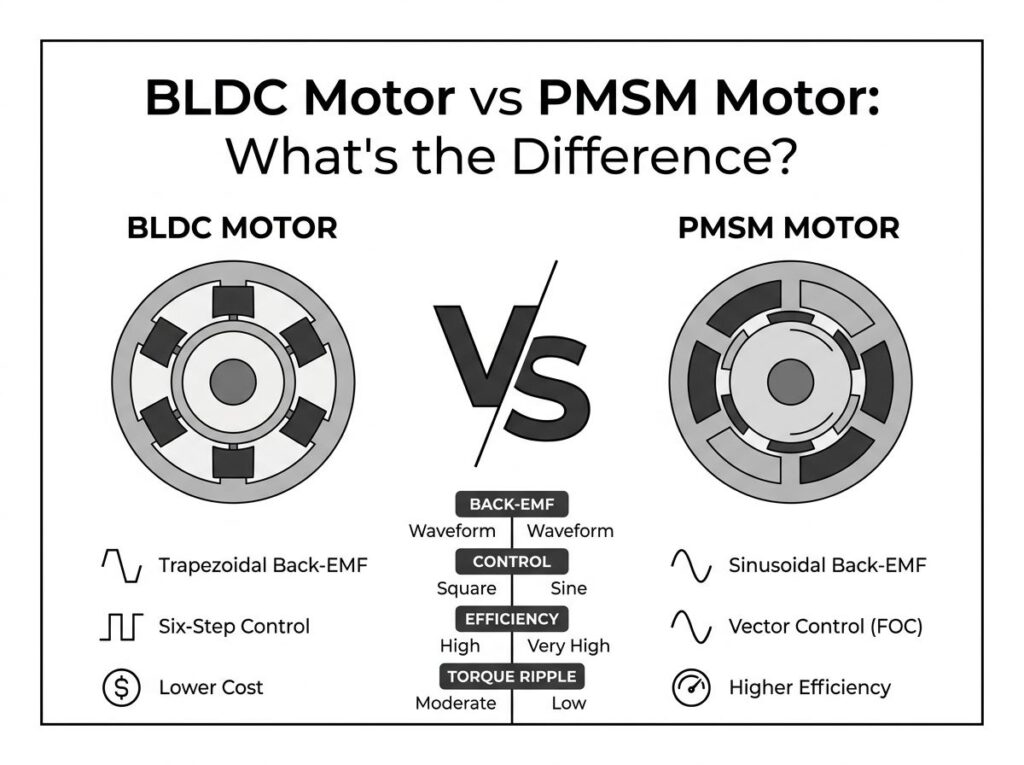
Les moteurs BLDC et les moteurs PMSM utilisent tous deux des aimants permanents, mais les moteurs BLDC utilisent généralement une force contre-électromotrice trapézoïdale et une commutation en six étapes, tandis que les moteurs PMSM utilisent une force contre-électromotrice sinusoïdale et un contrôle sinusoïdal.. Les moteurs PMSM offrent généralement un fonctionnement plus fluide et un rendement plus élevé, tandis que les moteurs BLDC offrent un contrôle plus simple et un coût système inférieur.
Dans les applications pratiques, Les moteurs BLDC sont généralement choisis pour les systèmes sensibles aux coûts nécessitant de bonnes performances, tandis que les moteurs PMSM sont préférés pour les applications haut de gamme exigeant une efficacité maximale, livraison de couple en douceur, et un contrôle précis.
Qu'est-ce qu'un moteur BLDC?
Un moteur à courant continu sans balais (Moteur BLDC) est un moteur à aimant permanent qui remplace les balais mécaniques par une commutation électronique. Au lieu d'utiliser des contacts physiques au pinceau, un contrôleur électronique alimente les enroulements du stator en fonction du retour d'informations sur la position du rotor.
Les moteurs BLDC se caractérisent par leur force contre-électromotrice trapézoïdale (retour CEM) forme d'onde et fonctionnent généralement à l'aide de stratégies de contrôle de commutation en six étapes.
Construction de base d'un moteur BLDC
- Rotor à aimant permanent
- Bobines de stator enroulées
- Contrôleur électronique
- Capteurs de position à effet Hall (facultatif)
- Circuits de l'onduleur
Comment fonctionne un moteur BLDC
Le contrôleur alimente les enroulements du stator de manière séquentielle pour créer un champ magnétique rotatif. Les aimants permanents montés sur le rotor suivent ce champ magnétique, produire un mouvement de rotation.
Les informations sur la position du rotor sont généralement obtenues à partir de capteurs Hall ou estimées à l'aide d'algorithmes de contrôle sans capteur.
Avantages des moteurs BLDC
- Haute efficacité
- Taille compacte
- Excellente densité de puissance
- Faibles besoins d’entretien
- Aucune usure des brosses
- Bonne capacité de contrôle de vitesse
- Coût du contrôleur réduit
Applications BLDC typiques
- Tondeuses à gazon électriques
- Outils électriques sans fil
- Souffleurs CVC
- Automatisation industrielle
- Équipement médical
- AGV et AMR
- Tourniquets de sécurité
- Vélos électriques
En raison de leur équilibre entre coût et performance, Les moteurs BLDC sont devenus l'une des technologies de moteur les plus populaires dans les équipements OEM modernes..
Qu'est-ce qu'un moteur PMSM?
Un moteur synchrone à aimant permanent (PMSM) est également un moteur à aimant permanent, mais contrairement à un moteur BLDC, il est conçu pour fonctionner avec une forme d'onde sinusoïdale de force contre-électromotrice et une excitation de courant sinusoïdal.
Le rotor tourne de manière synchrone avec le champ magnétique tournant du stator, éliminant le glissement et permettant un fonctionnement très efficace.
Construction de base d'un moteur PMSM
- Rotor à aimant permanent
- Enroulements de stator distribués
- Onduleur haute performance
- Codeur de position ou résolveur
- Contrôleur de moteur avancé
Comment fonctionne un moteur PMSM
Le contrôleur génère des formes d’onde de courant sinusoïdales qui interagissent avec le champ magnétique permanent du rotor. Le moteur fonctionne en synchronisme précis avec le champ magnétique tournant généré par le stator.
La plupart des systèmes PMSM utilisent un contrôle orienté champ (FOC), ce qui permet une production de couple fluide et un contrôle précis de la vitesse et de la position.
Avantages des moteurs PMSM
- Très haute efficacité
- Excellente densité de couple
- Sortie de couple fluide
- Faible bruit acoustique
- Faibles niveaux de vibrations
- Performances dynamiques supérieures
- Capacité à grande vitesse
Applications PMSM typiques
- Véhicules électriques
- Systèmes d'asservissement industriels
- Robotique
- Machines CNC
- Systèmes aérospatiaux
- Équipement d'automatisation de précision
- Systèmes CVC haut de gamme
La technologie PMSM domine de nombreuses applications hautes performances où l'efficacité, précision, et un fonctionnement fluide sont des exigences essentielles.
BLDC et PMSM: Différences clés
Bien que les deux technologies appartiennent à la famille des moteurs à aimants permanents, leur comportement électromagnétique et leurs philosophies de contrôle diffèrent considérablement.
| Fonctionnalité | Moteur BLDC | Moteur PMSM |
|---|---|---|
| Retour EMF | Trapézoïdal | Sinusoïdale |
| Forme d'onde actuelle | Rectangulaire | Sinusoïdale |
| Méthode de contrôle | Commutation en six étapes | Contrôle FOC |
| Efficacité | Haut | Très élevé |
| Niveau de bruit | Moyen | Faible |
| Rippage de couple | Plus haut | Inférieur |
| Réponse dynamique | Bien | Excellent |
| Complexité du contrôleur | Inférieur | Plus haut |
| Coût du système | Inférieur | Plus haut |
| Applications typiques | Équipement de pelouse, CVC | VÉ, Robotique |
La distinction technique la plus importante réside dans la manière dont les moteurs génèrent et utilisent le couple électromagnétique..
Comparaison des champs électromagnétiques arrière
Force électromotrice arrière (Retour EMF) est la tension générée par un moteur lorsque le rotor se déplace dans le champ magnétique du stator. La forme d'onde de la force contre-électromotrice influence directement les stratégies de contrôle du moteur, efficacité, douceur du couple, et performances globales.
Moteur BLDC contre EMF
Les moteurs BLDC sont conçus pour produire une forme d'onde trapézoïdale contre-EMF.
Pour maximiser la production de couple, le contrôleur applique des impulsions de courant rectangulaires synchronisées avec la forme d'onde de tension trapézoïdale.
Cette approche simplifie la conception du contrôleur et réduit le coût du système, mais cela introduit également une ondulation de couple lors de la commutation de phase.
Caractéristiques du BLDC Back EMF
- Forme d'onde trapézoïdale
- Algorithme de contrôle plus simple
- Exigences de traitement réduites
- Ondulation de couple plus élevée
- Bruit acoustique plus élevé
Moteur PMSM contre EMF
Les moteurs PMSM génèrent une forme d'onde sinusoïdale de force contre-électromotrice.
Le contrôleur fournit un courant sinusoïdal pour correspondre à la forme d'onde générée, résultant en une production continue de couple tout au long du cycle électrique.
Cela réduit considérablement l'ondulation du couple et améliore la douceur globale du moteur..
Caractéristiques du PMSM Back EMF
- Forme d'onde sinusoïdale
- Production de couple plus fluide
- Moins de vibrations
- Efficacité supérieure
- Contrôle dynamique supérieur
Pourquoi le retour aux champs électromagnétiques est important
Influence des caractéristiques du champ électromagnétique arrière:
- Efficacité du moteur
- Rippage de couple
- Génération de bruit
- Complexité du contrôleur
- Densité de puissance
- Adéquation des applications
Pour les applications hautes performances telles que la robotique, systèmes d'asservissement, et véhicules électriques, la force contre-électromotrice sinusoïdale offre des avantages substantiels.
Comparaison des méthodes de contrôle
La méthode de contrôle représente l'une des différences les plus significatives entre les moteurs BLDC et PMSM.
Contrôle du moteur BLDC: Commutation en six étapes
Les moteurs BLDC utilisent généralement une commutation en six étapes, également connu sous le nom de commutation trapézoïdale.
Le contrôleur alimente deux phases à la fois tout en laissant la troisième phase flottante. Chaque 60 diplômes en électricité, le contrôleur passe à l'état de commutation suivant.
Avantages du contrôle en six étapes
- Mise en œuvre simple
- Exigences de processeur réduites
- Coût du contrôleur réduit
- Intégration facile du système
Limites du contrôle en six étapes
- Ondulation de couple plus élevée
- Augmentation du bruit
- Douceur réduite à basse vitesse
- Précision inférieure
Contrôle du moteur PMSM: Contrôle orienté champ (FOC)
Les moteurs PMSM utilisent généralement un contrôle orienté champ (FOC), l'une des techniques de contrôle moteur les plus avancées utilisées aujourd'hui.
Le FOC sépare le courant du stator en composants produisant du couple et du flux., permettant un contrôle précis du fonctionnement du moteur dans des conditions de charge variables.
Avantages du FOC
- Efficacité maximale
- Production de couple fluide
- Excellent contrôle à basse vitesse
- Réponse dynamique supérieure
- Vibrations réduites
- Haute précision de positionnement
Limites du FOC
- Contrôleur plus cher
- Complexité logicielle plus élevée
- Exigences de traitement plus élevées
Alors que la technologie des semi-conducteurs continue de progresser, Le FOC devient de plus en plus accessible, même dans les applications sensibles aux coûts.
Continuer à partager 2: Comparaison d'efficacité, Comparaison de couple, Comparaison du bruit et des vibrations, Analyse des coûts, Applications pour véhicules électriques, Applications robotiques, Applications de tondeuse à gazon, Guide de sélection OEM, Solutions d'alimentation Greensky, FAQ, Cluster de liens internes, et références.
Comparaison de l'efficacité BLDC et PMSM
L'efficacité est l'un des indicateurs de performance les plus importants lors de la sélection d'un moteur électrique. Une efficacité plus élevée se traduit directement par une consommation d’énergie inférieure, génération de chaleur réduite, fiabilité améliorée, et des coûts d'exploitation réduits tout au long du cycle de vie de l'équipement.
Les moteurs BLDC et PMSM atteignent des rendements nettement supérieurs à ceux des moteurs à courant continu à balais et des moteurs à induction traditionnels.. Cependant, La technologie PMSM offre généralement les niveaux d'efficacité les plus élevés grâce à son champ magnétique sinusoïdal et à ses stratégies de contrôle avancées..
Plages d'efficacité typiques
| Type de moteur | Efficacité typique | Efficacité maximale |
|---|---|---|
| Moteur à courant continu brossé | 70–85% | 88% |
| Moteur à induction | 80–93% | 95% |
| Moteur BLDC | 85–95% | 96% |
| Moteur PMSM | 90–97% | 98%+ |
Pourquoi les moteurs PMSM sont plus efficaces
- Le champ magnétique sinusoïdal réduit les pertes harmoniques
- Le contrôle orienté champ optimise l'utilisation actuelle
- Une ondulation de couple plus faible réduit les pertes mécaniques
- Harmoniques de courant statoriques réduites
- Meilleures caractéristiques de fonctionnement à grande vitesse
Quand l’efficacité du BLDC est suffisante
Pour de nombreux produits OEM tels que les tondeuses à gazon, pompes, Ventilateurs, portes de sécurité, et systèmes d'automatisation industrielle, L'efficacité du BLDC est déjà suffisamment élevée pour que le gain marginal du PMSM ne justifie pas le coût supplémentaire du contrôleur..
C'est l'une des raisons pour lesquelles les moteurs BLDC continuent de dominer de nombreuses applications commerciales et industrielles malgré les avantages techniques du PMSM..
Comparaison des couples BLDC et PMSM
La production de couple affecte directement l'accélération du moteur, capacité de manutention de charge, performances à basse vitesse, et la productivité globale de la machine.
Dans les systèmes de moteurs électriques, le couple est fondamentalement défini comme:
Où:
- t = Couple (N·m)
- r = Distance du pivot (m)
- F = Force appliquée (N)
- je = Angle de force
Par exemple:
Si une force de 6 N est appliqué à un rayon de 3 m avec un angle de 90°, le couple résultant devient:
t = 3 × 6 × péché(90°) = 18 N·m
Dans les applications moteurs, le couple électromagnétique est généré par l'interaction entre les champs magnétiques du stator et les aimants permanents du rotor.
Caractéristiques du couple BLDC
- Couple de démarrage élevé
- Forte capacité d'accélération
- Ondulation de couple plus élevée
- Convient aux charges intermittentes
- Excellent rapport coût/couple
Caractéristiques du couple PMSM
- Sortie de couple plus douce
- Ondulation de couple inférieure
- Densité de couple continue plus élevée
- Contrabilité supérieure à basse vitesse
- Excellentes performances des servos
Comparaison de densité de couple
| Facteur | BLDC | PMSM |
|---|---|---|
| Couple de démarrage | Excellent | Excellent |
| Couple continu | Haut | Très élevé |
| Rippage de couple | Plus haut | Inférieur |
| Précision à basse vitesse | Bien | Excellent |
| Performances des servos | Modéré | Excellent |
Pour les systèmes de mouvement de haute précision, Les moteurs PMSM surpassent généralement les moteurs BLDC en raison de leur génération de couple plus fluide et de leurs caractéristiques de contrôle supérieures..
Comparaison du bruit et des vibrations
Le bruit et les vibrations sont des facteurs de plus en plus importants dans la conception d’équipements modernes. Un bruit acoustique réduit améliore l'expérience utilisateur, tandis que la réduction des vibrations augmente la durée de vie des composants et la précision du positionnement..
Caractéristiques du bruit du moteur BLDC
En raison de la commutation trapézoïdale et d'une ondulation de couple plus élevée, Les moteurs BLDC génèrent généralement plus de bruit audible que les moteurs PMSM.
Les sources de bruit courantes comprennent:
- Événements de commutation de commutation
- Rippage de couple
- Résonance mécanique
- Bruit de roulement
Caractéristiques du bruit du moteur PMSM
L'excitation du courant sinusoïdal et le contrôle FOC minimisent les transitions brusques de couple, résultant en un fonctionnement beaucoup plus fluide.
Les avantages incluent:
- Émissions acoustiques réduites
- Vibrations réduites
- Précision améliorée
- Meilleur confort d'utilisation
Tableau de comparaison du bruit
| Facteur de performance | BLDC | PMSM |
|---|---|---|
| Bruit Acoustique | Moyen | Faible |
| Rippage de couple | Plus haut | Inférieur |
| Niveau de vibration | Modéré | Minimal |
| Applications de précision | Bien | Excellent |
Comparaison des coûts BLDC et PMSM
Le coût est souvent le facteur décisif pour les acheteurs OEM et les fabricants d’équipements..
Bien que les moteurs PMSM offrent des performances supérieures, ils ont généralement besoin:
- Des contrôleurs plus sophistiqués
- Capacité de processeur plus élevée
- Algorithmes logiciels avancés
- Matériel de détection supplémentaire
Comparaison des coûts totaux du système
| Facteur de coût | BLDC | PMSM |
|---|---|---|
| Coût du moteur | Inférieur | Plus haut |
| Coût du contrôleur | Inférieur | Plus haut |
| Complexité du logiciel | Inférieur | Plus haut |
| Coût de développement | Inférieur | Plus haut |
| Coût d'exploitation | Faible | Très faible |
Pour les produits sensibles aux coûts, BLDC offre souvent le meilleur équilibre entre performances et prix abordable.
Quel moteur est le meilleur pour les véhicules électriques?
L'industrie des véhicules électriques est devenue l'un des plus grands consommateurs de technologies de moteurs à aimants permanents..
Les véhicules électriques modernes sont prioritaires:
- Efficacité maximale
- Autonomie étendue
- Accélération douce
- Capacité à grande vitesse
- Excellent freinage régénératif
En raison de ces exigences, Les moteurs PMSM sont devenus le choix dominant pour les véhicules électriques de tourisme.
Les grands constructeurs automobiles utilisent fréquemment la technologie PMSM car elle offre:
- Efficacité supérieure
- Densité de couple supérieure
- Meilleures performances NVH
- Portée améliorée
Gagnant pour les véhicules électriques: PMSM
Quel moteur est le meilleur pour la robotique?
Les systèmes robotiques nécessitent:
- Contrôle de position précis
- Mouvement fluide
- Stabilité à basse vitesse
- Réponse rapide
- Haute répétabilité
Ces exigences privilégient fortement la technologie PMSM associée aux systèmes d'asservissement.
Robots industriels, robots collaboratifs, et les systèmes CNC utilisent couramment des servomoteurs PMSM en raison de leur excellente réponse dynamique et de leur excellente précision de positionnement..
Gagnant pour la robotique: PMSM
Quel moteur est le meilleur pour les tondeuses à gazon?
Les applications des tondeuses à gazon présentent un ensemble de priorités différent:
- Sortie de couple élevée
- Durabilité en extérieur
- Compétitivité des coûts
- Efficacité de la batterie
- Commande électronique simple
Pour tondeuses à gazon électriques à conducteur marchant et robots tondeuses, Les moteurs BLDC sont souvent la solution privilégiée.
Les avantages incluent:
- Coût du système réduit
- Couple de démarrage élevé
- Excellentes performances de la batterie
- Architecture de contrôleur simplifiée
- Forte fiabilité
Gagnant pour les tondeuses à gazon: BLDC
Comment choisir entre BLDC et PMSM
Le meilleur moteur dépend des priorités de l'application.
| Si vous avez besoin… | Choisir |
|---|---|
| Coût le plus bas | BLDC |
| Efficacité maximale | PMSM |
| Contrôle de mouvement de précision | PMSM |
| Automatisation industrielle | Soit |
| Robotique | PMSM |
| Véhicules électriques | PMSM |
| Équipement de pelouse | BLDC |
| Systèmes CVC | BLDC ou PMSM |
Pourquoi les acheteurs OEM choisissent Greensky Power
Pour les fabricants d’équipements OEM, le choix du bon fournisseur de moteur est aussi important que le choix de la technologie du moteur elle-même.
Greensky Power se spécialise dans les solutions de moteurs personnalisées pour les clients OEM mondiaux.
Portefeuille de produits de base
Avantages OEM
- Développement de moteurs sur mesure
- Prise en charge de l'intégration du contrôleur
- Correspondance des réducteurs planétaires
- Prototypage rapide
- Options à faible quantité de commande
- Expérience d'exportation mondiale
Industries clés desservies
- Robotique
- Tondeuses à gazon
- Équipement CVC
- Automatisation industrielle
- Dispositifs médicaux
- Systèmes de sécurité
FAQ-Moteur BLDC vs Moteur PMSM
Le PMSM est-il meilleur que le BLDC?
Pas nécessairement. PMSM offre une efficacité supérieure et un fonctionnement plus fluide, tandis que BLDC offre un coût système inférieur et un contrôle plus simple. Le meilleur choix dépend des exigences de l'application.
Pourquoi les moteurs PMSM sont-ils utilisés dans les véhicules électriques?
Les moteurs PMSM offrent une efficacité supérieure, densité de couple, douceur, et performances de la gamme, ce qui les rend idéaux pour les plates-formes EV modernes.
Les moteurs BLDC peuvent-ils utiliser le contrôle FOC?
Oui. De nombreux moteurs BLDC modernes peuvent fonctionner à l'aide d'algorithmes FOC, réduisant l'ondulation du couple et améliorant l'efficacité.
Quel moteur est le plus efficace, BLDC ou PMSM?
Les moteurs PMSM atteignent généralement un rendement plus élevé grâce à la force contre-électromotrice sinusoïdale et aux stratégies de contrôle avancées..
Quel moteur est le meilleur pour les tondeuses à gazon?
Les moteurs BLDC sont souvent la solution privilégiée en raison de leur excellent équilibre entre efficacité, couple, fiabilité, et le coût.
Ressources connexes
Références
- https://www.ieee.org
- https://ieeexplore.ieee.org
- https://www.nidec.com
- https://www.siemens.com
- https://global.abb
- https://www.weg.net
- https://www.energy.gov
- https://www.iea.org
- https://www.iec.ch
- https://www.mathworks.com
- https://www.microchip.com
- https://www.ti.com