
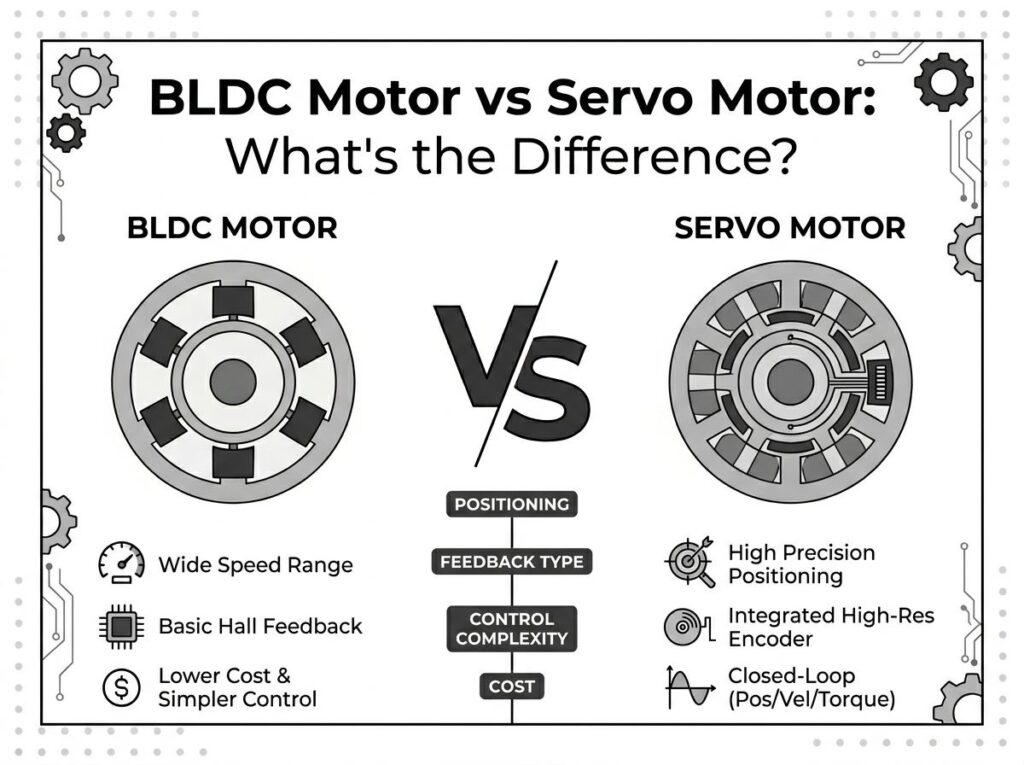
Motor BLDC frente a servomotor: ¿Cuál es la diferencia??
Seleccionar la tecnología de motor adecuada es una de las decisiones más importantes en el diseño de equipos modernos.. Si desarrollar un brazo robótico, un vehículo guiado automatizado (AGV), un transportador industrial, una cortadora de césped, o una máquina de fabricación de precisión, Los ingenieros deben evaluar cuidadosamente los requisitos de rendimiento., controlar la complejidad, exactitud, eficiencia, y costo total del sistema.
Entre las tecnologías más comúnmente comparadas se encuentran Brushless DC (BLDC) motores y servomotores. Si bien ambos se utilizan ampliamente en aplicaciones de control de movimiento, no son equivalentes directos. En realidad, Uno de los mayores conceptos erróneos en la industria del motor es suponer que un servomotor es simplemente otro tipo de motor..
La realidad es que un motor BLDC es una tecnología de motor, mientras que un servomotor es un sistema completo de control de movimiento que combina un motor, dispositivo de retroalimentación, y controlador para lograr un posicionamiento altamente preciso y un rendimiento dinámico.
Esta guía proporciona una comparación de ingeniería detallada de motores BLDC y servomotores., ayudando a los fabricantes OEM, ingenieros, y los equipos de adquisiciones determinan qué solución se adapta mejor a los requisitos de su aplicación..
Motor BLDC frente a servomotor
Tanto los motores BLDC como los servomotores se utilizan para un control de movimiento preciso, pero un motor BLDC es un tipo de motor, mientras que un servomotor es un sistema completo de control de movimiento que incluye un motor, codificador, y controlador. Los servomotores proporcionan mayor precisión de posicionamiento y respuesta dinámica., Mientras que los motores BLDC ofrecen un menor coste y una implementación más sencilla..
En general, Los servosistemas son los preferidos para la robótica., Equipos CNC, y automatización de precisión, mientras que los motores BLDC a menudo se seleccionan para cortadoras de césped, sistemas de climatización, zapatillas, accionamientos industriales, y productos OEM sensibles a los costos.
¿Qué es un motor BLDC??
Un motor de CC sin escobillas (Motor CC CC) Es un motor conmutado electrónicamente que elimina las escobillas y el conmutador utilizados en los motores CC tradicionales.. En lugar de conmutación mecánica, Los controladores electrónicos energizan los devanados del estator según la posición del rotor..
Los motores BLDC se han convertido en una de las tecnologías de motores de más rápido crecimiento debido a su alta eficiencia., tamaño compacto, larga vida útil, y excelente densidad de potencia.
Estructura del motor BLDC
Un motor BLDC típico consta de:
- Rotor de imán permanente
- Núcleo de estator laminado
- Devanados de estator multifásicos
- Sensores de efecto Hall (opcional)
- controlador electrónico
- Etapa del inversor de potencia
A diferencia de los motores cepillados, no existe contacto físico entre los componentes eléctricos estacionarios y giratorios.
Conmutación Electrónica
La innovación clave detrás de los motores BLDC es la conmutación electrónica.
El controlador del motor monitorea continuamente la posición del rotor y energiza los devanados del estator en una secuencia que genera un campo magnético giratorio.. El rotor sigue este campo y produce un movimiento de rotación..
La conmutación electrónica proporciona varias ventajas.:
- Sin desgaste del cepillo
- Menores requisitos de mantenimiento
- Ruido eléctrico reducido
- Mayor eficiencia
- Vida operativa más larga
Sensores de pasillo
Muchos motores BLDC utilizan sensores de efecto Hall para determinar la posición del rotor..
Estos sensores detectan cambios en el campo magnético a medida que gira el rotor y proporcionan retroalimentación de posición al controlador..
Los sensores Hall permiten:
- Rendimiento de inicio confiable
- Sincronización de conmutación precisa
- Control de baja velocidad mejorado
- Producción de par mejorada
Los sistemas BLDC modernos sin sensores pueden estimar la posición del rotor mediante la detección de EMF inverso, eliminando la necesidad de sensores Hall en ciertas aplicaciones.
Controlador de motores BLDC
El controlador actúa como el cerebro del sistema motor..
Las funciones incluyen:
- Regulación de velocidad
- control actual
- Gestión de par
- Funciones de protección
- generación pwm
- Interfaces de comunicación
La simplicidad del control BLDC es una de las razones por las que estos motores se utilizan ampliamente en productos comerciales que requieren un equilibrio entre rendimiento y asequibilidad..
Aplicaciones BLDC comunes
- cortacéspedes eléctricos
- cortacésped robóticos
- Sopladores de climatización
- bombas de agua
- ventiladores industriales
- AGV
- Sistemas de torniquete
- Bicicletas electricas
- Dispositivos médicos
- Electrodomésticos de consumo
¿Qué es un servomotor??
Uno de los conceptos más incomprendidos en el control de movimiento es la definición de servomotor..
Mucha gente cree que un servomotor es un tipo de motor específico.. En realidad, Un servosistema es una solución completa de control de movimiento de circuito cerrado..
Arquitectura del servosistema
Un servosistema consta de:
Servosistema =
Motor
+
Codificador
+
Controlador
El motor en sí puede ser:
- motor PMSM
- Motor CC CC
- Motor síncrono de CA
- Motor de accionamiento directo
La característica definitoria no es la tecnología del motor sino el uso de retroalimentación continua y control de circuito cerrado..
Componentes principales de un servosistema
1. Motor
El motor genera movimiento de rotación y par..
Los servosistemas industriales modernos utilizan con mayor frecuencia motores PMSM debido a sus características de par suave y alta eficiencia..
2. Codificador
El codificador mide continuamente:
- Posición
- Velocidad
- Dirección
- desplazamiento angular
La retroalimentación del codificador permite al controlador realizar correcciones en tiempo real.
3. Servoaccionamiento
El servoaccionamiento procesa señales de retroalimentación y ajusta la corriente., Voltaje, y cambiar patrones para lograr perfiles de movimiento objetivo.
La unidad asegura:
- Posicionamiento preciso
- Control de velocidad estable
- Respuesta de par dinámica
- Aceleración y desaceleración precisas
Por qué los servosistemas son diferentes
A diferencia de los sistemas de motor BLDC estándar que pueden funcionar en circuito abierto o semicerrado., Los servosistemas comparan constantemente el movimiento ordenado con el movimiento real..
Si ocurre un error, el controlador compensa inmediatamente.
Este mecanismo de retroalimentación permite:
- Posicionamiento a nivel de micras
- Respuesta dinámica de alta velocidad
- Repetibilidad excepcional
- Control preciso de la trayectoria
Aplicaciones servo típicas
- Robots industriales
- centros de mecanizado CNC
- Equipos semiconductores
- Maquinaria de embalaje
- Sistemas de montaje automatizados
- robots medicos
- Equipos de inspección de precisión
- Sistemas de movimiento aeroespacial
BLDC frente a servomotor: Diferencias clave
Aunque los motores BLDC y los servosistemas a veces pueden utilizar tecnologías de motor similares internamente, sus funciones previstas y niveles de rendimiento difieren significativamente.
| Característica | Motor CC CC | servomotor |
|---|---|---|
| Comentarios de posición | Opcional | Requerido |
| Exactitud | Medio | muy alto |
| Control de velocidad | Bien | Excelente |
| Control de par | Bien | Excelente |
| Costo | Más bajo | Más alto |
| Complejidad | Más bajo | Más alto |
| Método de control | Bucle abierto / Bucle semicerrado | Bucle cerrado |
| Codificador | Opcional | Obligatorio |
| Aplicación típica | Cortacésped, Zapatillas, climatización | robótica, CNC, Automatización de precisión |
La distinción más importante es que los servosistemas priorizan la precisión y el control de retroalimentación., mientras que los sistemas BLDC priorizan la eficiencia, sencillez, y rentabilidad.
Comparación de principios de funcionamiento
Comprender los principios operativos de los motores y servosistemas BLDC ayuda a aclarar por qué difieren sus características de rendimiento..
Cómo funcionan los motores BLDC
Los motores BLDC dependen de la conmutación electrónica para reemplazar las escobillas mecánicas.
El controlador energiza los devanados del estator en una secuencia predefinida basada en la información de la posición del rotor..
Características operativas clave:
- Conmutación electrónica
- Retroalimentación del sensor Hall (opcional)
- control de velocidad pwm
- Funcionamiento en bucle abierto o semicerrado
La mayoría de las aplicaciones BLDC se centran en mantener la velocidad en lugar de lograr un control de posición preciso..
Cómo funcionan los servosistemas
Los servosistemas monitorean continuamente la posición real del motor y la comparan con la posición ordenada.
Cualquier desviación desencadena inmediatamente una acción correctiva por parte del controlador..
Esta arquitectura de circuito cerrado permite:
- Posicionamiento de alta precisión
- Seguimiento preciso de la trayectoria
- Respuesta rápida a los cambios de carga.
- Control de par superior
El codificador sirve como dispositivo de retroalimentación crítico que hace posible el servocontrol..
Bucle abierto vs bucle cerrado
| Tipo de control | BLDC | servo |
|---|---|---|
| Operación de bucle abierto | Común | No |
| Operación de circuito cerrado | Opcional | Estándar |
| Dependencia de retroalimentación | Bajo | Alto |
| Corrección de posición | Limitado | Continuo |
Comparación de precisión de posición
Para ingenieros que evalúan sistemas de control de movimiento, La precisión de la posición es a menudo el factor más importante..
Aquí es donde los servosistemas demuestran su mayor ventaja..
Precisión de posición BLDC
Los motores BLDC estándar suelen estar diseñados para control de velocidad y generación de par en lugar de posicionamiento de precisión..
Sin retroalimentación del codificador, La precisión posicional es inherentemente limitada..
Las características típicas de BLDC incluyen:
- Capacidad de posicionamiento moderada
- Buena regulación de velocidad
- Adecuado para aplicaciones de rotación continua
- Precisión de posicionamiento limitada
Precisión de la posición del servo
Los servosistemas están diseñados específicamente para un posicionamiento preciso.
Los codificadores de alta resolución permiten que el controlador rastree continuamente el movimiento del rotor y aplique correcciones en tiempo real.
Las ventajas típicas de los servos incluyen:
- Precisión de posicionamiento de subgrado
- Excelente repetibilidad
- Control preciso de la trayectoria
- Respuesta de alta velocidad
- Error de posicionamiento mínimo
Esta capacidad explica por qué la robótica, maquinas CNC, equipo semiconductor, y los sistemas de fabricación automatizados dependen abrumadoramente de la tecnología servo.
Continuar a la parte 2: Comparación de par, Comparación de control de velocidad, Comparación de eficiencia, Comparación de costos, Aplicaciones de robótica, AGV & Aplicaciones de resistencia a los antimicrobianos, Aplicaciones de cortacésped, Guía de selección de automatización industrial, Por qué los compradores OEM eligen Greensky Power, Preguntas frecuentes, Estrategia de enlace interno, y referencias.
Comparación de par
El par es uno de los parámetros más críticos al evaluar los sistemas de control de movimiento.. Determina la capacidad de un motor para acelerar cargas., superar la resistencia, mantener la posición, y realizar movimientos dinámicos en diferentes condiciones operativas.
En sistemas mecánicos, El par se puede expresar como:
τ = rFsen(i)
Dónde:
- t = par (Nuevo Méjico)
- riñonal = Distancia desde el punto de pivote (metro)
- F = Fuerza aplicada (norte)
- i = Ángulo entre la fuerza y el brazo de palanca
Por ejemplo:
t= (3)(6)pecado(90°) = 18 Nuevo Méjico
Sólo el componente de fuerza perpendicular al brazo de palanca contribuye a la generación de par..
Torque continuo
El par continuo representa la cantidad de par que un motor puede producir indefinidamente sin sobrecalentarse..
| Característica | Motor CC CC | servomotor |
|---|---|---|
| Densidad de par continuo | Alto | muy alto |
| Gestión térmica | Bien | Excelente |
| Estabilidad a largo plazo | Bien | Excelente |
Par máximo
El par máximo se refiere al par máximo de corta duración que un motor puede ofrecer..
Los servomotores están diseñados específicamente para proporcionar un par máximo significativamente mayor durante la aceleración., posicionamiento, y cambios repentinos de carga.
Esto es especialmente importante en robótica., Equipos CNC, y sistemas de montaje automatizados.
Par de paradas
El par de parada es el par producido cuando el eje del motor no está girando..
Los servosistemas generalmente ofrecen una gestión superior del par de parada porque la retroalimentación del codificador permite una regulación de corriente precisa mientras se mantiene la posición del eje..
Resumen del rendimiento del par
| Factor de torsión | BLDC | servo |
|---|---|---|
| Torque continuo | Alto | muy alto |
| Par máximo | Bien | Excelente |
| Control de par de calado | Limitado | Excelente |
| Precisión del par | Moderado | muy alto |
| Ondulación del par | Más alto | Más bajo |
Para aplicaciones exigentes de control de movimiento, Los servosistemas suelen superar a los motores BLDC estándar en control de par y respuesta dinámica..
Comparación de control de velocidad
La regulación de velocidad es otra diferencia importante entre los motores BLDC y los servosistemas..
Control de velocidad BLDC
Los motores BLDC suelen utilizar:
- Control de bucle abierto
- Control de circuito semicerrado
- Regulación de velocidad PWM
- Conmutación del sensor Hall
El rendimiento del control de velocidad generalmente es suficiente para aplicaciones donde no se requiere un posicionamiento exacto.
Los ejemplos incluyen:
- cortadoras de césped
- aficionados
- Zapatillas
- sistemas de climatización
- Transportadores
Control de velocidad servo
Los servosistemas utilizan un control de circuito cerrado completo.
El controlador compara continuamente:
- velocidad comandada
- Velocidad real
- Condiciones de carga
- Comentarios de posición
Las correcciones en tiempo real permiten una regulación de velocidad altamente estable incluso bajo cargas que cambian rápidamente.
Tabla comparativa de control de velocidad
| Factor | BLDC | servo |
|---|---|---|
| Estabilidad de velocidad | Bien | Excelente |
| Respuesta dinámica | Bien | Excelente |
| Compensación de carga | Limitado | Automático |
| Control de baja velocidad | Moderado | Excelente |
Comparación de eficiencia de servo y BLDC
La eficiencia afecta directamente los costos operativos, duración de la batería, rendimiento térmico, y confiabilidad general del equipo.
Ambas tecnologías ofrecen una eficiencia significativamente mayor que los motores de CC con escobillas..
Eficiencia del motor BLDC
- Normalmente entre 85% y 95%
- Bajas pérdidas del rotor
- Excelente utilización de la batería
- Alta densidad de potencia
Eficiencia del servomotor
Los servosistemas modernos suelen utilizar motores PMSM internamente, habilitando:
- 90–98% de eficiencia
- Control de corriente optimizado
- Pérdidas armónicas reducidas
- Utilización superior de la energía
Tabla comparativa de eficiencia
| Tipo de motor | Eficiencia típica |
|---|---|
| Motor de CC cepillado | 70–85% |
| Motor de inducción | 80–93% |
| Motor CC CC | 85–95% |
| Sistema de servomotor | 90–98% |
Para la mayoría de los equipos comerciales, La eficiencia del BLDC ya es excelente. Sin embargo, Los servosistemas mantienen una ventaja en aplicaciones de precisión que requieren el máximo rendimiento..
Comparación de costos de BLDC y servo
El coste suele ser el factor decisivo para los compradores OEM.
Aunque los servosistemas proporcionan un rendimiento superior, Requieren componentes adicionales de hardware y software..
| Artículo de costo | BLDC | servo |
|---|---|---|
| Motor | Más bajo | Más alto |
| Controlador | Más bajo | Más alto |
| Codificador | Opcional | Requerido |
| Electrónica de accionamiento | Más simple | Más complejo |
| Costo total del sistema | Más bajo | Más alto |
Para aplicaciones donde no es necesaria una precisión ultraalta, Los motores BLDC suelen ofrecer el mejor retorno de la inversión.
¿Cuál es mejor para la robótica??
La robótica es uno de los mercados de mayor valor para las tecnologías de control de movimiento..
La mayoría de los sistemas robóticos requieren:
- Posicionamiento preciso
- Control de trayectoria suave
- Aceleración rápida
- Alta repetibilidad
- Retroalimentación de circuito cerrado
Debido a estos requisitos, Los servosistemas dominan la robótica industrial.
Por qué los servomotores ganan en robótica
- Comentarios del codificador
- Capacidad de posicionamiento a nivel de micras
- Respuesta dinámica superior
- Control de trayectoria de alta precisión
- Excelente repetibilidad
Ganador de Robótica: servomotor
¿Cuál es mejor para AGV y AMR??
Vehículos guiados automatizados (AGV) y robots móviles autónomos (AMR) ocupar un término medio único.
Cuando se prefiere BLDC
- AGV sensibles a los costes
- Transporte de almacén
- Sistemas de navegación básicos
- Requisitos de batería de larga duración
Cuando se prefiere el servo
- Navegación de alta velocidad
- Atraque de precisión
- Robots colaborativos
- Sistemas autónomos avanzados
Muchos AGV modernos utilizan con éxito motores de accionamiento BLDC con retroalimentación de codificador., Creando una solución híbrida entre arquitecturas BLDC tradicionales y servo..
Ganador para AGV: Depende de los requisitos de precisión de la navegación..
¿Cuál es mejor para las cortadoras de césped??
Las cortadoras de césped requieren:
- Salida de alto par
- Durabilidad al aire libre
- Eficiencia de la batería
- Competitividad de costos
- Operación confiable
A diferencia de la robótica, Las cortadoras de césped rara vez requieren una precisión de posicionamiento inferior a un grado..
En cambio, Los fabricantes priorizan la eficiencia., fiabilidad, y asequibilidad.
Por qué los motores BLDC son ideales para cortadoras de césped
- Menor costo del sistema
- Excelente eficiencia
- Alto par de arranque
- Arquitectura electrónica sencilla
- Fiabilidad probada en exteriores
Esta es una de las razones por las que los cortacéspedes inalámbricos y robóticos modernos dependen cada vez más de la tecnología BLDC..
Ganador por cortadoras de césped: Motor CC CC
¿Cuál es mejor para la automatización industrial??
La automatización industrial abarca una amplia gama de tipos de equipos..
| Solicitud | Solución recomendada |
|---|---|
| Transportadores | BLDC |
| Máquinas de embalaje | servo |
| Torniquetes | BLDC |
| Equipos CNC | servo |
| Ventiladores industriales | BLDC |
| Sistemas de recogida y colocación | servo |
En general, la elección depende de si la aplicación prioriza la precisión o la rentabilidad.
Cómo elegir entre BLDC y servomotores
La siguiente guía de selección puede simplificar las decisiones sobre tecnología de motores..
| Solicitud | La mejor elección |
|---|---|
| robótica | servo |
| CNC | servo |
| Cortacésped | BLDC |
| climatización | BLDC |
| Bomba | BLDC |
| Torniquete | BLDC |
| AGV | depende |
Elija un servosistema cuando la precisión, precisión de posicionamiento, y la respuesta dinámica son fundamentales.
Elija un motor BLDC cuando la eficiencia, fiabilidad, sencillez, y el menor costo son prioridades principales.
Por qué los compradores OEM eligen Greensky Power
Greensky Power se especializa en soluciones de movimiento personalizadas para fabricantes OEM en todo el mundo..
Portafolio de productos principales
- Motores BLDC
- Motores de engranajes
- Motores de engranajes planetarios
- Motores de engranajes helicoidales
- Soluciones de motores personalizadas
Capacidades de ingeniería OEM
- Integración del codificador
- Coincidencia de controladores
- Diseño de caja de cambios planetaria
- Creación rápida de prototipos
- Optimización del rendimiento personalizada
Industrias clave atendidas
- Equipo de césped
- Sistemas HVAC
- Automatización Industrial
- robótica
- Dispositivos médicos
- Sistemas de seguridad
Preguntas frecuentes
¿Es un servomotor un motor BLDC??
No necesariamente. Un servomotor es un sistema completo de control de circuito cerrado.. Muchos servomotores modernos utilizan tecnología de motor PMSM o BLDC internamente.
¿Qué motor es mejor para la robótica??
Generalmente se prefieren los servomotores porque proporcionan una precisión de posicionamiento superior., respuesta dinámica, y repetibilidad.
¿Qué motor es más barato??
Los motores BLDC suelen tener costos de motor más bajos, costos del controlador, y costos generales del sistema.
¿Los motores BLDC necesitan codificadores??
No. Muchos motores BLDC funcionan con éxito utilizando sensores Hall o métodos de control sin sensores.. Los codificadores son opcionales a menos que se requiera un posicionamiento preciso.
¿Se puede utilizar un motor BLDC como servomotor??
Sí. Cuando se combina con un codificador y un controlador de circuito cerrado, Un motor BLDC puede funcionar como parte de un servosistema..
Artículos relacionados
Referencias
- https://www.ieee.org
- https://ieeexplore.ieee.org
- https://www.energía.gov
- https://www.iea.org
- https://www.iec.ch
- https://www.mathworks.com
- https://www.microchip.com
- https://www.ti.com
- https://www.nidec.com
- https://www.siemens.com
- https://global.abb
- https://www.weg.net