
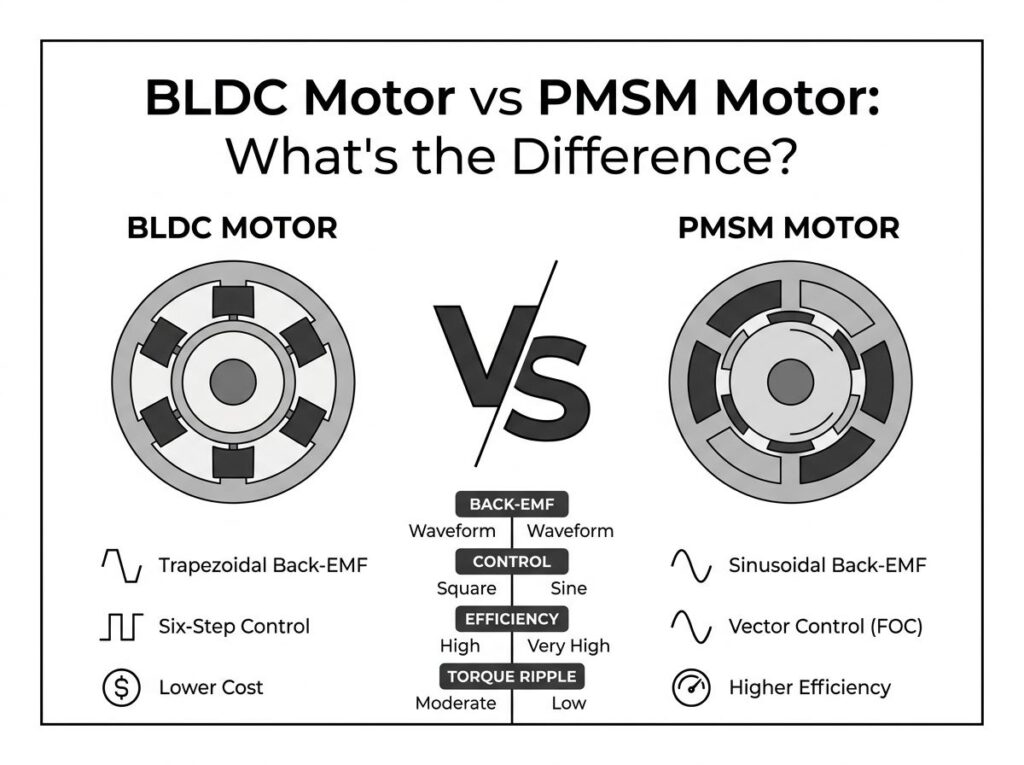
Motor BLDC frente a motor PMSM: ¿Cuál es la diferencia??
Las tecnologías de motores de imanes permanentes se han convertido en la opción preferida para los sistemas de accionamiento eléctricos modernos debido a su eficiencia superior., alta densidad de potencia, tamaño compacto, y controlabilidad precisa. Entre estas tecnologías, Motores CC sin escobillas (BLDC) y motores síncronos de imanes permanentes (PMSM) son las dos soluciones más adoptadas en los vehículos eléctricos, robótica, sistemas de climatización, automatización industrial, Equipo medico, y equipos eléctricos para exteriores.
Porque ambos tipos de motores utilizan imanes permanentes y sistemas de control electrónicos., Muchos ingenieros y profesionales de adquisiciones asumen que son esencialmente la misma tecnología.. En realidad, Existen diferencias importantes en las características de los campos electromagnéticos posteriores., algoritmos de control, ondulación del par, ruido acustico, eficiencia, y costo del sistema.
Esta guía de ingeniería proporciona una comparación detallada entre los motores BLDC y PMSM para ayudar a los ingenieros., Fabricantes OEM, y los compradores industriales seleccionan la tecnología de motor más adecuada para sus aplicaciones.
Motor BLDC frente a motor PMSM
Tanto los motores BLDC como los motores PMSM utilizan imanes permanentes., pero los motores BLDC suelen utilizar EMF trapezoidal y conmutación de seis pasos., mientras que los motores PMSM utilizan contraEMF sinusoidal y control sinusoidal. Los motores PMSM generalmente ofrecen un funcionamiento más suave y una mayor eficiencia., Mientras que los motores BLDC proporcionan un control más simple y un menor costo del sistema..
En aplicaciones prácticas, Los motores BLDC se eligen comúnmente para sistemas sensibles al costo que requieren un buen rendimiento., mientras que los motores PMSM se prefieren para aplicaciones premium que exigen la máxima eficiencia, entrega de par suave, y control preciso.
¿Qué es un motor BLDC??
Un motor de CC sin escobillas (Motor CC CC) Es un motor de imanes permanentes que sustituye las escobillas mecánicas por conmutación electrónica.. En lugar de utilizar contactos de cepillo físicos, Un controlador electrónico energiza los devanados del estator basándose en la retroalimentación de la posición del rotor..
Los motores BLDC se caracterizan por su fuerza electromotriz trasera trapezoidal. (espalda CEM) forma de onda y normalmente funcionan utilizando estrategias de control de conmutación de seis pasos.
Construcción básica de un motor BLDC
- Rotor de imán permanente
- Bobinas de estator bobinadas
- controlador electrónico
- Sensores de posición de efecto Hall (opcional)
- Circuito inversor de potencia
Cómo funciona un motor BLDC
El controlador energiza los devanados del estator secuencialmente para crear un campo magnético giratorio.. Los imanes permanentes montados en el rotor siguen este campo magnético., produciendo movimiento de rotación.
La información de la posición del rotor generalmente se obtiene de los sensores Hall o se estima mediante algoritmos de control sin sensores..
Ventajas de los motores BLDC
- Alta eficiencia
- Tamaño compacto
- Excelente densidad de potencia
- Bajos requisitos de mantenimiento
- Sin desgaste del cepillo
- Buena capacidad de control de velocidad.
- Menor costo del controlador
Aplicaciones típicas de BLDC
- cortacéspedes eléctricos
- herramientas eléctricas inalámbricas
- Sopladores de climatización
- Automatización industrial
- Equipo medico
- AGV y AMR
- Torniquetes de seguridad
- Bicicletas electricas
Por su equilibrio entre coste y rendimiento., Los motores BLDC se han convertido en una de las tecnologías de motores más populares en los equipos OEM modernos..
¿Qué es un motor PMSM??
Un motor síncrono de imán permanente (PMSM) También es un motor de imán permanente., pero a diferencia de un motor BLDC, Está diseñado para funcionar con una forma de onda EMF trasera sinusoidal y excitación de corriente sinusoidal..
El rotor gira sincrónicamente con el campo magnético giratorio del estator., eliminando el deslizamiento y permitiendo una operación altamente eficiente.
Construcción básica de un motor PMSM
- Rotor de imán permanente
- Devanados de estator distribuidos
- Inversor de alto rendimiento
- Codificador de posición o resolutor
- Controlador de motor avanzado
Cómo funciona un motor PMSM
El controlador genera formas de onda de corriente sinusoidales que interactúan con el campo magnético permanente del rotor.. El motor funciona en sincronismo preciso con el campo magnético giratorio generado por el estator..
La mayoría de los sistemas PMSM utilizan control orientado al campo. (FOC), lo que permite una producción suave de par y un control preciso de la velocidad y la posición..
Ventajas de los motores PMSM
- Muy alta eficiencia
- Excelente densidad de par
- Salida de par suave
- Bajo ruido acústico
- Bajos niveles de vibración
- Rendimiento dinámico superior
- Capacidad de alta velocidad
Aplicaciones PMSM típicas
- Vehículos eléctricos
- Servosistemas industriales
- robótica
- Maquinaria CNC
- Sistemas aeroespaciales
- Equipos de automatización de precisión.
- Sistemas HVAC de alta gama
La tecnología PMSM domina muchas aplicaciones de alto rendimiento donde la eficiencia, precisión, y el buen funcionamiento son requisitos críticos.
BLDC frente a PMSM: Diferencias clave
Aunque ambas tecnologías pertenecen a la familia de motores de imanes permanentes, su comportamiento electromagnético y sus filosofías de control difieren significativamente.
| Característica | Motor CC CC | Motor PMSM |
|---|---|---|
| Atrás CEM | trapezoidal | Sinusoidal |
| Forma de onda actual | Rectangular | Sinusoidal |
| Método de control | Conmutación de seis pasos | FOC Control |
| Eficiencia | Alto | muy alto |
| Nivel de ruido | Medio | Bajo |
| Ondulación del par | Más alto | Más bajo |
| Respuesta dinámica | Bien | Excelente |
| Complejidad del controlador | Más bajo | Más alto |
| Costo del sistema | Más bajo | Más alto |
| Aplicaciones típicas | Equipo de césped, climatización | vehículos eléctricos, robótica |
La distinción técnica más importante radica en cómo los motores generan y utilizan el par electromagnético..
Comparación de campos electromagnéticos
Fuerza electromotriz trasera (Atrás CEM) es el voltaje generado por un motor cuando el rotor se mueve a través del campo magnético del estator. La forma de onda de la EMF posterior influye directamente en las estrategias de control del motor., eficiencia, suavidad del par, y rendimiento general.
Motor BLDC trasero EMF
Los motores BLDC están diseñados para producir una forma de onda EMF trasera trapezoidal.
Para maximizar la producción de torque, El controlador aplica pulsos de corriente rectangulares sincronizados con la forma de onda de voltaje trapezoidal..
Este enfoque simplifica el diseño del controlador y reduce el costo del sistema., pero también introduce ondulación del par durante la conmutación de fase..
Características de BLDC Back EMF
- Forma de onda trapezoidal
- Algoritmo de control más simple
- Menores requisitos de procesamiento
- Mayor ondulación del par
- Mayor ruido acústico
Motor PMSM trasero EMF
Los motores PMSM generan una forma de onda EMF trasera sinusoidal.
El controlador suministra corriente sinusoidal para coincidir con la forma de onda generada., lo que resulta en una producción continua de torque durante todo el ciclo eléctrico.
Esto reduce significativamente la fluctuación del par y mejora la suavidad general del motor..
Características del PMSM Back EMF
- Forma de onda sinusoidal
- Producción de par más suave
- Menor vibración
- Mayor eficiencia
- Control dinámico superior
Por qué es importante respaldar los EMF
Volver Influencia de las características de los campos electromagnéticos:
- Eficiencia del motor
- Par de pares
- Generación de ruido
- Complejidad del controlador
- Densidad de potencia
- Idoneidad de la aplicación
Para aplicaciones de alto rendimiento como la robótica, servosistemas, y vehículos eléctricos, La EMF trasera sinusoidal proporciona ventajas sustanciales.
Comparación de métodos de control
El método de control representa una de las diferencias más significativas entre los motores BLDC y PMSM..
Control de motores BLDC: Conmutación de seis pasos
Los motores BLDC suelen utilizar conmutación de seis pasos., también conocida como conmutación trapezoidal.
El controlador energiza dos fases a la vez mientras deja la tercera fase flotando.. Cada 60 grados electricos, el controlador cambia al siguiente estado de conmutación.
Ventajas del control de seis pasos
- Implementación sencilla
- Requisitos de procesador más bajos
- Costo reducido del controlador
- Fácil integración del sistema
Limitaciones del control de seis pasos
- Mayor ondulación del par
- Mayor ruido
- Suavidad reducida a baja velocidad.
- Menor precisión
Control de motores PMSM: Control orientado al campo (FOC)
Los motores PMSM generalmente emplean control orientado al campo (FOC), Una de las técnicas de control de motores más avanzadas utilizadas en la actualidad..
FOC separa la corriente del estator en componentes que producen torque y que producen flujo, permitiendo un control preciso del funcionamiento del motor en condiciones de carga variables.
Ventajas del FOC
- Eficacia máxima
- Producción de par suave
- Excelente control a baja velocidad
- Respuesta dinámica superior
- Vibración reducida
- Alta precisión de posicionamiento
Limitaciones de FOC
- Controlador más caro
- Mayor complejidad del software
- Mayores requisitos de procesamiento
A medida que la tecnología de semiconductores continúa avanzando, FOC es cada vez más accesible incluso en aplicaciones sensibles a los costes.
Continuar a la parte 2: Comparación de eficiencia, Comparación de par, Comparación de ruido y vibración, Análisis de costos, Aplicaciones de vehículos eléctricos, Aplicaciones de robótica, Aplicaciones de cortacésped, Guía de selección de OEM, Soluciones de energía Greensky, Preguntas frecuentes, Clúster de enlaces internos, y referencias.
Comparación de eficiencia de BLDC y PMSM
La eficiencia es uno de los indicadores de rendimiento más importantes a la hora de seleccionar un motor eléctrico.. Una mayor eficiencia se traduce directamente en un menor consumo de energía, generación de calor reducida, confiabilidad mejorada, y menores costos operativos durante todo el ciclo de vida del equipo.
Tanto los motores BLDC como PMSM logran eficiencias significativamente mayores que los motores de CC con escobillas y los motores de inducción tradicionales.. Sin embargo, La tecnología PMSM generalmente ofrece los niveles de eficiencia más altos debido a su campo magnético sinusoidal y estrategias de control avanzadas..
Rangos de eficiencia típicos
| Tipo de motor | Eficiencia típica | Eficiencia máxima |
|---|---|---|
| Motor de CC cepillado | 70–85% | 88% |
| Motor de inducción | 80–93% | 95% |
| Motor CC CC | 85–95% | 96% |
| Motor PMSM | 90–97% | 98%+ |
Por qué los motores PMSM son más eficientes
- El campo magnético sinusoidal reduce las pérdidas armónicas
- El control orientado al campo optimiza la utilización actual
- La menor ondulación del par reduce las pérdidas mecánicas
- Armónicos de corriente del estator reducidos
- Mejores características operativas de alta velocidad
Cuando la eficiencia del BLDC es suficiente
Para muchos productos OEM, como cortadoras de césped., zapatillas, aficionados, puertas de seguridad, y sistemas de automatización industrial, La eficiencia del BLDC ya es lo suficientemente alta como para que la ganancia marginal del PMSM no justifique el costo adicional del controlador..
Esta es una de las razones por las que los motores BLDC siguen dominando numerosas aplicaciones comerciales e industriales a pesar de las ventajas técnicas del PMSM..
Comparación de par entre BLDC y PMSM
La producción de par afecta directamente la aceleración del motor., capacidad de manejo de carga, rendimiento a baja velocidad, y productividad general de la máquina.
En sistemas de motores eléctricos., El par se define fundamentalmente como:
Dónde:
- t = par (Nuevo Méjico)
- riñonal = Distancia desde el pivote (metro)
- F = Fuerza aplicada (norte)
- i = Ángulo de fuerza
Por ejemplo:
Si una fuerza de 6 N se aplica en un radio de 3 m con un ángulo de 90°, el par resultante se convierte en:
t= 3 × 6 × pecado(90°) = 18 Nuevo Méjico
En aplicaciones de motor, El par electromagnético se genera por la interacción entre los campos magnéticos del estator y los imanes permanentes del rotor..
Características de par BLDC
- Alto par de arranque
- Fuerte capacidad de aceleración
- Mayor ondulación del par
- Adecuado para cargas intermitentes
- Excelente relación costo-torque
Características de par del PMSM
- Salida de par más suave
- Ondulación de par más baja
- Mayor densidad de par continuo
- Controlabilidad superior a baja velocidad
- Excelente rendimiento de los servos
Comparación de densidad de par
| Factor | BLDC | PMSM |
|---|---|---|
| Par inicial | Excelente | Excelente |
| Torque continuo | Alto | muy alto |
| Ondulación del par | Más alto | Más bajo |
| Precisión de baja velocidad | Bien | Excelente |
| Rendimiento servo | Moderado | Excelente |
Para sistemas de movimiento de alta precisión, Los motores PMSM generalmente superan a los motores BLDC debido a su generación de par más suave y características de control superiores..
Comparación de ruido y vibración
El ruido y las vibraciones son factores cada vez más importantes en el diseño de equipos modernos.. Un menor ruido acústico mejora la experiencia del usuario, mientras que la vibración reducida aumenta la vida útil de los componentes y la precisión de posicionamiento.
Características de ruido del motor BLDC
Debido a la conmutación trapezoidal y a la mayor ondulación del par, Los motores BLDC suelen generar más ruido audible que los motores PMSM.
Las fuentes de ruido comunes incluyen:
- Eventos de conmutación de conmutación
- Par de pares
- resonancia mecánica
- Ruido del rodamiento
Características del ruido del motor PMSM
La excitación de corriente sinusoidal y el control FOC minimizan las transiciones de par abruptas, lo que resulta en un funcionamiento mucho más suave.
Las ventajas incluyen:
- Menores emisiones acústicas
- Vibración reducida
- Precisión mejorada
- Mayor comodidad para el usuario
Tabla comparativa de ruido
| Factor de rendimiento | BLDC | PMSM |
|---|---|---|
| Ruido Acústico | Medio | Bajo |
| Ondulación del par | Más alto | Más bajo |
| Nivel de vibración | Moderado | Mínimo |
| Aplicaciones de precisión | Bien | Excelente |
Comparación de costos BLDC vs PMSM
El costo es a menudo el factor decisivo para los compradores OEM y los fabricantes de equipos..
Aunque los motores PMSM proporcionan un rendimiento superior, normalmente requieren:
- Controladores más sofisticados
- Mayor capacidad del procesador
- Algoritmos de software avanzados
- Hardware de detección adicional
Comparación del costo total del sistema
| Factor de costo | BLDC | PMSM |
|---|---|---|
| Costo del motor | Más bajo | Más alto |
| Costo del controlador | Más bajo | Más alto |
| Complejidad del software | Más bajo | Más alto |
| Costo de desarrollo | Más bajo | Más alto |
| Costo operativo | Bajo | Muy bajo |
Para productos sensibles a los costos, BLDC suele ofrecer el mejor equilibrio entre rendimiento y asequibilidad.
¿Qué motor es mejor para los vehículos eléctricos??
La industria de los vehículos eléctricos se ha convertido en uno de los mayores consumidores de tecnologías de motores de imanes permanentes..
Los vehículos eléctricos modernos priorizan:
- Eficacia máxima
- Campo de prácticas ampliado
- Aceleración suave
- Capacidad de alta velocidad
- Excelente frenado regenerativo
Debido a estos requisitos, Los motores PMSM se han convertido en la opción dominante para los vehículos eléctricos de pasajeros.
Los principales fabricantes de automóviles utilizan con frecuencia la tecnología PMSM porque ofrece:
- Mayor eficiencia
- Densidad de par superior
- Mejor rendimiento NVH
- Alcance mejorado
Ganador para vehículos eléctricos: PMSM
¿Qué motor es mejor para la robótica??
Los sistemas robóticos requieren:
- Control de posición preciso
- Movimiento suave
- Estabilidad a baja velocidad
- Respuesta rápida
- Alta repetibilidad
Estos requisitos favorecen fuertemente la tecnología PMSM combinada con sistemas de servocontrol..
Robots industriales, robots colaborativos, y los sistemas CNC suelen utilizar servomotores PMSM debido a su excelente respuesta dinámica y precisión de posicionamiento..
Ganador de Robótica: PMSM
¿Qué motor es mejor para las cortadoras de césped??
Las aplicaciones de cortacésped presentan un conjunto diferente de prioridades:
- Salida de alto par
- Durabilidad al aire libre
- Competitividad de costos
- Eficiencia de la batería
- Control electrónico sencillo
Para cortacéspedes eléctricos de operador a pie y cortacéspedes robóticos, Los motores BLDC suelen ser la solución preferida.
Los beneficios incluyen:
- Menor costo del sistema
- Alto par de arranque
- Excelente rendimiento de la batería
- Arquitectura de controlador simplificada
- Gran confiabilidad
Ganador por cortadoras de césped: BLDC
Cómo elegir entre BLDC y PMSM
El mejor motor depende de las prioridades de la aplicación..
| Si lo necesitas… | Elegir |
|---|---|
| Costo más bajo | BLDC |
| Eficacia máxima | PMSM |
| Control de movimiento de precisión | PMSM |
| Automatización Industrial | Cualquiera |
| robótica | PMSM |
| Vehículos eléctricos | PMSM |
| Equipo de césped | BLDC |
| Sistemas HVAC | BLDC o PMSM |
Por qué los compradores OEM eligen Greensky Power
Para fabricantes de equipos OEM, Seleccionar el proveedor de motores adecuado es tan importante como seleccionar la tecnología del motor en sí..
Greensky Power se especializa en soluciones de motores personalizadas para clientes OEM globales.
Portafolio de productos principales
Ventajas del OEM
- Desarrollo de motores personalizados
- Soporte de integración del controlador
- Coincidencia de caja de cambios planetaria
- creación rápida de prototipos
- Opciones de MOQ bajo
- Experiencia exportadora global
Industrias clave atendidas
- robótica
- cortadoras de césped
- equipos de climatización
- Automatización industrial
- Dispositivos médicos
- Sistemas de seguridad
Preguntas frecuentes: motor BLDC frente a motor PMSM
¿PMSM es mejor que BLDC??
No necesariamente. PMSM ofrece mayor eficiencia y un funcionamiento más fluido, mientras que BLDC proporciona un menor costo del sistema y un control más simple. La mejor opción depende de los requisitos de la aplicación..
¿Por qué se utilizan motores PMSM en vehículos eléctricos??
Los motores PMSM proporcionan una eficiencia superior, densidad de par, suavidad, y rendimiento del alcance, haciéndolos ideales para plataformas EV modernas.
¿Pueden los motores BLDC utilizar el control FOC??
Sí. Muchos motores BLDC modernos pueden funcionar utilizando algoritmos FOC, reduciendo la ondulación del par y mejorando la eficiencia.
¿Qué motor es más eficiente?, BLDC o PMSM?
Los motores PMSM generalmente logran una mayor eficiencia debido a la EMF inversa sinusoidal y estrategias de control avanzadas..
¿Qué motor es mejor para cortadoras de césped??
Los motores BLDC suelen ser la solución preferida debido a su excelente equilibrio de eficiencia., esfuerzo de torsión, fiabilidad, y costo.
Recursos relacionados
Referencias
- https://www.ieee.org
- https://ieeexplore.ieee.org
- https://www.nidec.com
- https://www.siemens.com
- https://global.abb
- https://www.weg.net
- https://www.energía.gov
- https://www.iea.org
- https://www.iec.ch
- https://www.mathworks.com
- https://www.microchip.com
- https://www.ti.com