
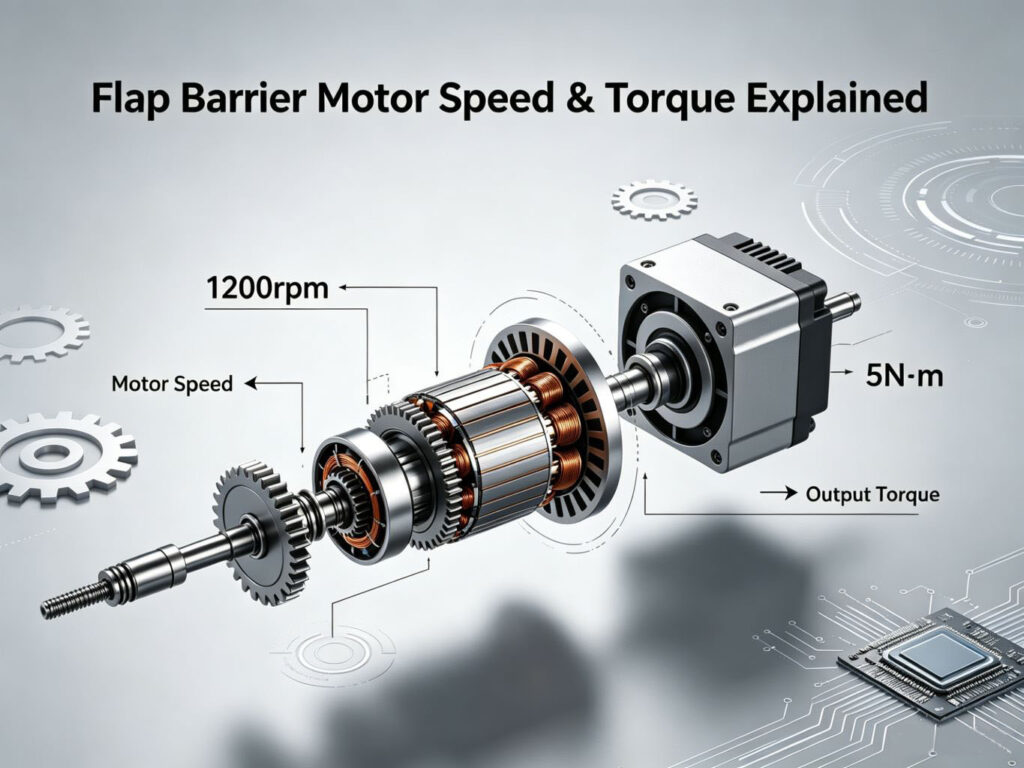
Geschwindigkeit des Klappenbarrieremotors & Drehmoment erklärt
Flap barrier motor speed and torque are two of the most critical parameters affecting the performance, Zuverlässigkeit, and user experience of intelligent access control systems. In modern flap barriers, the motor must open and close the barrier panels rapidly while maintaining smooth motion, präzise positionierung, wenig Lärm, and long-term operational stability.
Most high-performance flap barrier systems use BLDC motors because they provide high torque density, fast acceleration response, superior efficiency, and excellent electronic control capability. Jedoch, improper motor speed selection or insufficient torque sizing can lead to vibration, Überhitzung, unstable flap motion, increased maintenance cost, and reduced system lifespan.
Für OEM-Hersteller, procurement engineers, und Systemintegratoren, understanding the engineering relationship between motor speed, Drehmomentabgabe, Wärmemanagement, and control systems is essential when selecting motors for industrial flap barrier applications. This guide explains the complete engineering logic behind flap barrier motor speed and torque while helping buyers choose reliable long-term motor solutions.
What Is Flap Barrier Motor Speed and Torque?
Motor speed and torque define how a flap barrier system performs during opening and closing cycles. These two parameters directly affect throughput efficiency, Bewegungsglätte, security response, und mechanische Zuverlässigkeit.
What Is Motor Speed?
Motor speed refers to the rotational velocity of the motor shaft, commonly measured in RPM (Revolutionen pro Minute). In flap barrier systems, motor speed influences:
- Opening time
- Closing speed
- Pedestrian throughput
- System response time
- Security performance
High-speed motors allow flap barriers to respond rapidly during user authorization cycles.
What Is Motor Torque?
Torque represents the rotational force generated by the motor. In flap barrier systems, torque determines:
- Acceleration capability
- Mechanical stability
- Load-handling capacity
- Resistance to obstruction
- Bewegungsglätte
Insufficient torque may cause unstable flap movement, excessive vibration, or incomplete opening and closing cycles.
Why Speed and Torque Must Be Balanced
A motor optimized only for speed may lack sufficient torque for stable operation, while excessive torque with low speed may reduce throughput efficiency. Successful flap barrier systems balance both parameters according to application requirements.
Verwandte Industriemotorlösungen:
BLDC motor for flap barrier
Why Motor Speed Matters in Flap Barrier Systems
Motor speed directly affects pedestrian throughput, anti-tailgating performance, and user experience in access control environments.
Faster Pedestrian Throughput
High-speed flap barriers improve access efficiency in:
- Metro stations
- Commercial office towers
- Flughäfen
- Fabriken
- Stadien
Rapid opening and closing cycles reduce waiting time and improve traffic flow during peak periods.
Improved Security Performance
Fast response speed reduces the time window available for unauthorized entry or tailgating attempts.
Smoother Motion Profiles
Modern BLDC systems use controlled acceleration curves to prevent sudden flap impact while maintaining rapid operation.
Reduced Mechanical Shock
Well-controlled high-speed motors minimize:
- Gear impact
- Vibration des Panels
- Mechanical fatigue
- Noise generation
This improves long-term reliability and reduces maintenance requirements.
Why Torque Is Critical in Flap Barrier Motors
While speed determines response time, torque determines whether the flap barrier can operate reliably under real-world mechanical conditions.
Stable Flap Acceleration
High starting torque allows smooth acceleration without hesitation or oscillation during opening cycles.
Resistance to External Force
Flap barriers often encounter:
- Pedestrian pushing force
- Mechanical resistance
- Wind load in outdoor systems
- Panel inertia
Adequate torque ensures consistent operation under these conditions.
Obstacle Detection Capability
Modern flap barriers use motor current feedback to detect obstructions. Stable torque control improves safety response accuracy.
Long-Term Mechanical Reliability
Undersized motors operate continuously near maximum load, accelerating:
- Lagerverschleiß
- Gear wear
- Thermal stress
- Controller overheating
Proper torque sizing significantly improves operational lifespan.
How BLDC Motors Improve Speed and Torque Performance
BLDC motors dominate modern flap barrier systems because they provide superior speed-torque characteristics compared with brushed DC and traditional AC motors.
Hohe Drehmomentdichte
BLDC motors generate strong torque within compact dimensions, enabling slim flap barrier cabinet designs.
Schnelle dynamische Reaktion
Electronic commutation enables rapid acceleration and deceleration control, which is essential for intelligent access systems.
Großer Geschwindigkeitsbereich
BLDC motors maintain stable torque across wide speed ranges, improving flap synchronization and motion smoothness.
Reduced Torque Ripple
Feldorientierte Steuerung (FOC) minimizes torque fluctuation, reduzieren:
- Lärm
- Vibration
- Mechanical shock
- Positioning error
Hocheffizienter Betrieb
BLDC systems commonly achieve efficiency above 85%, reducing thermal losses during continuous operation.
BLDC Motors vs Brushed Motors for Flap Barrier Applications
| Parameter | BLDC-Motor | Gebürsteter Gleichstrommotor |
|---|---|---|
| Speed Control Precision | Exzellent | Mäßig |
| Drehmomentdichte | Hoch | Mäßig |
| Effizienz | 85–92 % | 60–75 % |
| Wärmeleistung | Exzellent | Begrenzt |
| Lärm | Niedrig | Höher |
| Wartung | Niedrig | Häufiger Bürstenwechsel |
| Lebensdauer | Lang | Kürzer |
| Industrial Suitability | Exzellent | Begrenzt |
Although brushed motors remain lower-cost solutions for basic systems, they struggle in high-frequency industrial flap barrier applications due to brush wear and reduced thermal stability.
High-Speed BLDC Motors vs Servo Motors
| Parameter | High-Speed BLDC Motor | Servomotor |
|---|---|---|
| Kosten | Mäßig | Höher |
| Komplexität kontrollieren | Mäßig | Hoch |
| Drehmomentstabilität | Exzellent | Exzellent |
| Positionsgenauigkeit | Hoch | Sehr hoch |
| Application Suitability | Flap Barriers | Präzisionsautomatisierung |
| Wartung | Niedrig | Niedrig |
| Effizienz | Exzellent | Exzellent |
Servo motors offer extremely high positioning precision but often introduce unnecessary system complexity and cost for standard flap barrier applications.
BLDC motors provide the best balance between speed, Drehmoment, Effizienz, Zuverlässigkeit, and OEM cost optimization.
Effizienz, Wärmeleistung, und Zuverlässigkeit bei Klappenbarrieremotoren
Motor speed and torque directly influence thermal behavior and long-term reliability.
Efficiency and Power Loss
Motor efficiency affects:
- Wärmeerzeugung
- Energieverbrauch
- Controller stress
- Operating stability
Higher efficiency reduces internal losses and improves continuous-duty performance.
Herausforderungen beim Wärmemanagement
High-speed opening cycles create repeated current peaks that generate heat inside compact barrier cabinets.
Industrial systems commonly use:
- Aluminum motor housings
- Thermal sensors
- Efficient MOSFET drivers
- Optimierung des natürlichen Luftstroms
Zuverlässigkeit und Lebensdauer
Long-term motor reliability depends on:
- Proper torque sizing
- Stable thermal operation
- Lagerqualität
- Controller-Tuning
- Mechanische Ausrichtung
Oversized or undersized motors both reduce lifecycle efficiency and increase maintenance risk.
How Motor Controllers Affect Speed and Torque Performance
Motor controllers are essential for regulating speed stability, Drehmomentabgabe, and motion smoothness in flap barriers.
Feldorientierte Steuerung (FOC)
FOC enables precise current vector control for:
- Sanfte Beschleunigung
- Stable low-speed torque
- Reduzierte Vibration
- Höhere Effizienz
Encoder Feedback Systems
Encoders provide real-time rotor position information, improving:
- Positioning accuracy
- Flap synchronization
- Hinderniserkennung
- Dynamic speed regulation
Current Monitoring
Modern controllers monitor current to:
- Prevent overload
- Protect against obstruction
- Improve safety response
- Reduce thermal stress
Intelligent Motion Profiles
Acceleration and deceleration curves reduce mechanical shock while maintaining rapid operation.
How to Choose Flap Barrier Motor Speed and Torque
Selecting the correct speed and torque combination requires balancing throughput requirements, mechanical load, thermal conditions, and installation environment.
Spannungsbereich
Common industrial configurations include:
- 24V-Kompaktsysteme
- 48V commercial systems
- 72V high-performance systems
Higher voltage systems reduce current demand and improve efficiency.
Leistungsbereich
Typical flap barrier motors range between 40W and 300W depending on:
- Panel size
- Traffic frequency
- Acceleration requirements
- Arbeitszyklus
Geschwindigkeitsanforderungen
High-throughput environments require rapid opening times without excessive mechanical shock.
Drehmomentanforderungen
Engineers must evaluate:
- Panel inertia
- Mechanische Reibung
- Untersetzungsverhältnis
- Peak acceleration load
- Outdoor wind resistance
Kühlmethode
Continuous-duty systems require optimized thermal dissipation structures.
Controller-Kompatibilität
OEM buyers should confirm compatibility with:
- FOC controllers
- RFID-Systeme
- Biometric readers
- Cloud-Plattformen
- Industrielle Automatisierungssysteme
Custom OEM motor solutions:
Kundenspezifischer BLDC-Motor
Industrial Applications Requiring High-Speed and High-Torque Flap Barrier Motors
Different industries prioritize different speed and torque characteristics.
U-Bahn- und Eisenbahnsysteme
Transportation hubs require extremely fast throughput with reliable continuous-duty performance.
Gewerbliche Bürogebäude
Office environments prioritize low noise, sanfte Bewegung, and aesthetic integration.
Fabriken und Industrieanlagen
Industrial facilities require robust motors capable of long operating cycles with minimal maintenance.
Rechenzentren und sichere Einrichtungen
High-security environments require precise positioning and rapid anti-tailgating response.
Smart City-Infrastruktur
IoT-connected flap barriers increasingly rely on intelligent motor systems integrated with cloud access platforms.
Verwandte industrielle Anwendungen:
Motor eines Elektrofahrzeugs
Future Trends in Flap Barrier Motor Speed and Torque Optimization
Future access control systems will continue evolving toward higher efficiency, Intelligentere Diagnose, and more compact motor platforms.
Higher Torque Density Motors
Motor manufacturers continue improving magnetic materials and winding structures to increase torque output within smaller dimensions.
AI-Based Predictive Maintenance
AI systems increasingly analyze:
- Current patterns
- Motor temperature
- Vibration behavior
- Cycle counts
This improves predictive maintenance capability and reduces downtime.
Integrierte Smart Controller
Modern controllers increasingly combine:
- Cloud-Diagnose
- Wireless communication
- Remote-Firmware-Updates
- Real-time performance analytics
Energieeffiziente Infrastruktur
Global sustainability regulations continue driving demand for high-efficiency BLDC systems with lower standby energy consumption.
FAQ: Geschwindigkeit des Klappenbarrieremotors & Drehmoment erklärt
Why is motor speed important in flap barriers?
Motor speed determines how quickly the flap panels open and close, directly affecting pedestrian throughput, security response, and user experience in access control systems.
Why is torque critical in flap barrier motors?
Torque provides the force required to accelerate the flap panels smoothly and maintain stable motion under varying mechanical loads and environmental conditions.
Are BLDC motors better than brushed motors for flap barriers?
Ja. BLDC-Motoren bieten einen höheren Wirkungsgrad, bessere Geschwindigkeitskontrolle, improved thermal performance, geringerer Wartungsaufwand, and longer operational lifespan compared with brushed DC motors.
What voltage is commonly used for flap barrier BLDC motors?
Most industrial systems use 24V, 48v, or 72V motor platforms depending on performance requirements and operating conditions.
How do engineers select the correct flap barrier motor?
Engineers evaluate speed, Drehmoment, power range, thermisches Verhalten, Controller-Kompatibilität, Installationsraum, and application environment to optimize long-term system performance.
Fazit
Motor speed and torque are fundamental engineering parameters that determine flap barrier performance, Zuverlässigkeit, security capability, and operational lifespan. Modern intelligent access systems increasingly rely on high-speed BLDC motors because they provide the optimal combination of efficiency, Drehmomentdichte, präzise Bewegungssteuerung, und wartungsarm.
Für OEM-Hersteller und Beschaffungsingenieure, successful motor selection requires careful evaluation of speed requirements, torque demand, Wärmemanagement, Controller-Architektur, and real-world operating conditions. Properly optimized BLDC motor systems significantly improve throughput efficiency while reducing lifecycle operating cost and maintenance risk.
Greensky Power provides customized high-speed BLDC motor solutions for flap barriers, Flügeltore, intelligent access systems, and industrial automation applications worldwide.
✔ Datenblatt anfordern
✔ Holen Sie sich eine OEM-Lösung
✔ Kontaktieren Sie unsere Ingenieure für technische Beratung
Holen Sie sich ein kostenloses Angebot
Referenzen
1. https://ieeexplore.ieee.org/
2. https://www.sciencedirect.com/topics/engineering/brushless-dc-motor
3. https://www.motioncontroltips.com/
4. https://www.controleng.com/
5. https://www.nidec.com/en/technology/motor/basic/
6. https://www.ti.com/motor-drivers/brushless-dc-bldc-drivers/overview.html
7. https://www.analog.com/en/technical-articles/field-oriented-control-for-pmsms-utilizing-a-dynamic-spannungsvektor.html
8. https://www.mdpi.com/topics/Brushless_DC_Motor
9. https://www.automationworld.com/