
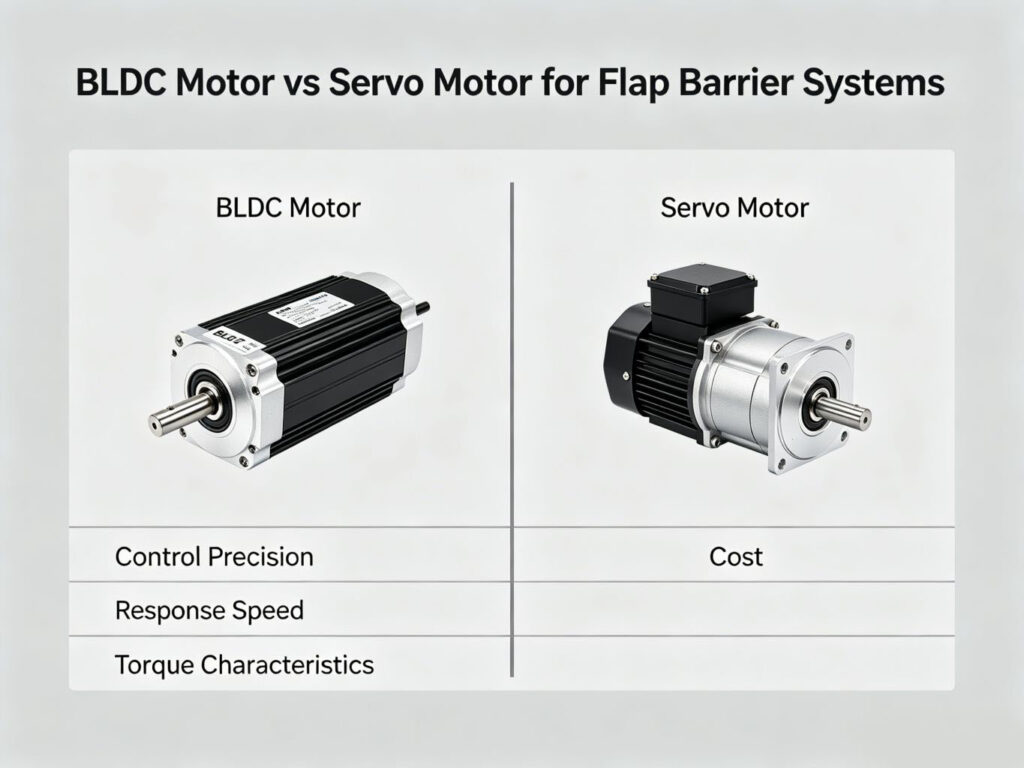
BLDC-Motor vs. Servomotor für Klappenbarrieresysteme
BLDC motors and servo motors are the two most common motion control technologies used in modern flap barrier systems. Both provide precise control, schnelle Reaktion, and reliable operation, but they differ significantly in cost structure, Komplexität kontrollieren, thermische Leistung, Drehmomenteigenschaften, and long-term maintenance requirements.
For most industrial flap barrier systems, high-performance BLDC motors provide the best balance between speed, Drehmomentdichte, Effizienz, Zuverlässigkeit, and OEM cost optimization. Servo motors offer extremely high positioning accuracy and dynamic control performance, but their higher system cost and control complexity are often unnecessary for standard access control applications.
Understanding the engineering differences between BLDC motors and servo motors is essential for OEM manufacturers, procurement engineers, and system integrators selecting motors for flap barriers, Flügeltore, intelligent access systems, and high-cycle pedestrian control equipment. This guide explains the complete technical comparison while helping buyers make better long-term procurement decisions.
What Is a BLDC Motor for Flap Barrier Systems?
Ein BLDC-Motor (Bürstenloser Gleichstrommotor) is an electronically commutated motor widely used in modern flap barrier systems because of its high efficiency, kompakte Struktur, fast dynamic response, und geringer Wartungsaufwand.
Wie BLDC-Motoren funktionieren
Im Gegensatz zu gebürsteten Motoren, BLDC-Motoren verwenden elektronische Kommutierung anstelle mechanischer Bürsten. The controller continuously switches current through the stator windings according to rotor position feedback.
This creates:
- Smooth rotational motion
- Schnelle Beschleunigung
- Präzise Geschwindigkeitsregelung
- Lower mechanical wear
- Higher operating efficiency
Why BLDC Motors Are Popular in Flap Barriers
Modern flap barriers require:
- Fast opening and closing
- Geräuscharmer Betrieb
- Kompakte Einbaugröße
- Continuous-duty capability
- Minimal maintenance
BLDC motors satisfy these requirements efficiently while maintaining lower overall system cost compared with servo systems.
Verwandte Industriemotorlösungen:
BLDC motor for flap barrier
What Is a Servo Motor in Flap Barrier Applications?
Servo motors are closed-loop motion systems designed for highly precise position, Geschwindigkeit, und Drehmomentregelung. Servo systems commonly include:
- Motor
- Encoder
- Servo drive
- Erweiterte Steueralgorithmen
How Servo Motors Operate
Servo motors continuously monitor position and speed using encoder feedback. The servo drive dynamically adjusts current output to maintain precise motion profiles.
Advantages of Servo Systems
Servo systems offer:
- Extremely accurate positioning
- Hohe dynamische Reaktion
- Präzise Drehmomentregelung
- Advanced synchronization capability
- Excellent low-speed stability
Why Servo Motors Are Less Common in Standard Flap Barriers
Although servo motors provide excellent precision, many flap barrier applications do not require ultra-high positioning accuracy. In diesen Fällen, servo systems may increase:
- System cost
- Controller complexity
- Integration difficulty
- Wartungsanforderungen
For many OEM manufacturers, BLDC motors provide a more commercially balanced solution.
BLDC-Motor vs. Servomotor: Core Engineering Differences
| Parameter | BLDC-Motor | Servomotor |
|---|---|---|
| Kontrollmethode | Elektronische Kommutierung | Closed-Loop Servo Control |
| Positionsgenauigkeit | Hoch | Sehr hoch |
| Systemkosten | Mäßig | Höher |
| Drehmomentdichte | Hoch | Hoch |
| Effizienz | 85–92 % | 88–94% |
| Controller-Komplexität | Mäßig | Hoch |
| Wartung | Niedrig | Niedrig |
| Wärmeleistung | Exzellent | Exzellent |
| OEM-Integration | Easier | Komplexer |
| Industrial Flap Barrier Suitability | Exzellent | Specialized Applications |
Aus ingenieurwissenschaftlicher Sicht, both technologies perform well, but BLDC motors usually provide the best balance between performance and procurement efficiency for access control systems.
Effizienzvergleich: BLDC-Motor vs. Servomotor
Motor efficiency directly affects energy consumption, Wärmeerzeugung, operating stability, and long-term lifecycle cost.
Effizienz des BLDC-Motors
Modern BLDC motors typically achieve:
- 85–92% operating efficiency
- Geringer Kupferverlust
- Reduced friction loss
- Excellent partial-load performance
In flap barriers operating continuously throughout the day, high efficiency significantly reduces thermal stress and electricity consumption.
Effizienz des Servomotors
Servo motors may achieve slightly higher peak efficiency under dynamic load conditions, especially in highly precise motion systems.
Jedoch, flap barriers rarely require the extreme positioning precision that justifies servo system cost premiums.
Why Efficiency Matters for OEM Buyers
Efficiency affects:
- Operating cost
- Power supply sizing
- Wärmemanagement
- Cabinet ventilation design
- Long-term reliability
In high-cycle transportation or commercial installations, improved efficiency can significantly reduce maintenance and operational expenses.
Vergleich von Drehmomentdichte und dynamischer Leistung
Torque density is one of the most important factors in compact flap barrier system design.
BLDC Motor Torque Characteristics
BLDC motors offer:
- Hohes Anlaufdrehmoment
- Schnelle Beschleunigung
- Kompakte Abmessungen
- Smooth continuous rotation
This enables slim flap barrier cabinet structures without sacrificing performance.
Servo Motor Torque Characteristics
Servo motors provide:
- Präzise Drehmomentregelung
- Exceptional low-speed stability
- Dynamic load compensation
- Accurate position holding
These advantages are critical in robotics and precision automation but may exceed the practical needs of most flap barrier systems.
Dynamic Response in Access Control Systems
Modern flap barriers require rapid opening cycles combined with smooth deceleration to prevent:
- Mechanical shock
- Lärm
- Vibration des Panels
- Premature wear
Both motor technologies can achieve this, but BLDC systems typically provide simpler implementation and lower total system cost.
Thermal Performance and Reliability Comparison
Thermal behavior directly influences motor lifespan, system stability, and maintenance frequency.
BLDC Motor Thermal Advantages
BLDC motors eliminate mechanical brushes, reduzieren:
- Friction heat
- Electrical arcing
- Bürstenverschleiß
- Maintenance intervals
Their efficient structure supports long continuous-duty operation inside compact barrier cabinets.
Servo Motor Thermal Characteristics
Servo motors also provide strong thermal performance, especially under variable load conditions. Jedoch, servo drives may generate additional heat due to advanced signal processing and higher switching frequencies.
Reliability Under High Duty Cycles
Transportation hubs and industrial facilities often require millions of operating cycles annually.
Reliability depends on:
- Motor bearing quality
- Cooling design
- Controller-Tuning
- Current stability
- Mechanische Ausrichtung
Well-designed BLDC systems commonly provide operational lifespans exceeding 5–10 years with minimal maintenance.
Kontrollsysteme: BLDC vs Servo Motion Control
The control architecture significantly affects system integration complexity and total OEM development cost.
BLDC Motor Control Systems
Modern BLDC motors commonly use:
- FOC (Feldorientierte Steuerung)
- Hall-Sensor-Feedback
- Encodersysteme
- Current monitoring algorithms
FOC control enables smooth torque output and highly stable motion performance.
Servo Motor Control Systems
Servo systems require:
- High-resolution encoders
- Advanced servo drives
- Closed-loop PID tuning
- High-speed communication systems
These systems provide superior precision but increase commissioning complexity.
Which Control System Is Better for Flap Barriers?
For standard pedestrian access systems, modern BLDC controllers provide sufficient precision while simplifying:
- OEM integration
- Software development
- Maintenance procedures
- Production scalability
BLDC Motor vs Servo Motor Cost Comparison
Cost is a major decision factor for OEM buyers and procurement managers.
| Kostenfaktor | BLDC-Motor | Servomotor |
|---|---|---|
| Motorkosten | Mäßig | Höher |
| Controller-Kosten | Untere | Höher |
| Integration Cost | Untere | Höher |
| Wartungskosten | Niedrig | Mäßig |
| Lebenszykluskosten | Exzellent | Höher |
| OEM-Skalierbarkeit | Exzellent | Mäßig |
Why Cost Optimization Matters
Flap barrier manufacturers often deploy thousands of systems annually. Even small component cost differences significantly affect:
- Project profitability
- Market competitiveness
- Lifecycle maintenance cost
- Service inventory requirements
BLDC motors generally provide stronger cost-performance value for large-scale deployment.
How to Choose Between BLDC and Servo Motors for Flap Barrier Systems
Choosing the correct motor depends on application requirements, performance targets, and system architecture.
Spannungsbereich
Common configurations include:
- 24V-Kompaktsysteme
- 48V Industrieanlagen
- 72V high-performance systems
Higher voltage systems reduce current load and improve thermal efficiency.
Leistungsbereich
Typical flap barrier systems use motors between 40W and 300W depending on:
- Panel size
- Arbeitszyklus
- Traffic flow
- Opening speed requirements
Geschwindigkeits- und Drehmomentanforderungen
High-throughput systems prioritize:
- Schnelle Beschleunigung
- Smooth deceleration
- Low vibration
- Stable torque output
Kühlmethode
Continuous-duty industrial systems require:
- Efficient aluminum housings
- Thermal sensors
- Optimized airflow
- Efficient MOSFET drivers
Controller-Kompatibilität
Modern access control systems must integrate with:
- RFID-Lesegeräte
- Biometric systems
- Cloud-Plattformen
- Industrial automation networks
Custom motor solutions:
Kundenspezifischer Gleichstrommotor
Industrial Applications for BLDC Motor vs Servo Motor for Flap Barrier Systems
Different industries require different performance priorities.
Metro and Transportation Systems
Transportation hubs prioritize:
- Hoher Durchsatz
- Geringer Wartungsaufwand
- Continuous-duty capability
- Schnelle Anti-Tailgating-Reaktion
BLDC systems are widely preferred in these environments.
Gewerbliche Bürogebäude
Office installations emphasize:
- Wenig Lärm
- Smooth motion
- Kompaktes Design
- Elegant operation
Industrial Factories
Factories require durable motors capable of operating under dust, Vibration, and heavy traffic conditions.
High-Security Facilities
Certain military or research facilities may use servo systems for enhanced synchronization and precision positioning.
Smart City-Infrastruktur
IoT-connected access systems increasingly integrate intelligent BLDC controllers with cloud-based diagnostics and predictive maintenance systems.
Verwandte industrielle Anwendungen:
Motor eines Elektrofahrzeugs
Zukünftige Trends in der Klappenbarriere-Motortechnologie
The future of access control systems will increasingly focus on energy efficiency, intelligent diagnostics, and compact high-torque motor platforms.
Advanced BLDC Algorithms
Future BLDC systems will use:
- AI-assisted motion optimization
- Adaptive torque control
- Vorausschauende Wartungsanalysen
- Real-time thermal management
Integrierte Smart Controller
Modern controllers increasingly combine:
- Cloud-Konnektivität
- Wireless communication
- Remote firmware upgrades
- Performance diagnostics
Konstruktionen mit höherer Drehmomentdichte
New magnetic materials and winding optimization continue improving motor compactness while increasing torque output.
Sustainability and Energy Regulations
Global efficiency regulations are accelerating the transition toward high-efficiency BLDC motor platforms with lower standby power consumption.
FAQ: BLDC-Motor vs. Servomotor für Klappenbarrieresysteme
Which is better for flap barriers: BLDC motor or servo motor?
For most flap barrier systems, BLDC motors provide the best balance between performance, Effizienz, Zuverlässigkeit, und kosten. Servo motors are mainly used in applications requiring extremely high positioning precision.
Why are BLDC motors widely used in access control systems?
BLDC motors offer high torque density, schnelle Reaktion, geringer Wartungsaufwand, kompakte Größe, und hervorragende Effizienz, making them ideal for modern intelligent access systems.
Are servo motors more accurate than BLDC motors?
Ja. Servo systems provide higher positioning precision due to advanced encoder feedback and closed-loop control architecture. Jedoch, many flap barrier applications do not require such extreme accuracy.
Do BLDC motors have lower maintenance requirements?
Ja. Weil BLDC-Motoren Bürsten und mechanische Kommutierung überflüssig machen, they experience less wear and require significantly lower maintenance than many traditional motor systems.
How do engineers choose the correct flap barrier motor?
Engineers evaluate voltage, power range, torque demand, opening speed, thermische Leistung, control compatibility, operating environment, and lifecycle cost when selecting motors for flap barrier systems.
Fazit
BLDC motors and servo motors both provide excellent motion control performance for flap barrier systems, but their practical value depends heavily on application requirements and cost-performance priorities.
Servo motors deliver exceptional positioning precision and dynamic control capability, making them suitable for highly specialized motion systems. Jedoch, for most commercial and industrial flap barrier applications, modern BLDC motors provide the ideal balance between efficiency, Drehmomentdichte, Zuverlässigkeit, kompakte Struktur, and OEM cost optimization.
As intelligent access control systems continue evolving toward smarter, Schneller, and more energy-efficient architectures, high-performance BLDC motor platforms are expected to remain the dominant solution across transportation, Werbung, industriell, and smart city applications.
Greensky Power provides customized BLDC motor solutions for flap barriers, Flügeltore, intelligent access systems, and industrial automation applications worldwide.
✔ Datenblatt anfordern
✔ Holen Sie sich eine OEM-Lösung
✔ Kontaktieren Sie unsere Ingenieure für technische Beratung
Holen Sie sich ein kostenloses Angebot
Referenzen
1. https://ieeexplore.ieee.org/
2. https://www.motioncontroltips.com/
3. https://www.controleng.com/
4. https://www.nidec.com/en/technology/motor/basic/
5. https://www.ti.com/motor-drivers/brushless-dc-bldc-drivers/overview.html
6. https://www.analog.com/en/technical-articles/field-oriented-control-for-pmsms-utilizing-a-dynamic-spannungsvektor.html
7. https://www.mdpi.com/topics/Brushless_DC_Motor
8. https://www.automationworld.com/
9. https://www.sciencedirect.com/topics/engineering/servo-motor