
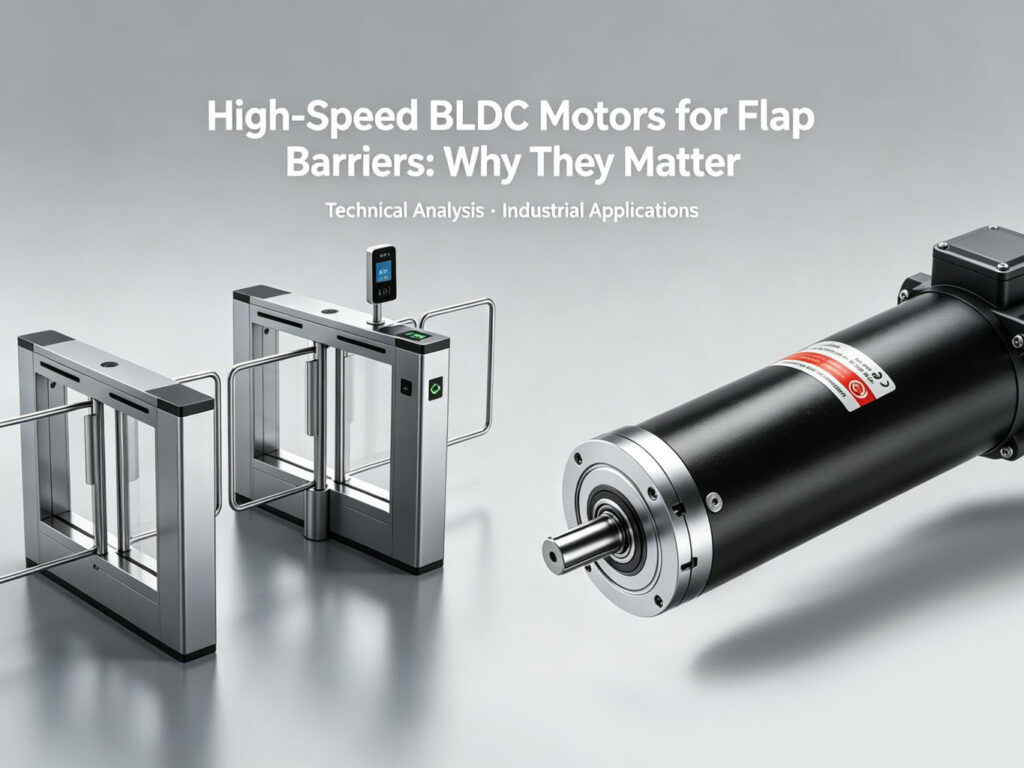
Hochgeschwindigkeits-BLDC-Motoren für Klappenbarrieren: Warum sie wichtig sind
High-speed BLDC motors have become the core drive technology behind modern flap barrier systems because they deliver fast response, präzise Bewegungssteuerung, geringer Wartungsaufwand, and high operational reliability. In intelligent access control environments such as metro stations, Bürogebäude, Flughäfen, und Industrieanlagen, flap barriers must complete thousands of opening and closing cycles daily while maintaining smooth operation and low failure rates.
Compared with brushed DC motors and conventional AC drive systems, high-speed BLDC motors provide superior efficiency, höhere Drehmomentdichte, lower thermal loss, and better electronic control integration. These advantages directly improve flap barrier throughput, anti-tailgating performance, and long-term lifecycle cost.
Für OEM-Hersteller, procurement engineers, und Systemintegratoren, understanding the engineering importance of high-speed BLDC motors is essential for selecting reliable flap barrier solutions. This guide explains how these motors work, why they outperform traditional technologies, and how to choose the best motor configuration for industrial access control applications.
What Are High-Speed BLDC Motors for Flap Barriers?
High-speed BLDC motors for flap barriers are electronically commutated brushless DC motors specifically designed for rapid start-stop motion control in intelligent pedestrian access systems. These motors convert electrical energy into highly controlled rotational movement that drives the opening and closing mechanism of flap barrier panels.
Im Gegensatz zu herkömmlichen Bürstenmotoren, BLDC-Motoren verwenden elektronische Kommutierung anstelle mechanischer Bürsten. This eliminates friction wear, reduces maintenance requirements, and improves operational lifespan.
In flap barrier applications, high-speed BLDC motors typically operate with:
- Encoder feedback systems
- Feldorientierte Steuerung (FOC)
- Precision gear reduction systems
- Integrated sensor logic
- Rapid acceleration profiles
Modern flap barriers require extremely fast opening times while maintaining stable motion and low vibration. High-speed BLDC platforms are specifically optimized for these dynamic operational conditions.
Verwandte Industriemotorlösungen:
BLDC motor for flap barrier
Why High-Speed BLDC Motors Matter in Flap Barrier Systems
The performance of a flap barrier system is directly influenced by motor behavior. In high-traffic environments, slow or unstable motors reduce throughput efficiency and increase mechanical stress.
Fast Pedestrian Throughput
High-speed BLDC motors enable flap barriers to open and close rapidly with precise timing control. This improves traffic flow in metro stations, office towers, and transportation hubs.
Improved Anti-tailgating Performance
Rapid flap response reduces the time window available for unauthorized passage. Fast motor acceleration improves security performance significantly.
Geräuscharmer Betrieb
FOC-controlled BLDC motors minimize torque ripple and vibration, creating quieter operation suitable for commercial buildings and premium facilities.
Higher Operational Reliability
Flap barriers often perform hundreds of thousands of cycles annually. Brushless architecture reduces wear components, improving long-term stability.
Reduced Maintenance Cost
Because BLDC motors eliminate brushes, they require less maintenance than brushed DC motors, lowering lifecycle operating cost for facility operators.
How High-Speed BLDC Motors Work in Flap Barrier Gates
The operation of a high-speed BLDC flap barrier motor involves electronic commutation, encoder feedback, and intelligent control algorithms working together.
Elektronische Kommutierung
Instead of mechanical brushes switching current flow, the controller electronically energizes stator windings in sequence to create a rotating magnetic field.
Rotor Position Detection
Encoders or Hall sensors provide real-time rotor position information, enabling accurate commutation timing.
Präzise Bewegungssteuerung
The controller regulates:
- Acceleration speed
- Drehmomentabgabe
- Position accuracy
- Current limiting
- Obstacle detection logic
Mechanische Übertragung
Motor torque is transmitted through gears or belt systems to move the flap panels smoothly and precisely.
Sensor Integration
Infrared sensors synchronize with motor operation to monitor pedestrian movement and prevent accidental closure.
BLDC Motors vs Brushed DC Motors for Flap Barriers
| Parameter | High-Speed BLDC Motor | Gebürsteter Gleichstrommotor |
|---|---|---|
| Effizienz | 85–92 % | 60–75 % |
| Wartung | Sehr niedrig | Häufiger Bürstenwechsel |
| Lärm | Niedrig | Höher |
| Drehmomentdichte | Hoch | Mäßig |
| Wärmeleistung | Exzellent | Begrenzt |
| Lebensdauer | Lang | Kürzer |
| Kontrollpräzision | Exzellent | Basic |
| Industrial Suitability | Exzellent | Begrenzt |
Brushed motors remain attractive for low-cost systems because of simpler controllers and lower initial cost. Jedoch, in high-frequency flap barrier applications, brush wear becomes a major reliability issue.
High-speed BLDC motors offer superior lifecycle economics because reduced maintenance and longer operational lifespan offset the higher initial system cost.
BLDC Motors vs Servo Motors for Intelligent Access Systems
| Parameter | High-Speed BLDC Motor | Servomotor |
|---|---|---|
| Kosten | Mäßig | Höher |
| Komplexität kontrollieren | Mäßig | Hoch |
| Positionsgenauigkeit | Hoch | Sehr hoch |
| Drehmomentdichte | Hoch | Hoch |
| Application Suitability | Excellent for Flap Barriers | Industrial Precision Systems |
| Wartung | Niedrig | Niedrig |
| Energieeffizienz | Exzellent | Exzellent |
Servo motors provide extremely precise positioning but often introduce unnecessary cost and system complexity for standard flap barrier applications.
High-speed BLDC motors provide the optimal balance between performance, Zuverlässigkeit, and cost for most access control systems.
Effizienz, Drehmomentdichte, and Thermal Performance in High-Speed BLDC Motors
Motor efficiency and thermal stability are critical factors in flap barrier reliability because these systems operate under frequent acceleration and deceleration cycles.
Efficiency Advantages
High-efficiency BLDC motors reduce:
- Copper losses
- Mechanische Reibung
- Switching losses
- Wärmeerzeugung
Lower thermal stress directly improves controller and bearing lifespan.
Hohe Drehmomentdichte
Flap barrier systems require compact motors capable of generating strong torque within limited installation space. High-speed BLDC motors provide excellent torque-to-size ratios, enabling slimmer gate cabinet designs.
Thermalmanagement
Thermal performance becomes increasingly important in:
- High-frequency transit stations
- Industrieanlagen
- Outdoor installations
- Continuous-duty environments
Industrial BLDC systems commonly use:
- Aluminum motor housings
- Efficient MOSFET drivers
- Thermal sensors
- Intelligent temperature protection
Reliability Under Continuous Operation
Repeated start-stop cycles generate periodic current peaks. Proper controller tuning and thermal design are essential to avoid premature motor degradation.
Control System Technologies in High-Speed Flap Barrier Motors
Modern flap barriers depend heavily on intelligent motor control systems to maintain smooth operation and safety performance.
Feldorientierte Steuerung (FOC)
FOC algorithms regulate motor current vectors precisely, reducing torque ripple and improving motion smoothness.
Compared with trapezoidal control, FOC provides:
- Lower noise
- Höhere Effizienz
- Better low-speed torque
- Smoother acceleration
Encoder Feedback Systems
Encoders enable accurate rotor position tracking for:
- Precise flap positioning
- Hinderniserkennung
- Synchronization control
- Dynamic speed regulation
Smart Diagnostic Functions
Modern controllers increasingly support:
- Current monitoring
- Temperature analysis
- Ferndiagnose
- Vorausschauende Wartung
Cloud-Based Access Integration
Smart buildings increasingly require flap barriers to integrate with cloud-based access management systems and IoT platforms.
How to Choose High-Speed BLDC Motors for Flap Barriers
Selecting the correct motor configuration requires balancing performance, thermisches Verhalten, Zuverlässigkeit, and application-specific requirements.
Spannungsbereich
Typical flap barrier systems use:
- 24V-Kompaktsysteme
- 48V Industrieanlagen
- 72V high-performance systems
Higher voltage systems reduce current demand and improve efficiency.
Leistungsbereich
Most flap barrier motors operate between 40W and 300W depending on:
- Flap size
- Traffic frequency
- Acceleration requirements
- Mechanical load
Torque and Speed Requirements
Ingenieure sollten bewerten:
- Peak acceleration torque
- Continuous operating torque
- Geschwindigkeitsziele öffnen
- Mechanical inertia
Kühlmethode
High-duty applications require optimized cooling through:
- Natürliche Konvektion
- Aluminum heat dissipation
- Thermal airflow optimization
Controller-Kompatibilität
OEM-Käufer sollten die Kompatibilität mit überprüfen:
- FOC controllers
- RFID-Systeme
- Biometric terminals
- Cloud-Plattformen
- Industrielle Automatisierungssysteme
Anwendungsspezifische Überlegungen
Outdoor systems may require:
- IP-geschützter Schutz
- Wide temperature capability
- Corrosion resistance
- Humidity protection
Custom OEM motor solutions:
Kundenspezifischer BLDC-Motor
Industrial Applications of High-Speed BLDC Flap Barrier Motors
High-speed BLDC motors are widely used across multiple intelligent infrastructure industries.
U-Bahn- und Eisenbahnsysteme
Transportation systems require extremely high throughput and reliable continuous-duty operation.
Gewerbliche Bürogebäude
Modern buildings prioritize quiet operation, Ästhetik, and intelligent access integration.
Fabriken und Industrieanlagen
Industrial environments require durable motors capable of handling high-frequency operation with low maintenance.
Data Centers
Secure facilities increasingly integrate biometric authentication with high-speed flap barrier systems.
Smart City-Infrastruktur
IoT-connected flap barriers are becoming part of intelligent urban access management systems.
Verwandte industrielle Anwendungen:
Motor eines Elektrofahrzeugs
Future Trends in High-Speed BLDC Motors for Flap Barriers
The flap barrier industry continues evolving toward smarter, quieter, and more energy-efficient motor systems.
Higher Torque Density
Future motors will continue shrinking in size while increasing torque capability to support compact architectural designs.
AI-Based Predictive Maintenance
AI algorithms increasingly analyze:
- Motor current patterns
- Thermisches Verhalten
- Bearing vibration
- Operational cycles
This enables predictive maintenance and reduced downtime.
Integrated Smart Electronics
Motor controllers are becoming increasingly integrated with:
- Cloud-Plattformen
- Ferndiagnose
- Wireless communication
- Real-time analytics
Energieeffiziente Infrastruktur
Global sustainability requirements continue driving demand for high-efficiency BLDC systems with lower standby power consumption.
FAQ: Hochgeschwindigkeits-BLDC-Motoren für Klappenbarrieren
Why are high-speed BLDC motors important in flap barriers?
High-speed BLDC motors provide rapid opening response, hohe Effizienz, präzise steuerung, und lange Lebensdauer. These advantages improve pedestrian throughput, anti-tailgating performance, and system reliability.
What voltage is commonly used in flap barrier BLDC motors?
Most systems use 24V, 48v, or 72V configurations depending on performance requirements, installation size, and duty cycle conditions.
Are BLDC motors better than brushed motors for flap barriers?
Ja. BLDC-Motoren bieten einen höheren Wirkungsgrad, geringerer Wartungsaufwand, leiserer Betrieb, and longer lifespan compared with brushed DC motors, especially in high-frequency applications.
What control method is used in modern flap barrier motors?
Most premium systems use Field-Oriented Control (FOC) combined with encoder feedback for smooth motion control, reduced noise, and improved positioning accuracy.
How do engineers choose the best BLDC motor for flap barriers?
Engineers evaluate voltage, Drehmomentanforderungen, thermische Leistung, Controller-Kompatibilität, Installationsraum, and application environment when selecting industrial flap barrier motors.
Fazit
High-speed BLDC motors have become the dominant drive technology for modern flap barrier systems because they provide the optimal combination of efficiency, fast dynamic response, geringer Wartungsaufwand, kompakte Größe, und langfristige Zuverlässigkeit. As intelligent access control systems continue evolving toward higher throughput and smarter infrastructure integration, motor performance increasingly determines overall system quality.
Für OEM-Hersteller, procurement engineers, und Systemintegratoren, selecting the correct BLDC motor platform requires careful evaluation of torque density, Wärmemanagement, Controller-Architektur, and application-specific operating conditions. High-quality BLDC systems significantly reduce lifecycle cost while improving access control performance and operational stability.
Greensky Power provides customized high-speed BLDC motor solutions for flap barriers, Flügeltore, intelligent access systems, and industrial automation applications worldwide.
✔ Datenblatt anfordern
✔ Holen Sie sich eine OEM-Motorlösung
✔ Kontaktieren Sie unsere Ingenieure für technische Beratung
Holen Sie sich ein kostenloses Angebot
Referenzen
1. https://ieeexplore.ieee.org/
2. https://www.sciencedirect.com/topics/engineering/brushless-dc-motor
3. https://www.nidec.com/en/technology/motor/basic/
4. https://www.motioncontroltips.com/
5. https://www.controleng.com/
6. https://www.automationworld.com/
7. https://www.mdpi.com/topics/Brushless_DC_Motor
8. https://www.analog.com/en/technical-articles/field-oriented-control-for-pmsms-utilizing-a-dynamic-spannungsvektor.html
9. https://www.ti.com/motor-drivers/brushless-dc-bldc-drivers/overview.html