
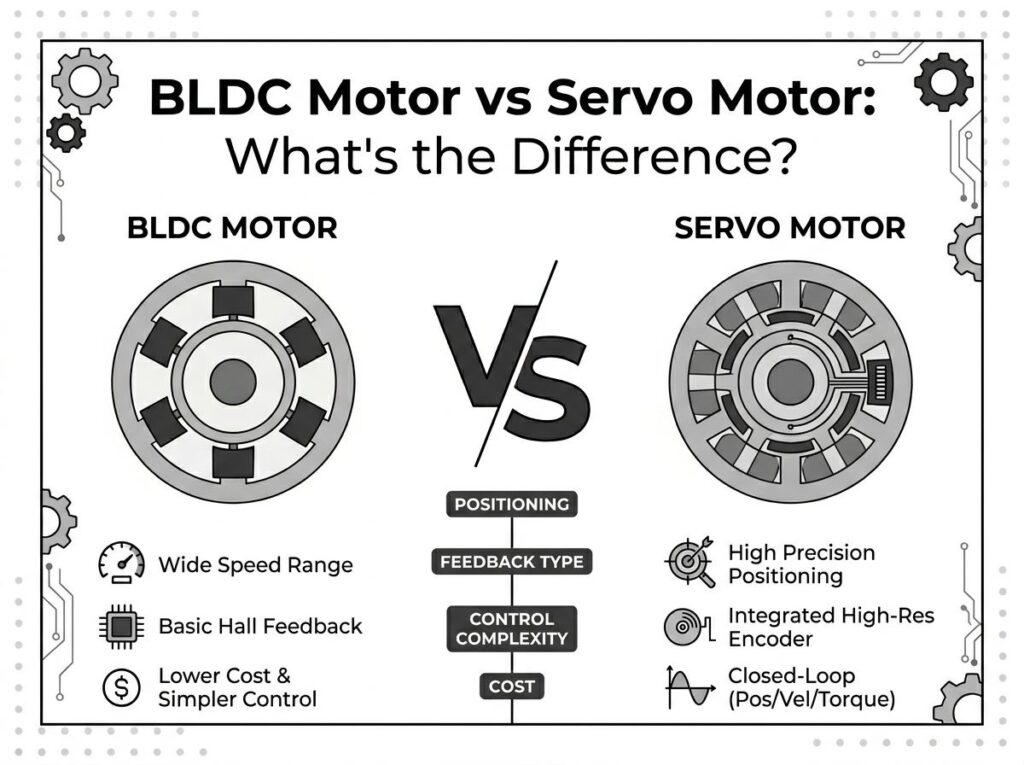
BLDC-Motor vs. Servomotor: Was ist der Unterschied??
Die Auswahl der richtigen Motortechnologie ist eine der wichtigsten Entscheidungen im modernen Gerätedesign. Ob die Entwicklung eines Roboterarms, ein fahrerloses Transportfahrzeug (AGV), ein Industrieförderer, ein Rasenmäher, oder eine Präzisionsfertigungsmaschine, Ingenieure müssen die Leistungsanforderungen sorgfältig bewerten, Komplexität kontrollieren, Richtigkeit, Effizienz, und Gesamtsystemkosten.
Zu den am häufigsten verglichenen Technologien gehört der bürstenlose Gleichstrom (BLDC) Motoren und Servomotoren. Während beide in Bewegungssteuerungsanwendungen weit verbreitet sind, sie sind keine direkten Äquivalente. In der Tat, Eines der größten Missverständnisse in der Automobilindustrie ist die Annahme, ein Servomotor sei lediglich ein anderer Motortyp.
Die Realität ist, dass ein BLDC-Motor eine Motortechnologie ist, während ein Servomotor ein komplettes Bewegungssteuerungssystem ist, das einen Motor kombiniert, Rückmeldungsgerät, und Steuerung, um eine hochpräzise Positionierung und dynamische Leistung zu erreichen.
Dieser Leitfaden bietet einen detaillierten technischen Vergleich von BLDC-Motoren und Servomotoren, Unterstützung von OEM-Herstellern, Ingenieure, und Beschaffungsteams bestimmen, welche Lösung am besten zu ihren Anwendungsanforderungen passt.
BLDC-Motor vs. Servomotor
Sowohl BLDC-Motoren als auch Servomotoren werden zur präzisen Bewegungssteuerung eingesetzt, aber ein BLDC-Motor ist ein Motortyp, während ein Servomotor ein komplettes Bewegungssteuerungssystem ist, das einen Motor umfasst, Encoder, und Controller. Servomotoren sorgen für eine höhere Positioniergenauigkeit und dynamische Reaktion, wohingegen BLDC-Motoren geringere Kosten und eine einfachere Implementierung bieten.
Im Algemeinen, Servosysteme werden für die Robotik bevorzugt, CNC-Ausrüstung, und Präzisionsautomatisierung, während BLDC-Motoren häufig für Rasenmäher ausgewählt werden, HVAC-Systeme, Pumps, Industrieantriebe, und kostensensible OEM-Produkte.
Was ist ein BLDC-Motor??
Ein bürstenloser Gleichstrommotor (BLDC-Motor) ist ein elektronisch kommutierter Motor, der auf die bei herkömmlichen Gleichstrommotoren verwendeten Bürsten und Kommutatoren verzichtet. Statt mechanischer Schaltung, Elektronische Steuerungen versorgen die Statorwicklungen entsprechend der Rotorposition mit Strom.
BLDC-Motoren haben sich aufgrund ihrer hohen Effizienz zu einer der am schnellsten wachsenden Motortechnologien entwickelt, kompakte Größe, lange lebensdauer, und hervorragende Leistungsdichte.
BLDC-Motorstruktur
Ein typischer BLDC-Motor besteht aus:
- Permanentmagnetrotor
- Lamellierter Statorkern
- Mehrphasige Statorwicklungen
- Hall-Effekt-Sensoren (optional)
- Elektronische Steuerung
- Wechselrichterstufe
Im Gegensatz zu gebürsteten Motoren, Es besteht kein physischer Kontakt zwischen stationären und rotierenden elektrischen Komponenten.
Elektronische Kommutierung
Die wichtigste Innovation hinter BLDC-Motoren ist die elektronische Kommutierung.
Die Motorsteuerung überwacht kontinuierlich die Rotorposition und erregt die Statorwicklungen in einer Reihenfolge, die ein rotierendes Magnetfeld erzeugt. Der Rotor folgt diesem Feld und erzeugt eine Drehbewegung.
Die elektronische Kommutierung bietet mehrere Vorteile:
- Kein Bürstenverschleiß
- Geringerer Wartungsaufwand
- Reduziertes elektrisches Rauschen
- Höhere Effizienz
- Längere Lebensdauer
Hall-Sensoren
Viele BLDC-Motoren verwenden Hall-Effekt-Sensoren zur Bestimmung der Rotorposition.
Diese Sensoren erkennen Magnetfeldänderungen, wenn sich der Rotor dreht, und geben eine Positionsrückmeldung an die Steuerung.
Hall-Sensoren ermöglichen:
- Zuverlässige Startleistung
- Präzises Kommutierungs-Timing
- Verbesserte Kontrolle bei niedriger Geschwindigkeit
- Verbesserte Drehmomenterzeugung
Moderne sensorlose BLDC-Systeme können die Rotorposition durch Rück-EMF-Erkennung schätzen, Dadurch entfällt in bestimmten Anwendungen der Bedarf an Hall-Sensoren.
BLDC-Motorsteuerung
Der Controller fungiert als Gehirn des motorischen Systems.
Zu den Funktionen gehören:
- Geschwindigkeitsregulierung
- Aktuelle Kontrolle
- Drehmomentmanagement
- Schutzfunktionen
- PWM-Erzeugung
- Kommunikationsschnittstellen
Die Einfachheit der BLDC-Steuerung ist einer der Gründe, warum diese Motoren häufig in kommerziellen Produkten eingesetzt werden, die ein Gleichgewicht zwischen Leistung und Erschwinglichkeit erfordern.
Gängige BLDC-Anwendungen
- Elektrische Rasenmäher
- Roboter-Rasenmäher
- HVAC-Gebläse
- Wasserpumpen
- Industrieventilatoren
- AGVs
- Drehkreuzsysteme
- Elektrofahrräder
- Medizinische Geräte
- Verbrauchergeräte
Was ist ein Servomotor??
Eines der am meisten missverstandenen Konzepte in der Bewegungssteuerung ist die Definition eines Servomotors.
Viele Menschen glauben, dass es sich bei einem Servomotor um einen bestimmten Motortyp handelt. In Wirklichkeit, Ein Servosystem ist eine vollständige Bewegungssteuerungslösung mit geschlossenem Regelkreis.
Servosystemarchitektur
Ein Servosystem besteht aus:
Servosystem =
Motor
+
Encoder
+
Regler
Möglicherweise liegt es am Motor selbst:
- PMSM-Motor
- BLDC-Motor
- AC-Synchronmotor
- Direktantriebsmotor
Das bestimmende Merkmal ist nicht die Motortechnologie, sondern der Einsatz von kontinuierlicher Rückmeldung und Regelung.
Kernkomponenten eines Servosystems
1. Motor
Der Motor erzeugt Drehbewegung und Drehmoment.
Moderne industrielle Servosysteme verwenden aufgrund ihrer gleichmäßigen Drehmomentcharakteristik und hohen Effizienz am häufigsten PMSM-Motoren.
2. Encoder
Der Encoder misst kontinuierlich:
- Position
- Geschwindigkeit
- Richtung
- Winkelverschiebung
Durch die Rückmeldung des Encoders kann der Controller Echtzeitkorrekturen vornehmen.
3. Servoantrieb
Der Servoantrieb verarbeitet Rückmeldungssignale und passt den Strom an, Stromspannung, und Musterwechsel, um Zielbewegungsprofile zu erreichen.
Der Antrieb sorgt dafür:
- Präzise Positionierung
- Stabile Geschwindigkeitsregelung
- Dynamische Drehmomentreaktion
- Präzise Beschleunigung und Verzögerung
Warum Servosysteme anders sind
Im Gegensatz zu Standard-BLDC-Motorsystemen, die im offenen oder halbgeschlossenen Regelkreis betrieben werden können, Servosysteme vergleichen ständig die befohlene Bewegung mit der tatsächlichen Bewegung.
Wenn ein Fehler auftritt, Der Regler kompensiert sofort.
Dieser Feedback-Mechanismus ermöglicht:
- Positionierung auf Mikrometerebene
- Dynamische Reaktion bei hoher Geschwindigkeit
- Außergewöhnliche Wiederholgenauigkeit
- Präzise Flugbahnkontrolle
Typische Servoanwendungen
- Industrieroboter
- CNC-Bearbeitungszentren
- Halbleiterausrüstung
- Verpackungsmaschinen
- Automatisierte Montagesysteme
- Medizinische Roboter
- Präzisionsprüfgeräte
- Bewegungssysteme für die Luft- und Raumfahrt
BLDC vs. Servomotor: Hauptunterschiede
Obwohl BLDC-Motoren und Servosysteme manchmal intern ähnliche Motortechnologien verwenden können, Ihre beabsichtigten Funktionen und Leistungsniveaus unterscheiden sich erheblich.
| Besonderheit | BLDC-Motor | Servomotor |
|---|---|---|
| Positionsrückmeldung | Optional | Erforderlich |
| Genauigkeit | Medium | Sehr hoch |
| Geschwindigkeitskontrolle | Gut | Exzellent |
| Drehmomentkontrolle | Gut | Exzellent |
| Kosten | Untere | Höher |
| Komplexität | Untere | Höher |
| Kontrollmethode | Offener Kreislauf / Halbgeschlossener Kreislauf | Geschlossener Kreislauf |
| Encoder | Optional | Obligatorisch |
| Typische Anwendung | Rasenmäher, Pumps, HVAC | Robotik, CNC, Präzisionsautomatisierung |
Der wichtigste Unterschied besteht darin, dass bei Servosystemen Präzision und Feedback-Steuerung im Vordergrund stehen, während BLDC-Systeme der Effizienz Priorität einräumen, Einfachheit, und Kosteneffizienz.
Vergleich der Funktionsprinzipien
Das Verständnis der Funktionsprinzipien von BLDC-Motoren und Servosystemen hilft zu klären, warum sich ihre Leistungsmerkmale unterscheiden.
Wie BLDC-Motoren funktionieren
BLDC-Motoren basieren auf elektronischer Kommutierung, um mechanische Bürsten zu ersetzen.
Die Steuerung erregt die Statorwicklungen in einer vordefinierten Reihenfolge basierend auf Rotorpositionsinformationen.
Wichtige Betriebsmerkmale:
- Elektronische Kommutierung
- Hall-Sensor-Feedback (optional)
- PWM-Geschwindigkeitsregelung
- Betrieb im offenen oder halbgeschlossenen Regelkreis
Bei den meisten BLDC-Anwendungen liegt der Schwerpunkt eher auf der Aufrechterhaltung der Geschwindigkeit als auf der Erzielung einer präzisen Positionssteuerung.
Wie Servosysteme funktionieren
Servosysteme überwachen kontinuierlich die tatsächliche Motorposition und vergleichen sie mit der Sollposition.
Jede Abweichung löst sofort Korrekturmaßnahmen durch den Controller aus.
Diese Closed-Loop-Architektur ermöglicht:
- Hochpräzise Positionierung
- Genaue Flugbahnverfolgung
- Schnelle Reaktion auf Laständerungen
- Überlegene Drehmomentkontrolle
Der Encoder dient als entscheidendes Feedbackgerät, das die Servosteuerung ermöglicht.
Offener Kreislauf vs. geschlossener Kreislauf
| Kontrolltyp | BLDC | Servo |
|---|---|---|
| Open-Loop-Betrieb | Gemeinsam | Nein |
| Closed-Loop-Betrieb | Optional | Standard |
| Feedback-Abhängigkeit | Niedrig | Hoch |
| Positionskorrektur | Begrenzt | Kontinuierlich |
Vergleich der Positionsgenauigkeit
Für Ingenieure, die Bewegungssteuerungssysteme bewerten, Positionsgenauigkeit ist oft der wichtigste Faktor.
Hier zeigen Servosysteme ihren größten Vorteil.
BLDC-Positionsgenauigkeit
Standard-BLDC-Motoren sind in der Regel eher für die Drehzahlregelung und Drehmomenterzeugung als für die Präzisionspositionierung ausgelegt.
Ohne Encoder-Feedback, Die Positionsgenauigkeit ist naturgemäß begrenzt.
Zu den typischen BLDC-Merkmalen gehören::
- Mäßige Positionierungsfähigkeit
- Gute Geschwindigkeitsregulierung
- Geeignet für Anwendungen mit kontinuierlicher Rotation
- Begrenzte Positionierungsgenauigkeit
Genauigkeit der Servoposition
Servosysteme sind speziell für eine genaue Positionierung ausgelegt.
Mithilfe hochauflösender Encoder kann die Steuerung die Rotorbewegung kontinuierlich verfolgen und Korrekturen in Echtzeit vornehmen.
Zu den typischen Servovorteilen gehören::
- Positionierungsgenauigkeit unter einem Grad
- Hervorragende Wiederholgenauigkeit
- Präzise Flugbahnkontrolle
- Schnelle Reaktion
- Minimaler Positionierungsfehler
Diese Fähigkeit erklärt, warum Robotik, CNC-Maschinen, Halbleiterausrüstung, und automatisierte Fertigungssysteme basieren überwiegend auf Servotechnologie.
Weiter zum Teil 2: Drehmomentvergleich, Vergleich der Geschwindigkeitsregelung, Effizienzvergleich, Kostenvergleich, Robotikanwendungen, AGV & AMR-Anwendungen, Rasenmäheranwendungen, Auswahlleitfaden für die industrielle Automatisierung, Warum sich OEM-Käufer für Greensky Power entscheiden, FAQ, Interne Link-Strategie, und Referenzen.
Drehmomentvergleich
Das Drehmoment ist einer der kritischsten Parameter bei der Bewertung von Bewegungssteuerungssystemen. Es bestimmt die Fähigkeit eines Motors, Lasten zu beschleunigen, Widerstände überwinden, Position halten, und dynamische Bewegungen unter wechselnden Betriebsbedingungen ausführen.
In mechanischen Systemen, Drehmoment kann ausgedrückt werden als::
τ = rFsin(ich)
Wo:
- T = Drehmoment (N·m)
- R = Abstand vom Drehpunkt (M)
- F = Angewandte Kraft (N)
- ich = Winkel zwischen Kraft und Hebelarm
Zum Beispiel:
t = (3)(6)Sünde(90°) = 18 N·m
Nur die Kraftkomponente senkrecht zum Hebelarm trägt zur Drehmomenterzeugung bei.
Kontinuierliches Drehmoment
Das Dauerdrehmoment gibt an, wie viel Drehmoment ein Motor unbegrenzt erzeugen kann, ohne dass es zu einer Überhitzung kommt.
| Merkmal | BLDC-Motor | Servomotor |
|---|---|---|
| Kontinuierliche Drehmomentdichte | Hoch | Sehr hoch |
| Thermalmanagement | Gut | Exzellent |
| Langzeitstabilität | Gut | Exzellent |
Spitzendrehmoment
Das Spitzendrehmoment bezieht sich auf das maximale Drehmoment, das ein Motor kurzzeitig liefern kann.
Servomotoren sind speziell darauf ausgelegt, beim Beschleunigen ein deutlich höheres Spitzendrehmoment bereitzustellen, Positionierung, und plötzliche Lastwechsel.
Dies ist besonders wichtig in der Robotik, CNC-Ausrüstung, und automatisierte Montagesysteme.
Stalldrehmoment
Das Stillstandsdrehmoment ist das Drehmoment, das entsteht, wenn sich die Motorwelle nicht dreht.
Servosysteme bieten im Allgemeinen ein hervorragendes Stillstandsdrehmomentmanagement, da die Rückmeldung des Encoders eine präzise Stromregelung bei gleichzeitiger Beibehaltung der Wellenposition ermöglicht.
Zusammenfassung der Drehmomentleistung
| Drehmomentfaktor | BLDC | Servo |
|---|---|---|
| Kontinuierliches Drehmoment | Hoch | Sehr hoch |
| Spitzendrehmoment | Gut | Exzellent |
| Stall-Drehmomentregelung | Begrenzt | Exzellent |
| Drehmomentgenauigkeit | Mäßig | Sehr hoch |
| Drehmomentwelligkeit | Höher | Untere |
Für anspruchsvolle Motion-Control-Anwendungen, Servosysteme übertreffen in der Regel Standard-BLDC-Motoren hinsichtlich Drehmomentsteuerung und dynamischer Reaktion.
Vergleich der Geschwindigkeitsregelung
Die Geschwindigkeitsregelung ist ein weiterer wesentlicher Unterschied zwischen BLDC-Motoren und Servosystemen.
BLDC-Geschwindigkeitsregelung
Typischerweise werden BLDC-Motoren verwendet:
- Steuerung im offenen Regelkreis
- Halbgeschlossene Regelung
- PWM-Geschwindigkeitsregelung
- Kommutierung des Hallsensors
Die Leistung der Geschwindigkeitsregelung reicht im Allgemeinen für Anwendungen aus, bei denen keine genaue Positionierung erforderlich ist.
Beispiele hierfür sind:
- Rasenmäher
- Fans
- Pumps
- HVAC-Systeme
- Förderer
Servo-Geschwindigkeitsregelung
Servosysteme nutzen eine vollständige Regelung.
Der Controller vergleicht kontinuierlich:
- Befohlene Geschwindigkeit
- Tatsächliche Geschwindigkeit
- Ladebedingungen
- Positionsrückmeldung
Echtzeitkorrekturen ermöglichen eine hochstabile Geschwindigkeitsregelung auch bei schnell wechselnden Lasten.
Vergleichstabelle zur Geschwindigkeitsregelung
| Faktor | BLDC | Servo |
|---|---|---|
| Geschwindigkeitsstabilität | Gut | Exzellent |
| Dynamische Reaktion | Gut | Exzellent |
| Lastausgleich | Begrenzt | Automatisch |
| Steuerung bei niedriger Geschwindigkeit | Mäßig | Exzellent |
Vergleich zwischen BLDC und Servoeffizienz
Effizienz wirkt sich direkt auf die Betriebskosten aus, Akkulaufzeit, thermische Leistung, und Gesamtzuverlässigkeit der Ausrüstung.
Beide Technologien bieten einen deutlich höheren Wirkungsgrad als bürstenbehaftete Gleichstrommotoren.
Effizienz des BLDC-Motors
- Typischerweise 85–95 %
- Geringe Rotorverluste
- Hervorragende Batterieausnutzung
- Hohe Leistungsdichte
Effizienz des Servomotors
Moderne Servosysteme verwenden intern häufig PMSM-Motoren, Aktivieren:
- 90–98 % Wirkungsgrad
- Optimierte Stromregelung
- Reduzierte harmonische Verluste
- Überlegene Energieausnutzung
Effizienzvergleichstabelle
| Motorentyp | Typische Effizienz |
|---|---|
| Gebürsteter Gleichstrommotor | 70–85 % |
| Induktionsmotor | 80–93 % |
| BLDC-Motor | 85–95 % |
| Servomotorsystem | 90–98 % |
Für die meisten kommerziellen Geräte, Der BLDC-Wirkungsgrad ist bereits ausgezeichnet. Jedoch, Servosysteme haben bei Präzisionsanwendungen, die maximale Leistung erfordern, einen Vorteil.
Kostenvergleich zwischen BLDC und Servo
Für OEM-Käufer sind oft die Kosten der entscheidende Faktor.
Obwohl Servosysteme eine überlegene Leistung bieten, sie erfordern zusätzliche Hardware- und Softwarekomponenten.
| Kostenartikel | BLDC | Servo |
|---|---|---|
| Motor | Untere | Höher |
| Regler | Untere | Höher |
| Encoder | Optional | Erforderlich |
| Antriebselektronik | Einfacher | Komplexer |
| Gesamtsystemkosten | Untere | Höher |
Für Anwendungen, bei denen höchste Präzision nicht erforderlich ist, BLDC-Motoren bieten oft die beste Kapitalrendite.
Was ist besser für die Robotik??
Die Robotik ist einer der Märkte mit dem höchsten Wert für Bewegungssteuerungstechnologien.
Die meisten Robotersysteme erfordern:
- Präzise Positionierung
- Reibungslose Flugbahnkontrolle
- Schnelle Beschleunigung
- Hohe Wiederholgenauigkeit
- Feedback im geschlossenen Regelkreis
Aufgrund dieser Anforderungen, Servosysteme dominieren die Industrierobotik.
Warum Servomotoren in der Robotik gewinnen
- Encoder-Feedback
- Positionierungsfähigkeit im Mikrometerbereich
- Überlegene dynamische Reaktion
- Hochpräzise Flugbahnsteuerung
- Hervorragende Wiederholgenauigkeit
Gewinner für Robotik: Servomotor
Was ist besser für AGV und AMR??
Fahrerlose Transportfahrzeuge (AGVs) und autonome mobile Roboter (AMRs) besetzen einen einzigartigen Mittelweg.
Wenn BLDC bevorzugt wird
- Kostensensible AGVs
- Lagertransport
- Grundlegende Navigationssysteme
- Anforderungen an eine lange Akkulaufzeit
Wenn Servo bevorzugt wird
- Hochgeschwindigkeitsnavigation
- Präzises Andocken
- Kollaborative Roboter
- Fortschrittliche autonome Systeme
Viele moderne AGVs nutzen erfolgreich BLDC-Antriebsmotoren mit Encoder-Feedback, Schaffung einer Hybridlösung zwischen traditionellen BLDC- und Servoarchitekturen.
Gewinner für AGVs: Hängt von den Anforderungen an die Navigationsgenauigkeit ab.
Was ist besser für Rasenmäher??
Rasenmäher erfordern:
- Hohe Drehmomentabgabe
- Haltbarkeit im Freien
- Batterieeffizienz
- Kostenwettbewerbsfähigkeit
- Zuverlässiger Betrieb
Im Gegensatz zur Robotik, Rasenmäher erfordern selten eine Positionierungsgenauigkeit unter einem Grad.
Stattdessen, Hersteller legen Wert auf Effizienz, Zuverlässigkeit, und Erschwinglichkeit.
Warum BLDC-Motoren ideal für Rasenmäher sind
- Niedrigere Systemkosten
- Hervorragende Effizienz
- Hohes Anlaufdrehmoment
- Einfache elektronische Architektur
- Bewährte Zuverlässigkeit im Außenbereich
Dies ist ein Grund, warum moderne Akku-Rasenmäher und Mähroboter zunehmend auf die BLDC-Technologie setzen.
Gewinner für Rasenmäher: BLDC-Motor
Was ist besser für die industrielle Automatisierung??
Die industrielle Automatisierung umfasst eine breite Palette von Gerätetypen.
| Anwendung | Empfohlene Lösung |
|---|---|
| Förderer | BLDC |
| Verpackungsmaschinen | Servo |
| Drehkreuze | BLDC |
| CNC-Ausrüstung | Servo |
| Industrieventilatoren | BLDC |
| Pick-and-Place-Systeme | Servo |
Im Algemeinen, Die Wahl hängt davon ab, ob bei der Anwendung Präzision oder Kosteneffizienz im Vordergrund steht.
So wählen Sie zwischen BLDC- und Servomotoren
Die folgende Auswahlhilfe kann motortechnische Entscheidungen vereinfachen.
| Anwendung | Beste Wahl |
|---|---|
| Robotik | Servo |
| CNC | Servo |
| Rasenmäher | BLDC |
| HVAC | BLDC |
| Pumpe | BLDC |
| Drehkreuz | BLDC |
| AGV | Kommt darauf an |
Wählen Sie ein Servosystem, wenn es um Präzision geht, Positionierungsgenauigkeit, und dynamische Reaktion sind entscheidend.
Wählen Sie einen BLDC-Motor, wenn es um Effizienz geht, Zuverlässigkeit, Einfachheit, und geringere Kosten stehen an erster Stelle.
Warum sich OEM-Käufer für Greensky Power entscheiden
Greensky Power ist auf maßgeschneiderte Bewegungslösungen für OEM-Hersteller weltweit spezialisiert.
Kernproduktportfolio
- BLDC-Motoren
- Getriebemotoren
- Planetengetriebemotoren
- Wurmgetriebemotoren
- Maßgeschneiderte Motorlösungen
OEM-Engineering-Fähigkeiten
- Encoder-Integration
- Controller-Anpassung
- Design eines Planetengetriebes
- Schnelles Prototyping
- Benutzerdefinierte Leistungsoptimierung
Belieferte Schlüsselindustrien
- Rasenausrüstung
- HVAC-Systeme
- Industrielle Automatisierung
- Robotik
- Medizinprodukte
- Sicherheitssysteme
Häufig gestellte Fragen
Ist ein Servomotor ein BLDC-Motor??
Nicht unbedingt. Ein Servomotor ist ein vollständiges Regelsystem. Viele moderne Servomotoren nutzen intern die PMSM- oder BLDC-Motortechnologie.
Welcher Motor ist besser für die Robotik??
Im Allgemeinen werden Servomotoren bevorzugt, da sie eine höhere Positionierungsgenauigkeit bieten, dynamische Reaktion, und Wiederholbarkeit.
Welcher Motor ist günstiger??
BLDC-Motoren haben typischerweise geringere Motorkosten, Controller-Kosten, und Gesamtsystemkosten.
Brauchen BLDC-Motoren Encoder??
Nein. Viele BLDC-Motoren arbeiten erfolgreich mit Hall-Sensoren oder sensorlosen Steuerungsmethoden. Encoder sind optional, es sei denn, eine präzise Positionierung ist erforderlich.
Kann ein BLDC-Motor als Servomotor verwendet werden??
Ja. In Kombination mit einem Encoder und einem Closed-Loop-Regler, Ein BLDC-Motor kann als Teil eines Servosystems funktionieren.
Verwandte Artikel
Referenzen
- https://www.ieee.org
- https://ieeexplore.ieee.org
- https://www.energy.gov
- https://www.iea.org
- https://www.iec.ch
- https://www.mathworks.com
- https://www.microchip.com
- https://www.ti.com
- https://www.nidec.com
- https://www.siemens.com
- https://global.abb
- https://www.weg.net