
搜索

BLDC 电机与 PMSM 电机: 有什么区别? 完整的工程比较指南 (2026)

BLDC 电机与 PMSM 电机

BLDC 电机与 PMSM 电机: 有什么区别?

Permanent magnet motor technologies have become the preferred choice for modern electric drive systems due to their superior efficiency, 高功率密度, 尺寸紧凑, and precise controllability. 在这些技术中, 无刷直流电机 (无刷直流) and Permanent Magnet Synchronous Motors (永磁同步电机) are the two most widely adopted solutions across electric vehicles, 机器人技术, 暖通空调系统, 工业自动化, 医疗器材, and outdoor power equipment.

Because both motor types utilize permanent magnets and electronic control systems, many engineers and procurement professionals assume they are essentially the same technology. 现实中, important differences exist in back EMF characteristics, control algorithms, 扭矩脉动, 噪音, 效率, 和系统成本.

This engineering guide provides a detailed comparison between BLDC and PMSM motors to help engineers, OEM厂商, and industrial buyers select the most suitable motor technology for their applications.


BLDC 电机与 PMSM 电机


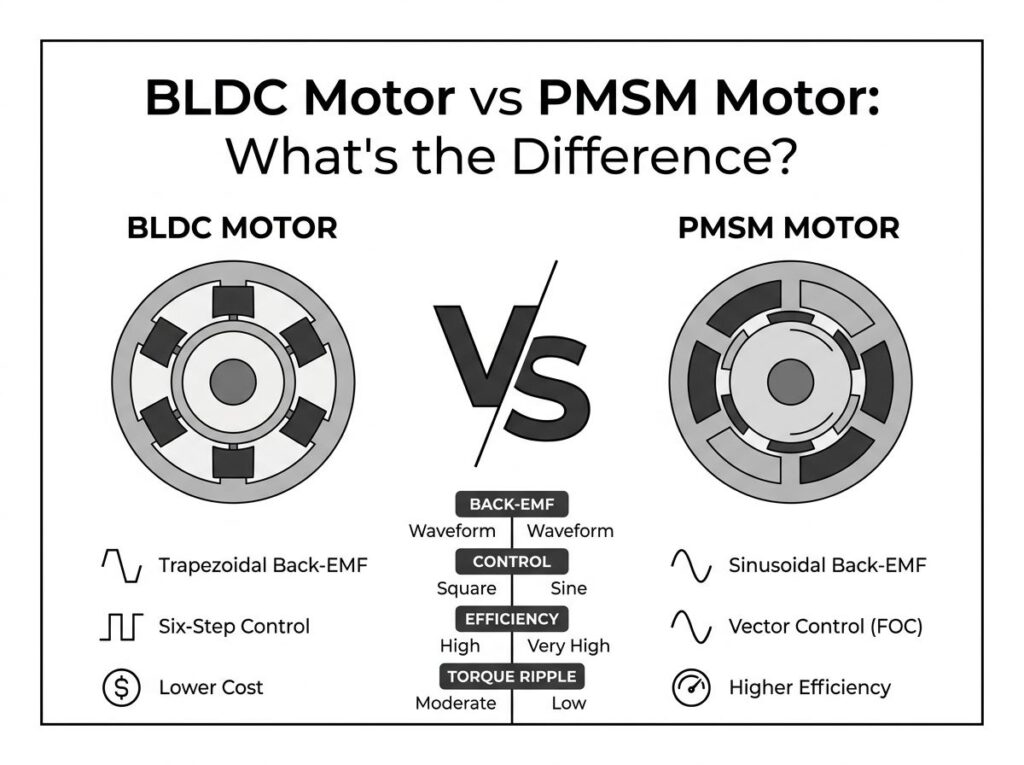
BLDC motors and PMSM motors both use permanent magnets, but BLDC motors typically use trapezoidal back EMF and six-step commutation, while PMSM motors use sinusoidal back EMF and sinusoidal control. PMSM motors generally offer smoother operation and higher efficiency, whereas BLDC motors provide simpler control and lower system cost.

在实际应用中, BLDC motors are commonly chosen for cost-sensitive systems requiring good performance, while PMSM motors are preferred for premium applications demanding maximum efficiency, 平稳的扭矩传递, 和精确的控制.


什么是 BLDC 电机?

无刷直流电机 (无刷直流电机) is a permanent magnet motor that replaces mechanical brushes with electronic commutation. Instead of using physical brush contacts, an electronic controller energizes stator windings based on rotor position feedback.

BLDC motors are characterized by their trapezoidal back electromotive force (back EMF) waveform and typically operate using six-step commutation control strategies.

Basic Construction of a BLDC Motor

  • 永磁转子
  • Wound stator coils
  • 电子控制器
  • Hall-effect position sensors (选修的)
  • Power inverter circuitry

How a BLDC Motor Works

The controller energizes stator windings sequentially to create a rotating magnetic field. Permanent magnets mounted on the rotor follow this magnetic field, producing rotational motion.

Rotor position information is typically obtained from Hall sensors or estimated using sensorless control algorithms.

BLDC 电机的优点

  • 高效率
  • 尺寸紧凑
  • Excellent power density
  • 维护要求低
  • 无电刷磨损
  • Good speed control capability
  • Lower controller cost

Typical BLDC Applications

  • Electric lawn mowers
  • 无绳电动工具
  • 暖通空调鼓风机
  • 工业自动化
  • 医疗器材
  • AGVs and AMRs
  • 安全闸机
  • 电动自行车

Because of their balance between cost and performance, BLDC motors have become one of the most popular motor technologies in modern OEM equipment.


What Is a PMSM Motor?

A Permanent Magnet Synchronous Motor (永磁同步电机) is also a permanent magnet motor, but unlike a BLDC motor, it is designed to operate with a sinusoidal back EMF waveform and sinusoidal current excitation.

The rotor rotates synchronously with the stator’s rotating magnetic field, eliminating slip and enabling highly efficient operation.

Basic Construction of a PMSM Motor

  • 永磁转子
  • Distributed stator windings
  • High-performance inverter
  • Position encoder or resolver
  • Advanced motor controller

How a PMSM Motor Works

The controller generates sinusoidal current waveforms that interact with the rotor’s permanent magnetic field. The motor operates in precise synchronism with the rotating magnetic field generated by the stator.

Most PMSM systems use Field-Oriented Control (FOC), which enables smooth torque production and precise control over speed and position.

PMSM 电机的优点

  • Very high efficiency
  • Excellent torque density
  • 扭矩输出平稳
  • 噪音低
  • Low vibration levels
  • Superior dynamic performance
  • High-speed capability

Typical PMSM Applications

  • 电动车
  • Industrial servo systems
  • 机器人学
  • 数控机械
  • 航空航天系统
  • Precision automation equipment
  • High-end HVAC systems

PMSM technology dominates many high-performance applications where efficiency, 精确, and smooth operation are critical requirements.


BLDC 与 PMSM: 主要差异

Although both technologies belong to the permanent magnet motor family, their electromagnetic behavior and control philosophies differ significantly.

特征无刷直流电机PMSM Motor
Back EMF梯形正弦波
Current WaveformRectangular正弦波
控制方式六步换向焦点控制
效率高的非常高
噪音水平中等的低的
扭矩脉动更高降低
动态响应好的出色的
控制器复杂性降低更高
系统成本降低更高
典型应用Lawn Equipment, 暖通空调电动汽车, 机器人学

The most important technical distinction lies in how the motors generate and utilize electromagnetic torque.


Back EMF Comparison

Back electromotive force (Back EMF) is the voltage generated by a motor as the rotor moves through the stator magnetic field. The waveform shape of back EMF directly influences motor control strategies, 效率, torque smoothness, and overall performance.

BLDC Motor Back EMF

BLDC motors are designed to produce a trapezoidal back EMF waveform.

To maximize torque production, the controller applies rectangular current pulses synchronized with the trapezoidal voltage waveform.

This approach simplifies controller design and reduces system cost, but it also introduces torque ripple during phase commutation.

Characteristics of BLDC Back EMF

  • Trapezoidal waveform
  • Simpler control algorithm
  • Lower processing requirements
  • 更高的扭矩脉动
  • Higher acoustic noise

PMSM Motor Back EMF

PMSM motors generate a sinusoidal back EMF waveform.

The controller supplies sinusoidal current to match the generated waveform, resulting in continuous torque production throughout the electrical cycle.

This significantly reduces torque ripple and improves overall motor smoothness.

Characteristics of PMSM Back EMF

  • Sinusoidal waveform
  • Smoother torque production
  • 振动更低
  • 效率更高
  • Superior dynamic control

Why Back EMF Matters

Back EMF characteristics influence:

  • 电机效率
  • 扭矩脉动
  • 噪音产生
  • 控制器复杂性
  • 功率密度
  • Application suitability

For high-performance applications such as robotics, 伺服系统, 和电动车, sinusoidal back EMF provides substantial advantages.


Control Method Comparison

The control method represents one of the most significant differences between BLDC and PMSM motors.

无刷直流电机控制: 六步换向

BLDC motors typically utilize six-step commutation, also known as trapezoidal commutation.

The controller energizes two phases at a time while leaving the third phase floating. Every 60 electrical degrees, the controller switches to the next commutation state.

Advantages of Six-Step Control

  • Simple implementation
  • Lower processor requirements
  • Reduced controller cost
  • Easy system integration

Limitations of Six-Step Control

  • 更高的扭矩脉动
  • Increased noise
  • Reduced smoothness at low speed
  • Lower precision

PMSM Motor Control: 磁场定向控制 (FOC)

PMSM motors generally employ Field-Oriented Control (FOC), one of the most advanced motor control techniques used today.

FOC separates stator current into torque-producing and flux-producing components, allowing precise control of motor operation under varying load conditions.

Advantages of FOC

  • Maximum efficiency
  • Smooth torque production
  • Excellent low-speed control
  • Superior dynamic response
  • 减少振动
  • 定位精度高

Limitations of FOC

  • More expensive controller
  • Higher software complexity
  • Greater processing requirements

As semiconductor technology continues advancing, FOC is becoming increasingly accessible even in cost-sensitive applications.


Continue to Part 2: 效率比较, 扭矩比较, Noise and Vibration Comparison, 成本分析, EV Applications, 机器人应用, Lawn Mower Applications, OEM选型指南, Greensky Power Solutions, 常问问题, Internal Link Cluster, and References.

BLDC vs PMSM Efficiency Comparison

Efficiency is one of the most important performance indicators when selecting an electric motor. Higher efficiency translates directly into lower energy consumption, reduced heat generation, 提高可靠性, and lower operating costs throughout the equipment lifecycle.

Both BLDC and PMSM motors achieve significantly higher efficiencies than traditional brushed DC motors and induction motors. 然而, PMSM technology generally delivers the highest efficiency levels due to its sinusoidal magnetic field and advanced control strategies.

Typical Efficiency Ranges

电机类型Typical Efficiency峰值效率
有刷直流电机70–85%88%
感应电机80–93%95%
无刷直流电机85–95%96%
PMSM Motor90–97%98%+

Why PMSM Motors Are More Efficient

  • Sinusoidal magnetic field reduces harmonic losses
  • Field-Oriented Control optimizes current utilization
  • Lower torque ripple reduces mechanical losses
  • Reduced stator current harmonics
  • Better high-speed operating characteristics

When BLDC Efficiency Is Sufficient

For many OEM products such as lawn mowers, 泵, 粉丝, 安全门, 和工业自动化系统, BLDC efficiency is already high enough that the marginal gain of PMSM may not justify the additional controller cost.

This is one reason why BLDC motors continue to dominate numerous commercial and industrial applications despite PMSM’s technical advantages.


BLDC vs PMSM Torque Comparison

Torque production directly affects motor acceleration, load handling capability, low-speed performance, and overall machine productivity.

In electric motor systems, torque is fundamentally defined as:

在哪里:

  • t = Torque (牛顿·米)
  • r = Distance from pivot (米)
  • F = Applied force (否)
  • θ = Force angle

例如:

If a force of 6 N is applied at a radius of 3 m with an angle of 90°, the resulting torque becomes:

τ = 3 × 6 × sin(90°) = 18 牛顿·米

In motor applications, electromagnetic torque is generated by the interaction between stator magnetic fields and rotor permanent magnets.

BLDC Torque Characteristics

  • 高启动扭矩
  • Strong acceleration capability
  • 更高的扭矩脉动
  • Suitable for intermittent loads
  • Excellent cost-to-torque ratio

PMSM Torque Characteristics

  • Smoother torque output
  • Lower torque ripple
  • Higher continuous torque density
  • Superior low-speed controllability
  • Excellent servo performance

Torque Density Comparison

因素无刷直流永磁同步电机
启动扭矩出色的出色的
连续扭矩高的非常高
扭矩脉动更高降低
Low-Speed Precision好的出色的
Servo Performance缓和出色的

For high-precision motion systems, PMSM motors generally outperform BLDC motors because of their smoother torque generation and superior control characteristics.


Noise and Vibration Comparison

Noise and vibration are increasingly important factors in modern equipment design. Lower acoustic noise improves user experience, while reduced vibration increases component life and positioning accuracy.

BLDC Motor Noise Characteristics

Because of trapezoidal commutation and higher torque ripple, BLDC motors typically generate more audible noise than PMSM motors.

Common noise sources include:

  • Commutation switching events
  • 扭矩脉动
  • Mechanical resonance
  • Bearing noise

PMSM Motor Noise Characteristics

Sinusoidal current excitation and FOC control minimize abrupt torque transitions, resulting in much smoother operation.

优点包括:

  • Lower acoustic emissions
  • 减少振动
  • Improved precision
  • Better user comfort

Noise Comparison Table

Performance Factor无刷直流永磁同步电机
Acoustic Noise中等的低的
扭矩脉动更高降低
Vibration Level缓和最小
Precision Applications好的出色的

BLDC vs PMSM Cost Comparison

Cost is often the deciding factor for OEM buyers and equipment manufacturers.

Although PMSM motors provide superior performance, they usually require:

  • More sophisticated controllers
  • Higher processor capability
  • Advanced software algorithms
  • Additional sensing hardware

Total System Cost Comparison

成本因素无刷直流永磁同步电机
电机成本降低更高
控制器成本降低更高
Software Complexity降低更高
开发成本降低更高
运营成本低的非常低

For cost-sensitive products, BLDC often delivers the best balance between performance and affordability.


Which Motor Is Better for Electric Vehicles?

The EV industry has become one of the largest consumers of permanent magnet motor technologies.

Modern electric vehicles prioritize:

  • Maximum efficiency
  • Extended driving range
  • 平稳加速
  • High-speed capability
  • Excellent regenerative braking

Because of these requirements, PMSM motors have become the dominant choice for passenger EVs.

Major automotive manufacturers frequently use PMSM technology because it offers:

  • 效率更高
  • 卓越的扭矩密度
  • Better NVH performance
  • Enhanced range

Winner for EVs: 永磁同步电机


Which Motor Is Better for Robotics?

Robotic systems require:

  • 精确的位置控制
  • 平滑运动
  • 低速稳定性
  • 快速响应
  • High repeatability

These requirements strongly favor PMSM technology combined with servo control systems.

工业机器人, collaborative robots, and CNC systems commonly use PMSM servo motors because of their excellent dynamic response and positioning accuracy.

Winner for Robotics: 永磁同步电机


Which Motor Is Better for Lawn Mowers?

Lawn mower applications present a different set of priorities:

  • 高扭矩输出
  • Outdoor durability
  • Cost competitiveness
  • Battery efficiency
  • Simple electronic control

For walk-behind electric lawn mowers and robotic lawn mowers, BLDC motors are often the preferred solution.

好处包括:

  • 降低系统成本
  • 高启动扭矩
  • Excellent battery performance
  • Simplified controller architecture
  • Strong reliability

Winner for Lawn Mowers: 无刷直流


How to Choose Between BLDC and PMSM

The best motor depends on application priorities.

If You NeedChoose
Lowest Cost无刷直流
最大效率永磁同步电机
精密运动控制永磁同步电机
工业自动化Either
机器人学永磁同步电机
电动汽车永磁同步电机
Lawn Equipment无刷直流
暖通空调系统BLDC or PMSM

为什么OEM买家选择Greensky Power

For OEM equipment manufacturers, selecting the right motor supplier is as important as selecting the motor technology itself.

Greensky Power specializes in customized motor solutions for global OEM customers.

Core Product Portfolio

OEM Advantages

  • Custom motor development
  • 控制器集成支持
  • Planetary gearbox matching
  • 快速原型制作
  • Low MOQ options
  • 全球出口经验

服务的重点行业

  • 机器人学
  • 割草机
  • HVAC equipment
  • 工业自动化
  • 医疗器械
  • 安全系统

FAQ-BLDC Motor vs PMSM Motor

Is PMSM better than BLDC?

未必. PMSM offers higher efficiency and smoother operation, while BLDC provides lower system cost and simpler control. The best choice depends on application requirements.

Why are PMSM motors used in electric vehicles?

PMSM motors provide superior efficiency, 扭矩密度, 平滑度, and range performance, making them ideal for modern EV platforms.

Can BLDC motors use FOC control?

是的. Many modern BLDC motors can operate using FOC algorithms, reducing torque ripple and improving efficiency.

哪种电机效率更高, BLDC or PMSM?

PMSM motors generally achieve higher efficiency because of sinusoidal back EMF and advanced control strategies.

Which motor is better for lawn mowers?

BLDC motors are often the preferred solution due to their excellent balance of efficiency, 扭矩, 可靠性, 和成本.


Related Resources


参考

  1. https://www.ieee.org
  2. https://ieeeexplore.ieee.org
  3. https://日本电产公司
  4. https://www.siemens.com
  5. https://全局.abb
  6. https://www.weg.net
  7. https://www.energy.gov
  8. https://www.iea.org
  9. https://www.iec.ch
  10. https://www.mathworks.com
  11. https://www.microchip.com
  12. https://www.ti.com

你可能也喜欢

BLDC 电机与 PMSM 电机: 有什么区别? 完整的工程比较指南 (2026)

欧洲市场CE认证割草机电机 | 完整的 OEM 合规性 & 选型指南

退出网格

今天发送您的询问

绿天电力微信

请留下您的工作邮箱.

告诉我们您的需求