
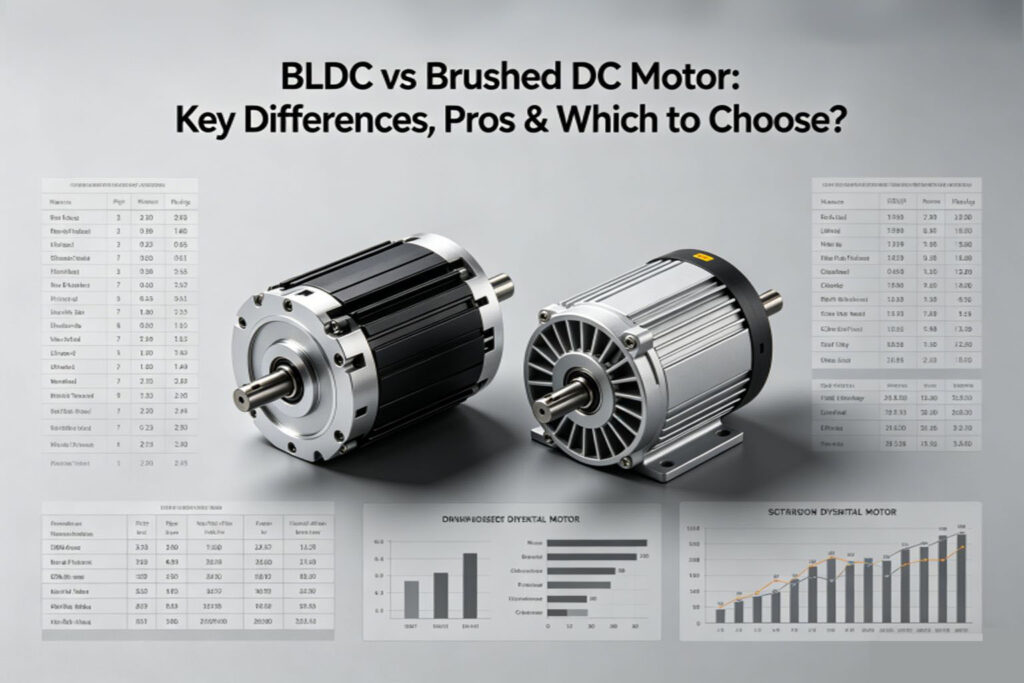
BLDC 與有刷直流電機: 主要差異, 優點 & 選擇哪個?
精選片段:
無刷直流電機 are more efficient, longer-lasting, and better suited for precision and high-performance applications, while brushed DC motors are simpler, lower-cost, and ideal for basic or cost-sensitive systems. The choice depends on factors such as efficiency requirements, maintenance tolerance, 控制複雜性, and total lifecycle cost. 對於原始設備製造商和工業買家, BLDC motors are typically preferred for modern systems, while brushed DC motors remain relevant in low-cost or intermittent-use applications.
In industrial and OEM motor selection, comparing BLDC vs brushed DC motor is a common decision point that directly affects system performance, 可靠性, 和長期成本. While both motor types operate on direct current, their internal structures and performance characteristics differ significantly. Engineers and procurement managers must evaluate these differences based on real application requirements rather than initial price alone.
什麼是 BLDC 電機?
無刷直流 (無刷直流電機) motor is an electronically commutated motor that replaces mechanical brushes with an electronic controller. Permanent magnets are embedded in the rotor, while stator windings are energized in a controlled sequence to generate rotation.
Key Engineering Features
- No mechanical brushes → reduced wear and maintenance
- 電子速度控制器 (ESC鍵) required
- 高效率 (85–95%)
- Excellent speed and torque control
BLDC馬達廣泛應用於電動車, 機器人技術, and industrial automation where performance, 效率, and reliability are critical.
👉探索: Industrial BLDC Motor Solutions
What Is a Brushed DC Motor?
A brushed DC motor uses mechanical brushes and a commutator to switch current within the motor windings. This design has been widely used for decades due to its simplicity and low cost.
Key Engineering Features
- Mechanical commutation using brushes
- 控制簡單 (direct DC supply)
- Lower initial cost
- Higher maintenance requirements
Brushed DC motors are commonly used in low-cost devices, automotive accessories, and applications where precision control is not required.
BLDC 與有刷直流電機: Core Differences Explained
| 範圍 | 無刷直流電機 | 有刷直流電機 |
|---|---|---|
| 效率 | 85–95% | 70–80% |
| 維護 | 低的 | 高的 (電刷磨損) |
| 控制 | 電子的 (ESC鍵) | Simple DC supply |
| 壽命 | 長的 | 較短 |
| 初始成本 | 更高 | 降低 |
| 噪音 | 低的 | 更高 |
The primary difference lies in commutation: BLDC motors rely on electronic switching, while brushed motors use physical contact. This leads to differences in efficiency, 耐用性, and system complexity.
Why BLDC Motors Are More Efficient
Efficiency is a critical factor in modern motor selection, especially in energy-intensive or battery-powered systems.
工程原因
- No friction losses from brushes
- Reduced electrical losses due to optimized control
- Lower heat generation in rotor
In applications such as electric vehicles or HVAC systems, higher efficiency translates directly into energy savings and longer system lifespan.
Torque Density and Performance Comparison
Torque density is a key metric for compact system design. BLDC motors offer higher torque density due to their permanent magnet structure.
無刷直流馬達的優點
- Higher torque-to-weight ratio
- Better dynamic response
- Suitable for compact systems
Brushed Motor Characteristics
- Adequate torque for basic applications
- Performance limited by brush wear and heat
For applications like AGVs or robotics, BLDC 馬達提供卓越的性能.
熱性能和熱管理
Thermal performance affects both reliability and lifespan.
無刷直流電機
- Lower heat generation due to higher efficiency
- 熱量集中在定子→更容易冷卻
Brushed Motors
- Higher heat due to friction and electrical losses
- Heat generated in rotor → harder to dissipate
This difference significantly impacts motor durability in continuous-duty applications.
控制系統差異
Control complexity is one of the biggest distinctions between BLDC and brushed motors.
無刷直流控制
- 需要ESC或驅動程式
- Supports precise speed and torque control
- Enables smart system integration
有刷馬達控制
- Simple voltage-based control
- No advanced electronics required
For modern automation systems, BLDC motors offer significant advantages.
可靠性和壽命比較
Lifespan is a major concern for OEM buyers and industrial operators.
- 無刷直流電機: No brushes → longer lifespan, fewer failures
- 拉絲: Brush wear limits service life
In high-duty-cycle applications, brushed motors may require frequent maintenance, increasing operational costs.
How to Choose BLDC or Brushed DC Motor for Your Application
Selecting the right motor requires a detailed engineering analysis.
主要選擇標準
- 電壓: 12V / 24V / 48V / 72V系統
- 功率範圍: Watts to several kW
- 速度 & 力矩: Match load profile
- 冷卻: Air or forced cooling
- 控制器: ESC vs direct DC supply
基於應用程式的建議
- 電動車 → BLDC 電機
- Low-cost consumer devices → Brushed motor
- Industrial automation → 無刷電機
- Intermittent-use equipment → Brushed motor
👉 Get expert support: 客製化電機解決方案
Industrial Applications of BLDC and Brushed DC Motors
BLDC Applications
- 電動車 (48V / 72V系統)
- 機器人技術和自動化
- 暖通空調系統
- 醫療器材
Brushed DC Applications
- Automotive accessories
- 家用電器
- 電動工具
👉 探索電動汽車電機: 電動汽車馬達解決方案
成本比較: BLDC 與有刷直流電機
| 成本因素 | 無刷直流電機 | 有刷直流電機 |
|---|---|---|
| 初始成本 | 更高 | 降低 |
| 營運成本 | 降低 | 更高 |
| 維護 | 最小 | 常 |
| 總擁有成本 | 長期較低 | Higher over time |
While brushed motors are cheaper upfront, BLDC motors often provide better ROI in continuous-use applications.
未來趨勢: Why BLDC Motors Are Replacing Brushed Motors
The global shift toward energy efficiency and automation is accelerating BLDC adoption.
- Energy regulations favor high-efficiency motors
- Growth of electric mobility
- Increasing demand for smart and connected systems
Brushed motors are gradually being replaced in many applications due to their maintenance limitations.
常問問題: BLDC 與有刷直流電機
1. 哪種馬達壽命較長, BLDC or brushed?
BLDC motors typically last significantly longer because they do not use brushes, which are subject to wear. This makes them ideal for continuous-duty applications.
2. Why are brushed motors cheaper?
Brushed motors have a simpler design and do not require electronic controllers, reducing manufacturing and system costs.
3. Is BLDC motor better for electric vehicles?
是的, BLDC 馬達提供更高的效率, better control, 和更長的使用壽命, making them ideal for EV applications.
4. Do BLDC motors require controllers?
是的, BLDC motors require an electronic speed controller to operate, which adds complexity but enables precise control.
5. When should I choose a brushed motor?
Brushed motors are suitable for low-cost, 簡單的, or intermittent-use applications where advanced performance is not required.
6. Which is better BLDC or brushed motor?
There is no single “better” option—it depends on your application. Choose based on your priorities: BLDC for performance and longevity; brushed for simplicity and upfront cost savings.
7. Why is BLDC more efficient?
BLDC motors are more efficient mainly because they eliminate brushes and a physical commutator, which reduces Friction and wear.
8. Is brushed motor obsolete?
不, brushed DC motors are not obsolete. Brushed motors remain relevant where their simplicity and low system cost outweigh their limitations.
結論: Which Motor Is Better?
比較時 BLDC vs brushed DC motor, the answer depends on your application. BLDC motors are better for efficiency, 可靠性, 和長期績效, while brushed motors are suitable for low-cost and simple designs.
For most modern industrial and OEM applications, BLDC motors are the preferred choice due to their superior performance and lower lifecycle cost.
Need help choosing the right motor?
✔ 索取資料表
✔ 取得 OEM 馬達解決方案
✔ 立即聯絡我們的工程師
參考
- IEEE Motor Design Handbook
- IEC 馬達效率標準
- Industrial Motor Application Reports