
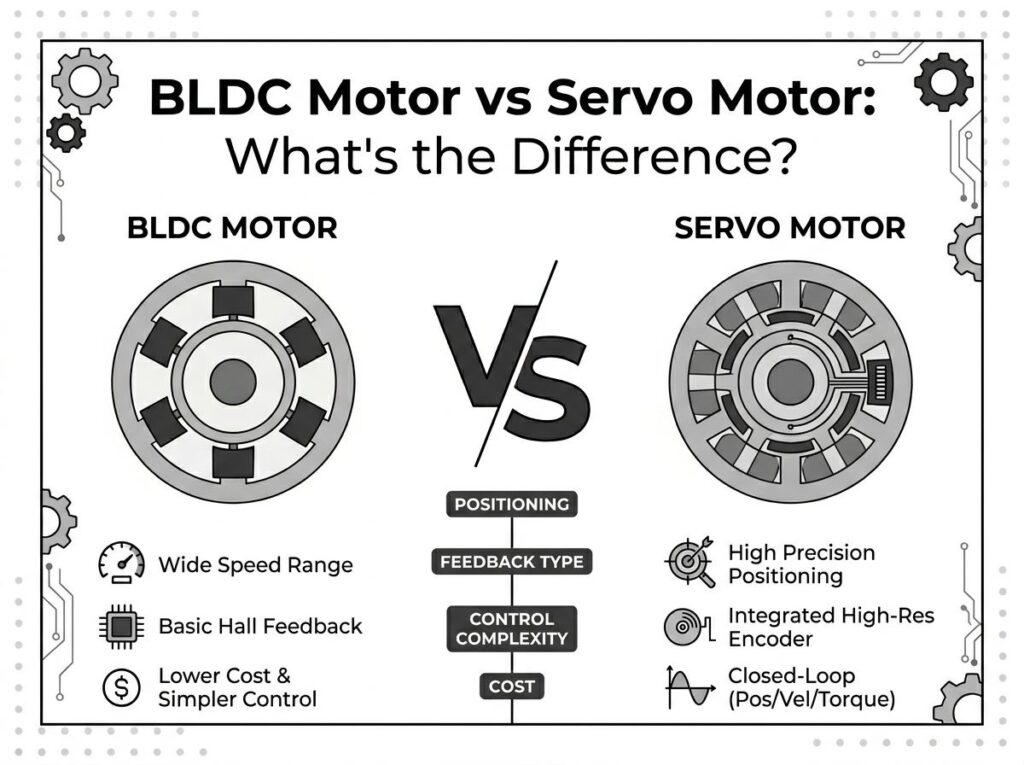
BLDC 馬達與伺服電機: 有什麼區別?
選擇正確的馬達技術是現代設備設計中最重要的決策之一. 是否開發機械手臂, 自動導引車 (自動導引車), 工業輸送機, 割草機, 或精密製造機器, 工程師必須仔細評估性能要求, 控制複雜性, 準確性, 效率, 和系統總成本.
最常比較的技術是無刷直流 (無刷直流電機) 馬達和伺服電機. 雖然兩者都廣泛應用於運動控制應用, 它們不是直接等價物. 實際上, 電機行業最大的誤解之一是認為伺服電機只是另一種類型的電機.
事實上,BLDC 馬達是一種馬達技術, 而伺服電機是一個完整的運動控制系統,結合了電機, 回饋裝置, 和控制器實現高精度定位和動態性能.
本指南提供了 BLDC 馬達和伺服馬達的詳細工程比較, 幫助OEM製造商, 工程師, 和採購團隊確定哪種解決方案最適合他們的應用需求.
BLDC 馬達與伺服電機
BLDC馬達和伺服馬達均用於精確運動控制, 但 BLDC 馬達是一種馬達類型, 而伺服電機是一個完整的運動控制系統,包括電機, 編碼器, 和控制器. 伺服馬達提供更高的定位精度和動態響應, 而 BLDC 馬達成本更低且實施更簡單.
一般來說, 伺服系統是機器人技術的首選, CNC設備, 和精密自動化, 而割草機則常選用 BLDC 電機, 暖通空調系統, 泵, 工業驅動, 以及對成本敏感的 OEM 產品.
什麼是 BLDC 電機?
無刷直流電機 (無刷直流電機) 是一種電子換向電機,消除了傳統直流電機中使用的電刷和換向器. 代替機械開關, 電子控制器依轉子位置為定子繞組供電.
BLDC 馬達因其高效率而成為發展最快的馬達技術之一, 尺寸緊湊, 使用壽命長, 和出色的功率密度.
無刷馬達結構
典型的 BLDC 馬達包括:
- 永磁轉子
- 疊片定子鐵芯
- 多相定子繞組
- 霍爾效應感測器 (選修的)
- 電子控制器
- 功率逆變級
與拉絲電動機不同, 固定和旋轉電氣部件之間不存在物理接觸.
電子換向
BLDC 馬達背後的關鍵創新是電子換向.
馬達控制器連續監控轉子位置並依序為定子繞組通電,產生旋轉磁場. 轉子跟隨該磁場並產生旋轉運動.
電子換向具有多種優勢:
- 無電刷磨損
- 較低的維護要求
- 減少電氣噪音
- 效率更高
- 更長的使用壽命
霍爾感測器
許多 BLDC 馬達使用霍爾效應感測器來確定轉子位置.
這些感測器檢測轉子旋轉時的磁場變化並向控制器提供位置回饋.
霍爾感測器啟用:
- 可靠的啟動性能
- 準確的換相定時
- 改良的低速控制
- 增強扭矩產生
現代無感測器 BLDC 系統可以透過反電動勢檢測來估計轉子位置, 在某些應用中無需霍爾感測器.
無刷直流電機控制器
控制器充當運動系統的大腦.
功能包括:
- 調速
- 電流控制
- 扭力管理
- 保護功能
- 脈寬調變產生
- 通訊介面
BLDC 控制的簡單性是這些馬達廣泛應用於需要性能和經濟性之間平衡的商業產品的原因之一.
常見 BLDC 應用
- 電動割草機
- 機器人割草機
- 暖通空調鼓風機
- 水泵浦
- 工業風扇
- AGV
- 旋轉門系統
- 電動自行車
- 醫療器材
- 消費性電器
什麼是伺服電機?
One of the most misunderstood concepts in motion control is the definition of a servo motor.
Many people believe that a servo motor is a specific motor type. 現實中, a servo system is a complete closed-loop motion control solution.
伺服系統架構
伺服系統包括:
伺服系統=
發動機
+
編碼器
+
控制器
電機本身可能是:
- 永磁同步電機
- 無刷電機
- 交流同步電機
- 直驅馬達
The defining characteristic is not the motor technology but the use of continuous feedback and closed-loop control.
Core Components of a Servo System
1. 發動機
The motor generates rotational motion and torque.
Modern industrial servo systems most commonly use PMSM motors because of their smooth torque characteristics and high efficiency.
2. 編碼器
編碼器連續測量:
- 位置
- 速度
- 方向
- 角位移
編碼器回饋允許控制器進行即時修正.
3. 伺服驅動器
伺服驅動器處理回授訊號並調整電流, 電壓, 和切換模式以實現目標運動曲線.
驅動器確保:
- 精準定位
- 穩定的速度控制
- 動態扭矩響應
- 準確的加減速
為什麼伺服系統不同
與可開環或半閉環運轉的標準 BLDC 馬達系統不同, 伺服系統不斷地將指令運動與實際運動進行比較.
如果發生錯誤, 控制器立即補償.
這種回饋機制使得:
- 微米級定位
- 高速動態響應
- 卓越的重複性
- 精確的軌跡控制
典型伺服應用
- 工業機器人
- 數控加工中心
- 半導體設備
- 包裝機械
- 自動化組裝系統
- 醫療機器人
- 精密檢測設備
- 航空航太運動系統
BLDC 與伺服電機: 主要差異
Although BLDC motors and servo systems can sometimes use similar motor technologies internally, their intended functions and performance levels differ significantly.
| 特徵 | 無刷直流電機 | 伺服電機 |
|---|---|---|
| 位置反饋 | 選修的 | 必需的 |
| 準確性 | 中等的 | 非常高 |
| 速度控制 | 好的 | 出色的 |
| 扭力控制 | 好的 | 出色的 |
| 成本 | 降低 | 更高 |
| 複雜 | 降低 | 更高 |
| 控制方式 | 開環 / 半閉環 | 閉環 |
| 編碼器 | 選修的 | 強制的 |
| 典型應用 | 割草機, 泵, 暖通空調 | 機器人技術, CNC系統, 精密自動化 |
The most important distinction is that servo systems prioritize precision and feedback control, while BLDC systems prioritize efficiency, 簡單, 和成本效益.
工作原理比較
Understanding the operating principles of BLDC motors and servo systems helps clarify why their performance characteristics differ.
BLDC 馬達的工作原理
BLDC motors rely on electronic commutation to replace mechanical brushes.
The controller energizes stator windings in a predefined sequence based on rotor position information.
主要營運特徵:
- 電子換相
- 霍爾感測器回饋 (選修的)
- 脈寬調變速度控制
- 開環或半閉環運行
大多數 BLDC 應用注重保持速度而不是實現精確的位置控制.
伺服系統如何運作
伺服系統持續監控實際馬達位置並與命令位置進行比較.
任何偏差都會立即觸發控制器的糾正措施.
這種閉環架構使得:
- 高精度定位
- 精準軌跡追蹤
- 快速響應負載變化
- 卓越的扭力控制
編碼器作為使伺服控製成為可能的關鍵回饋設備.
開環與閉環
| 控制類型 | 無刷直流電機 | 伺服 |
|---|---|---|
| 開環操作 | 常見的 | 不 |
| 閉環運行 | 選修的 | 標準 |
| 反饋依賴性 | 低的 | 高的 |
| 位置修正 | 有限的 | 連續的 |
位置精度比較
適用於評估運動控制系統的工程師, 位置精度往往是最重要的因素.
這是伺服系統展現最大優勢的地方.
BLDC 位置精度
Standard BLDC motors are typically designed for speed control and torque generation rather than precision positioning.
無編碼器回饋, 定位精度本質上是有限的.
典型的 BLDC 特性包括:
- 定位能力中等
- 良好的調速能力
- Suitable for continuous rotation applications
- 定位精度有限
伺服位置精度
伺服系統專為精確定位而設計.
High-resolution encoders enable the controller to track rotor movement continuously and apply corrections in real time.
典型的伺服優勢包括:
- 亞度定位精度
- 優異的重複性
- 精確的軌跡控制
- 高速回應
- 最小定位誤差
這種能力解釋了為什麼機器人, 數控機床, 半導體設備, and automated manufacturing systems overwhelmingly rely on servo technology.
繼續分開 2: 扭力比較, 速度控制比較, 效率比較, 成本比較, 機器人應用, 自動導引車 & AMR應用, 割草機應用, 工業自動化選用指南, 為什麼OEM買家選擇Greensky Power, 常問問題, 內部連結策略, 和參考文獻.
扭力比較
扭力是評估運動控制系統時最關鍵的參數之一. 它決定了馬達加速負載的能力, 克服阻力, 維持立場, 並在不同的操作條件下執行動態運動.
在機械系統中, 扭力可表示為:
τ = rFsin(我)
在哪裡:
- t = 扭矩 (牛頓·米)
- r = 距樞軸點的距離 (米)
- F = 施加的力 (否)
- 我 = 力與槓桿臂之間的角度
例如:
t = (3)(6)罪(90°) = 18 牛頓·米
只有垂直於槓桿臂的分力有助於產生扭矩.
連續扭矩
連續扭矩表示馬達在不過熱的情況下可以無限期產生的扭矩量.
| 特徵 | 無刷直流電機 | 伺服電機 |
|---|---|---|
| 連續扭力密度 | 高的 | 非常高 |
| 熱管理 | 好的 | 出色的 |
| 長期穩定性 | 好的 | 出色的 |
峰值扭矩
峰值扭矩是指馬達可以提供的最大短時扭矩.
伺服馬達經過專門設計,可在加速過程中提供更高的峰值扭矩, 定位, 和突然的負載變化.
這在機器人技術中尤其重要, CNC設備, 和自動化組裝系統.
攤位扭矩
堵轉扭矩是馬達軸不旋轉時產生的扭矩.
伺服系統通常提供卓越的失速扭力管理,因為編碼器回饋允許精確的電流調節,同時保持軸位置.
扭力性能總結
| 扭力係數 | 無刷直流電機 | 伺服 |
|---|---|---|
| 連續扭矩 | 高的 | 非常高 |
| 峰值扭矩 | 好的 | 出色的 |
| 失速扭力控制 | 有限的 | 出色的 |
| 扭力精度 | 緩和 | 非常高 |
| 扭力脈動 | 更高 | 降低 |
適用於要求嚴苛的運動控制應用, 伺服系統在扭矩控制和動態響應方面通常優於標準 BLDC 電機.
速度控制比較
速度調節是 BLDC 馬達和伺服系統之間的另一個主要區別.
無刷直流速度控制
BLDC 馬達通常使用:
- 開環控制
- 半閉環控制
- 脈寬調變調速
- 霍爾感測器換向
速度控制性能通常足以滿足不需要精確定位的應用.
例子包括:
- 割草機
- 粉絲
- 泵
- 暖通空調系統
- 輸送機
伺服速度控制
伺服系統採用全閉環控制.
控制器不斷比較:
- 指令速度
- 實際速度
- 負載條件
- 位置回饋
即使在快速變化的負載下,即時校正也能實現高度穩定的速度調節.
速度控制對照表
| 因素 | 無刷直流電機 | 伺服 |
|---|---|---|
| 速度穩定性 | 好的 | 出色的 |
| 動態響應 | 好的 | 出色的 |
| 負載補償 | 有限的 | 自動的 |
| 低速控制 | 緩和 | 出色的 |
BLDC 與伺服效率比較
效率直接影響營運成本, 電池壽命, 熱性能, 和整體設備可靠性.
這兩種技術都比有刷直流馬達提供更高的效率.
BLDC 馬達效率
- 通常為 85–95%
- 轉子損耗低
- 出色的電池利用率
- 高功率密度
伺服馬達效率
現代伺服系統內部通常使用 PMSM 電機, 啟用:
- 90–98% 效率
- 最佳化電流控制
- 減少諧波損耗
- 優越的能源利用率
效率比較表
| 馬達類型 | 典型效率 |
|---|---|
| 有刷直流電機 | 70–85% |
| 感應電機 | 80–93% |
| 無刷直流電機 | 85–95% |
| 伺服馬達系統 | 90–98% |
對於大多數商業設備, BLDC 效率已經非常出色. 然而, 伺服系統在需要最高性能的精密應用中保持優勢.
BLDC 與伺服成本比較
成本往往是 OEM 買家的決定性因素.
儘管伺服系統提供了卓越的性能, 他們需要額外的硬體和軟體組件.
| 成本項目 | 無刷直流電機 | 伺服 |
|---|---|---|
| 發動機 | 降低 | 更高 |
| 控制器 | 降低 | 更高 |
| 編碼器 | 選修的 | 必需的 |
| 驅動電子設備 | 更簡單 | 更複雜 |
| 系統總成本 | 降低 | 更高 |
適用於不需要超高精度的應用, BLDC 馬達通常提供最佳的投資回報.
哪個更適合機器人?
機器人技術是運動控制技術價值最高的市場之一.
大多數機器人系統需要:
- 精準定位
- 平滑的軌跡控制
- 加速快
- 高重複性
- 閉環回饋
因為這些要求, 伺服系統主導工業機器人.
為什麼伺服馬達在機器人領域獲勝
- 編碼器回饋
- 微米級定位能力
- 卓越的動態回應
- High precision trajectory control
- 優異的重複性
機器人技術優勝者: 伺服電機
Which Is Better for AGV and AMR?
自動導引車 (AGV) and Autonomous Mobile Robots (AMRs) occupy a unique middle ground.
When BLDC Is Preferred
- Cost-sensitive AGVs
- Warehouse transportation
- Basic navigation systems
- Long battery life requirements
When Servo Is Preferred
- High-speed navigation
- Precision docking
- 協作機器人
- Advanced autonomous systems
Many modern AGVs successfully utilize BLDC drive motors with encoder feedback, creating a hybrid solution between traditional BLDC and servo architectures.
Winner for AGVs: Depends on navigation precision requirements.
Which Is Better for Lawn Mowers?
Lawn mowers require:
- 高扭力輸出
- 戶外耐用性
- 電池效率
- 成本競爭力
- 運作可靠
Unlike robotics, lawn mowers rarely require sub-degree positioning accuracy.
反而, manufacturers prioritize efficiency, 可靠性, and affordability.
Why BLDC Motors Are Ideal for Lawn Mowers
- 降低系統成本
- 卓越的效率
- 高啟動扭力
- Simple electronic architecture
- Proven outdoor reliability
這就是為什麼現代無線割草機和機器人割草機越來越依賴 BLDC 技術的原因之一.
割草機優勝者: 無刷直流電機
哪個更適合工業自動化?
工業自動化涵蓋多種設備類型.
| 應用 | 推薦解決方案 |
|---|---|
| 輸送機 | 無刷直流電機 |
| 包裝機 | 伺服 |
| 旋轉柵門 | 無刷直流電機 |
| CNC設備 | 伺服 |
| 工業風扇 | 無刷直流電機 |
| 取放系統 | 伺服 |
一般來說, 選擇取決於應用程式是否優先考慮精度或成本效率.
如何選擇 BLDC 和伺服電機
以下選擇指南可以簡化馬達技術決策.
| 應用 | 最佳選擇 |
|---|---|
| 機器人技術 | 伺服 |
| CNC系統 | 伺服 |
| 割草機 | 無刷直流電機 |
| 暖通空調 | 無刷直流電機 |
| 泵 | 無刷直流電機 |
| 旋轉門 | 無刷直流電機 |
| 自動導引車 | 視情況而定 |
選擇精準時的伺服系統, 定位精度, 和動態響應至關重要.
當效率較高時選擇 BLDC 電機, 可靠性, 簡單, 降低成本是首要任務.
為什麼OEM買家選擇Greensky Power
Greensky Power 專注於為全球 OEM 製造商提供客製化運動解決方案.
核心產品組合
- 無刷直流電機
- 齒輪馬達
- 行星齒輪電機
- 蝸輪蝸桿減速電機
- 客製化電機解決方案
OEM 工程能力
- 編碼器集成
- 控制器匹配
- 行星齒輪箱設計
- 快速原型製作
- 客製化效能優化
服務的重點行業
- 草坪設備
- 暖通空調系統
- 工業自動化
- 機器人技術
- 醫療設備
- 安全系統
常見問題解答
伺服馬達是BLDC馬達嗎?
未必. 伺服馬達是一個完整的閉環控制系統. 許多現代伺服馬達內部使用 PMSM 或 BLDC 馬達技術.
哪種馬達更適合機器人?
伺服馬達通常是首選,因為它們提供卓越的定位精度, 動態回應, 和重複性.
哪種馬達比較便宜?
BLDC 馬達通常具有較低的馬達成本, 控製成本, 和整體系統成本.
BLDC馬達需要編碼器嗎?
不. 許多 BLDC 馬達使用霍爾感測器或無感測器控制方法成功運行. 除非需要精確定位,否則編碼器是可選的.
BLDC馬達可以當伺服馬達嗎?
是的. 與編碼器和閉環控制器結合使用時, BLDC 馬達可以作為伺服系統的一部分.
相關文章
參考
- https://IEEE.org
- https://ieeexplore.ieee.org
- https://www.energy.gov
- https://www.iea.org
- https://www.iec.ch
- https://www.mathworks.com
- https://www.microchip.com
- https://www.ti.com
- https://日本電產公司
- https://www.siemens.com
- https://全域.abb
- https://www.weg.net