
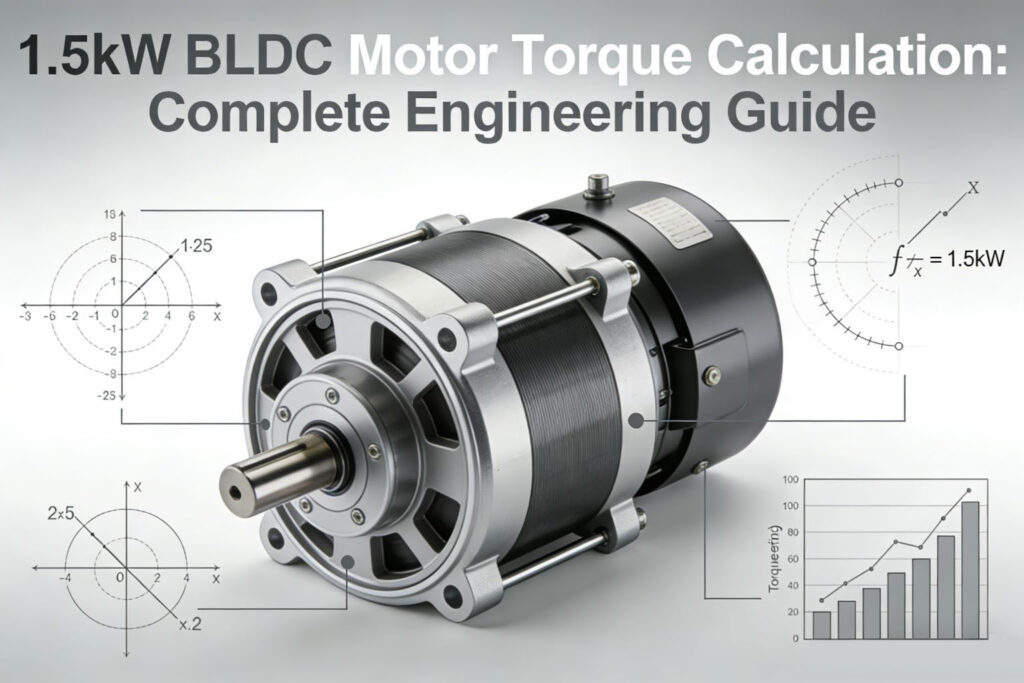
1.5kW BLDC 馬達扭力計算: 完整的工程指南
精選片段:
To calculate torque for a 1.5kW BLDC motor, use the formula: 力矩 (牛米) = (9550 × Power in kW) ÷ Speed (轉速). 例如, a 1.5kW motor at 3000 RPM produces approximately 4.78 Nm of torque. 然而, real-world torque depends on efficiency, controller strategy, thermal limits, and load characteristics. Engineers and OEM buyers must consider not only theoretical torque but also continuous torque, 峰值扭矩, and application-specific duty cycles when selecting a BLDC motor.
What is Torque in a 1.5kW BLDC Motor?
Torque is the rotational force generated by a motor shaft, directly determining the ability of a system to move or drive a load. In a 1.5kW BLDC motor, torque is not a fixed value—it varies with speed, 電壓, and control strategy.
從工程角度來看, torque defines how effectively mechanical work is delivered. 例如, in conveyor systems, torque determines load capacity, while in electric vehicles, it impacts acceleration performance. 與拉絲電動機不同, BLDC motors provide a flatter torque curve and better controllability, which is critical in industrial applications.
Understanding torque is essential for avoiding undersized motors (leading to overheating) or oversized motors (increasing cost and inefficiency).
How to Calculate Torque for a 1.5kW BLDC Motor
Standard Torque Formula
The fundamental formula used in motor engineering is:
力矩 (牛米) = (9550 × 電源 (千瓦)) ÷ Speed (轉速)
Example Calculations
- 在 1500 RPM → Torque = (9550 × 1.5) ÷ 1500 = 9.55 牛米
- 在 3000 RPM → Torque = 4.78 牛米
- 在 6000 RPM → Torque = 2.39 牛米
This illustrates a key engineering principle: torque decreases as speed increases, assuming constant power.
工程洞察
In real applications, torque must be derated based on efficiency (typically 85–92%), thermal constraints, and controller limits. 所以, actual usable torque is often 10–20% lower than theoretical values.
Why Torque Calculation Matters in Motor Selection
Incorrect torque estimation is one of the most common causes of motor failure in industrial systems. Underestimating torque leads to overheating, reduced lifespan, and system instability. Overestimating torque results in higher procurement cost and inefficient operation.
For B2B buyers and OEM engineers, torque calculation directly affects:
- System performance and reliability
- Energy efficiency and operating cost
- Mechanical design (變速箱, 聯軸器)
- Controller and power supply sizing
In applications such as pumps or robotics, torque spikes during startup or load variation must also be considered.
BLDC Motor vs Induction Motor: 扭力比較
| 範圍 | 無刷直流電機 (1.5千瓦) | 感應電機 (1.5千瓦) |
|---|---|---|
| 扭矩密度 | 高的 | 中等的 |
| 效率 | 85–92% | 75–88% |
| 啟動扭力 | 高的 (帶控制器) | 緩和 |
| 控制 | 精確的 (電子的) | 無 VFD 限制 |
| 成本 | 前期費用較高 | 降低前期費用 |
BLDC motors provide better torque control and higher efficiency, making them ideal for applications requiring precision and energy savings.
BLDC 馬達與有刷電機: 扭力特性
| 範圍 | 無刷直流電機 | 有刷電機 |
|---|---|---|
| Torque Efficiency | 高的 | 降低 |
| 維護 | 低的 | 高的 (電刷磨損) |
| 熱性能 | 更好的 | 有限的 |
| 壽命 | 長的 | 較短 |
對於 OEM 項目, BLDC motors reduce maintenance costs and improve long-term reliability.
Efficiency and Torque Relationship in BLDC Motors
Efficiency directly impacts torque output. Higher efficiency means more electrical energy is converted into mechanical torque rather than heat.
In a 1.5kW BLDC motor:
- 在 90% efficiency → usable torque is close to theoretical
- 在 80% efficiency → torque loss increases significantly
適用於工業應用, selecting a high-efficiency motor reduces energy cost and improves thermal stability.
Thermal Performance and Continuous Torque
Thermal performance defines how long a motor can sustain torque without overheating. Continuous torque is always lower than peak torque due to thermal limits.
Factors affecting thermal performance include:
- Cooling method (air vs liquid)
- Ambient temperature
- 工作週期
例如, a 1.5kW BLDC motor may provide 10 Nm peak torque but only 6–7 Nm continuous torque under industrial conditions.
Control System Impact on Torque Output
The controller plays a critical role in torque delivery. BLDC motors rely on electronic commutation, which allows precise torque control.
Key control strategies include:
- FOC (磁場定向控制) for smooth torque
- Trapezoidal control for cost-sensitive applications
For applications like robotics or EV systems, FOC provides superior torque stability and efficiency.
How to Choose a 1.5kW BLDC Motor for Your Application
電壓範圍
Common options include 48V and 72V systems. 更高的電壓可減少電流並提高效率.
功率範圍
Ensure the 1.5kW rating matches continuous load requirements, not just peak demand.
速度和扭矩
Match RPM to application requirements. Use gear reduction if higher torque is needed.
冷卻方式
風冷為標準配置; liquid cooling is used for high-load applications.
控制器相容性
Ensure compatibility with FOC or trapezoidal controllers depending on performance requirements.
應用注意事項
例如:
- Pumps → require stable continuous torque
- EV → require high starting torque
- Robotics → require precise torque control
電腦輔助科技協會: Request datasheet or get OEM solution 適合您的應用.
Applications of 1.5kW BLDC Motors
Typical applications include:
- 工業自動化系統
- 電動車和電動自行車
- HVAC and pump systems
- Robotics and AGV platforms
例如, 在泵浦系統中, torque stability ensures consistent fluid flow, while in EVs, torque impacts acceleration and hill-climbing ability.
BLDC 馬達扭矩優化的未來趨勢
Emerging trends include:
- Higher efficiency magnets and materials
- Advanced FOC algorithms
- Integration with IoT monitoring systems
These innovations aim to improve torque density and reduce system cost for OEM manufacturers.
常問問題: 1.5kW BLDC 馬達扭力計算
1. What is the torque of a 1.5kW motor at 3000 轉速?
大約 4.78 Nm using the standard formula. Actual torque may vary depending on efficiency and controller performance.
2. Why does torque decrease with speed?
Because power is constant, increasing speed reduces torque proportionally according to the power equation.
3. What is peak vs continuous torque?
Peak torque is short-term maximum output, while continuous torque is sustainable without overheating.
4. How does voltage affect torque?
Higher voltage allows lower current for the same power, improving efficiency and thermal performance.
5. Is BLDC better than induction motors for torque?
BLDC motors offer higher torque density and better control, making them suitable for precision applications.
結論
Accurate torque calculation is essential when selecting a 1.5kW BLDC motor for industrial or OEM applications. While the formula provides a theoretical baseline, real-world performance depends on efficiency, 熱管理, and control strategy.
對於工程師和採購經理, the key is balancing torque, 成本, 和可靠性. Choosing the right motor ensures optimal system performance and long-term operational efficiency.
下一步: 探索我們的 BLDC 馬達解決方案, 或者 EV motor options, or contact our engineers for a custom recommendation.
參考
- 國際電工委員會 60034 Electric Machines Standard
- IEEE 工業電子學報
- Motor Control Theory – Field-Oriented Control (FOC)
- Industrial Motor Efficiency Guidelines (歐盟 & US DOE)