
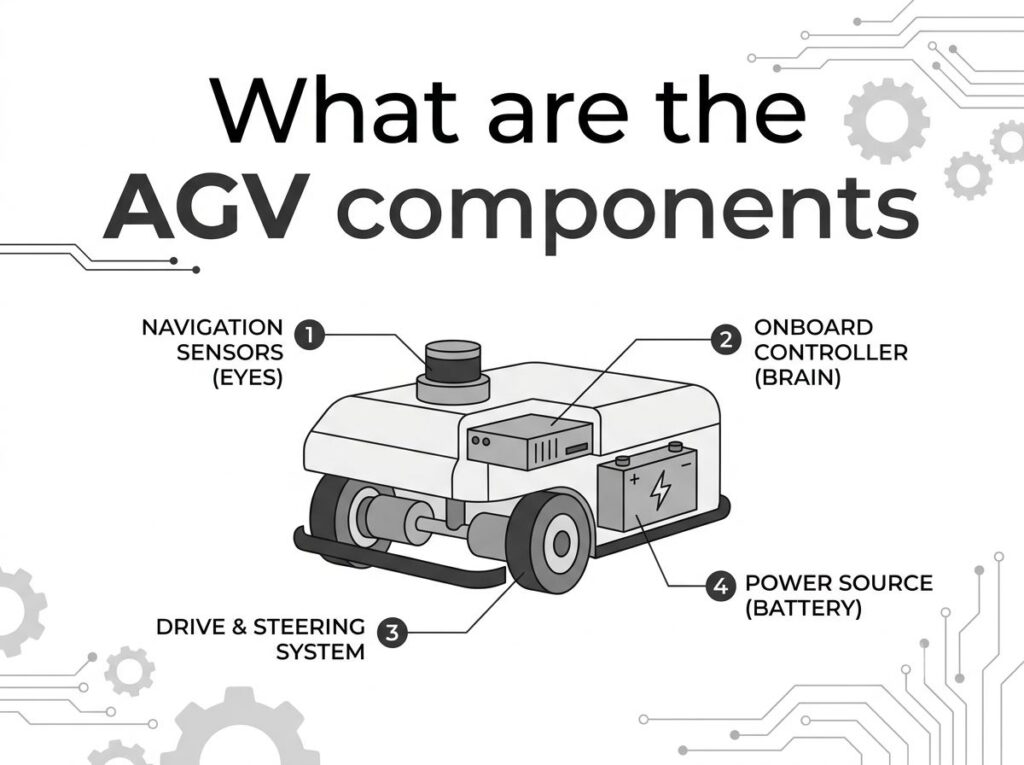
AGV Components: การแยกย่อยโดยระบบย่อย
ตอบด่วน: What are the components of an AGV?
An automated guided vehicle is not a single machine but a stack of six interacting subsystems: เดอะ motion/drive system (เซอร์โวมอเตอร์ BLDC + กระปุกเกียร์ดาวเคราะห์ + drive wheel + เบรค + ตัวเข้ารหัส), เดอะ ระบบควบคุม (บมจ / ตัวควบคุมการเคลื่อนไหว), เดอะ navigation & perception system (LiDAR, IMU, markers), เดอะ safety system (laser scanner, bumper, e-stop, สทีโอ), เดอะ power system (LiFePO₄ battery + BMS + charger), และ communication system (Wi-Fi / CANopen / EtherCAT). A seventh, application-specific load-handling module (fork, ยก, conveyor) sits on top. Most AGV motors run under ไออีซี 60034-1 duty S3 or S4, so the motor’s continuous torque must cover the RMS torque of the duty cycle, not just the peak — a detail many component lists ignore.
เนื้อหาของหน้า
สลับ1. What Is an AGV Vehicle? (Concept Definition)
หนึ่ง ยานพาหนะนำทางอัตโนมัติ (เอจีวี) is a driverless transport platform that moves materials along a route using onboard sensors, a controller, and a powered drive subsystem. เดอะ “ส่วนประกอบ” of an AGV are best understood as functional subsystems rather than a flat parts list — each subsystem has an interface (เครื่องกล, ไฟฟ้า, or data) to the others.
1.1 The six core subsystems
| Subsystem | Primary Function | ส่วนประกอบสำคัญ | Interface to Rest of Vehicle |
|---|---|---|---|
| Motion / ขับ | Convert electrical energy into controlled wheel motion | BLDC/servo motor, กระปุกเกียร์ดาวเคราะห์, drive wheel, holding brake, ตัวเข้ารหัส, คนขับมอเตอร์ | Receives torque/speed commands from controller; returns position/velocity feedback |
| ควบคุม | “Brain” — task execution, path planning, coordination | Main controller / บมจ, ตัวควบคุมการเคลื่อนไหว, I/O modules, safety PLC | Sends commands to drive; reads nav, ความปลอดภัย, power status |
| Navigation & Perception | Locate vehicle, sense surroundings, detect obstacles | LiDAR, IMU, magnetic/QR/RFID sensors, vision camera, odometry encoder | Feeds position + obstacle data to control |
| ความปลอดภัย | Protect people, equipment, and the AGV | Safety laser scanner, bumper, e-stop, warning lights, STO controller | Can override drive commands (decelerate / หยุด) |
| พลัง | Store and deliver energy to all subsystems | LiFePO₄ battery, BMS, charger / wireless pad, PDU | Supplies 24/48 V bus; reports SOC/SOH to control |
| การสื่อสาร | Exchange data with fleet, WMS/MES, chargers | Wi-Fi/Ethernet module, CANopen/EtherCAT bus, 5G modem | Carries task, status, and coordination messages |
| การจัดการโหลด (7th, app-specific) | Carry / ยก / transfer the payload | Fork, scissor lift, roller/belt conveyor, tow hook, jacking module | Actuated by control; load mass feeds back into drive sizing |
1.2 AGV vs. AMR: same components, different architecture weight
| มิติ | เอจีวี (fixed-route) | AMR (autonomous) |
|---|---|---|
| Navigation basis | Magnetic tape, QR, reflector, ลวด | LiDAR/vision SLAM, no fixed infrastructure |
| Compute load | ต่ำ (follow path) | สูง (onboard mapping + dynamic planning) |
| Encoder resolution | ปานกลาง | สูงกว่า (precise odometry for SLAM) |
| Drive subsystem | Identical motor/gearbox/wheel | Identical motor/gearbox/wheel |
| Safety controller | Zone-based | Often dual — safety PLC + dynamic field |
2. How the Components Work Together (หลักการทำงาน)
An AGV is a closed control loop. The sequence below shows how the subsystems hand off to one another on a typical transport cycle:
- Task receipt — Communication system pulls an order from the fleet manager (WMS/MES) over Wi-Fi/EtherCAT.
- Route planning — Control system computes the path using the Navigation system’s current pose (LiDAR + IMU + encoder odometry).
- Motion command — Control sends torque/speed setpoints to the Motor Driver for each drive wheel.
- Power conversion — Power system delivers 24/48 V from the LiFePO₄ pack through the BMS and PDU to the driver.
- Electromechanical actuation — BLDC motor spins, the planetary gearbox multiplies torque, the drive wheel pushes against the floor (traction = μ·N).
- ข้อเสนอแนะ & ความปลอดภัย — Encoder and IMU report actual motion; the Safety system continuously monitors the protective field and can command an emergency stop (สทีโอ) if a person enters it.
- Load handling — On arrival, the Load Handling module lifts/transfers the payload; status returns to the fleet manager via Communication.
3. The Drive / Motion Subsystem in Detail (Comparison Tables)
The drive subsystem is where most AGV performance — and most AGV failures — originate. It deserves more than a one-line “เครื่องยนต์ + wheel” entry.
3.1 Drive wheel topologies
| Topology | How steering works | ดีที่สุดสำหรับ | Motor/gearbox implication |
|---|---|---|---|
| Differential (2-wheel) | Speed difference between L/R wheels | Compact AMRs, cleaning robots | 2 identical servo motors, no steering actuator |
| Steering drive wheel | ขับ + steer integrated in one module | Forklift/tugger AGVs, heavy payload | เครื่องยนต์ + กระปุกเกียร์ดาวเคราะห์ + steering servo |
| Omnidirectional (Mecanum / omni) | Rollers at 45° enable lateral motion | Tight spaces, dock alignment | 4+ มอเตอร์, high controller complexity |
| Integrated wheel drive | เครื่องยนต์ + กระปุกเกียร์ + wheel in one unit | Standard pallet AGVs | Drop-in (เช่น. maxon MW500, ≤500 kg/drive) |
3.2 Motor technology options for the drive subsystem
| ประเภทมอเตอร์ | แรงดันไฟฟ้า | Typical torque | ประสิทธิภาพ | AGV fit |
|---|---|---|---|---|
| บีแอลดีซี + กระปุกเกียร์ดาวเคราะห์ | 24–48 วี | 5–50 N·m wheel | 85–92% | General-purpose, best cost/performance |
| Integrated servo wheel drive | 30–48 วี | 11–24 N·m cont. | 80–88% | Compact pallet/AMR |
| AC servo (iron-core torque) | 200/400 วี | 1.3–240 N·m | 88–94% | Heavy direct-drive wheels |
| สเตปเปอร์ + กระปุกเกียร์ | 24–48 วี | Low–mid | 60–75% | ต้นทุนต่ำ, open-loop only |
4. ข้อมูลทางวิศวกรรม & มาตรฐาน
4.1 ไออีซี 60034-1 duty cycles for AGV motors
AGV motors do not run at constant load. ต่อ ไออีซี 60034-1:2022, most AGVs fall under S3 (intermittent periodic) หรือ S4 (with starting). Sizing must use RMS torque over the cycle, not nameplate continuous torque.
| ไออีซีคลาส | Thermal behavior | AGV application match | Torque derating note |
|---|---|---|---|
| S1 | ต่อเนื่อง, steady-state temp | Conveyor-style AGV, 24/7 เส้น | None — rated = continuous |
| เอส2 | Short-time, cools between runs | Batch transport, long idle | Can exceed S1 torque 1.5–2× briefly |
| S3 | ไม่ต่อเนื่อง, little cooling between cycles | Goods-to-person AMR, pick-place | Depends on duty cycle % (ed) |
| S4 | Intermittent with starting losses | Frequent start-stop feeder AGV | Derate 10–20% vs S1 (start current heat) |
| S5 | Intermittent with electric braking | Ramp AGV with regen braking | Braking energy adds heat |
| S6 | Continuous periodic, load/unload | Rolling with idle periods | Motor keeps rotating, partial cooling |
4.2 Efficiency classes: IEC vs NEMA
| ไออีซี 60034-30-1 | ไม่มีเอ็มจี 1 เทียบเท่า | Loss vs previous | AGV relevance |
|---|---|---|---|
| IE1 | ประสิทธิภาพมาตรฐาน | baseline | Legacy only |
| IE2 | ประสิทธิภาพสูง | −~15% loss | ขั้นต่ำในบางภูมิภาค |
| IE3 | NEMA Premium® | −~20% loss | Common AGV servo minimum |
| IE4 | ซูเปอร์พรีเมี่ยม (IE4 rule 2027, US) | −~15% loss vs IE3 | Recommended for efficiency/runtime |
| IE5 | No NEMA equivalent yet | −~20% loss vs IE4 | Emerging, synchronous PM |
4.3 Core formulas for component sizing
4.4 Manufacturer reference data
| ผู้ผลิต / แบบอย่าง | Key spec | AGV relevance |
|---|---|---|
| maxon MW500 wheel drive | ≤500 kg/drive; 11.4–23.7 N·m cont.; 30–48 วี; IP54; 1024 cpt encoder | Compact integrated wheel drive for pallet/AMR |
| maxon IDX 56 | 471–794 mNm; 24/48 วี; IP65; integrated EPOS4 positioning | High torque-density servo for AGV joints/wheels |
| Faulhaber DualGear (BX4 + GPT) | Ø32 mm; 1.1 N·m cont. / 7 N·m peak; ≤0.6° backlash; −30…120 °C | Dual-output compact drive for conveyor/wheel |
| Yaskawa Sigma-7 SGM7D | 1.3–240 N·m; 30–360 rpm; 24-bit encoder; 3.1 kHz bandwidth; 350% overload; STO SIL3 | Direct-drive wheel / heavy AGV axis |
| SKF E2 deep-groove bearing | 30–50% lower friction than standard; up to IEC frame 355 | Reduces motor/wheel losses, extends life |
5. Component Configuration by Application (Best Applications)
| AGV type | ขับ | Navigation | Motor spec | Safety emphasis |
|---|---|---|---|---|
| Pallet/unit-load | Steering drive wheel | LiDAR/reflector | BLDC 15–25 N·m wheel | Scanner + bumper |
| Goods-to-person AMR | Differential | SLAM | Integrated 11–24 N·m | Dynamic field |
| Tugger | พวงมาลัย + caster | Magnetic/QR | แรงบิดเริ่มต้นสูง (S4) | Tow-load braking |
| Forklift AGV | Dual steering wheels | Reflector + vision | AC servo 50–240 N·m | Stability + load sensor |
| Conveyor/roller AGV | Differential | RFID dock | Compact BLDC + DualGear | Dock-zone scanner |
6. How to Select AGV Components (Step-by-Step Selection Guide)
- Define the mission profile — payload, takt, route length, ระดับ, floor, shifts per day.
- Size the drive motor to RMS torque — use the S3/S4 formula; never size to peak only. ดูของเรา AGV motor torque calculation guide.
- Choose gearbox ratio — place the motor in its efficient speed band; confirm wheel speed at nominal voltage (ดู AGV speed & RPM guide).
- Match navigation to route flexibility — fixed route → magnetic/QR; variable → LiDAR SLAM.
- Specify the power system — 48 V LiFePO₄ for heavier loads; size Ah from shift energy; plan charging (opportunity vs. swap). ของเรา ประสิทธิภาพ & battery runtime article has the model.
- Design the safety architecture — ISO 3691-4; STO at SIL3/PL-e on the servo drives; scanner + bumper + e-stop.
- Verify thermal & ambient derating — apply the 40 องศาเซลเซียส / 50 °C factors; upgrade to Class F/H if needed.
7. ข้อผิดพลาดทางวิศวกรรมทั่วไป
| ความผิดพลาด | ผลที่ตามมา | Correct approach |
|---|---|---|
| Sizing motor to peak, not RMS torque | Overheating in S3/S4 duty | Use RMS formula over full cycle |
| Ignoring ambient derating | Premature insulation failure in hot warehouses | Derate 10–25% above 40 องศาเซลเซียส; use Class F/H |
| Under-specifying encoder resolution | Poor SLAM odometry, drift | Use ≥1000 cpt or 24-bit absolute |
| การผสม 24 V and 48 V subsystems | Extra DC-DC losses, complexity | Standardize on one bus (usually 48 วี) |
| Skipping STO/SIL3 on servo drives | Fails ISO 3691-4 การปฏิบัติตาม | Specify STO SIL3/PL-e as standard |
| Selecting navigation before route is fixed | Overpays for SLAM or under-performs | Fix route flexibility requirement first |
| Underestimating cable/harness losses | Voltage sag at wheel under load | Size conductors for I²R at peak current |
| No regen handling on ramps | Bus overvoltage, tripped drives | Add brake resistor or bidirectional charger |
8. ตารางการแก้ไขปัญหา (ปัญหา → สาเหตุ → วิธีแก้ไข)
| ปัญหา | สาเหตุน่าจะ | สารละลาย | Subsystem |
|---|---|---|---|
| Motor overheats on shift | RMS torque > จัดอันดับ; no derating | Re-size to RMS; improve cooling | ขับ |
| AGV drifts off path | Low encoder resolution / wheel slip | Higher-res encoder; traction check | นำทาง + ขับ |
| Battery dies before shift end | Capacity undersized vs. duty | Increase Ah or add opportunity charging | พลัง |
| Unexpected e-stop trips | Safety field mis-set or reflective surface | Re-tune scanner zones; check mirrors | ความปลอดภัย |
| CAN/EtherCAT drops | EMI from motor cables | Shield + separate trays; ferrite cores | การสื่อสาร |
| Controller loses WMS link | Wi-Fi dead zone | Add AP or 5G roaming | การสื่อสาร |
| Wheel slips on grade | Insufficient traction / แรงบิด | Higher torque or dual drive | ขับ |
| Lift jams under load | Motor undersized for payload | Re-size lift actuator | Load handling |
| Bus voltage sags under accel | Conductor too thin | Upsize harness; add local cap | พลัง |
| Slow settling after move | Low servo bandwidth / tuning | Use ≥3 kHz loop; auto-tune | ควบคุม + ขับ |
9. คำถามที่พบบ่อย
What are the main components of an AGV?
An AGV is built from six interacting subsystems: the motion/drive system (เครื่องยนต์ + กระปุกเกียร์ + wheel + เบรค + ตัวเข้ารหัส), the control system (บมจ / ตัวควบคุมการเคลื่อนไหว), the navigation and perception system (LiDAR, IMU, markers), the safety system (laser scanner, bumper, e-stop, สทีโอ), the power system (LiFePO₄ battery + BMS + charger), and the communication system (Wi-Fi / สามารถ / EtherCAT). The load-handling module (fork, ยก, conveyor) is the seventh, application-specific layer.
Which motor is used in AGV drive systems?
Most modern AGVs use 24–48 V BLDC servo motors paired with a planetary gearbox, or integrated servo wheel drives. For high-torque direct-drive wheels, iron-core torque motors (เช่น. Yaskawa SGM7D, 1.3–240 N·m) are used. ตาม IEC 60034-1, AGV duty is typically S3 or S4, so the motor’s continuous torque must exceed the RMS torque over the duty cycle.
What is the difference between AGV and AMR architecture?
Both share the same six subsystems, but AMRs add onboard compute for SLAM and dynamic path planning, replacing fixed-infrastructure navigation (magnetic tape, reflectors) with LiDAR/vision. This shifts architecture weight from the navigation sensor to the control/compute subsystem and usually raises encoder resolution and safety-controller requirements.
How is AGV component reliability specified?
Drivetrain components use IEC 60034-1 duty cycles (ส1–S10) and insulation classes (B/F/H/N). Motors are rated by continuous and peak torque at 25 °C โดยรอบ, with derating at higher temperatures. Safety functions follow ISO 3691-4 / ไออีซี 61508, with STO at SIL3 / PL-e being standard on servo drives such as Yaskawa Sigma-7.
What voltage do AGV batteries use?
The dominant platforms are 24 V and 48 V DC lithium iron phosphate (LiFePO₄). 48 V is preferred for heavier payloads and longer takt because it halves current for the same power, reducing I²R losses in the cable harness and controller. Battery capacity of 100–500 Ah supports 8–12 h shifts.
How do I select AGV components as a complete system?
Define payload, ความเร็ว, รอบหน้าที่, and floor condition first; then size the drive motor to the RMS torque (not peak), choose a gearbox ratio that puts the motor in its efficient speed band, select a navigation method matched to route flexibility, and verify safety architecture (กอ.รมน 3691-4) and battery runtime against the shift profile.
10. Why Choose GreenSky for AGV Components?
24–48 V integrated servo wheel drives and motor+planetary-gearbox pairs sized to your RMS torque.
We quote IEC 60034-1 duty (S1–S6) and insulation class on every AGV motor datasheet.
IE3/IE4-class designs that extend battery runtime — see our ประสิทธิภาพ & runtime guide.
แรงบิด, ความเร็ว, and duty-cycle sizing support — start with how much torque an AGV needs.
11. Related AGV Guides
- AGV คืออะไรและทำงานอย่างไร? — pillar page for the whole cluster
- How AGV Drive Systems Work — deep dive on the motion subsystem
- ประเภทของ AGV ที่ใช้ในคลังสินค้าสมัยใหม่ — matching vehicle to components
- Motor for AGV — motor selection fundamentals
- BLDC กับเซอร์โวมอเตอร์สำหรับ AGV — drive technology comparison
- มอเตอร์เกียร์กับมอเตอร์ขับเคลื่อนโดยตรงสำหรับ AGV
12. Authority References
มาตรฐาน, manufacturer technical documentation, and peer-reviewed research cited in this article: