
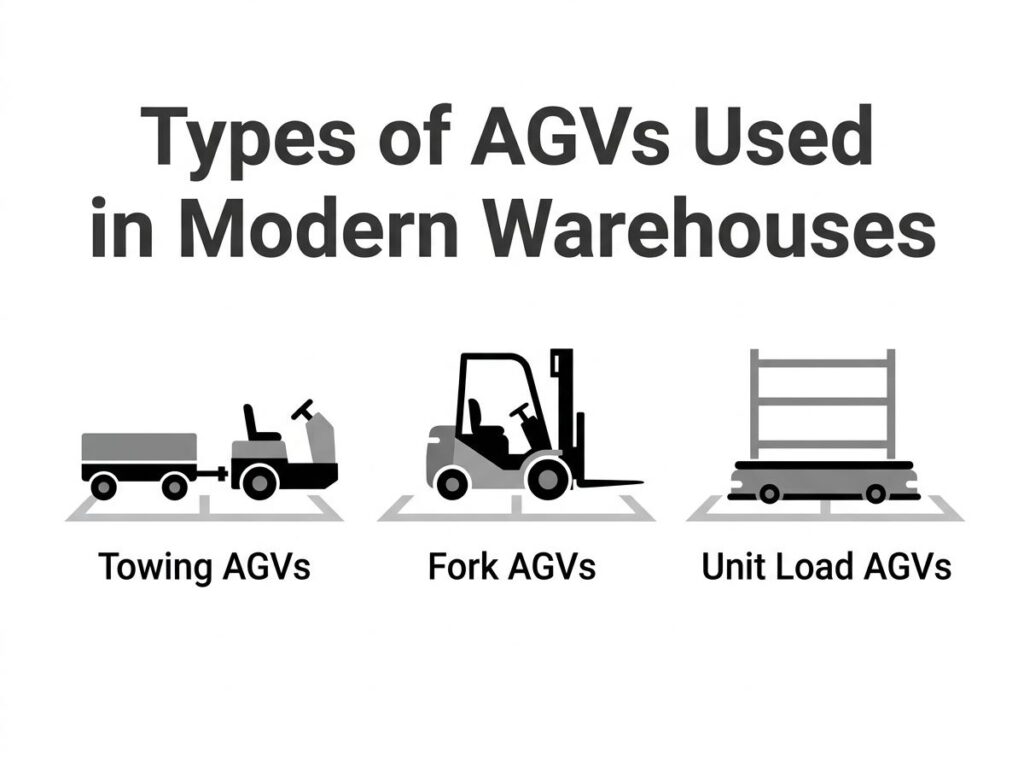
ประเภทของ AGV ที่ใช้ในคลังสินค้าสมัยใหม่
ตอบด่วน
Modern warehouses deploy seven primary AGV types—tugger, unit-load, forklift/stacker, assembly-line, heavy-duty burden carrier, under-ride (turtle) and goods-to-person (GTP) หุ่นยนต์. The right choice depends on load shape, lift height and route variability, but every type is defined by its drive system: differential, tricycle or omnidirectional wheels powered by BLDC or servo motors. Most AGV traction motors run on ไออีซี 60034-1 duty class S3/S4 and reach IE3–IE4 efficiency ตาม IEC 60034-30-1. Below, each type is mapped to its motor torque, duty cycle and selection criteria so you can spec the drivetrain before the vehicle.
เนื้อหาของหน้า
สลับWhat Is an AGV Type? (Classification by Load Handling)
An Automated Guided Vehicle (เอจีวี) is a battery-powered, driverless robot that transports materials along predefined or dynamically planned paths. The family is broad: “เอจีวี” is not one category but a set of load-handling architectures. The most useful classification groups vehicles by how they carry and transfer the load, because that single attribute dictates the drive topology and motor sizing.
The Seven Warehouse AGV Classes
| ระดับ | Load-Handling Method | Typical Payload | Primary Drive Topology | Motor Duty (ไออีซี 60034-1) |
|---|---|---|---|---|
| Tugger / Tow | Pulls train of carts via hitch | 1,000–10,000 kg towed | Differential, 2× driven wheels | S3 (long loops) |
| Unit-Load | Flat/roller deck carries pallet or tote | 500–5,000 kg | Differential or tricycle | S3 / S4 |
| Forklift / Stacker | Forks lift & rack pallets | 1,000–3,000 kg | Differential + mast servo | S4 (frequent start-stop) |
| Assembly-Line | Moving production platform | 500–20,000 kg | Tricycle or omnidirectional | S1 / S6 (อย่างต่อเนื่อง) |
| Heavy-Duty Burden | Custom deck for oversized loads | 10,000–100,000+ kg | Multi-wheel, 4+ driven axles | S4 / S5 (with braking) |
| Under-ride / Turtle | Slides under cart, ลิฟท์ & moves it | 500–2,000 kg | Differential, low-profile | S3 |
| Goods-to-Person (GTP) | Drives under pod, ลิฟท์ & carries shelf | 200–1,500 kg | Omnidirectional (Mecanum) | S3 (high cycle count) |
Source synthesis from Dematic AGV application matrix, DNC Automation AGV type table and Phenikaa-X AGV vehicle classification.
AGV vs AMR — one clarification: Traditional AGVs follow fixed infrastructure (magnetic tape, ลวด, QR codes). หุ่นยนต์เคลื่อนที่อัตโนมัติ (AMRs) use SLAM with dynamic routing and obstacle bypass. Many vehicles marketed as “AGV” today run AMR-style navigation. For vehicle-type selection the practical filter is flexibility vs. ค่าใช้จ่าย, not a rigid label. ดูของเรา AGV vs AMR comparison for the full drive-system breakdown.
How Each AGV Type’s Drive System Works
Regardless of class, every AGV shares a drive chain: battery → motor controller → traction motor (+กระปุกเกียร์) → wheel → floor. The differences lie in wheel count, steering method and how torque is distributed. Three base topologies cover all seven classes:
1. Differential Drive (two independently driven wheels)
Two opposed wheels are driven at different speeds to steer. เรียบง่าย, low-cost, high maneuverability. Dominant in tugger, unit-load, under-ride and GTP vehicles. ก 500 kg unit-load AGV typically uses two BLDC gear-motors of 11–24 N·m continuous wheel torque each.
2. Tricycle Drive (one steered driven wheel + two casters)
One powered, steerable wheel handles both propulsion and steering; two passive casters stabilize. Common in forklift and assembly AGVs where a single driven wheel simplifies the chassis. Requires a steering servo in addition to the traction motor.
3. Omnidirectional Drive (Mecanum / Swedish wheels)
Four 45°-roller wheels enable lateral and diagonal motion without turning. Used in GTP robots and tight-aisle assembly platforms where space is at a premium. Each wheel needs its own BLDC servo with independent current control.
Step-by-step: power flow in a unit-load AGV
- Battery bus (24/48 V DC) supplies the motor controller.
- Controller converts DC → 3-phase PWM for the BLDC traction motor(ส).
- Planetary gearbox multiplies motor torque to wheel torque (typical ratio 15:1–50:1).
- Wheel transfers tractive force to the floor:
F = T_wheel / r_wheel. - Hall/encoder feedback closes the speed loop (bandwidth up to 3.1 kHz on servo drives).
- Fleet manager assigns tasks; safety LiDAR enforces stopping distance per ISO 3691-4.
For the complete torque model behind these steps, ดูของเรา AGV motor torque calculation guide และ AGV motor speed & RPM selection guide.
AGV Type Comparison Table
| พารามิเตอร์ | Tugger | Unit-Load | Forklift | Assembly | Heavy-Duty | Under-ride | GTP |
|---|---|---|---|---|---|---|---|
| Payload range | 1–10 t (towed) | 0.5–5 t | 1–3 t | 0.5–20 t | 10–100+ t | 0.5–2 t | 0.2–1.5 t |
| ดีที่สุดสำหรับ | Long loops, kits | Flat pallets | Vertical racking | Line feeding | Coils, dies | Carts/F&บี | E-commerce pick |
| Drive topology | Differential | Differential | Differential+servo | Tricycle/OMNI | Multi-axle | Differential | Omnidirectional |
| ประเภทมอเตอร์ | BLDC GB | BLDC GB | BLDC+servo mast | Servo/ BLDC | AC servo ×N | BLDC GB | BLDC servo ×4 |
| Typical wheel torque | 11–24 N·m | 12–42 N·m | 20–60 N·m | 40–200 N·m | 200–600 N·m | 6–15 N·m | 5–12 N·m |
| IEC duty | S3 | S3/S4 | S4 | S1/S6 | S4/S5 | S3 | S3 |
| Navigation | Tape/wire/SLAM | Laser/SLAM | Laser SLAM | Wire/magnetic | Laser/wire | QR/magnetic | SLAM |
| Lift required | เลขที่ | ต่ำ (deck) | ใช่ (mast) | เลขที่ | ต่ำ | ใช่ (ยก) | ใช่ (ยก) |
| ต้นทุนสัมพัทธ์ | $30–70k | $40–80k | $50–100k | $60–120k | $150k+ | $20–50k | $25–60k |
Cost ranges synthesized from Phenikaa-X, HELI and FreightAmigo 2025 AGV market data.
ข้อมูลทางวิศวกรรม: รอบการทำงาน, ประสิทธิภาพ & แรงบิด
ไออีซี 60034-1 Duty Cycle per AGV Type
ไออีซี 60034-1:2022 defines ten duty classes (ส1–S10). For AGVs, five are relevant—the duty class sets how much continuous torque the motor may sustain versus its peak rating.
| ไออีซีคลาส | คำอธิบาย | Thermal Behavior | AGV Type Match | Torque Derating |
|---|---|---|---|---|
| S1 | Continuous running | Reaches steady-state temp | Conveyor-style AGV, 24/7 เส้น | None — rated = continuous |
| S3 | Intermittent periodic | No cooling between cycles | Unit-load, GTP, tugger loops | By duty factor % (ed = on-time / total) |
| S4 | Intermittent w/ starting | Start current heats winding | Forklift, assembly feeder | Derâte 10–20% vs S1 |
| S5 | Intermittent w/ braking | Braking adds heat | Heavy-duty w/ regen braking | Braking energy must dissipate/recover |
| S6 | Continuous periodic | Never stops, load varies | Assembly line (no idle) | By load/unload ratio |
Most AGVs run S3 or S4. A forklift AGV with a 10 s move / 20 s load cycle never fully cools, so the motor’s RMS torque over the full cycle—not its peak—must stay under the S1 continuous rating. The RMS formula:
T_rms = √[(T₁²·t₁ + T₂²·t₂ + … + Tₙ²·tₙ) / (t₁ + t₂ + … + tₙ)]
คลาสประสิทธิภาพ (ไออีซี 60034-30-1 vs NEMA MG 1)
| ไออีซี 60034-30-1 | ไม่มีเอ็มจี 1 Equivalent | Loss Band | AGV Traction Use |
|---|---|---|---|
| IE1 | Standard | พื้นฐาน | Not recommended |
| IE2 | ประสิทธิภาพสูง | −20% vs IE1 | Legacy only |
| IE3 | ไม่มีพรีเมี่ยม | −40% vs IE1 | Minimum for new AGVs |
| IE4 | ซูเปอร์พรีเมี่ยม (pending) | −50% vs IE1 | Preferred for 24/7 fleets |
| IE5 | — | −60% vs IE1 | Emerging (sync-rel.) |
ไม่มีเอ็มจี 1 §12.58 states the full-load efficiency shall not fall below the minimum associated with nominal efficiency (≈20% higher losses than nominal). For EU-bound AGVs, Commission Regulation (EC) 2019/1781 mandates IE3 from 0.75 กิโลวัตต์; the US DOE 2027 rule pushes mid-range motors to IE4 (DOE projects $8.8 B savings / 92 M tons CO₂ over 30 ปี).
Core Torque & Speed Formulas
| ปริมาณ | สูตร | หมายเหตุ |
|---|---|---|
| Wheel tractive force | F = T_w / r_w | T_w = wheel torque, r_w = wheel radius |
| Motor torque from wheel | T_m = T_w / (i · η_g) | ผม = อัตราทดเกียร์, η_g = gearbox efficiency (~0.9) |
| Required wheel speed | n_w = v / (2π · r_w) · 60 | v = vehicle speed (M/S) |
| RMS torque (S3/S4) | T_rms = √[Σ(T₂·t)/Σt] | Must be ≤ motor S1 rating |
Manufacturer Drive-System Benchmarks
| Maker / Platform | Relevant AGV Type | Key Spec | แหล่งที่มา |
|---|---|---|---|
| Maxon MW500 wheel drive | Unit-load, under-ride, GTP | ≤500 kg payload/drive; 11.4–23.7 N·m cont. wheel torque; 30–48 วี; IP54; 1024 cpt encoder | maxongroup.com MW500 PDF |
| Maxon IDX 56 | Assembly, forklift aux | 471–794 mNm; 24/48 วี; IP65; 6000 รอบต่อนาที; integrated EPOS4 controller | idx.maxongroup.com |
| Faulhaber DualGear | Compact wheel drives, สายพานลำเลียง | 32 มม; BX4 + GPT; 1.1 N·m cont. / 7 N·m peak; ≤0.6° backlash; −30…120 °C; 40 ว | faulhaber.com DualGear |
| Yaskawa Sigma-7 SGM7D | Forklift mast, งานหนัก | 1.3–240 N·m rated; 3.1 kHz speed-loop bandwidth; 350% overload 3–5 s; 24-bit encoder; STO SIL3 | yaskawa.com Sigma-7 |
These benchmarks show the span: a GTP robot’s 5–12 N·m wheel requirement fits a Maxon MW500 or Faulhaber DualGear, while a forklift mast servo lands on Yaskawa Sigma-7 class. BLDC vs servo for AGVs covers the trade-off in depth.
Best AGV Type per Warehouse Scenario
| Warehouse Scenario | Best AGV Type | ทำไม | ขับ / Motor Note |
|---|---|---|---|
| High-volume pallet shuttling | Unit-load | Flat deck + conveyor transfer, no lift | 2× BLDC gear-motor, S3 |
| Kitting & line feed over long distance | Tugger | Pulls multiple carts in one trip | Differential BLDC, S3 |
| High-bay racking (ขึ้นไป 12 ม.) | Forklift / reach | Vertical storage, 3D precision | BLDC traction + servo mast, S4 |
| ยานยนต์ / electronics assembly | Assembly-line | Moving platform, programmable flow | Tricycle or omni servo, S1/S6 |
| Steel coil / die transport | Heavy-duty burden | Oversized, ultra-heavy | Multi-axle AC servo, S4/S5 |
| Food & beverage cart moves | Under-ride / turtle | Standardized carts, low profile | Differential BLDC, S3 |
| E-commerce goods-to-person | GTP / latent | Pod comes to picker | Omnidirectional BLDC servo ×4, S3 |
7-Step AGV Type & Motor Selection Guide
- Define the load. Shape, น้ำหนัก, and whether it needs lift. Pallets on racking → forklift; carts on routes → tugger; discrete units → unit-load.
- Set lift height. Any vertical requirement above floor level forces a forklift/stacker or under-ride with lift—flat-deck won’t do.
- Map route variability. Predictable loops → simpler guidance (tape/wire) saves cost. Highly variable missions → SLAM/AMR navigation.
- Choose drive topology. Differential for most; tricycle for single-wheel简化; omnidirectional only where space demands lateral motion.
- Size the motor (torque first). Use our torque-by-payload matrix: ก 500 kg AGV needs ~12 N·m/wheel flat, ~26 N·m on a 3% ระดับ. Verify T_rms ≤ S1 rating.
- Confirm efficiency & การปฏิบัติตาม. Specify IE3 minimum, IE4 for 24/7. For Europe, meet EC 2019/1781; for the US, plan for DOE 2027 IE4. See AGV motor efficiency & battery runtime.
- Validate with a pilot. Run 4 weeks in one zone; measure cycle time, duty factor and thermal rise before fleet roll-out. For OEM sourcing, ดูของเรา OEM AGV motor manufacturing guide และ AGV motor supplier for Europe.
ข้อผิดพลาดทางวิศวกรรมทั่วไป
| ความผิดพลาด | ผลที่ตามมา | Correct Approach |
|---|---|---|
| Sizing motor on peak, not RMS torque | Overheating in S3/S4 duty | Compute T_rms over full cycle; derate 10–20% for S4 |
| Choosing flat-deck AGV for racked pallets | Cannot reach racking height | Specify forklift/stacker with mast servo |
| Under-rating gearbox for heavy-duty | Backlash growth, premature failure | Use planetary (≤0.6° backlash, เช่น. Faulhaber GPT) for precision |
| Ignoring ambient temperature | Motor derated 10–15% at 40 องศาเซลเซียส | Apply IEC 60034-1 thermal derating; pick Class F/H |
| Mismatching voltage bus | Motor runs in low-efficiency zone | Match motor rated V to 24/48 V battery bus |
| Specifying omnidirectional unnecessarily | 4× controller cost, complex tuning | Use differential unless lateral motion is required |
| Overlooking inertia match (J_load/J_motor) | Poor dynamic response, resonance | Keep ratio ≤10:1 or raise gear ratio |
| Skipping regenerative braking design | Heat from S5 braking dissipates in motor | Add DC-bus sharing or braking resistor |
ตารางการแก้ไขปัญหา
| ปัญหา | Possible Cause | สารละลาย | Applies To |
|---|---|---|---|
| Motor overheats on long shifts | S4 duty, no RMS derating | Resize to T_rms; improve cooling or duty class | Forklift, การประกอบ |
| AGV drifts off path | Encoder resolution too low | Use ≥1024 cpt (Maxon) or 24-bit (ยาสกาวา) | All SLAM types |
| Excess vibration at speed | J_load/J_motor > 10:1 | Higher gear ratio or larger rotor inertia | งานหนัก, unit-load |
| Battery drains fast | Motor in low-efficiency zone | Re-match RPM/ratio; ดู efficiency guide | All battery AGVs |
| Fork misaligns at rack | Mast servo bandwidth insufficient | Upgrade to ≥3.1 kHz loop (Sigma-7 class) | Forklift |
| Wheel slips on startup | แรงบิด > friction limit | Lower gear ratio or add traction control | Tugger, unit-load |
| Cogging at low speed | Open-loop BLDC commutation | Closed-loop servo with ripple compensation | Assembly, GTP |
| Gearbox noise rising | Bearing friction loss | Use low-friction bearings (SKF E2: 30–50% less) | All geared types |
| Cannot meet EU efficiency | IE2 motor specified | Move to IE3/IE4 per EC 2019/1781 | Europe-bound fleets |
| Safety stop fails audit | No STO function | Specify STO SIL3 (Yaskawa Sigma-7 standard) | All human-zone AGVs |
คำถามที่พบบ่อย
What are the main types of AGVs used in modern warehouses?
The dominant warehouse AGV types are tugger (tow) AGV, unit-load carriers, forklift/stacker AGVs, assembly-line AGVs, heavy-duty burden carriers, under-ride (turtle) AGVs and goods-to-person (GTP) หุ่นยนต์. Each pairs with a distinct drive-system topology and motor duty profile.
Which AGV type is best for high-throughput pallet transport?
Unit-load carriers with differential or tricycle drive and a planetary-gearbox BLDC motor are the workhorse for flat-deck pallet transport. Forklift AGVs are preferred when vertical racking or lift is required.
How does IEC 60034-1 duty cycle affect AGV motor selection by type?
Most AGVs run S3 (intermittent periodic) or S4 (intermittent with starting). A forklift AGV doing frequent start-stop in racking is an S4 case needing RMS-torque derating; ก 24/7 conveyor-style AGV is S1. The duty class dictates allowable continuous vs. แรงบิดสูงสุด.
What motor technology powers most modern warehouse AGVs?
BLDC motors with planetary gearboxes dominate traction wheels (IE3–IE4). Integrated servo (บีแอลดีซี + ตัวเข้ารหัส + closed-loop controller) is used where precision and bandwidth matter, เช่น. forklift masts and assembly platforms. Direct-drive wheel motors appear in compact AMRs.
How much torque does a warehouse AGV motor need?
Torque scales with payload, acceleration and grade. ก 500 kg mid-size AGV on flat ground needs roughly 12 N·m per wheel; ก 1,200 kg heavy AGV on a 3% grade needs ~26–42 N·m per wheel. ดูของเรา AGV motor torque calculation guide for the full model.
Are AGVs and AMRs the same thing?
Not exactly. Traditional AGVs follow fixed paths (magnetic tape, ลวด, QR). AMRs use SLAM with dynamic routing. Many vehicles marketed as AGVs today use AMR-style navigation, so the practical filter is flexibility vs. ค่าใช้จ่าย. ดูของเรา AGV vs AMR comparison.
Why Choose Greensky Power for Your AGV Drivetrain
Greensky Power has designed and manufactured motion solutions for AGV and AMR OEMs since 2011, serving customers in over 50 countries with local engineering support in North America and Europe.
| Capability | What You Get |
|---|---|
| Full drivetrain from one supplier | บีแอลดีซี, brushed DC and micro-AC motors that pair with our planetary, หนอน, parallel-shaft and right-angle gearboxes |
| AGV-specific engineering | Send payload, ความเร็ว, การเร่งความเร็ว, grade and wheel diameter—receive a calculation sheet with recommended motor, gearbox and controller |
| การปฏิบัติตามมาตรฐาน | All motors tested per IEC 60034 และ NEMA MG 1; dynamometer test report with every batch; Thermal Class F (155 องศาเซลเซียส) มาตรฐาน |
| Efficiency for fleets | IE3–IE4 capable BLDC platforms; ดูของเรา ประสิทธิภาพ & battery runtime guide |
| Custom sizing | Frame sizes 22–120 mm, 12–72 V DC, integrated gearbox solutions for any of the seven AGV classes above |
| คุณภาพ & support | 100% การทดสอบรายบุคคล, ISO/CE certified, 24/7 การสนับสนุนด้านเทคนิค, 1-รับประกันปี |
Start with our how to choose a motor for AGV applications แนะนำ, หรือ ติดต่อทีมวิศวกรของเรา for a custom drivetrain spec.
อ้างอิง
- ไออีซี 60034-1:2022 — เครื่องใช้ไฟฟ้าแบบหมุน — ส่วนหนึ่ง 1: คะแนนและประสิทธิภาพ (duty cycles S1–S10, คลาสความร้อน). https://webstore.iec.ch/publication/69481
- ไม่มีเอ็มจี 1-2021 – มอเตอร์และเครื่องกำเนิดไฟฟ้า (โต๊ะ 12-12 ประสิทธิภาพ, §12.58 tolerance). https://www.nema.org/standards/view/mg-1-2021
- ไออีซี 60034-30-1:2014 — Efficiency classes of line-operated AC motors (IE1–IE5). https://webstore.iec.ch/publication/6739
- US DOE — 10 ส่วนซีเอฟอาร์ 431 Subpart B, 2027 motor efficiency rule (IE4 mid-range). https://www.energy.gov/eere/amo/energy-efficiency-program-commercial-and-industrial-equipment-electric-motors
- IEA — Energy Efficiency 2024 (motor-driven systems = 53% ของไฟฟ้าทั่วโลก). https://www.iea.org/reports/energy-efficiency-2024
- SKF — Energy Efficient (E2) deep groove ball bearings for electric motors (30–50% lower friction). https://www.skf.com/binary/57-121274/E2-Electric-motors-offer-sheet_13279_EN.pdf
- Siemens — Digital Enterprise / Electronics Factory Erlangen (digital twin: −40% time-to-market, +60% คุณภาพ). https://www.siemens.com/…/electronics-factory-erlangen/artificial-intelligence.html
- Maxon — Wheel Drive MW500 for AGV/AMR (≤500 kg/drive, 11.4–23.7 N·m). maxongroup.com MW500 PDF
- Faulhaber — DualGear drive system for logistics (BX4 + GPT, 1.1 N·m cont., ≤0.6° backlash). https://www.faulhaber.com/nl/lp/faulhaber-dualgear/
- Yaskawa — SIGMA-7 Servo Systems (SGM7D 1.3–240 N·m, 3.1 kHz bandwidth, STO SIL3). yaskawa.com Sigma-7 PDF
- IEEE TIE 2023 — Zhang R. et al., “Design and Practical Implementation of a High Efficiency Two-Layer Trajectory Planning Method for AGV,” IEEE ทรานส์. Industrial Electronics, 71(2):1811–1822. ดอย:10.1109/TIE.2023.3250847
Related guides: AGV คืออะไรและทำงานอย่างไร? · Motor for AGV · Gear Motor vs Direct Drive for AGVs