
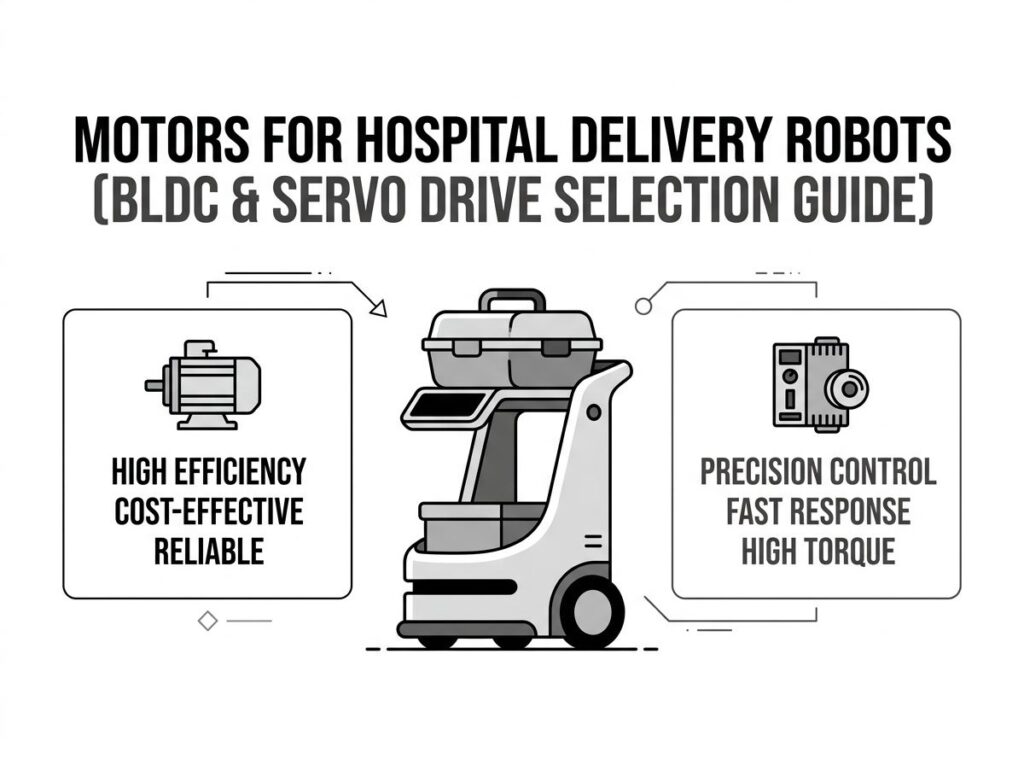
Motors for Hospital Delivery Robots: บีแอลดีซี & Servo Drive Selection Guide
ตอบด่วน
Hospital delivery robots are almost always driven by brushless DC (บีแอลดีซี) motors with Hall sensors, paired with a planetary gearbox, encoder and brake. What makes the hospital case special is การปฏิบัติตาม, not raw torque: the motor must run at ≤45 dB(ก), meet medical EMC (ไออีซี 60601-1-2 / CISPR 11 คลาสบี), and be built under an ISO 13485 quality system. Match the topology to the payload—geared BLDC hub motors for 10–150 kg medication/meal runners, integrated servo or frameless flat motors for heavy linen carts and lift/arm mechanisms—and rate the winding for IEC 60034-1 S3/S6 intermittent duty.
เนื้อหาของหน้า
สลับWhat Are Hospital Delivery Robots?
Every hospital delivery robot is a battery-powered, autonomous indoor vehicle that moves medication, linens, meals, lab specimens, sterile supplies and PPE between departments. The phrase “motors for hospital delivery robots” therefore covers the whole traction assembly—motor, ตัวควบคุม, กระปุกเกียร์, encoder/feedback and brake—because in a certified medical device these are specified and validated as a system.
The logistics problem is real: a typical 300-bed hospital employs 40–60 full-time transport staff who walk 8–12 miles per shift moving carts through hallways. Autonomous robots cut logistics labor by 30–50% and delivery time by ~25%, while reducing infection transmission by taking human trips out of the corridor. Market leaders such as Aethon TUG (>600 hospital installs, 600 lb / ~272 kg payload), Swisslog RoboCourier, Diligent Moxi, Savioke Relay and Swisslog TransRob (300–600 kg) prove the form factor at scale. A single medication robot making 20–30 trips/day replaces ~1.5–2 pharmacy transport FTEs and pays back in 10–16 months.
How the Hospital Robot Drive System Works
Regardless of payload, every hospital delivery robot shares the same drive chain. Selecting the motor means walking this chain and assigning the right component at each stage:
ขั้นตอน 1 — Battery supplies the bus
A Li-ion or LiFePO₄ pack delivers a nominal bus voltage (24/36/48 วี). Because P = V × I, a higher bus voltage means lower current for the same power, reducing cable size and copper loss. Hospital small runners favor 24 V for safety and simplicity; larger linen/utility robots move to 48 วี. ดูของเรา AGV battery-voltage selection guide for the full derivation.
ขั้นตอน 2 — Controller commutates the motor
สำหรับ มอเตอร์บีแอลดีซี, the controller switches current based on rotor position from Hall sensors (block commutation) or an encoder (sinusoidal / ฟค). Maxon documents that block commutation shows ~14% torque ripple, while field-oriented control (ฟค) delivers about 5% more continuous torque with smoother running—important in a quiet ward. Sensorless schemes exist but hesitate at 0 รอบต่อนาที, which is unacceptable for a loaded robot starting on a ramp (ดูของเรา Hall vs sensorless comparison).
ขั้นตอน 3 — Gearbox multiplies torque
A planetary gearbox trades speed for torque at 90–95% efficiency. Wheel torque is T_wheel = T_motor × ratio × η_gear. Geared BLDC hub motors (เช่น. 6.5 ใน, 24 วี, 250 ว, 4 น.ม, 1024/4096-line encoder, IP54/IP65) are the workhorses of small medication and meal runners because the reduction and wheel are one sealed unit.
ขั้นตอน 4 — Wheel meets the floor
Differential drive (two independently driven wheels) steers by speed difference; omnidirectional robots add Mecanum or omni-wheels to move sideways in crowded corridors. The motor only “works” if the wheel transmits traction without slipping on polished hospital floors.
ขั้นตอน 5 — Feedback and safety close the loop
An encoder reports position and speed for precise docking at pharmacy windows and elevators. Yaskawa’s Sigma-7 servo uses a 24-bit absolute encoder (16.7 million pulses/rev) with ripple compensation and vibration suppression; integrated servo motors from Maxon and Faulhaber embed Hall + NTC temperature sensors for commutation and thermal protection in one housing.
Motor Topology Comparison for Hospital Robots
Four motor families cover the hospital spectrum. The table contrasts them on the parameters that decide a medical build:
| Topology | Typical use in hospital robots | แรงดันไฟฟ้า / พลัง | เสียงรบกวน & การสั่นสะเทือน | Key strength | Watch-out |
|---|---|---|---|---|---|
| Geared BLDC hub motor | Medication, meal, specimen runners (10–150 kg) | 24 วี / 150–400 W | ต่ำ (เรียบ, ไม่มีแปรง) | Integrated wheel+reduction, low profile, ราคาถูก | Sealed—harder to service; gear limited life |
| Geared servo (motor+driver+encoder) | Linen/utility carts (300–600 kg), ลิฟท์ | 48 วี / 0.4–2 kW | Very low with FOC | ควบคุมแรงบิดได้อย่างแม่นยำ, regen brake, serviceable | ต้นทุนที่สูงขึ้น, more integration |
| Frameless / flat BLDC | Robot arms, lift columns, compact joints | 12–48 วี / 30–260 W | Lowest (ironless option) | Thin profile, high torque density, fits tight spaces | Needs custom mechanical integration |
| Coreless / ironless BLDC | Surgical & precision sub-systems, instrument trays | 6–24 โวลต์ / 1–50 W | Ultra-low (no cogging) | Zero cogging, ตอบสนองอย่างรวดเร็ว, minimal EMI | Lower peak torque; specialized |
ข้อมูลทางวิศวกรรม: เสียงรบกวน, ประสิทธิภาพ, แรงบิด
Noise and vibration limits (the medical differentiator)
Hospital robots run in wards, ICUs and pharmacies, so audible comfort is a spec, not a nicety. The medical-grade target is ≤45 dB(ก) ที่ 1 ม., with some high-end builds down to ~32 dB(ก). Achieve it with ironless/4-pole rotors that avoid cogging, sinusoidal FOC commutation, and balanced rotors. Low vibration also protects nearby precision medical equipment and satisfies IEC 60034-14 vibration grading.
| ความต้องการ | Medical target | บันทึก |
|---|---|---|
| Sound pressure | ≤45 dB(ก) (≤32 dB high-end) | Ward / ICU comfort |
| การสั่นสะเทือน | ไออีซี 60034-14 compliant | Protects nearby instruments |
| EMC emissions | CISPR 11 คลาสบี | Patient-area equipment |
| EMC immunity | ไออีซี 60601-1-2 (Ed. 4.1) | Phones, Wi-Fi, surgical RF |
| Quality system | กอ.รมน 13485:2016 | Traceable production |
Efficiency and thermal limits
BLDC traction motors for hospital robots typically run 85–91% efficiency. Specifying IE3–IE4 equivalents (ตาม IEC 60034-30-1) extends runtime per charge and cuts heat—important because the motor often sits inside an enclosed, insulated bay. Insulation classes from IEC 60034-1 define the ceiling:
| ชั้นฉนวนกันความร้อน | Max winding temp | การใช้งานทั่วไป |
|---|---|---|
| บี | 130 องศาเซลเซียส | Light-duty, cool ambient |
| เอฟ | 155 องศาเซลเซียส | Standard enclosed bays |
| ชม | 180 องศาเซลเซียส | High ambient (≤40 °C hospital) / regen-heavy |
Torque and force formulas
Size the drive from first principles. Required wheel force on a grade:
F = m·g·Crr + m·g·sinθ + m·a
ที่ไหน m = total mass (หุ่นยนต์ + payload), g - 9.81, Crr ≈ 0.01–0.02 for rubber on smooth floor, θ = ramp angle, a = acceleration. Wheel torque:
T_wheel = F · r และ T_motor = T_wheel / (ratio · η_gear)
ตัวอย่างการทำงาน: ก 100 kg medication runner on a 5° ramp at 0.3 เมตร/วินาที². m·g·sin5° ≈ 100·9.81·0.0872 ≈ 85.5 N; rolling m·g·Crr ≈ 100·9.81·0.015 ≈ 14.7 N; การเร่งความเร็ว 100·0.3 = 30 N. Total F ≈ 130 N. กับ r = 0.085 m (6.5 in wheel), T_wheel ≈ 11 N·m. ก 4 N·m hub motor at 3:1 reduction (η≈0.9) gives 4·3·0.9 ≈ 10.8 N·m—two such wheels (one per side) comfortably cover it. Add a 1.5× safety factor and verify against the full load–stop–load cycle.
Duty cycles (ไออีซี 60034-1)
| Duty | Pattern | Hospital example |
|---|---|---|
| S1 | ต่อเนื่อง, unbroken | Long uninterrupted transport corridors |
| S3 | Run/stop, starting ignored | Most medication & meal runners |
| S4 | Run/stop with starting heating | Frequent elevator/dock cycles |
| S6 | Continuous with periodic loading | Robots looping all day |
Best Applications by Robot Type
| หุ่นยนต์ / payload | What it carries | Recommended drive | ทำไม |
|---|---|---|---|
| Medication runner (≤100 kg) | Pharmacy carts, controlled substances | Geared BLDC hub, 24 วี, 4 N·m/wheel | เงียบ, low-profile, secure docking |
| Meal / tray runner (≤50 kg) | Food, patient records | Geared BLDC hub, 24 วี, ≤2 N·m | Light load, frequent stops |
| Lab specimen (≤45 kg) | Samples, chain-of-custody | Geared BLDC, low-vibration FOC | Gentle motion protects samples |
| Linen / utility cart (300–600 kg) | Linens, ของเสีย, supplies | Integrated servo, 48 วี, 0.4–2 kW | แรงบิดสูง, regen brake |
| Lift / arm sub-system | Tray hand-off, shelf access | Frameless or flat BLDC, 12–48 วี | Thin profile, high torque density |
How to Select a Hospital Robot Motor (8 ขั้นตอน)
- Define the payload and route. Mass, ramp angle, floor type and whether it rides elevators set the force budget. A 5° threshold or 8° ramp is common in hospitals.
- Compute required wheel torque กับ
T_wheel = F·rand the force equation above; add a 1.5× safety factor. - Pick the topology. ≤150 kg → geared BLDC hub; 300–600 kg → integrated servo; arms/lifts → frameless flat BLDC.
- Choose bus voltage. 24 V for ≤500 W small runners; 48 V for ≥0.5 kW linen/utility robots. Keep below the 60 V DC SELV boundary for service simplicity.
- Specify the feedback & เบรค. ห้องโถง + encoder for commutation and docking; an electromagnetic brake holds position on ramps and during power loss.
- Set the noise & EMC bar. ≤45 dB(ก), CISPR 11 Class B emissions, ไออีซี 60601-1-2 immunity. Validate in the real ward, not just the lab.
- Rate for duty and ambient. ไออีซี 60034-1 S3/S6, insulation class F or H for enclosed 40 °C bays; verify thermal headroom. ของเรา motor-overheating guide covers the failure modes.
- Lock the quality system. Require an ISO 13485-capable supplier with full material and test traceability—certification bodies will ask for it.
ข้อผิดพลาดทางวิศวกรรมทั่วไป
- Sizing for peak, not RMS. Hospital robots accelerate, dwell and stop constantly; thermal failure comes from the cycle average, not the brief peak.
- Ignoring noise until prototyping. A motor that is fine on the bench becomes unacceptable in a quiet ward—specify ≤45 dB(ก) up front.
- Treating EMC as an afterthought. ไออีซี 60601-1-2 immunity to phones/Wi-Fi must be designed in; retrofitting shielding is expensive.
- Over-reducing for a tiny robot. Too-high a ratio kills top speed and wastes efficiency; balance torque against cruise speed.
- Skipping the brake. On any ramp or threshold, an e-brake is a safety item, not an option.
- Using a generic industrial AGV motor. Non-medical builds lack the traceability and quiet running hospitals require. ดูของเรา warehouse AGV motor guide for the contrast.
- Forgetting serviceability. Sealed hub motors are cheap but must be replaced as a unit; high-utilization linen fleets prefer serviceable servos.
ตารางการแก้ไขปัญหา
| ปัญหา | สาเหตุน่าจะ | สารละลาย |
|---|---|---|
| Robot hesitates at startup on a ramp | Sensorless control or weak low-speed torque | Use Hall-sensored BLDC; verify 0-RPM torque; raise reduction |
| Audible whine in ward | Block commutation ripple or unbalanced rotor | Switch to FOC; balance rotor; check gear meshing |
| EMC test fails near Wi-Fi | Inadequate shielding / filtering | Design to IEC 60601-1-2; add filters; route sensor cables away from RF |
| Motor overheats in enclosed bay | S3 rating too small or ambient 40 องศาเซลเซียส | Upsize winding, use class H, add bay ventilation |
| Drifts on threshold / dock | No holding brake or brake too weak | Fit electromagnetic brake; verify holding torque |
| Battery drains too fast | Low-efficiency gearbox or oversized motor | Use IE3–IE4 motor; 90–95% planetary; right-size power |
| Encoder loses count at elevator | EMI from inductive loads | Twisted-pair + ferrite; differential encoder; ไออีซี 60601-1-2 ออกแบบ |
| Premature bearing noise | VFD electrical erosion or poor lube | Use insulated/hybrid bearings (SKF CeraDrive-type); correct regrease |
คำถามที่พบบ่อย
What type of motor is used in hospital delivery robots?
Most use brushless DC (บีแอลดีซี) motors with Hall sensors for traction, paired with a planetary gearbox, encoder and brake. Geared BLDC hub motors suit small medication/meal runners; integrated servo and frameless flat BLDC motors are used for heavy linen carts and lift/arm mechanisms.
Why do hospital robots need low-noise motors?
They operate in wards, ICUs and pharmacies where loud drives disturb patients and staff. The medical-grade target is ≤45 dB(ก) (some down to ~32 dB(ก)), achieved with ironless/4-pole rotors and sinusoidal FOC to avoid cogging vibration.
What EMC and safety standards apply to hospital robot motors?
ไออีซี 60601-1-2 (Ed. 4.1, 2020) governs medical EMC, referencing CISPR 11 Class B for emissions and setting immunity to ESD, RF, surge and proximity fields. Quality follows ISO 13485:2016; the rotating machine is rated per IEC 60034-1.
How do I size a motor for a medication delivery robot?
Compute wheel force F = m·g·Crr + m·g·sinθ + m·a, convert to wheel torque T = F·r, divide by gear ratio and efficiency, add a 1.5× factor, and size for RMS torque over the duty cycle. ก 6.5 in hub motor (4 น.ม, 24 วี, 250 ว) covers ~100 kg at 0.5 m/s per pair of wheels.
Is a hub motor or a geared motor better for hospital robots?
For ≤150 kg runners, a geared BLDC hub motor keeps the chassis simple and low-cost. For ≥300 kg linen/utility transports, a separate geared servo is more efficient and serviceable. Direct-drive wheels are used only where silence and zero maintenance beat cost.
What duty cycle should a hospital delivery robot motor be rated for?
Most run IEC 60034-1 S3 (run/stop) or S6 (continuous periodic); S1 only for long uninterrupted corridors. Size for RMS torque over the real cycle and add thermal headroom for 40 °C ambient and enclosed bays.
Why Choose GreenSky for Hospital Robot Motors?
GreenSky Power is a China-based B2B motor manufacturer supplying BLDC, มุ่ง, servo and frameless drive assemblies to medical and logistics robot OEMs worldwide. เราสนับสนุน Hall-sensored and encoder-based BLDC builds, planetary reductions, integrated electromagnetic brakes, and low-noise rotors tuned to ≤45 dB(ก) ward targets. Our engineering team helps you map the right topology to your payload and duty cycle, and we work to ISO 13485-aligned quality processes with full material and test traceability for medical certification. Whether you are building a 100 kg medication runner or a 600 kg linen transporter, start from our motor selection guide or talk to us about a torque-engineering review.
อ้างอิง
- ไออีซี 60034-1:2022 — Rotating electrical machines, ส่วนหนึ่ง 1: คะแนนและประสิทธิภาพ (duty types, ขีดจำกัดความร้อน, EMC). webstore.iec.ch/publication/8905
- ไออีซี 60034-30-1:2014 — Efficiency classes of single-speed three-phase cage-induction motors (รหัสไออี). webstore.iec.ch/publication/63421
- ไออีซี 60601-1-2:2020 (Ed. 4.1) — Medical electrical equipment, ส่วนหนึ่ง 1-2: EMC — collateral standard. micomlabs.com/iec-60601-1-2-emc-testing
- กอ.รมน 13485:2016 — Medical devices — Quality management systems. iso.org/iso-13485-medical-devices.html
- ไม่มีเอ็มจี 1-2021 – มอเตอร์และเครื่องกำเนิดไฟฟ้า (rotating electrical machines standard). nema.org/standards/view/mg-1-tr-2021-rotating-electrical-machines
- เรา. กรมวิชาการเกษตร 10 ส่วนซีเอฟอาร์ 431 — Energy efficiency program for certain commercial and industrial equipment (มอเตอร์ไฟฟ้า). ecfr.gov/…/part-431
- Dei N.N. et al., “Design and Performance Evaluation of a Modular Mobile Robot for Autonomous Hospital Logistics,” IEEE ทรานส์. Automation Science and Engineering, 2026. doi.org/10.1109/TASE.2026.3674356
- Fung W.K. et al., “Development of a hospital service robot for transporting task,” IEEE RISSP 2003. doi.org/10.1109/RISSP.2003.1285647
- SKF — Hybrid ceramic (CeraDrive) bearings for electric motors: insulation against stray-current erosion. skf.com/…/skf-ceradrive
- Siemens — Energy-efficient drives (SIMOTICS SD in IE4, ขึ้นไป >96% ประสิทธิภาพของมอเตอร์). assets.new.siemens.com/…/Siemens-EE-Drive-Systems-Background-Information.pdf