
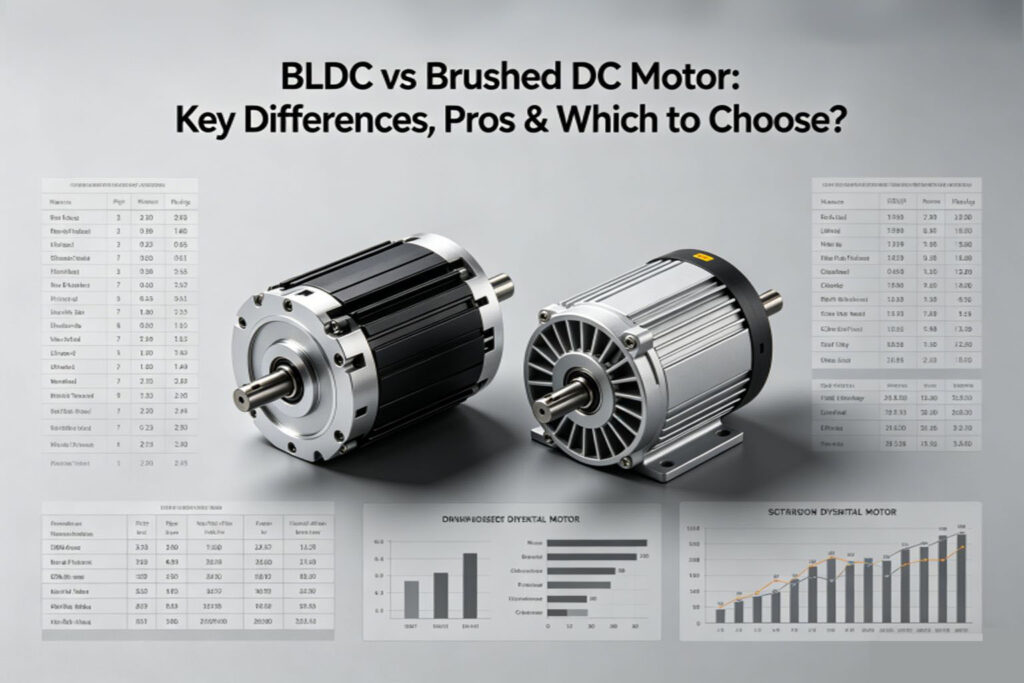
BLDC กับมอเตอร์กระแสตรงแบบมีแปรงถ่าน: ความแตกต่างที่สำคัญ, ข้อดี & ว่าจะเลือกแบบไหน?
ตัวอย่างข้อมูลแนะนำ:
มอเตอร์ BLDC are more efficient, longer-lasting, and better suited for precision and high-performance applications, while brushed DC motors are simpler, lower-cost, and ideal for basic or cost-sensitive systems. The choice depends on factors such as efficiency requirements, maintenance tolerance, ควบคุมความซับซ้อน, and total lifecycle cost. For OEMs and industrial buyers, BLDC motors are typically preferred for modern systems, while brushed DC motors remain relevant in low-cost or intermittent-use applications.
In industrial and OEM motor selection, comparing BLDC vs brushed DC motor is a common decision point that directly affects system performance, ความน่าเชื่อถือ, and long-term cost. While both motor types operate on direct current, their internal structures and performance characteristics differ significantly. Engineers and procurement managers must evaluate these differences based on real application requirements rather than initial price alone.
มอเตอร์ BLDC คืออะไร?
กระแสตรงไร้แปรงถ่าน (บีแอลดีซี) motor is an electronically commutated motor that replaces mechanical brushes with an electronic controller. Permanent magnets are embedded in the rotor, while stator windings are energized in a controlled sequence to generate rotation.
Key Engineering Features
- No mechanical brushes → reduced wear and maintenance
- ตัวควบคุมความเร็วอิเล็กทรอนิกส์ (เอสซี) required
- ประสิทธิภาพสูง (85–95%)
- Excellent speed and torque control
BLDC motors are widely used in electric vehicles, วิทยาการหุ่นยนต์, and industrial automation where performance, ประสิทธิภาพ, and reliability are critical.
👉 สำรวจ: Industrial BLDC Motor Solutions
What Is a Brushed DC Motor?
A brushed DC motor uses mechanical brushes and a commutator to switch current within the motor windings. This design has been widely used for decades due to its simplicity and low cost.
Key Engineering Features
- Mechanical commutation using brushes
- Simple control (direct DC supply)
- ต้นทุนเริ่มต้นที่ต่ำกว่า
- Higher maintenance requirements
Brushed DC motors are commonly used in low-cost devices, automotive accessories, and applications where precision control is not required.
BLDC กับมอเตอร์กระแสตรงแบบมีแปรงถ่าน: Core Differences Explained
| พารามิเตอร์ | มอเตอร์ BLDC | มอเตอร์ DC แบบแปรงถ่าน |
|---|---|---|
| ประสิทธิภาพ | 85–95% | 70–80% |
| การซ่อมบำรุง | ต่ำ | สูง (การสึกหรอของแปรง) |
| ควบคุม | อิเล็กทรอนิกส์ (เอสซี) | Simple DC supply |
| อายุการใช้งาน | ยาว | สั้นลง |
| ต้นทุนเริ่มต้น | สูงกว่า | ต่ำกว่า |
| เสียงรบกวน | ต่ำ | สูงกว่า |
The primary difference lies in commutation: BLDC motors rely on electronic switching, while brushed motors use physical contact. This leads to differences in efficiency, ความทนทาน, and system complexity.
Why BLDC Motors Are More Efficient
Efficiency is a critical factor in modern motor selection, especially in energy-intensive or battery-powered systems.
เหตุผลทางวิศวกรรม
- No friction losses from brushes
- Reduced electrical losses due to optimized control
- Lower heat generation in rotor
In applications such as electric vehicles or HVAC systems, higher efficiency translates directly into energy savings and longer system lifespan.
Torque Density and Performance Comparison
Torque density is a key metric for compact system design. BLDC motors offer higher torque density due to their permanent magnet structure.
ข้อดีของ BLDC
- Higher torque-to-weight ratio
- Better dynamic response
- Suitable for compact systems
Brushed Motor Characteristics
- Adequate torque for basic applications
- Performance limited by brush wear and heat
For applications like AGVs or robotics, BLDC motors provide superior performance.
ประสิทธิภาพการระบายความร้อนและการจัดการความร้อน
Thermal performance affects both reliability and lifespan.
บีแอลดีซีมอเตอร์
- Lower heat generation due to higher efficiency
- Heat concentrated in stator → easier cooling
Brushed Motors
- Higher heat due to friction and electrical losses
- Heat generated in rotor → harder to dissipate
This difference significantly impacts motor durability in continuous-duty applications.
Control System Differences
Control complexity is one of the biggest distinctions between BLDC and brushed motors.
BLDC Control
- Requires ESC or driver
- Supports precise speed and torque control
- Enables smart system integration
Brushed Motor Control
- Simple voltage-based control
- No advanced electronics required
For modern automation systems, BLDC motors offer significant advantages.
Reliability and Lifespan Comparison
Lifespan is a major concern for OEM buyers and industrial operators.
- บีแอลดีซี: No brushes → longer lifespan, fewer failures
- แปรง: Brush wear limits service life
In high-duty-cycle applications, brushed motors may require frequent maintenance, increasing operational costs.
How to Choose BLDC or Brushed DC Motor for Your Application
Selecting the right motor requires a detailed engineering analysis.
เกณฑ์การคัดเลือกที่สำคัญ
- แรงดันไฟฟ้า: 12วี / 24วี / 48วี / 72ระบบวี
- ช่วงพลังงาน: Watts to several kW
- ความเร็ว & แรงบิด: Match load profile
- ระบายความร้อน: Air or forced cooling
- คอนโทรลเลอร์: ESC vs direct DC supply
คำแนะนำตามแอปพลิเคชัน
- Electric vehicles → BLDC motor
- Low-cost consumer devices → Brushed motor
- Industrial automation → มอเตอร์บีแอลดีซี
- Intermittent-use equipment → Brushed motor
👉 Get expert support: โซลูชั่นมอเตอร์แบบกำหนดเอง
Industrial Applications of BLDC and Brushed DC Motors
BLDC Applications
- ยานพาหนะไฟฟ้า (48วี / 72ระบบวี)
- หุ่นยนต์และระบบอัตโนมัติ
- ระบบปรับอากาศ
- อุปกรณ์การแพทย์
Brushed DC Applications
- Automotive accessories
- เครื่องใช้ในครัวเรือน
- เครื่องมือไฟฟ้า
👉 สำรวจมอเตอร์ EV: โซลูชั่นมอเตอร์ EV
การเปรียบเทียบต้นทุน: BLDC กับมอเตอร์กระแสตรงแบบมีแปรงถ่าน
| ปัจจัยด้านต้นทุน | มอเตอร์ BLDC | มอเตอร์ DC แบบแปรงถ่าน |
|---|---|---|
| ต้นทุนเริ่มต้น | สูงกว่า | ต่ำกว่า |
| Operating Cost | ต่ำกว่า | สูงกว่า |
| การซ่อมบำรุง | น้อยที่สุด | บ่อย |
| ต้นทุนการเป็นเจ้าของทั้งหมด | ระยะยาวลดลง | Higher over time |
While brushed motors are cheaper upfront, BLDC motors often provide better ROI in continuous-use applications.
แนวโน้มในอนาคต: Why BLDC Motors Are Replacing Brushed Motors
The global shift toward energy efficiency and automation is accelerating BLDC adoption.
- Energy regulations favor high-efficiency motors
- Growth of electric mobility
- Increasing demand for smart and connected systems
Brushed motors are gradually being replaced in many applications due to their maintenance limitations.
คำถามที่พบบ่อย: BLDC กับมอเตอร์กระแสตรงแบบมีแปรงถ่าน
1. Which motor lasts longer, BLDC or brushed?
BLDC motors typically last significantly longer because they do not use brushes, which are subject to wear. This makes them ideal for continuous-duty applications.
2. Why are brushed motors cheaper?
Brushed motors have a simpler design and do not require electronic controllers, reducing manufacturing and system costs.
3. Is BLDC motor better for electric vehicles?
ใช่, มอเตอร์ BLDC ให้ประสิทธิภาพสูงกว่า, better control, และมีอายุยืนยาวขึ้น, making them ideal for EV applications.
4. Do BLDC motors require controllers?
ใช่, BLDC motors require an electronic speed controller to operate, which adds complexity but enables precise control.
5. When should I choose a brushed motor?
Brushed motors are suitable for low-cost, เรียบง่าย, or intermittent-use applications where advanced performance is not required.
6. Which is better BLDC or brushed motor?
There is no single “better” option—it depends on your application. Choose based on your priorities: BLDC for performance and longevity; brushed for simplicity and upfront cost savings.
7. Why is BLDC more efficient?
BLDC motors are more efficient mainly because they eliminate brushes and a physical commutator, which reduces Friction and wear.
8. Is brushed motor obsolete?
เลขที่, brushed DC motors are not obsolete. Brushed motors remain relevant where their simplicity and low system cost outweigh their limitations.
บทสรุป: Which Motor Is Better?
When comparing BLDC vs brushed DC motor, the answer depends on your application. BLDC motors are better for efficiency, ความน่าเชื่อถือ, และประสิทธิภาพในระยะยาว, while brushed motors are suitable for low-cost and simple designs.
For most modern industrial and OEM applications, BLDC motors are the preferred choice due to their superior performance and lower lifecycle cost.
Need help choosing the right motor?
✔ขอเอกสารข้อมูล
✔ รับซ่อมมอเตอร์ OEM
✔ ติดต่อวิศวกรของเราวันนี้
อ้างอิง
- IEEE Motor Design Handbook
- IEC Motor Efficiency Standards
- Industrial Motor Application Reports