
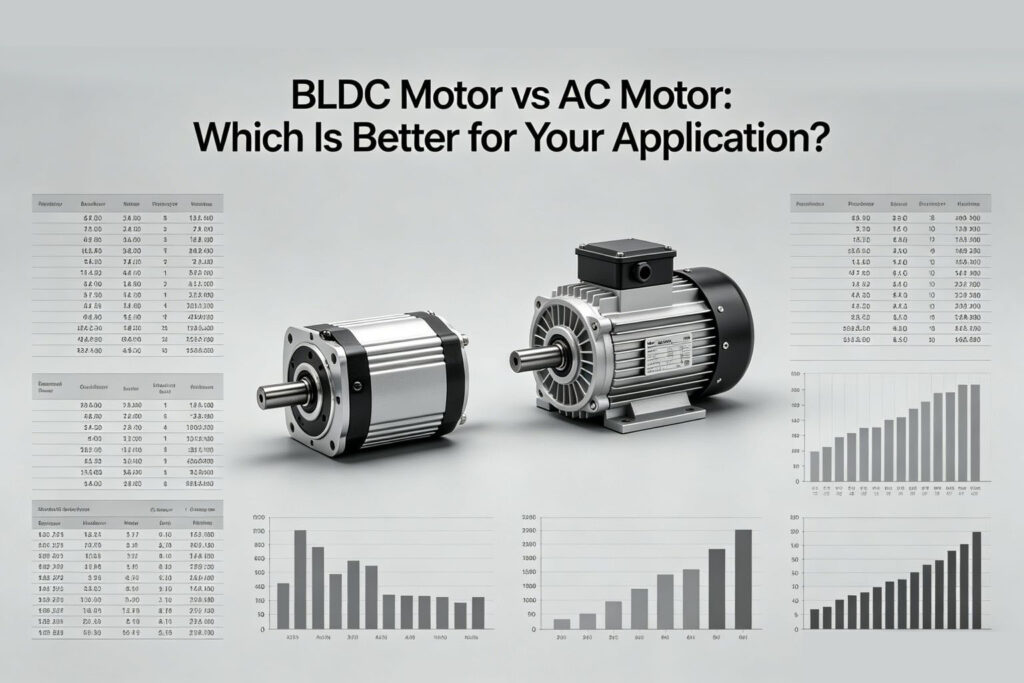
มอเตอร์ BLDC กับมอเตอร์ AC: ซึ่งดีกว่าสำหรับการสมัครของคุณ?
ตัวอย่างข้อมูลแนะนำ:
มอเตอร์ BLDC are generally better for applications requiring high efficiency, การควบคุมที่แม่นยำ, and compact size, while AC motors are preferred for cost-sensitive, high-power, and rugged industrial environments. The best choice depends on factors such as torque requirements, ควบคุมความซับซ้อน, thermal conditions, and lifecycle cost. For OEMs and engineers, selecting between BLDC and AC motors requires a performance-driven analysis rather than a simple cost comparison.
In modern industrial systems, choosing between a BLDC motor vs AC motor is a critical engineering decision that directly impacts efficiency, ความน่าเชื่อถือ, และต้นทุนการเป็นเจ้าของทั้งหมด. Whether you are designing electric vehicles, ระบบปรับอากาศ, ปั๊ม, or automation equipment, understanding the differences between these motor technologies is essential for achieving optimal performance and ROI.
มอเตอร์ BLDC คืออะไร?
กระแสตรงไร้แปรงถ่าน (บีแอลดีซี) motor is an electronically commutated motor that eliminates mechanical brushes by using a controller to switch current in the stator windings. The rotor typically contains permanent magnets, allowing for high torque density and efficiency.
ลักษณะสำคัญของมอเตอร์ BLDC
- Electronic commutation using Hall sensors or sensorless control
- ประสิทธิภาพสูง (typically 85–95%)
- Compact design with high power-to-weight ratio
- Low maintenance due to absence of brushes
BLDC motors are widely used in applications where efficiency and precise speed control are critical, เช่น วิทยาการหุ่นยนต์, ยานพาหนะไฟฟ้า, และระบบ HVAC อัจฉริยะ.
👉 Explore industrial solutions: BLDC Motor Product Range
มอเตอร์ AC คืออะไร?
มอเตอร์เอซี, including induction motors and synchronous motors, operate using alternating current supplied directly from the grid. The most common type in industrial applications is the induction motor, known for its simplicity and robustness.
Key Characteristics of AC Motors
- สิ่งก่อสร้างที่เรียบง่ายและขรุขระ
- Lower upfront cost compared to BLDC motors
- Suitable for high-power industrial applications
- Can operate directly from AC supply without complex electronics
AC motors dominate traditional industrial sectors such as pumps, คอมเพรสเซอร์, and heavy machinery due to their reliability and scalability.
มอเตอร์ BLDC กับมอเตอร์ AC: Key Differences Explained
| พารามิเตอร์ | มอเตอร์ BLDC | เอซีมอเตอร์ (การเหนี่ยวนำ) |
|---|---|---|
| ประสิทธิภาพ | 85–95% | 75–90% |
| ความหนาแน่นของแรงบิด | สูง | ปานกลาง |
| ควบคุม | Advanced electronic control | Simple or VFD-based |
| ต้นทุนเริ่มต้น | สูงกว่า | ต่ำกว่า |
| การซ่อมบำรุง | ต่ำ | Low to moderate |
| การใช้งาน | อีวี, วิทยาการหุ่นยนต์, เครื่องปรับอากาศ | Industrial pumps, แฟน ๆ |
The fundamental difference lies in commutation: BLDC motors rely on electronic switching, while AC motors use electromagnetic induction. This leads to differences in efficiency, control flexibility, and system complexity.
Why BLDC Motors Are More Efficient
Efficiency is one of the most important factors in modern motor selection, especially in energy-sensitive applications.
Engineering Reasons for Higher Efficiency
- ไม่มีการสูญเสียแรงเสียดทานของแปรง
- Reduced rotor heating due to permanent magnets
- Precise current control minimizes copper losses
In applications like electric vehicles or HVAC systems, a 5–10% efficiency improvement can significantly reduce energy consumption over time. This is why BLDC motors are increasingly replacing traditional AC motors in energy-regulated markets.
Torque Density and Performance Comparison
Torque density determines how much torque a motor can deliver relative to its size. BLDC motors outperform AC motors in this aspect due to their permanent magnet design.
ข้อดีของ BLDC
- Higher torque at lower speeds
- Better dynamic response
- Compact footprint
AC Motor Characteristics
- Stable operation at constant speed
- Better suited for continuous-duty heavy loads
For OEM designs where space is limited, such as AGV robots or electric scooters, BLDC motors provide a clear advantage.
Thermal Performance and Cooling Considerations
Thermal management directly impacts motor lifespan and reliability. BLDC motors typically generate less heat due to higher efficiency, but their electronics require careful cooling design.
BLDC Cooling
- Air cooling or liquid cooling in high-power systems
- Controller heat dissipation must be considered
AC Motor Cooling
- Often uses fan-based cooling
- More tolerant of harsh environments
In industrial environments with high ambient temperatures, AC motors may still be preferred for their robustness.
Control Systems: มอเตอร์ BLDC กับมอเตอร์ AC
Control strategy is a major differentiator between these motor types.
BLDC Control
- Requires electronic speed controller (เอสซี)
- Supports precise speed and torque control
- Enables IoT and smart system integration
AC Motor Control
- Can run directly on AC supply
- Variable Frequency Drives (VFD) improve flexibility
For smart manufacturing and automation, BLDC motors provide superior control capabilities.
Reliability and Lifespan Comparison
Both BLDC and AC motors offer long service life, but their failure modes differ.
- บีแอลดีซี: Longer lifespan due to no brushes, but sensitive to electronics failure
- เอซีมอเตอร์: Extremely robust, fewer electronic components
In mission-critical applications, engineers often consider redundancy and controller quality when selecting BLDC systems.
BLDC Motor vs AC Motor how to Choose for Your Application
Choosing the right motor requires balancing performance, ค่าใช้จ่าย, and system requirements.
ปัจจัยการคัดเลือกที่สำคัญ
- แรงดันไฟฟ้า: 24วี, 48วี, 72V for BLDC; 220V/380V for AC
- พลัง: From watts to hundreds of kW
- ความเร็ว & แรงบิด: Match load requirements
- ระบายความร้อน: Air vs liquid cooling
- ความเข้ากันได้ของคอนโทรลเลอร์: ESC vs VFD
Application-Specific Recommendations
- Electric vehicles → BLDC motor
- Industrial pumps → AC motor
- Robotics → BLDC motor
- Heavy machinery → AC motor
👉 Request a custom solution: OEM Motor Design Service
Industrial Applications of BLDC and AC Motors
Different industries prioritize different performance characteristics.
การใช้งานมอเตอร์ BLDC
- ยานพาหนะไฟฟ้าและจักรยานไฟฟ้า
- หุ่นยนต์และระบบอัตโนมัติ
- ระบบปรับอากาศ
การใช้งานมอเตอร์ AC
- ปั๊มและคอมเพรสเซอร์
- ระบบสายพานลำเลียง
- Heavy-duty industrial equipment
👉 Explore EV solutions: โซลูชั่นยานยนต์ไฟฟ้า
การเปรียบเทียบต้นทุน: BLDC vs AC Motor
| ปัจจัยด้านต้นทุน | มอเตอร์ BLDC | เอซีมอเตอร์ |
|---|---|---|
| ต้นทุนเริ่มต้น | สูงกว่า | ต่ำกว่า |
| Operating Cost | ต่ำกว่า (ประสิทธิภาพสูง) | สูงกว่า (energy loss) |
| การซ่อมบำรุง | ต่ำ | ต่ำ |
| ต้นทุนการเป็นเจ้าของทั้งหมด | Lower in long term | Higher in energy-intensive use |
For B2B buyers, lifecycle cost is often more important than upfront price, especially in energy-intensive applications.
แนวโน้มในอนาคต: Why BLDC Motors Are Gaining Market Share
The global motor market is shifting toward energy-efficient solutions due to regulatory and sustainability pressures.
- Stricter energy efficiency regulations (IE3, IE4 standards)
- Growth of electric vehicles
- Smart manufacturing and Industry 4.0
BLDC motors are expected to see rapid adoption in both industrial and consumer applications.
คำถามที่พบบ่อย: มอเตอร์ BLDC กับมอเตอร์ AC
1. Which motor is more efficient, BLDC or AC?
BLDC motors are generally more efficient due to the absence of brushes and reduced energy losses. They can achieve efficiencies above 90%, making them ideal for energy-sensitive applications.
2. Why are AC motors still widely used?
AC motors are cost-effective, แข็งแกร่ง, and easy to operate. They are suitable for heavy-duty industrial applications where efficiency is less critical.
3. Is BLDC motor better for electric vehicles?
ใช่, BLDC motors are widely used in EVs due to their high efficiency, ขนาดกะทัดรัด, และความสามารถในการควบคุมที่แม่นยำ.
4. What is the cost difference between BLDC and AC motors?
BLDC motors have higher upfront costs but lower operating costs, while AC motors are cheaper initially but less efficient over time.
5. Can AC motors replace BLDC motors?
ในบางแอพพลิเคชั่น, yes. อย่างไรก็ตาม, for high-performance and energy-efficient systems, BLDC motors are generally preferred.
บทสรุป: Which Motor Should You Choose?
The choice between a BLDC motor vs AC motor ultimately depends on your application requirements. If you prioritize efficiency, การออกแบบที่กะทัดรัด, และควบคุมความแม่นยำ, BLDC motors are the better option. For cost-sensitive, งานอุตสาหกรรมกำลังสูง, AC motors remain a reliable choice.
For OEMs and industrial buyers, the best approach is to evaluate total lifecycle cost, performance requirements, and system integration complexity.
ต้องการความช่วยเหลือในการเลือกมอเตอร์ที่เหมาะสม?
✔ขอเอกสารข้อมูล
✔ Get OEM customization support
✔ ติดต่อวิศวกรของเราวันนี้
อ้างอิง
- ธุรกรรม IEEE เกี่ยวกับอิเล็กทรอนิกส์อุตสาหกรรม
- สำนักงานพลังงานระหว่างประเทศ (ไออีเอ) Motor Systems Report
- IEC Efficiency Standards Documentation