
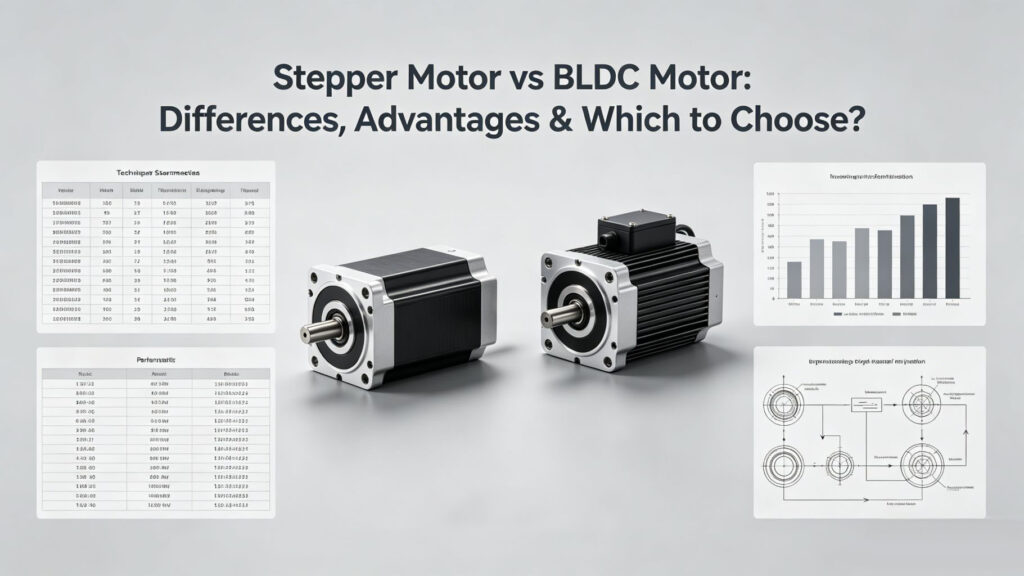
Шаговый двигатель против двигателя BLDC: Различия, Преимущества & Что выбрать?
Избранный фрагмент:
Stepper motors are ideal for precise positioning and low-speed control without feedback systems, пока BLDC двигатели offer higher efficiency, better torque density, and superior performance in dynamic and high-speed applications. The best choice depends on whether your application prioritizes accuracy, cost simplicity, or energy efficiency and long-term reliability. For OEM and industrial buyers, BLDC motors are typically preferred for performance-driven systems, while stepper motors remain optimal for positioning-focused applications such as CNC and 3D printing.
When evaluating stepper motor vs BLDC motor, engineers and procurement managers must consider more than basic specifications. The decision affects system architecture, control strategy, потребление энергии, and long-term maintenance costs. In modern industrial environments—where automation, эффективность, and reliability are critical—understanding the engineering trade-offs between these motor types is essential.
What Is a Stepper Motor?
A stepper motor is a brushless synchronous motor that divides a full rotation into discrete steps. Each pulse sent to the motor results in a precise angular movement, enabling open-loop position control without feedback systems.
Key Engineering Characteristics
- Discrete step movement (например, 1.8° per step)
- High holding torque at standstill
- Simple control without feedback loop
- Lower efficiency compared to BLDC motors
Stepper motors are widely used in applications where precise positioning is required, такие как станки с ЧПУ, 3Д-принтеры, и медицинские приборы.
Что такое двигатель BLDC?
Бесщеточный DC (BLDC) motor uses electronic commutation and permanent magnets to deliver continuous rotation with high efficiency and precise control.
Key Engineering Characteristics
- Continuous rotation with smooth torque output
- Высокая эффективность (85–95%)
- Требуется электронный регулятор скорости. (ESC)
- Высокая удельная мощность
BLDC motors are widely used in electric vehicles, робототехника, системы отопления, вентиляции и кондиционирования, и промышленная автоматизация.
👉 Explore solutions: Ассортимент двигателей BLDC
Шаговый двигатель против двигателя BLDC: Объяснение ключевых отличий
| Параметр | Шаговый двигатель | BLDC двигатель |
|---|---|---|
| Тип управления | Разомкнутый контур (no feedback) | Замкнутый контур (with controller) |
| Эффективность | Низкий (50–70%) | Высокий (85–95%) |
| Torque Behavior | High at low speed | Consistent across speed range |
| Диапазон скоростей | От низкого до умеренного | Широкий (low to high speed) |
| Точность | Very high positioning accuracy | Requires feedback for precision |
| Расходы | Более низкая стоимость системы | Более высокая первоначальная стоимость |
The core difference lies in how motion is generated: stepper motors move in discrete steps, while BLDC motors provide continuous rotation. This leads to fundamental differences in performance, эффективность, and control requirements.
Why BLDC Motors Are More Efficient Than Stepper Motors
Efficiency is a key factor in modern motor selection, especially in energy-sensitive industrial systems.
Engineering Analysis
- Stepper motors draw constant current regardless of load → energy loss
- BLDC motors adjust current dynamically based on load
- Reduced copper and iron losses in BLDC design
In applications such as conveyor systems or electric mobility, switching from stepper to BLDC motors can significantly reduce energy consumption and operating costs.
Torque Density and Dynamic Performance Comparison
Torque density and dynamic response are critical in modern automation systems.
Stepper Motor Characteristics
- High holding torque at zero speed
- Torque drops rapidly at higher speeds
Преимущества двигателя BLDC
- High torque across wide speed range
- Better acceleration and deceleration
- Higher power density
For dynamic systems such as AGVs or robotic arms, BLDC motors provide superior performance.
Тепловые характеристики и управление теплом
Управление температурным режимом напрямую влияет на срок службы и надежность двигателя..
Шаговые двигатели
- Continuous current leads to constant heat generation
- Lower efficiency increases thermal stress
BLDC Motors
- Lower heat due to higher efficiency
- Heat concentrated in stator → easier cooling
This makes BLDC motors more suitable for continuous-duty industrial applications.
Control System Differences: Stepper motor vs BLDC motor
Control strategy is a key decision factor for engineers.
Stepper Motor Control
- Simple pulse-based control
- No feedback required (open-loop)
- Lower system complexity
Управление двигателем BLDC
- Requires ESC or driver
- Supports closed-loop control with sensors
- Enables high precision and smart integration
For Industry 4.0 и умная автоматизация, BLDC motors provide more flexibility.
Сравнение надежности и срока службы
Reliability is a key concern for OEM buyers.
- Шаговые двигатели: Simple design but prone to overheating
- BLDC Motors: Longer lifespan due to efficient operation
In continuous-use systems, BLDC motors typically offer better long-term reliability.
How to Choose Stepper or BLDC Motor for Your Application
Motor selection should be based on application requirements rather than general preferences.
Ключевые факторы выбора
- Напряжение: 12В / 24В / 48В / 72V-системы
- Сила: From small precision motors to kW-level systems
- Скорость & крутящий момент: Continuous vs holding torque needs
- Охлаждение: Passive or forced cooling
- Контроллер: Stepper driver vs ESC
Рекомендации для приложений
- ЧПУ / 3D printing → Stepper motor
- Электромобили → Двигатель BLDC
- Робототехника → Двигатель BLDC
- Precision positioning → Stepper motor
👉 Get OEM support: Custom Motor Solutions
Industrial Applications of Stepper and BLDC Motors
Stepper Motor Applications
- станки с ЧПУ
- 3Д-принтеры
- Медицинское оборудование
- Precision positioning systems
Применение двигателей BLDC
- Электрические транспортные средства (48В / 72V-системы)
- Робототехника и автоматизация
- системы отопления, вентиляции и кондиционирования
- Промышленное оборудование
👉 Изучите решения для электромобилей: Electric Vehicle Motor
Сравнение затрат: Шаговый двигатель против двигателя BLDC
| Фактор стоимости | Шаговый двигатель | BLDC двигатель |
|---|---|---|
| Первоначальная стоимость | Ниже | Выше |
| Эксплуатационные расходы | Выше (inefficient) | Ниже |
| Обслуживание | Низкий | Низкий |
| Общая стоимость владения | Higher in long-term use | Lower for continuous operation |
While stepper motors offer lower upfront costs, BLDC двигатели provide better ROI in energy-intensive applications.
Будущие тенденции: Stepper Motor vs BLDC Motor in Modern Industry
Industry trends are shifting toward efficiency and smart systems.
- Increasing adoption of BLDC motors in automation
- Integration with IoT and smart control systems
- Energy efficiency regulations driving BLDC growth
Stepper motors will remain relevant in niche precision applications, but BLDC motors are becoming dominant in broader industrial use.
Часто задаваемые вопросы: Шаговый двигатель против двигателя BLDC
1. Which motor is better for precision applications?
Stepper motors are better for precision positioning because they move in fixed steps and do not require feedback systems.
2. Почему двигатели BLDC более эффективны?
BLDC motors adjust current based on load and eliminate constant power draw, reducing energy losses significantly.
3. Can BLDC motors replace stepper motors?
В некоторых приложениях, да. Однако, stepper motors are still preferred for low-cost, high-precision positioning tasks.
4. Which motor is better for continuous operation?
BLDC motors are better due to higher efficiency and lower heat generation.
5. What is the cost difference?
Stepper motors have lower upfront cost, but BLDC motors offer better long-term value.
6. Is BLDC better than stepper motor?
Neither is universally better—BLDC excels in high-speed efficiency and dynamic torque, while steppers lead in open-loop positioning simplicity and low-speed stability.
7. Which motor is more precise?
Stepper motors typically offer superior open-loop positioning accuracy without feedback hardware, whereas BLDCs require encoders to match precision.
8. Can BLDC replace stepper motor in CNC?
Да, but only with closed-loop control systems; BLDCs outperform in high-RPM cutting tasks, while steppers remain simpler for low-speed precision milling.
Заключение: Какой двигатель выбрать?
When comparing stepper motor vs BLDC motor, the choice depends on your application priorities. Stepper motors excel in precision and simplicity, while BLDC motors deliver superior efficiency, производительность, и долговременная надежность.
For most modern OEM and industrial applications, BLDC motors are becoming the preferred choice due to their efficiency and scalability.
Нужна помощь в выборе подходящего двигателя.?
✔ Запросить техническое описание
✔ Получите OEM-решение для двигателя
✔ Свяжитесь с нашими инженерами сегодня
Ссылки
- Транзакции IEEE по промышленной электронике
- IEC Motor Efficiency Standards
- Industrial Motion Control Reports