
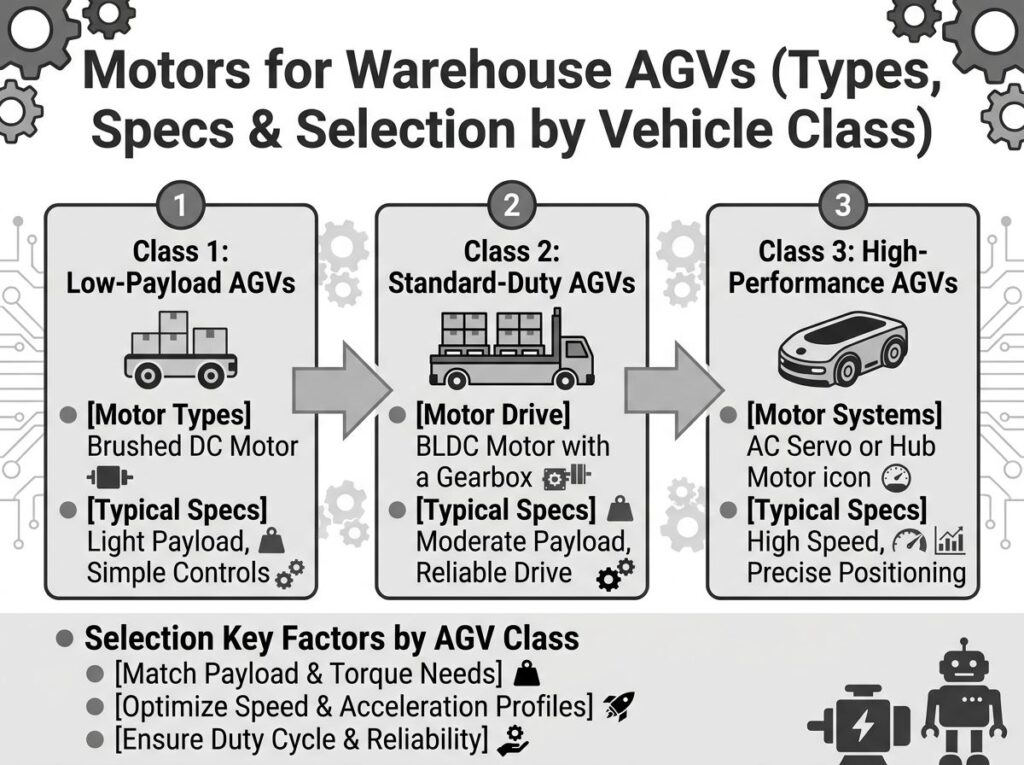
Motors for Warehouse AGVs: Типы, Specs and Selection by Vehicle Class
Быстрый ответ
Warehouse AGVs are almost always driven by brushless DC (BLDC) motors with Hall sensors, paired with a planetary gearbox, encoder and brake. Match the motor to the vehicle class and its duty cycle: tuggers and goods-to-person robots run intermittent МЭК 60034-1 S3; forklifts and high-frequency pick-and-place run S4; only long-distance towing runs S1. Pick voltage by power—24 V for ≤500 W micro-AMRs, 48 V for the 0.5–2 kW mainstream, 60–72 V for ≥1.5 kW heavy loads—and specify IE3–IE4 efficiency to extend battery runtime and cut heat.
Содержание страницы
ПереключатьWhat Are Motors for Warehouse AGVs?
Every warehouse AGV is a battery-powered, driverless robot whose motion comes from one or more electric traction motors. Термин “motors for warehouse AGVs” covers the full set of drive components—the motor itself, its controller, коробка передач, the encoder/feedback device and the brake—because in an AGV these are specified as a system, not piecemeal.
The global warehouse-AGV market reached US$12.68 billion in 2025, up 23.4% year on year, and is projected to pass US$31.2 billion by 2030 (≈19.7% CAGR). E-commerce and express logistics alone bought about 182,000 units in 2025—40.5% of all shipments. That demand is what drives motor selection: integrators need drives that deliver high torque from standstill, survive 24/7 duty, and squeeze maximum runtime from a battery pack. For a full taxonomy of the vehicles themselves, see our guide to the types of AGVs used in modern warehouses.
How the AGV Drive Chain Works
Regardless of vehicle class, every warehouse AGV shares the same drive chain. Mapping the motor to the job means walking this chain and assigning the right component at each stage:
Шаг 1 — Battery supplies the bus
A LiFePO₄ or Li-ion pack delivers a nominal bus voltage (24/48/60/72 В). The motor controller converts DC to the three-phase waveform the motor needs. Потому что P = V × I, a higher bus voltage means lower current for the same power, вот почему 48 V displaced 24 V as the warehouse default.
Шаг 2 — Controller commutates the motor
Для BLDC двигатель, the controller switches current based on rotor position from Hall sensors (block commutation) or an encoder (sinusoidal/FOC). Maxon documents that block commutation shows ~14% torque ripple, while field-oriented control (ВОК) delivers about 5% more continuous torque with smoother running. Sensorless schemes exist but hesitate at 0 RPM—problematic for a loaded AGV at startup (см. наш Hall vs sensorless comparison).
Шаг 3 — Gearbox multiplies torque
A planetary gearbox trades speed for torque at 90–95% efficiency. The wheel torque is T_wheel = T_motor × ratio × η_gear. A worm gear (60–75% efficient) self-locks but wastes 25–40% of the motor’s effort; it is reserved for forklift masts where locking matters more than efficiency.
Шаг 4 — Wheel meets the floor
Two independently driven wheels (differential drive) steer by speed difference; a tricycle drive uses one steered powered wheel; omnidirectional AGVs use Mecanum or omni-wheels. The motor only “works” if the wheel can transmit traction without slipping.
Шаг 5 — Feedback closes the loop
An encoder or resolver reports position and speed to the controller for precise docking. Yaskawa’s Sigma-7 servo uses a 24-bit absolute encoder (16.7 million pulses/rev); integrated servo motors from Maxon and Faulhaber embed Hall + NTC temperature sensors for commutation and thermal protection in the same housing.
Motor Topology Comparison for Warehouse AGVs
Five motor families cover the entire warehouse AGV spectrum. The table contrasts them on the parameters that actually decide a build:
| Topology | Best AGV fit | Обратная связь | Напряжение | Typical power | Torque character | Why choose it |
|---|---|---|---|---|---|---|
| BLDC, block commutation (Зал) | Tuggers, unit-load, under-ride | 3× Hall | 24–72 V | 200 W–3 kW | High start torque, ~14% ripple | Cheapest, крепкий, certain at 0 об/мин |
| BLDC with FOC / sinusoidal | Forklift, precise docking, GTP | Кодер + Зал | 24–72 V | 200 W–3 kW | +5% continuous torque vs block, гладкий; плавный | Smooth low-speed, less vibration |
| Integrated servo (motor+driver+encoder) | Space-limited chassis, AMR | 17-bit+ absolute | 24–60 V | 200 W–2 kW | Высокий динамический отклик | Cuts wiring 50%+, fast commissioning |
| Closed-loop hybrid stepper | Sorting diverts, lift axes | Кодер | 24–48 В | 50–400 W | High holding torque, zero step loss | Millisecond start/stop, дешевый |
| Бескня / flat BLDC | Robot joints, thin modules | Hall or TSX encoder | 12–60 V | 30–600 W | Very high torque density, thin | Max torque in minimum axial space |
Faulhaber’s BX4 series (Ø22–32 mm, 6–48 В, вплоть до 96 mN·m, ~78% max efficiency) and BXT flat motors (Ø22–42 mm, вплоть до 134 mN·m at just 14 mm length) are textbook examples of the compact end; Maxon’s EC frameless flat kits (Ø43–90 mm, 30–600 W, NTC at the winding) show the high-torque-density approach for embedded joints.
Инженерные данные: Эффективность, Torque and Duty
Efficiency and the heat it leaves behind
A BLDC traction motor runs at roughly 85–91% efficiency, so 9–15% of input power becomes heat. Higher IE class means less waste heat and longer runtime per charge:
| IE class (МЭК 60034-30-1) | Типичная эффективность | Warehouse AGV implication |
|---|---|---|
| IE1 / IE2 | Базовый уровень / Высокий | Not used in battery AGVs—too much heat, short runtime |
| IE3 (Премиум) | ~90–93% | Minimum for new warehouse traction drives |
| IE4 (Супер Премиум) | ~93–96% | Recommended for 24/7 fleets; matches EU ErP 2019/1781 |
| IE5 (Ultra) | >96% | Emerging in reluctance/synchronous PM drives |
Siemens reports its SIMOTICS SD IE4 motors reach над 96% эффективность and exceed the EU ErP 2019/1781 пороги; Yaskawa’s Sigma-7 SGM7A 2.0 kW servo is rated ≥94% with a 24-bit encoder and optional brake. In the U.S., в МО 10 Часть CFR 431 rule will require IE4 for 1–750 hp grid motors from June 1, 2027—signaling the global direction even though battery AGVs follow IEC 60034-30-1.
Torque and the force model
Wheel torque comes from the resistance force the vehicle must overcome. For a 2-wheel differential drive:
T_wheel = (F_roll + F_acc + F_grade) × r ÷ n
где F_roll = m × g × Crr (rolling resistance, polyurethane on concrete Crr ≈ 0.015–0.025), F_acc = m × a (acceleration force, a ≈ 0.3–0.8 m/s²), r is wheel radius and n is the number of driven wheels. Per-wheel targets by payload class:
| Payload class | Gross mass | Per-wheel cont. крутящий момент | Напряжение | Typical motor power |
|---|---|---|---|---|
| Micro AMR (shelf-scan) | 30–80 kg | 0.5–2.0 N·m | 12–24 В | 30–100 W |
| Light AMR (goods-to-person) | 80–200 kg | 2.0–5.0 N·m | 24 В | 100–300 W |
| Medium AGV (pallet, unit-load) | 200–500 kg | 5.0–15.0 N·m | 24–36 V | 300–800 W |
| Heavy AGV (сборка, hospital) | 500–3,000 kg | 15–60 N·m | 48 В | 800 W–2 kW |
| Heavy transfer cart | 3,000–60,000 kg | 60–300+ N·m (dual) | 48–72 V | 2× 1.5–3 kW |
Always verify with RMS torque over the duty cycle, not the peak: T_rms = √(Σ(Tᵢ²·tᵢ) / Σtᵢ). A motor sized only for peak will overheat on an S4 cycle (см. наш AGV motor overheating guide).
Рабочий цикл (МЭК 60034-1)
The duty class decides how hard the motor may run between cooling rests:
| МЭК 60034-1 class | Pattern | Warehouse AGV example | Sizing note |
|---|---|---|---|
| С1 | Непрерывный, reaches thermal equilibrium | Long-distance towing loop | Nameplate values are safe |
| S3 | Run/stop, starting ignored | Tugger, goods-to-person | S3-40% can deliver ~1.6× S1 torque in on-period |
| S4 | Run/stop with starting heat | Forklift, high-freq pick-place | Add starts/hr to the rating |
| S5 | + electric braking | Stacker crane positioning | Braking adds winding heat |
| S6 | Непрерывный, load/no-load | Assembly-line platform | Never fully cools while spinning |
Temperature and insulation limits
Warehouse AGV traction motors should use at least Класс F (155 °С) изоляция, с Класс Н (180 °С) for foundries, steel mills or ambient above 50 °С. Ан “F/B” рейтинг (Изоляция класса F, Повышение класса B) buys ~25 °C extra margin and roughly doubles insulation life. Field stop-and-inspect thresholds: case above 90 °C or bearing outer ring above 95 °С (per SKF bearing-temperature guidance).
Best Applications by AGV Class
The reliable way to spec a motor is to start from the vehicle class. Each class has a dominant drive topology, voltage and duty:
| Warehouse AGV class | Payload | Drive topology | Напряжение | IEC duty | Motor recommendation |
|---|---|---|---|---|---|
| Tugger / tow | 1,000–10,000 kg towed | Differential, 2× driven | 48 В | S3 (long loops) | BLDC gear-motor, 800 W–2 kW/wheel |
| Unit-load | 500–5,000 kg | Differential or tricycle | 24–48 В | S3 / S4 | BLDC + планетарный, 300 W–2 kW |
| Forklift / stacker | 1,000–3,000 kg | Differential + mast servo | 48–60 V | S4 | BLDC traction + servo lift, brake on mast |
| Goods-to-person (GTP) | 200–1,500 kg | Omnidirectional (Mecanum) | 24–48 В | S3 (high cycles) | 4× integrated servo or BLDC omni |
| Under-ride / turtle | 500–2,000 kg | Differential, low-profile | 24–48 В | S3 | Flat/outrunner BLDC, thin profile |
| Heavy-duty burden | 10,000–100,000+ kg | Multi-wheel, 4+ driven | 60–72 V | S4 / S5 | Dual BLDC + brake gearbox per axle |
| Sorting cart / divert | parcels | Per-divert actuator | 24–48 В | S6 | Closed-loop stepper or low-inertia BLDC |
For drive-wheel architecture and radial-load handling, см. наш AGV wheel-motor design guide; for gearbox trade-offs, наш gear-motor vs direct-drive comparison.
How to Select a Warehouse AGV Motor (Шаг за шагом)
- Fix the vehicle class and payload. Use the class table above to set the starting torque and voltage band.
- Compute resistance force.
F = m·g·Crr + m·a(добавлятьm·g·sinθfor ramps). Pick Crr from your wheel/floor combo. - Convert to wheel torque.
T_wheel = F·rfor one wheel (double it for a single 2-wheel differential drive). - Back out motor torque. Divide by gear ratio and gear efficiency; choose a motor whose rated torque clears the value with a 1.5 запас прочности.
- Pick the voltage by power. ≤500 W → 24 В; 0.5–2 kW → 48 В; ≥1.5 kW or 1.5–3 t → 60–72 V. Посмотрите наш battery voltage selection guide.
- Match the duty cycle. Confirm S1/S3/S4 against the real load-stop profile and size for RMS torque. Наш скорость & RPM guide links duty to usable speed.
- Set the efficiency and insulation class. Specify IE3–IE4 and Class F (H for harsh sites). Verify the controller’s under-voltage and current-limit protection are enabled.
- Confirm feedback and brake. Зал + encoder for traction; an electromagnetic brake for any vertical or parked-load axis. Validate the full stack against our motor selection checklist а также torque calculator.
Распространенные инженерные ошибки
| # | Ошибка | Последствие |
|---|---|---|
| 1 | Sizing for peak power, not RMS torque | Overheats on S4 cycles; insulation ages 2× faster |
| 2 | Running an S1 motor on an S3/S4 stop-start load | Never sheds start-up heat; winding fails early |
| 3 | Choosing 24 V for a >500 W drive | Double current → 4× copper loss, fat cables, hot controller |
| 4 | Ignoring voltage sag under load | Controller raises current to hold torque; I²R loss climbs |
| 5 | Skipping the brake on vertical/lift axes | Load drop on power loss; safety risk |
| 6 | Specifying IE1/IE2 to cut cost | More heat, shorter runtime, fails EU/IE4 trend |
| 7 | Undersizing radial-load capacity of the wheel motor | Bearing fails; SKF notes >95 °C outer-ring is the danger line |
Таблица устранения неполадок
| Проблема | Likely cause | Решение |
|---|---|---|
| Motor overheats only at startup | Duty mismatch (S4) or mechanical binding | Verify S4 rating; check brake release and wheel alignment |
| Short runtime per charge | Low IE class or oversized current draw | Move to IE3–IE4; check voltage sag and Crr |
| Hesitant / jerky launch under load | Sensorless commutation at 0 об/мин | Use Hall-sensored BLDC or FOC with encoder |
| Bearing runs hot (>95 °С) | Lubrication or fit issue | Re-grease, check tolerance; inspect per SKF guidance |
| Won’t hold position on a slope | No brake or brake disabled | Enable 24 V DC electromagnetic brake on the axis |
| Controller trips on acceleration | Current limit too low for peak torque | Raise limit or upsize motor/voltage |
| Uneven straight-line tracking | Left/right wheel torque mismatch | Match gearbox backlash (≤3 arc-min); recalibrate |
| Excess vibration at low speed | Block-commutation torque ripple | Switch to FOC/sinusoidal commutation |
Часто задаваемые вопросы
What type of motor is used in warehouse AGVs?
Most use brushless DC (BLDC) motors with Hall sensors for traction, paired with a planetary gearbox, encoder and brake. Integrated servo motors dominate space-constrained chassis; closed-loop steppers drive sorting diverts; frameless/flat BLDC motors fit tight axial spaces.
How do I choose a motor for a specific warehouse AGV class?
Start from the vehicle class and duty cycle (tugger = S3, forklift = S4, GTP = S3 high-cycle), size for RMS torque, pick voltage by power (24/48/60–72 V bands), and confirm IE3–IE4. The class-to-motor matrix above is the starting point.
Why is 48 V the default for warehouse AGVs?
В 48 V the same 1 kW drive draws about half the current of 24 В, so I²R copper loss and cable size drop ~4×. It sits below the 60 V DC SELV limit, keeps drivers/batteries cost-effective, and matches a 16S LiFePO₄ pack (51.2 В). Above ~1.5 kW or 1.5–3 t, move to 60–72 V.
Do AGV motors need IE3 or IE4?
Battery AGVs follow IEC 60034-30-1. Specifying IE3–IE4 extends runtime and reduces heat; EU ErP 2019/1781 already requires IE3 from 0.75 кВт, and the U.S. DOE IE4 rule (Июнь 1, 2027, 1–750 л.с.) shows the global trend. IE3–IE4 is the safe baseline.
What duty cycle should a warehouse AGV motor be rated for?
Most run intermittent: S3 for tuggers and goods-to-person, S4 for forklifts and high-frequency pick-and-place. Size for RMS torque over the full cycle—an S1 motor on S4 will overheat. S1 fits only long-distance towing.
How much torque does a warehouse AGV motor need?
Per driven wheel: 200–500 kg medium AGV ≈ 5–15 N·m; 500–3,000 kg heavy ≈ 15–60 N·m; 3–60 t cart ≈ 60–300+ N·m (dual). Derive from T = F·r / n с F = m·g·Crr + m·a, добавить 1.5 запас прочности, and verify against the load-stop-load cycle.
Why Choose GreenSky for Warehouse AGV Motors?
GreenSky Power designs and manufactures BLDC and integrated servo traction motors built around the realities of warehouse duty—Class F/H insulation, S1/S3/S4 ratings, Зал + encoder feedback, and electromagnetic brakes as standard. Наш OEM motor manufacturing program lets integrators specify voltage (24/48/60/72 В), фланец, encoder resolution and gearbox ratio per vehicle class, with IE3–IE4 efficiency and full IEC 60034 документация. From micro-AMRs to 60 t transfer carts, we supply the drive stack—not just the motor—so your AGV hits its torque, runtime and duty targets on the first build.
Talk to our AGV drive engineers →
Ссылки
- МЭК 60034-1:2022 — Rotating electrical machines, Часть 1: Рейтинг и производительность (duty cycles S1–S10). webstore.iec.ch/publication/84115
- МЭК 60034-30-1:2014 — Efficiency classes of line-operated AC motors (IE1–IE5). webstore.iec.ch/publication/6549
- НЕТ МГ 1-2021 — Двигатели и Генераторы (tests, производительность, insulation/temperature). nema.org/standards/view/mg-1-tr-2021-motors-and-generators
- НАС. МО, 10 Часть CFR 431 — Energy conservation standards for electric motors (IE4 с июня 1, 2027, 1–750 л.с.). ecfr.gov/current/title-10/chapter-II/subchapter-D/part-431
- Mejri E. et al., “Energy Efficient Order Picking Routing for a Pick Support AGV,” IEEE Access, том. 10, 2022 (18% tour-cost saving). doi.org/10.1109/ACCESS.2022.3212797
- Schmidt M. et al., “Energy efficiency optimization by automatic coordination of motor speeds in conveying systems,” IEEE, 2015. ieeexplore.ieee.org/document/7125185
- “Optimization of motion and energy consumption of an industrial automated ground vehicle,” IEEE, 2021. ieeexplore.ieee.org/document/9555554
- Сименс АГ, “SIMOTICS SD motor series consistently in efficiency class IE4” (ErP 2019/1781). press.siemens.com/global/en/node/6164
- СКФ, Bearing knowledge centre — bearing temperature, lubrication and failure analysis for motors. skf.com/group/knowledge-centre
- Международное энергетическое агентство (МЭА), Industry — motor-driven systems and energy efficiency. iea.org/energy-system/industry