
What Is an AGV and How Does It Work?
Conteúdo da página
AlternarO que é um AGV? (Definição)
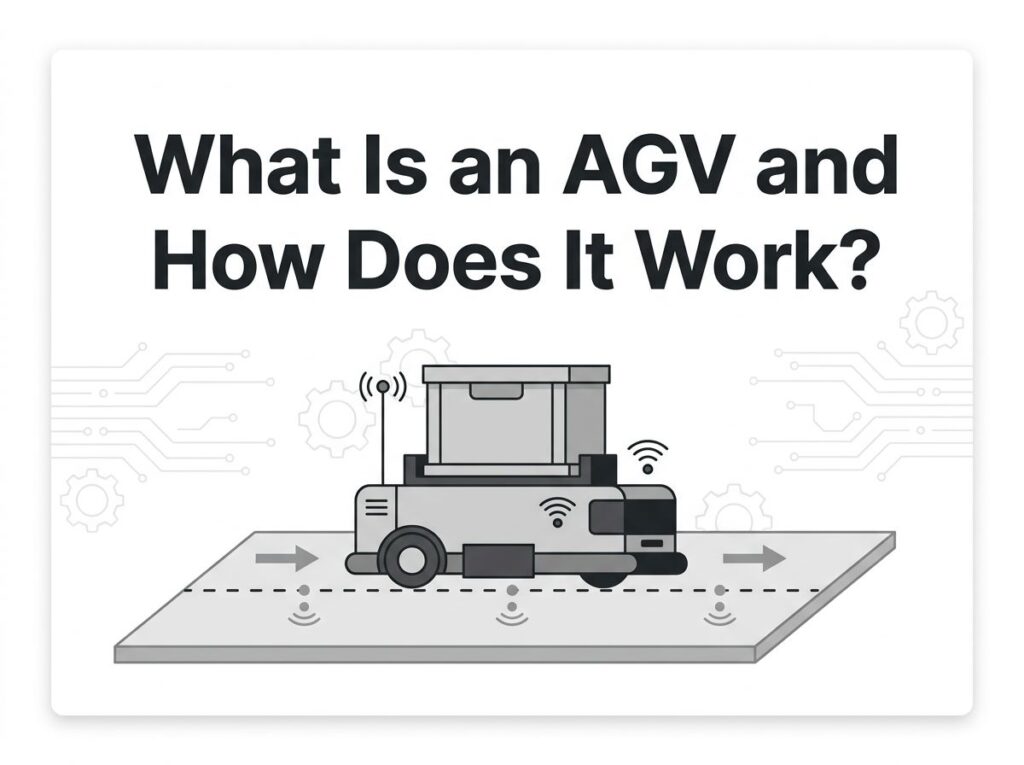
Um Veículo guiado automatizado (AGV) is a driverless floor-level transport vehicle that moves materials without a human operator. In standards and industry usage, the term refers both to the individual vehicle and to the larger Automated Guided Vehicle System (AGVS), which bundles the vehicles, the guidance or navigation infrastructure, the safety sensors, and the fleet-control software into one coordinated material-handling solution.
The first AGV was built in 1953 by Barrett Electric as a modified tow tractor following a wire buried in a warehouse floor. The technology matured through the 1970s—notably at Volvo’s Kalmar plant, where roughly 280 computer-controlled assembly AGVs were deployed—and has since expanded from simple tow tractors into forked, unit-load, omnidirectional, and heavy-industrial platforms.
AGV vs. AMR: Where the Boundary Sits
The distinction that most often confuses buyers is the one between an AGV and an Robô Móvel Autônomo (AMR). Traditional AGVs follow fixed physical guides—magnetic tape, embedded wire, QR codes, or laser reflector arrays—and halt when their path is blocked. AMRs sense their environment with LiDAR, 3D cameras, and SLAM software, navigating dynamically and rerouting around obstacles. In practice the line is blurring: many current “AGVs” ship with natural-feature navigation that removes the need for floor infrastructure.
| Dimensão | AGV (guided) | AMR (autonomous) |
|---|---|---|
| Navigation basis | Magnetic tape, wire, QR code, laser reflector | SLAM + LiDAR / 3D camera, no fixed guide |
| Path flexibility | Fixed; re-layout requires new infrastructure | Software-defined; rerouted in minutes |
| Obstacle response | Stops at blockage | Detects and drives around |
| Deployment time | Days–weeks (infrastructure install) | Hours–days (map + teach) |
| Upfront cost | Lower per unit | Higher per unit |
| Best fit | Estável, repetitive, high-volume flows | Changing layouts, mixed human traffic |
How Does an AGV Work? (Passo a passo)
An AGV operates as a closed loop of command, perception, motion, and feedback. The sequence below describes a single transport cycle for a typical line-feed AGV.
Etapa 1 — Receive and queue the transport order
The fleet management system (FMS) or warehouse control system (WCS) issues a move task: pick up at station A, deliver to station B. The order is transmitted over Wi-Fi/5G to the vehicle’s onboard controller.
Etapa 2 — Plan the path
For guided AGVs, the route is a stored line-follow profile. For autonomous units, the navigation stack computes a path using the live map, traffic rules, and current obstacle state. Traffic management prevents two vehicles from claiming the same segment.
Etapa 3 — Localize and perceive
Sensors establish the vehicle’s position: magnetic tape readers and RFID tags for guided AGVs; LiDAR odometry, IMU, and wheel encoders for autonomous units. A safety laser scanner continuously sweeps a 270°–360° zone for people and obstacles.
Etapa 4 — Drive the wheels
The controller commands the motores de acionamento. Electric current is modulated by the servo or BLDC driver to produce the torque needed for acceleration, cruising, and climbing. The required wheel torque depends on total mass, rolling resistance, ramp angle, and acceleration—quantified in the engineering section below.
Etapa 5 — Close the loop with feedback
Incremental or absolute encoders on the motor and/or wheel report speed and position at kHz rates. Field-oriented control (FOC) uses this feedback to hold velocity against load changes and to stop at the docking point within the specified tolerance (±1–10 mm depending on the architecture).
Etapa 6 — Handle the load and report
Fork, roller deck, lift platform, or hook executes the pick/place. The vehicle confirms completion to the FMS, then idles or moves to its next assigned task. Battery state is monitored continuously; the AGV diverts to a charger or battery-swap station when state-of-charge crosses the threshold.
The drive system—motor, caixa de velocidade (or hub), codificador, and controller—is the only subsystem that directly turns stored energy into motion. Everything else (navigation, segurança, load handling) exists to tell it onde e when to apply torque.
AGV Types & Drive System Comparison
Vehicle types by load function
| Modelo | Load method | Typical payload | Signature use |
|---|---|---|---|
| Tugger AGV | Pulls carts/trailers | 0.5–3 t (train) | Line-side kit delivery |
| Unit-load AGV | Conveyor/roller deck on top | 50–1500kg | palete & tote transport |
| Forklift AGV | Lift + forks | 1–2 t | Pallet stacking, rack interface |
| Underride AGV | Drives under racks/carts | 0.3–1 t | Shelf transport, goods-to-person |
| Heavy-duty AGV | Platform / omnidirectional | 2–50 t | Automotive body, steel coil |
Drive system architectures
The drive system defines how the vehicle steers and moves. Gear-motor and direct-drive options are covered in depth elsewhere; the three steering topologies below are the ones most AGV buyers must choose between.
| Drive type | Steering principle | Precisão | Complexidade / custo | Common AGV use |
|---|---|---|---|---|
| Differential | Two driven wheels, speed difference turns | ±5–10 mm | Baixo | Standard transport, tow, underride |
| Direção (舵轮) | Rotating drive module controls drive + direção | ±1–5 mm | Médio | Forklift, AMR, omnidirectional |
| Omnidirectional | Mecanum / swerve wheels, any direction | ±1–2 mm | Alto | Tight aisles, precision docking |
Motor technology in the drive system
| Motor | Eficiência | Life (h) | Posicionamento | Tensão | Best AGV fit |
|---|---|---|---|---|---|
| DC escovado | 60–75% | 2,000–5,000 | ±5–10 mm | 24/48 V | Low-cost carts |
| BLDC | 85–92% | 10,000–20,000+ | ±0.5–2 mm (enc.) | 24/48 V | Warehouse AMR, logística |
| BLDC servo | 90–95% | 10,000–20,000+ | ±0.1 mm | 48 V | Docking, elevador, steering |
| AC servo | 90–96% | 20,000+ | ±0.05 mm | 72/80 V | Heavy >2 t, conjunto |
| Passo a passo | 70–80% | 10,000+ | ±1–5 mm (open) | 12/24 V | Light, low-speed AGC |
Dados de engenharia: Ciclos de trabalho, Eficiência & Motor Formulas
IEC 60034-1 duty cycles for AGV motors
AGV motors rarely run at constant load. IEC 60034-1:2022 defines ten duty types (S1–S10); five govern AGV selection. Most AGVs operate in S3 (intermittent periodic) ou S4 (with starting losses). The key consequence: a motor’s continuous torque rating must cover the RMS torque over the full cycle, not the peak.
| IEC class | Thermal behavior | AGV match | Torque derating |
|---|---|---|---|
| S1 | Reaches steady-state temperature | 24/7 conveyor-style, long-haul tow | None — rated = continuous |
| S2 | Cools to ambient between runs | Batch transport, long idle | 1.5–2× S1 for short bursts |
| S3 | No full cooling between cycles | Goods-to-person AMR, pick-place | By duty % (ed = on-time / cycle) |
| S4 | Starting losses included | Frequent start-stop feeder | Derate 10–20% vs S1 |
| S5 | Braking energy adds heat | Ramp AGV with regen braking | Braking heat must dissipate/regen |
RMS torque for intermittent duty
For S3/S4 operation, compute RMS torque over one cycle and require the motor’s continuous rating to exceed it at operating ambient temperature:
TRMS = √[(T₁²·t₁ + T₂²·t₂ + … + Tₙ²·tₙ) / (t₁ + t₂ + … + tₙ)]
Core drive formulas
| Quantity | Formula | Symbols |
|---|---|---|
| Wheel torque (traction) | T = (m·g·(μ + sinθ) + m·a) · r / (n·η) | m = total mass; μ = rolling resist.; θ = ramp; a = accel.; r = wheel radius; n = drive wheels; η = drivetrain eff. |
| Vehicle speed | v = π · D · N / ig | D = wheel Ø; N = motor rpm; eug = gear ratio |
| Potência do motor | P = T · ω = T · 2πN / 60 | T in N·m; N in rpm; P in W |
| Climb force | Fclimb = m · g · sinθ | θ = ramp angle (E.G.. 5° = 0.087 rad) |
NÃO MG 1 and IEC efficiency reference
NÃO MG 1 (Mesa 12-12) sets the nominal full-load efficiency values enforced in the U.S. by the DOE; IEC 60034-30-1 defines the IE1–IE5 classes used internationally. For battery AGVs the incremental loss between classes translates directly into runtime:
| Aula | Relative loss vs IE1 | AGV relevance |
|---|---|---|
| IE1 (Padrão) | Baseline | Legacy / non-regulated |
| IE2 (Alto) | −10% loss | Entry BLDC |
| IE3 (Prêmio / SEM Prêmio) | −20% loss | Baseline for new AGV motors |
| IE4 (Superpremium) | −30% loss vs IE1 | Preferred for long-shift AGVs |
| IE5 (Ultrapremium) | −40% loss vs IE1 | Integrated servo / PMSM |
Manufacturer benchmark data
| Fornecedor | produtos / method | Relevant figure |
|---|---|---|
| Maxão | IDX / EC wheel drive (MW500) | ≤500 kg per drive; 11.4–23.7 N·m continuous wheel torque; IP65; 24/48 V |
| Faulhaber | DualGear (BX4 + GPT) | 32 mm Ø; 1.1 N·m cont. / 7 N·m peak; ≤0.6° backlash; −30…120 °C |
| Yaskawa | Sigma-7 servo | 3.1 kHz speed-loop bandwidth; 350% overload 3–5 s; 24-bit encoder; STO SIL3 |
Best Applications for AGVs
| Indústria | Inscrição | Preferred AGV / dirigir |
|---|---|---|
| Automotivo | Line-side kit delivery, body transport | Tugger / heavy unit-load, differential |
| Warehouse & 3PL | Pallet move, goods-to-person | Underride / AMR, BLDC servo |
| Food & Beverage | Cold-store supply, production feed | Unit-load, IP65 BLDC |
| Pharma | Cleanroom transport, track & trace | Low-vibration servo, omnidirectional |
| Eletrônicos | Precision workpiece supply | Steering drive, ±1 mm encoder |
| Heavy industry | Coil, mold, assembly transport | Serviço Pesado >2 t, AC servo |
How to Choose an AGV: Passo a passo
- Define the transport task. Mass, dimensions, pick/place points, cycle time, and routes. Estável, high-volume flows favor guided AGVs; variable layouts favor AMRs.
- Set accuracy and speed. Mechanical-stop docking (±5–10 mm) needs only Hall BLDC; QR/laser/vision docking (±1–2 mm) needs encoder BLDC servo; sub-mm assembly needs AC servo.
- Pick the drive topology. Differential for cost-sensitive transport; steering (舵轮) for forklift and flexible AMR; omnidirectional for tight-aisle precision.
- Size the motor. Use the torque and speed formulas above; select a motor whose rated speed is 1.5–2× the required wheel speed, then choose the gear ratio. Verify continuous torque vs. RMS torque for the S3/S4 duty.
- Match the voltage bus. 24/48 V DC → BLDC family; 72/80 V → AC servo or high-power BLDC servo. Confirm charger and battery capacity against shift energy demand.
- Specify safety & ambiente. Classificação IP (IP54 minimum for dusty floors, IP65 for washdown), safety scanner zone, STO (SIL3/PL-e) for collaborative space.
- Validate with a pilot. Run the duty cycle on the floor; measure actual current draw and temperature. Compare against the speed/RPM selection guide before fleet rollout.
Common Engineering & Procurement Mistakes
| Mistake | Consequence | Correct approach |
|---|---|---|
| Sizing on peak torque only | Superaquecimento, mid-shift thermal shutdown | Size on RMS torque over the full S3/S4 cycle |
| Ignoring ambient derating | 40 °C warehouse cuts torque 10–15% | Derate per IEC thermal class; use Class F/H for hot sites |
| Wrong gear ratio | Motor runs in inefficient low-speed zone | Keep motor above ½ no-load speed; ratio down to wheel speed |
| Under-specifying IP rating | Bearing failure in dust/washdown | IP54 minimum; IP65 for harsh/food environments |
| Choosing AC servo on 48 V bus | Needs DC-AC conversion, added cost | Use BLDC servo on DC bus; reserve AC servo for >2 t |
| No safety interlock (STO) | Fails ISO 3691-4 / CE audit | Specify STO SIL3/PL-e from the start |
| Oversizing battery | Cost and weight penalty | Model energy per cycle; size to 1.2–1.5× shift demand |
| Treating AGV and AMR as identical | Wrong TCO, poor flexibility | Decide by layout stability, not by price alone |
AGV Troubleshooting Table
| Problema | Likely cause | Solução | Subsystem |
|---|---|---|---|
| Mid-shift thermal trip | RMS torque > continuous rating | Reselect motor or improve cooling; check duty % | Motor |
| Poor docking repeatability | Encoder resolution too low / escorregar | Upgrade to 17-bit+ encoder; verify wheel grip | Dirigir / feedback |
| Premature bearing wear | Contamination, wrong IP rating | Move to IP65; use low-friction bearing | Mecânico |
| Short battery runtime | Baixa eficiência do motor (IE1/IE2) | Switch to IE3/IE4 BLDC; review regen | Poder |
| Wandering path | Tape damage / LiDAR drift | Replace guide; recalibrate map; check IMU | Navigation |
| Ruído excessivo | Worm gearbox / engrenagem | Use planetary (η 0.90–0.95); FOC tuning | Gear / ao controle |
| Can’t climb ramp | Undersized torque margin | Add 1.2–1.5× safety factor; lower ratio | Motor / engrenagem |
| Controller fault on start | Inrush current vs S4 rating | Select for S4 duty; soft-start profile | Motor / dirigir |
| Communication drop | Wi-Fi dead zone | Add access point; mesh network | FMS |
| Unexpected stop near people | Safety scanner too sensitive | Zone tuning per ISO 3691-4 | Segurança |
Perguntas frequentes
What is an AGV in simple terms?
An AGV is a driverless, battery-powered industrial transport robot that moves materials along predetermined paths (ou, in modern AMR-class vehicles, via autonomous navigation). It receives orders from a fleet controller and reports completion without a human operator.
How does an AGV actually move?
An electric drive system generates motion: a BLDC, servo, or stepper motor converts battery energy into torque, a gearbox or direct-drive hub multiplies that torque to the wheel, and an encoder feeds position/speed back to the controller, which modulates current to follow the commanded path.
What is the difference between an AGV and an AMR?
AGVs follow fixed physical guides and stop when blocked; AMRs use SLAM, LiDAR, and 3D cameras to navigate dynamically and reroute in software. The boundary is blurring as AGVs adopt natural-feature navigation. See the AGV vs AMR comparison.
What motor does an AGV use?
Most AGVs use 24 V/48 V BLDC motors (85–92% efficiency) for standard transport, BLDC servo with encoders for ±1–2 mm docking, and AC servo (72–80 V) for heavy units above 2 t. Stepper motors appear in low-cost, low-speed carts.
How much torque does an AGV motor need?
Wheel torque follows T = (m·g·(μ + sinθ) + m·a)·r / (n·η). For intermittent S3/S4 duty the motor’s continuous torque must exceed the RMS torque over the full cycle—see AGV motor torque calculation.
Are AGVs worth the investment?
For repetitive, stable flows (automotivo, pallet moves, cleanrooms) AGVs give 24/7 operation and fast payback. Where layouts change often, an AMR’s software flexibility usually lowers total cost of ownership despite higher upfront price.
Why Choose GreenSky Power?
GreenSky Power has designed and manufactured motion-control solutions for AGV and AMR builders since 2011, supplying OEM customers in 50+ países. For AGV drive systems we provide:
- One-source motor + caixa de velocidade + controlador. DC escovado, BLDC, BLDC servo, and micro-AC platforms deploy as direct-drive hubs or pair with our planetary, minhoca, parallel-shaft, and right-angle gearboxes—see gear motor vs direct drive e spur vs planetary.
- AGV-specific engineering support. Send mass, velocidade, aceleração, slope, and wheel diameter; our team returns a calculation sheet with recommended motor, caixa de velocidade, and controller specs.
- Standards compliance. All motors tested per IEC 60034 and NEMA MG 1; batch dynamometer reports supplied. Thermal Class F (155 °C) padrão, Class H available.
- Efficiency focus. IE3/IE4 BLDC servo platforms extend per-charge runtime—relevant to the battery runtime discussion above.
- Custom OEM programs. From prototype to volume production, including the OEM manufacturing process e EU-compliant supply.
Referências & Authority Sources
- Comissão Eletrotécnica Internacional. IEC 60034-1:2022 — Rotating Electrical Machines, Papel 1: Rating and Performance. Geneva: IEC, 2022. https://webstore.iec.ch/publication/60796
- Associação Nacional de Fabricantes Elétricos. NÃO MG 1-2021 — Motores e Geradores (Mesa 12-12 eficiência; §12.58 tolerance). Rosslyn, VA: NÃO HÁ, 2021. https://www.nema.org/standards/view/mg-1-motors-and-generators
- NÓS. Departamento de Energia. 10 CFR Part 431 — Energy Conservation Program for Certain Industrial Equipment. 2027 motor efficiency rule. https://www.ecfr.gov/current/title-10/chapter-II/subchapter-D/part-431
- Agência Internacional de Energia (IEA 4E EMSA). Electric Motor Systems: Why Are They Important? Policy Brief, 2025 (motor systems = 53% da eletricidade global). https://www.iea-4e.org/publications/
- SKF Group. Energy Efficient (E2) Deep Groove Ball Bearings for Electric Motors (30–50% friction reduction). https://www.skf.com/binary/57-121274/E2-Electric-motors-offer-sheet_13279_EN.pdf
- Siemens AG. Digital Enterprise — Electronics Factory Erlangen (Digital Twin, −40% time-to-market, +60% qualidade, AGV material flow). https://www.siemens.com/global/en/products/automation/topic-areas/digital-enterprise/digital-transformers/electronics-factory-erlangen/artificial-intelligence.html
- maxon Group. IDX Integrated Drive & MW500 Wheel Drive for AGV/AMR (technical data). https://www.maxongroup.com/
- Dr.. Fritz Faulhaber GmbH. DualGear BX4 + GPT Drive System for Logistics (technical data). https://www.faulhaber.com/nl/lp/faulhaber-dualgear/
- Yaskawa elétrica. SIGMA-7 Servo Systems (3.1 kHz bandwidth, 350% sobrecarga, 24-bit encoder, STO SIL3). https://www.yaskawa.com/delegate/getAttachment?documentId=BL.Sigma-7.01
- IEEE. Zhang R., Chai R., Chai S., Xia Y., Tsourdos A. Design and Practical Implementation of a High Efficiency Two-Layer Trajectory Planning Method for AGV. Transações IEEE em Eletrônica Industrial, 2024, 71(2):1811–1822. DOI: 10.1109/TIE.2023.3250847
This article is for technical reference. Confirm final motor, caixa de velocidade, and controller selection with GreenSky Power engineering using your actual vehicle parameters.