
Motor BLDC vs Motor PMSM: Qual é a diferença?
As tecnologias de motores de ímã permanente tornaram-se a escolha preferida para sistemas de acionamento elétrico modernos devido à sua eficiência superior, alta densidade de potência, tamanho compacto, e controlabilidade precisa. Entre essas tecnologias, Motores CC sem escova (BLDC) e motores síncronos de ímã permanente (PMSM) são as duas soluções mais amplamente adotadas em veículos elétricos, robótica, Sistemas HVAC, automação industrial, equipamento médico, e equipamentos de energia ao ar livre.
Porque ambos os tipos de motores utilizam ímãs permanentes e sistemas de controle eletrônico, muitos engenheiros e profissionais de compras assumem que são essencialmente a mesma tecnologia. Na realidade, existem diferenças importantes nas características do Back EMF, algoritmos de controle, ondulação de torque, ruído acústico, eficiência, e custo do sistema.
Este guia de engenharia fornece uma comparação detalhada entre motores BLDC e PMSM para ajudar os engenheiros, Fabricantes OEM, e compradores industriais selecionam a tecnologia de motor mais adequada para suas aplicações.
Motor BLDC vs Motor PMSM
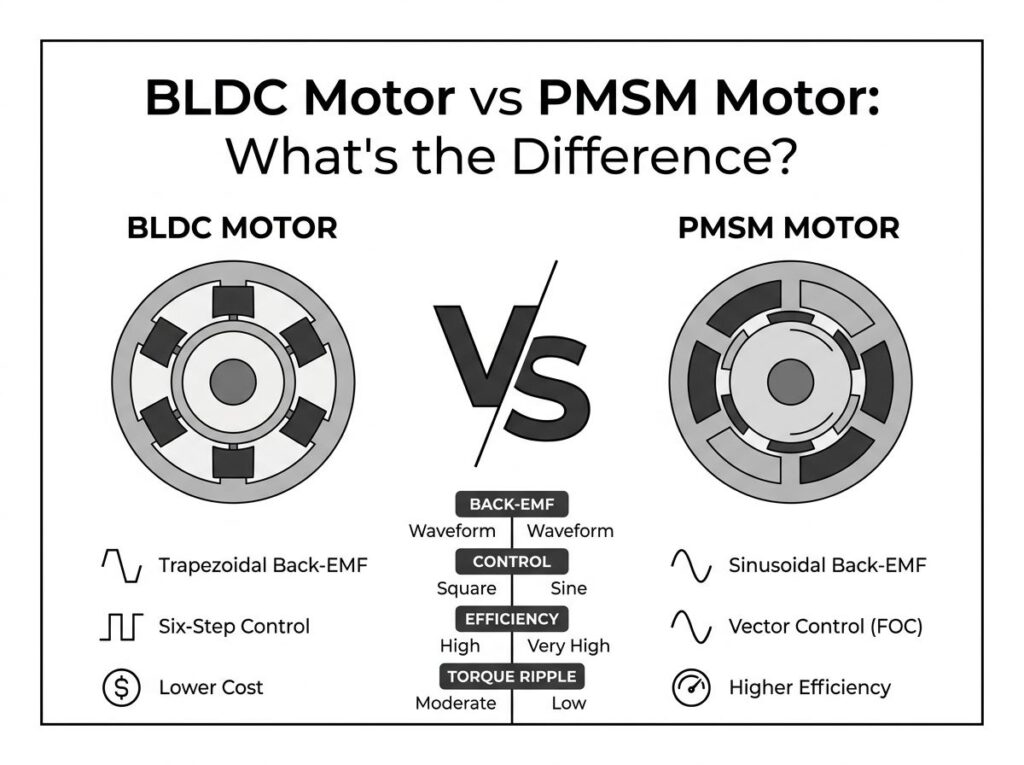
Os motores BLDC e os motores PMSM usam ímãs permanentes, mas os motores BLDC normalmente usam EMF traseiro trapezoidal e comutação de seis etapas, enquanto os motores PMSM usam EMF traseiro senoidal e controle senoidal. Os motores PMSM geralmente oferecem operação mais suave e maior eficiência, enquanto os motores BLDC fornecem controle mais simples e menor custo do sistema.
Em aplicações práticas, Os motores BLDC são comumente escolhidos para sistemas sensíveis ao custo que exigem bom desempenho, enquanto os motores PMSM são preferidos para aplicações premium que exigem eficiência máxima, entrega de torque suave, e controle preciso.
O que é um motor BLDC?
Um motor DC sem escova (Motor BLDC) é um motor de ímã permanente que substitui escovas mecânicas por comutação eletrônica. Em vez de usar contatos físicos de escova, um controlador eletrônico energiza os enrolamentos do estator com base no feedback da posição do rotor.
Os motores BLDC são caracterizados por sua força eletromotriz traseira trapezoidal (voltar EMF) forma de onda e normalmente operam usando estratégias de controle de comutação de seis etapas.
Construção Básica de um Motor BLDC
- Rotor de ímã permanente
- Bobinas do estator enroladas
- Controlador eletrônico
- Sensores de posição de efeito Hall (opcional)
- Circuito inversor de energia
Como funciona um motor BLDC
O controlador energiza os enrolamentos do estator sequencialmente para criar um campo magnético rotativo. Os ímãs permanentes montados no rotor seguem este campo magnético, produzindo movimento rotacional.
As informações de posição do rotor são normalmente obtidas de sensores Hall ou estimadas usando algoritmos de controle sem sensor.
Vantagens dos motores BLDC
- Alta eficiência
- Tamanho compacto
- Excelente densidade de potência
- Baixos requisitos de manutenção
- Sem desgaste da escova
- Boa capacidade de controle de velocidade
- Menor custo do controlador
Aplicações BLDC típicas
- Cortadores de grama elétricos
- Ferramentas elétricas sem fio
- Sopradores HVAC
- Automação industrial
- Equipamento médico
- AGVs e AMRs
- Catracas de segurança
- Bicicletas elétricas
Devido ao seu equilíbrio entre custo e desempenho, Os motores BLDC tornaram-se uma das tecnologias de motor mais populares em equipamentos OEM modernos.
O que é um motor PMSM?
Um motor síncrono de ímã permanente (PMSM) também é um motor de ímã permanente, mas ao contrário de um motor BLDC, ele é projetado para operar com uma forma de onda EMF traseira senoidal e excitação de corrente senoidal.
O rotor gira sincronizadamente com o campo magnético rotativo do estator, eliminando o deslizamento e permitindo uma operação altamente eficiente.
Construção Básica de um Motor PMSM
- Rotor de ímã permanente
- Enrolamentos de estator distribuídos
- Inversor de alto desempenho
- Codificador de posição ou resolvedor
- Controlador de motor avançado
Como funciona um motor PMSM
O controlador gera formas de onda de corrente senoidal que interagem com o campo magnético permanente do rotor. O motor opera em sincronismo preciso com o campo magnético rotativo gerado pelo estator.
A maioria dos sistemas PMSM usa Controle Orientado a Campo (FOC), que permite a produção suave de torque e controle preciso sobre velocidade e posição.
Vantagens dos motores PMSM
- Eficiência muito alta
- Excelente densidade de torque
- Saída de torque suave
- Baixo ruído acústico
- Baixos níveis de vibração
- Desempenho dinâmico superior
- Capacidade de alta velocidade
Aplicações típicas de PMSM
- Veículos elétricos
- Servosistemas industriais
- Robótica
- Máquinas CNC
- Sistemas aeroespaciais
- Equipamentos de automação de precisão
- Sistemas HVAC de última geração
A tecnologia PMSM domina muitas aplicações de alto desempenho onde a eficiência, precisão, e operação suave são requisitos críticos.
BLDC versus PMSM: Principais diferenças
Embora ambas as tecnologias pertençam à família de motores de ímã permanente, seu comportamento eletromagnético e filosofias de controle diferem significativamente.
| Recurso | Motor BLDC | Motor PMSM |
|---|---|---|
| EMF traseiro | Trapezoidal | Senoidal |
| Forma de onda atual | Retangular | Senoidal |
| Método de controle | Comutação em seis etapas | Controle FOC |
| Eficiência | Alto | Muito alto |
| Nível de ruído | Médio | Baixo |
| Ondulação de torque | Mais alto | Mais baixo |
| Resposta Dinâmica | Bom | Excelente |
| Complexidade do controlador | Mais baixo | Mais alto |
| Custo do sistema | Mais baixo | Mais alto |
| Aplicações Típicas | Equipamento para gramado, AVAC | VEs, Robótica |
A distinção técnica mais importante reside na forma como os motores geram e utilizam torque eletromagnético.
Comparação de EMF traseiro
Força eletromotriz traseira (EMF traseiro) é a tensão gerada por um motor à medida que o rotor se move através do campo magnético do estator. A forma de onda do EMF traseiro influencia diretamente as estratégias de controle motor, eficiência, suavidade de torque, e desempenho geral.
EMF traseiro do motor BLDC
Os motores BLDC são projetados para produzir uma forma de onda EMF traseira trapezoidal.
Para maximizar a produção de torque, o controlador aplica pulsos de corrente retangulares sincronizados com a forma de onda de tensão trapezoidal.
Esta abordagem simplifica o projeto do controlador e reduz o custo do sistema, mas também introduz ondulação de torque durante a comutação de fase.
Características do BLDC Back EMF
- Forma de onda trapezoidal
- Algoritmo de controle mais simples
- Requisitos de processamento mais baixos
- Maior ondulação de torque
- Maior ruído acústico
EMF traseiro do motor PMSM
Os motores PMSM geram uma forma de onda EMF traseira senoidal.
O controlador fornece corrente senoidal para corresponder à forma de onda gerada, resultando na produção contínua de torque ao longo do ciclo elétrico.
Isto reduz significativamente a ondulação de torque e melhora a suavidade geral do motor.
Características do PMSM Back EMF
- Forma de onda sinusoidal
- Produção de torque mais suave
- Vibração mais baixa
- Maior eficiência
- Controle dinâmico superior
Por que o Back EMF é importante
Influência das características do Back EMF:
- Eficiência do motor
- Torque onda
- Geração de ruído
- Complexidade do controlador
- Densidade de potência
- Adequação da aplicação
Para aplicações de alto desempenho, como robótica, sistemas servo, e veículos eléctricos, EMF traseiro sinusoidal oferece vantagens substanciais.
Comparação de métodos de controle
O método de controle representa uma das diferenças mais significativas entre os motores BLDC e PMSM.
Controle de Motor BLDC: Comutação em seis etapas
Os motores BLDC normalmente utilizam comutação de seis etapas, também conhecida como comutação trapezoidal.
O controlador energiza duas fases por vez enquanto deixa a terceira fase flutuante. Todo 60 graus elétricos, o controlador muda para o próximo estado de comutação.
Vantagens do controle em seis etapas
- Implementação simples
- Requisitos mais baixos do processador
- Custo reduzido do controlador
- Fácil integração do sistema
Limitações do controle em seis etapas
- Maior ondulação de torque
- Aumento de ruído
- Suavidade reduzida em baixa velocidade
- Menor precisão
Controle de motor PMSM: Controle Orientado a Campo (FOC)
Os motores PMSM geralmente empregam controle orientado a campo (FOC), uma das técnicas de controle motor mais avançadas usadas atualmente.
FOC separa a corrente do estator em componentes produtores de torque e produtores de fluxo, permitindo controle preciso da operação do motor sob condições de carga variadas.
Vantagens do FOC
- Eficiência máxima
- Produção suave de torque
- Excelente controle de baixa velocidade
- Resposta dinâmica superior
- Vibração reduzida
- Alta precisão de posicionamento
Limitações do FOC
- Controlador mais caro
- Maior complexidade de software
- Maiores requisitos de processamento
À medida que a tecnologia de semicondutores continua avançando, O FOC está se tornando cada vez mais acessível, mesmo em aplicações sensíveis ao custo.
Continuar para a parte 2: Comparação de eficiência, Comparação de torque, Comparação de ruído e vibração, Análise de custos, Aplicações de veículos elétricos, Aplicações de Robótica, Aplicações para cortadores de grama, Guia de seleção de OEM, Soluções de energia Greensky, Perguntas frequentes, Cluster de link interno, e Referências.
Comparação de eficiência BLDC vs PMSM
A eficiência é um dos indicadores de desempenho mais importantes na seleção de um motor elétrico. Maior eficiência se traduz diretamente em menor consumo de energia, geração de calor reduzida, confiabilidade aprimorada, e custos operacionais mais baixos durante todo o ciclo de vida do equipamento.
Os motores BLDC e PMSM alcançam eficiências significativamente mais altas do que os tradicionais motores CC com escovas e motores de indução. No entanto, A tecnologia PMSM geralmente oferece os mais altos níveis de eficiência devido ao seu campo magnético sinusoidal e estratégias de controle avançadas.
Faixas de eficiência típicas
| Tipo de motor | Eficiência Típica | Eficiência máxima |
|---|---|---|
| Motor CC escovado | 70–85% | 88% |
| Motor de indução | 80–93% | 95% |
| Motor BLDC | 85–95% | 96% |
| Motor PMSM | 90–97% | 98%+ |
Por que os motores PMSM são mais eficientes
- O campo magnético sinusoidal reduz as perdas harmônicas
- O controle orientado a campo otimiza a utilização atual
- A menor ondulação de torque reduz as perdas mecânicas
- Harmônicos de corrente do estator reduzidos
- Melhores características operacionais de alta velocidade
Quando a eficiência do BLDC é suficiente
Para muitos produtos OEM, como cortadores de grama, bombas, fãs, Portões de segurança, e sistemas de automação industrial, A eficiência do BLDC já é alta o suficiente para que o ganho marginal do PMSM possa não justificar o custo adicional do controlador.
Esta é uma das razões pelas quais os motores BLDC continuam a dominar inúmeras aplicações comerciais e industriais, apesar das vantagens técnicas do PMSM..
Comparação de torque BLDC vs PMSM
A produção de torque afeta diretamente a aceleração do motor, capacidade de manuseio de carga, desempenho de baixa velocidade, e produtividade geral da máquina.
Em sistemas de motores elétricos, torque é fundamentalmente definido como:
Onde:
- t = Torque (N·m)
- r = Distância do pivô (eu)
- F = Força aplicada (N)
- eu = Ângulo de força
Por exemplo:
Se uma força de 6 N é aplicado em um raio de 3 m com um ângulo de 90°, o torque resultante se torna:
t = 3 × 6 × pecado(90°) = 18 N·m
Em aplicações motorizadas, o torque eletromagnético é gerado pela interação entre os campos magnéticos do estator e os ímãs permanentes do rotor.
Características de torque BLDC
- Alto torque de partida
- Forte capacidade de aceleração
- Maior ondulação de torque
- Adequado para cargas intermitentes
- Excelente relação custo/torque
Características de torque PMSM
- Saída de torque mais suave
- Menor ondulação de torque
- Maior densidade de torque contínuo
- Controlabilidade superior em baixa velocidade
- Excelente desempenho servo
Comparação de densidade de torque
| Fator | BLDC | PMSM |
|---|---|---|
| Torque inicial | Excelente | Excelente |
| Torque Contínuo | Alto | Muito alto |
| Ondulação de torque | Mais alto | Mais baixo |
| Precisão em baixa velocidade | Bom | Excelente |
| Desempenho Servo | Moderado | Excelente |
Para sistemas de movimento de alta precisão, Os motores PMSM geralmente superam os motores BLDC devido à sua geração de torque mais suave e características de controle superiores.
Comparação de ruído e vibração
Ruído e vibração são fatores cada vez mais importantes no design de equipamentos modernos. Menor ruído acústico melhora a experiência do usuário, enquanto a vibração reduzida aumenta a vida útil dos componentes e a precisão do posicionamento.
Características de ruído do motor BLDC
Devido à comutação trapezoidal e maior ondulação de torque, Os motores BLDC normalmente geram mais ruído audível do que os motores PMSM.
Fontes de ruído comuns incluem:
- Eventos de comutação de comutação
- Torque onda
- Ressonância mecânica
- Ruído de rolamento
Características de ruído do motor PMSM
A excitação de corrente sinusoidal e o controle FOC minimizam transições abruptas de torque, resultando em uma operação muito mais suave.
As vantagens incluem:
- Emissões acústicas mais baixas
- Vibração reduzida
- Precisão aprimorada
- Melhor conforto do usuário
Tabela de comparação de ruído
| Fator de desempenho | BLDC | PMSM |
|---|---|---|
| Ruído acústico | Médio | Baixo |
| Ondulação de torque | Mais alto | Mais baixo |
| Nível de vibração | Moderado | Mínimo |
| Aplicações de precisão | Bom | Excelente |
Comparação de custos BLDC vs PMSM
O custo costuma ser o fator decisivo para compradores OEM e fabricantes de equipamentos.
Embora os motores PMSM forneçam desempenho superior, eles geralmente exigem:
- Controladores mais sofisticados
- Maior capacidade de processador
- Algoritmos de software avançados
- Hardware de detecção adicional
Comparação de custos totais do sistema
| Fator de custo | BLDC | PMSM |
|---|---|---|
| Custo do motor | Mais baixo | Mais alto |
| Custo do controlador | Mais baixo | Mais alto |
| Complexidade de Software | Mais baixo | Mais alto |
| Custo de Desenvolvimento | Mais baixo | Mais alto |
| Custo Operacional | Baixo | Muito baixo |
Para produtos sensíveis ao custo, O BLDC geralmente oferece o melhor equilíbrio entre desempenho e acessibilidade.
Qual motor é melhor para veículos elétricos?
A indústria de EV tornou-se um dos maiores consumidores de tecnologias de motores de ímã permanente.
Os veículos elétricos modernos priorizam:
- Eficiência máxima
- Autonomia estendida
- Aceleração suave
- Capacidade de alta velocidade
- Excelente travagem regenerativa
Por causa desses requisitos, Os motores PMSM tornaram-se a escolha dominante para veículos elétricos de passageiros.
Os principais fabricantes automotivos usam frequentemente a tecnologia PMSM porque ela oferece:
- Maior eficiência
- Densidade de torque superior
- Melhor desempenho NVH
- Alcance aprimorado
Vencedor para EVs: PMSM
Qual motor é melhor para robótica?
Os sistemas robóticos exigem:
- Controle de posição preciso
- Movimento suave
- Estabilidade em baixa velocidade
- Resposta rápida
- Alta repetibilidade
Esses requisitos favorecem fortemente a tecnologia PMSM combinada com sistemas de servocontrole.
Robôs industriais, robôs colaborativos, e sistemas CNC geralmente usam servomotores PMSM devido à sua excelente resposta dinâmica e precisão de posicionamento.
Vencedor da Robótica: PMSM
Qual motor é melhor para cortadores de grama?
As aplicações de cortadores de grama apresentam um conjunto diferente de prioridades:
- Saída de alto torque
- Durabilidade ao ar livre
- Competitividade de custos
- Eficiência da bateria
- Controle eletrônico simples
Para cortadores de relva eléctricos de condutor apeado e cortadores de relva robóticos, Os motores BLDC são frequentemente a solução preferida.
Os benefícios incluem:
- Menor custo do sistema
- Alto torque de partida
- Excelente desempenho da bateria
- Arquitetura de controlador simplificada
- Confiabilidade forte
Vencedor para cortadores de grama: BLDC
Como escolher entre BLDC e PMSM
O melhor motor depende das prioridades da aplicação.
| Se você precisar… | Escolher |
|---|---|
| Custo mais baixo | BLDC |
| Eficiência Máxima | PMSM |
| Controle de movimento de precisão | PMSM |
| Automação Industrial | Qualquer |
| Robótica | PMSM |
| Veículos Elétricos | PMSM |
| Equipamento para gramado | BLDC |
| Sistemas HVAC | BLDC ou PMSM |
Por que os compradores OEM escolhem Greensky Power
Para fabricantes de equipamentos OEM, selecionar o fornecedor de motor certo é tão importante quanto selecionar a própria tecnologia do motor.
A Greensky Power é especializada em soluções de motores personalizadas para clientes OEM globais.
Portfólio de produtos principais
Vantagens OEM
- Desenvolvimento de motor personalizado
- Suporte à integração do controlador
- Correspondência de caixa de engrenagens planetárias
- Prototipagem rápida
- Opções de baixo MOQ
- Experiência global de exportação
Principais indústrias atendidas
- Robótica
- Cortadores de grama
- Equipamento HVAC
- Automação industrial
- Dispositivos médicos
- Sistemas de segurança
FAQ-Motor BLDC vs Motor PMSM
O PMSM é melhor que o BLDC?
Não necessariamente. PMSM oferece maior eficiência e operação mais suave, enquanto o BLDC proporciona menor custo do sistema e controle mais simples. A melhor escolha depende dos requisitos da aplicação.
Por que os motores PMSM são usados em veículos elétricos?
Os motores PMSM proporcionam eficiência superior, densidade de torque, suavidade, e desempenho de alcance, tornando-os ideais para plataformas EV modernas.
Os motores BLDC podem usar o controle FOC?
Sim. Muitos motores BLDC modernos podem operar usando algoritmos FOC, reduzindo a ondulação de torque e melhorando a eficiência.
Qual motor é mais eficiente, BLDC ou PMSM?
Os motores PMSM geralmente alcançam maior eficiência devido ao EMF traseiro senoidal e estratégias de controle avançadas.
Qual motor é melhor para cortadores de grama?
Os motores BLDC são frequentemente a solução preferida devido ao seu excelente equilíbrio de eficiência, torque, confiabilidade, e custo.
Recursos relacionados
Referências
- https://www.ieee.org
- https://ieeexplore.ieee.org
- https://www.nidec.com
- https://www.siemens.com
- https://global.abb
- https://www.weg.net
- https://www.energy.gov
- https://www.iea.org
- https://www.iec.ch
- https://www.mathworks.com
- https://www.microchip.com
- https://www.ti.com