
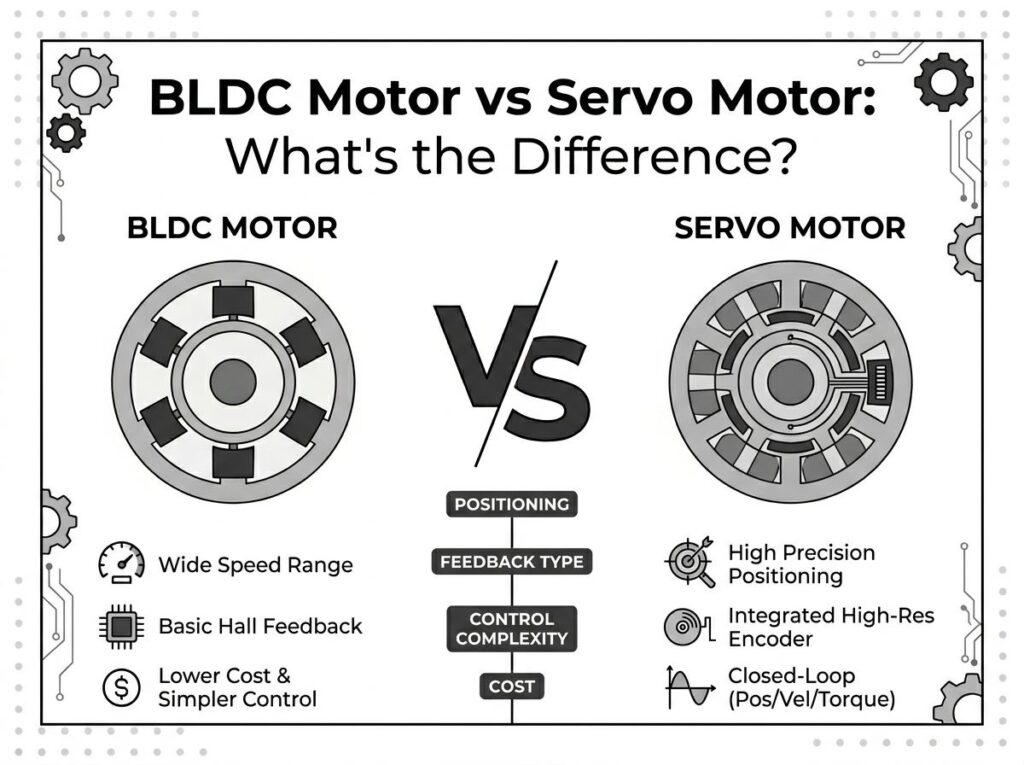
BLDC-motor versus servomotor: Wat is het verschil?
Selecting the right motor technology is one of the most important decisions in modern equipment design. Whether developing a robotic arm, an automated guided vehicle (AGV), an industrial conveyor, a lawn mower, or a precision manufacturing machine, engineers must carefully evaluate performance requirements, complexiteit beheersen, nauwkeurigheid, efficiëntie, and total system cost.
Among the most commonly compared technologies are Brushless DC (BLDC) motors and servo motors. While both are widely used in motion control applications, they are not direct equivalents. In werkelijkheid, one of the biggest misconceptions in the motor industry is assuming that a servo motor is simply another type of motor.
The reality is that a BLDC motor is a motor technology, while a servo motor is a complete motion control system that combines a motor, feedback device, and controller to achieve highly precise positioning and dynamic performance.
This guide provides a detailed engineering comparison of BLDC motors and servo motors, helping OEM manufacturers, ingenieurs, and procurement teams determine which solution best fits their application requirements.
BLDC-motor versus servomotor
BLDC motors and servo motors are both used for precise motion control, but a BLDC motor is a motor type, while a servo motor is a complete motion control system that includes a motor, encoder, and controller. Servo motors provide higher positioning accuracy and dynamic response, whereas BLDC motors offer lower cost and simpler implementation.
In het algemeen, servo systems are preferred for robotics, CNC-apparatuur, and precision automation, while BLDC motors are often selected for lawn mowers, HVAC -systemen, pompen, industrial drives, and cost-sensitive OEM products.
Wat is een BLDC-motor?
A Brushless DC Motor (BLDC-motor) is an electronically commutated motor that eliminates the brushes and commutator used in traditional DC motors. Instead of mechanical switching, electronic controllers energize stator windings according to rotor position.
BLDC motors have become one of the fastest-growing motor technologies due to their high efficiency, compacte maat, lange levensduur, and excellent power density.
BLDC Motor Structure
A typical BLDC motor consists of:
- Permanente magneetrotor
- Laminated stator core
- Multi-phase stator windings
- Hall-effect sensors (optioneel)
- Elektronische regelaar
- Power inverter stage
In tegenstelling tot geborstelde motoren, no physical contact exists between stationary and rotating electrical components.
Elektronische commutatie
The key innovation behind BLDC motors is electronic commutation.
The motor controller continuously monitors rotor position and energizes stator windings in a sequence that generates a rotating magnetic field. The rotor follows this field and produces rotational motion.
Electronic commutation provides several advantages:
- No brush wear
- Lagere onderhoudsvereisten
- Reduced electrical noise
- Hogere efficiëntie
- Longer operational life
Hall Sensors
Many BLDC motors use Hall-effect sensors to determine rotor position.
These sensors detect magnetic field changes as the rotor rotates and provide position feedback to the controller.
Hall sensors enable:
- Reliable startup performance
- Accurate commutation timing
- Improved low-speed control
- Enhanced torque production
Modern sensorless BLDC systems can estimate rotor position through back-EMF detection, eliminating the need for Hall sensors in certain applications.
BLDC-motorcontroller
The controller acts as the brain of the motor system.
Functions include:
- Snelheidsregeling
- Current control
- Torque management
- Protection functions
- PWM generation
- Communication interfaces
The simplicity of BLDC control is one reason these motors are widely used in commercial products requiring a balance between performance and affordability.
Common BLDC Applications
- Electric lawn mowers
- Robotachtige grasmaaiers
- HVAC-ventilatoren
- Water pumps
- Industrial fans
- AGV's
- Turnstile systems
- Elektrische fietsen
- Medische hulpmiddelen
- Consumer appliances
Wat is een servomotor?
One of the most misunderstood concepts in motion control is the definition of a servo motor.
Many people believe that a servo motor is a specific motor type. In reality, a servo system is a complete closed-loop motion control solution.
Servo System Architecture
A servo system consists of:
Servo System =
Motor
+
Encoder
+
Controleur
The motor itself may be:
- PMSM motor
- BLDC-motor
- AC synchronous motor
- Direct drive motor
The defining characteristic is not the motor technology but the use of continuous feedback and closed-loop control.
Core Components of a Servo System
1. Motor
The motor generates rotational motion and torque.
Modern industrial servo systems most commonly use PMSM motors because of their smooth torque characteristics and high efficiency.
2. Encoder
The encoder continuously measures:
- Position
- Snelheid
- Direction
- Angular displacement
Encoder feedback allows the controller to make real-time corrections.
3. Servo Drive
The servo drive processes feedback signals and adjusts current, Spanning, and switching patterns to achieve target motion profiles.
The drive ensures:
- Nauwkeurige positionering
- Stable speed control
- Dynamic torque response
- Accurate acceleration and deceleration
Why Servo Systems Are Different
Unlike standard BLDC motor systems that may operate open-loop or semi-closed-loop, servo systems constantly compare commanded motion with actual motion.
If an error occurs, the controller immediately compensates.
This feedback mechanism enables:
- Micron-level positioning
- High-speed dynamic response
- Exceptional repeatability
- Precise trajectory control
Typical Servo Applications
- Industrial robots
- CNC-bewerkingscentra
- Semiconductor equipment
- Verpakkingsmachines
- Automated assembly systems
- Medical robots
- Precision inspection equipment
- Aerospace motion systems
BLDC vs Servo Motor: Belangrijkste verschillen
Although BLDC motors and servo systems can sometimes use similar motor technologies internally, their intended functions and performance levels differ significantly.
| Functie | BLDC-motor | Servomotor |
|---|---|---|
| Positiefeedback | Optioneel | Required |
| Nauwkeurigheid | Medium | Zeer hoog |
| Snelheidscontrole | Goed | Uitstekend |
| Koppelcontrole | Goed | Uitstekend |
| Kosten | Lager | Hoger |
| Complexiteit | Lager | Hoger |
| Controlemethode | Open Loop / Semi Closed Loop | Closed Loop |
| Encoder | Optioneel | Mandatory |
| Typische toepassing | Grasmaaiers, Pompen, HVAC | Robotica, CNC, Precision Automation |
The most important distinction is that servo systems prioritize precision and feedback control, while BLDC systems prioritize efficiency, eenvoud, and cost effectiveness.
Working Principle Comparison
Understanding the operating principles of BLDC motors and servo systems helps clarify why their performance characteristics differ.
Hoe BLDC-motoren werken
BLDC motors rely on electronic commutation to replace mechanical brushes.
The controller energizes stator windings in a predefined sequence based on rotor position information.
Key operating characteristics:
- Electronic commutation
- Hall sensor feedback (optioneel)
- PWM speed control
- Open-loop or semi-closed-loop operation
Most BLDC applications focus on maintaining speed rather than achieving precise position control.
How Servo Systems Work
Servo systems continuously monitor actual motor position and compare it with commanded position.
Any deviation immediately triggers corrective action by the controller.
This closed-loop architecture enables:
- High-precision positioning
- Accurate trajectory tracking
- Rapid response to load changes
- Superior torque control
The encoder serves as the critical feedback device that makes servo control possible.
Open Loop vs Closed Loop
| Controletype | BLDC | Servo |
|---|---|---|
| Open Loop Operation | Common | Nee |
| Closed Loop Operation | Optioneel | Standaard |
| Feedback Dependency | Laag | Hoog |
| Position Correction | Beperkt | Continu |
Position Accuracy Comparison
For engineers evaluating motion control systems, position accuracy is often the most important factor.
This is where servo systems demonstrate their greatest advantage.
BLDC Position Accuracy
Standard BLDC motors are typically designed for speed control and torque generation rather than precision positioning.
Without encoder feedback, positional accuracy is inherently limited.
Typical BLDC characteristics include:
- Moderate positioning capability
- Good speed regulation
- Suitable for continuous rotation applications
- Limited positioning precision
Servo Position Accuracy
Servo systems are specifically engineered for accurate positioning.
High-resolution encoders enable the controller to track rotor movement continuously and apply corrections in real time.
Typical servo advantages include:
- Positioneringsnauwkeurigheid tot onder de graad
- Excellent repeatability
- Precise trajectory control
- High-speed response
- Minimal positioning error
This capability explains why robotics, CNC-machines, semiconductor equipment, and automated manufacturing systems overwhelmingly rely on servo technology.
Continue to Part 2: Koppelvergelijking, Speed Control Comparison, Efficiëntievergelijking, Kostenvergelijking, Robotica-toepassingen, AGV & AMR Applications, Lawn Mower Applications, Industrial Automation Selection Guide, Waarom OEM-kopers voor Greensky Power kiezen, Veelgestelde vragen, Internal Link Strategy, and References.
Koppelvergelijking
Torque is one of the most critical parameters when evaluating motion control systems. It determines a motor’s ability to accelerate loads, overcome resistance, maintain position, and perform dynamic movements under varying operating conditions.
In mechanical systems, torque can be expressed as:
τ = rFsin(i)
Waar:
- τ = Torque (N·m)
- R = Distance from pivot point (M)
- F = Applied force (N)
- i = Angle between force and lever arm
Bijvoorbeeld:
τ = (3)(6)sin(90°) = 18 N·m
Only the force component perpendicular to the lever arm contributes to torque generation.
Continuous Torque
Continuous torque represents the amount of torque a motor can produce indefinitely without overheating.
| Characteristic | BLDC-motor | Servomotor |
|---|---|---|
| Continuous Torque Density | Hoog | Zeer hoog |
| Thermisch beheer | Goed | Uitstekend |
| Long-Term Stability | Goed | Uitstekend |
Piekkoppel
Peak torque refers to the maximum short-duration torque a motor can deliver.
Servo motors are specifically designed to provide significantly higher peak torque during acceleration, positioning, and sudden load changes.
This is especially important in robotics, CNC-apparatuur, and automated assembly systems.
Kraam koppel
Stall torque is the torque produced when the motor shaft is not rotating.
Servo systems generally offer superior stall torque management because encoder feedback allows precise current regulation while maintaining shaft position.
Torque Performance Summary
| Torque Factor | BLDC | Servo |
|---|---|---|
| Continuous Torque | Hoog | Zeer hoog |
| Piekkoppel | Goed | Uitstekend |
| Stall Torque Control | Beperkt | Uitstekend |
| Torque Accuracy | Gematigd | Zeer hoog |
| Koppel rimpel | Hoger | Lager |
For demanding motion-control applications, servo systems typically outperform standard BLDC motors in torque control and dynamic response.
Speed Control Comparison
Speed regulation is another major difference between BLDC motors and servo systems.
BLDC Speed Control
BLDC motors typically use:
- Open-loop control
- Semi-closed-loop control
- PWM speed regulation
- Hall sensor commutation
Speed control performance is generally sufficient for applications where exact positioning is not required.
Examples include:
- Grasmaaiers
- Fans
- Pompen
- HVAC -systemen
- Transportbanden
Servo Speed Control
Servo systems utilize full closed-loop control.
The controller continuously compares:
- Commanded speed
- Actual speed
- Laadomstandigheden
- Position feedback
Real-time corrections enable highly stable speed regulation even under rapidly changing loads.
Speed Control Comparison Table
| Factor | BLDC | Servo |
|---|---|---|
| Speed Stability | Goed | Uitstekend |
| Dynamische reactie | Goed | Uitstekend |
| Load Compensation | Beperkt | Automatic |
| Low-Speed Control | Gematigd | Uitstekend |
BLDC vs Servo Efficiency Comparison
Efficiency directly affects operating costs, levensduur van de batterij, thermal performance, and overall equipment reliability.
Both technologies offer significantly higher efficiency than brushed DC motors.
BLDC Motor Efficiency
- Typically 85–95%
- Low rotor losses
- Excellent battery utilization
- Hoge vermogensdichtheid
Servo Motor Efficiency
Modern servo systems often use PMSM motors internally, het mogelijk maken:
- 90–98% efficiency
- Geoptimaliseerde stroomregeling
- Reduced harmonic losses
- Superior energy utilization
Efficiency Comparison Table
| Motortype | Typische efficiëntie |
|---|---|
| Geborstelde gelijkstroommotor | 70–85% |
| Inductiemotor | 80–93% |
| BLDC-motor | 85–95% |
| Servo Motor System | 90–98% |
For most commercial equipment, BLDC efficiency is already excellent. Echter, servo systems maintain an advantage in precision applications requiring maximum performance.
BLDC vs Servo Cost Comparison
Cost is often the decisive factor for OEM buyers.
Although servo systems provide superior performance, they require additional hardware and software components.
| Cost Item | BLDC | Servo |
|---|---|---|
| Motor | Lager | Hoger |
| Controleur | Lager | Hoger |
| Encoder | Optioneel | Required |
| Aandrijfelektronica | Simpler | More Complex |
| Total System Cost | Lager | Hoger |
For applications where ultra-high precision is unnecessary, BLDC motors often provide the best return on investment.
Which Is Better for Robotics?
Robotics is one of the highest-value markets for motion control technologies.
Most robotic systems require:
- Nauwkeurige positionering
- Smooth trajectory control
- Snelle acceleratie
- High repeatability
- Closed-loop feedback
Because of these requirements, servo systems dominate industrial robotics.
Why Servo Motors Win in Robotics
- Encoder feedback
- Micron-level positioning capability
- Superior dynamic response
- High precision trajectory control
- Excellent repeatability
Winner for Robotics: Servomotor
Which Is Better for AGV and AMR?
Geautomatiseerde geleide voertuigen (AGV's) and Autonomous Mobile Robots (AMRs) occupy a unique middle ground.
When BLDC Is Preferred
- Cost-sensitive AGVs
- Warehouse transportation
- Basic navigation systems
- Long battery life requirements
When Servo Is Preferred
- High-speed navigation
- Precision docking
- Collaboratieve robots
- Advanced autonomous systems
Many modern AGVs successfully utilize BLDC drive motors with encoder feedback, creating a hybrid solution between traditional BLDC and servo architectures.
Winner for AGVs: Depends on navigation precision requirements.
Which Is Better for Lawn Mowers?
Lawn mowers require:
- Hoog koppelvermogen
- Outdoor durability
- Battery efficiency
- Cost competitiveness
- Reliable operation
Unlike robotics, lawn mowers rarely require sub-degree positioning accuracy.
In plaats van, manufacturers prioritize efficiency, betrouwbaarheid, and affordability.
Why BLDC Motors Are Ideal for Lawn Mowers
- Lagere systeemkosten
- Uitstekende efficiëntie
- Hoog startkoppel
- Simple electronic architecture
- Proven outdoor reliability
This is one reason why modern cordless lawn mowers and robotic lawn mowers increasingly rely on BLDC technology.
Winner for Lawn Mowers: BLDC-motor
Which Is Better for Industrial Automation?
Industrial automation encompasses a wide range of equipment types.
| Sollicitatie | Recommended Solution |
|---|---|
| Transportbanden | BLDC |
| Verpakkingsmachines | Servo |
| Turnstiles | BLDC |
| CNC Equipment | Servo |
| Industrial Fans | BLDC |
| Pick-and-Place Systems | Servo |
In het algemeen, the choice depends on whether the application prioritizes precision or cost efficiency.
How to Choose Between BLDC and Servo Motors
The following selection guide can simplify motor technology decisions.
| Sollicitatie | Best Choice |
|---|---|
| Robotica | Servo |
| CNC | Servo |
| Grasmaaier | BLDC |
| HVAC | BLDC |
| Pomp | BLDC |
| Tourniquet | BLDC |
| AGV | Depends |
Choose a servo system when precision, positioneringsnauwkeurigheid, and dynamic response are critical.
Choose a BLDC motor when efficiency, betrouwbaarheid, eenvoud, and lower cost are primary priorities.
Waarom OEM-kopers voor Greensky Power kiezen
Greensky Power specializes in customized motion solutions for OEM manufacturers worldwide.
Core Product Portfolio
- BLDC-motoren
- Tandwielmotoren
- Planetaire reductiemotoren
- Worm Gear Motors
- Customized Motor Solutions
OEM Engineering Capabilities
- Encoder Integration
- Controllermatching
- Planetary Gearbox Design
- Rapid Prototyping
- Custom Performance Optimization
Belangrijke industrieën bediend
- Lawn Equipment
- HVAC-systemen
- Industriële automatisering
- Robotica
- Medische apparaten
- Security Systems
Veelgestelde vragen
Is a servo motor a BLDC motor?
Not necessarily. A servo motor is a complete closed-loop control system. Many modern servo motors use PMSM or BLDC motor technology internally.
Which motor is better for robotics?
Servo motors are generally preferred because they provide superior positioning accuracy, dynamic response, and repeatability.
Which motor is cheaper?
BLDC motors typically have lower motor costs, controller costs, and overall system costs.
Do BLDC motors need encoders?
Nee. Many BLDC motors operate successfully using Hall sensors or sensorless control methods. Encoders are optional unless precise positioning is required.
Can a BLDC motor be used as a servo motor?
Ja. When combined with an encoder and a closed-loop controller, a BLDC motor can function as part of a servo system.
Gerelateerde artikelen
Referenties
- HTTPS://www.ieee.org
- https://ieeexplore.ieee.org
- HTTPS://www.energie.gov
- HTTPS://www.iea.org
- HTTPS://www.iec.ch
- HTTPS://www.mathworks.com
- HTTPS://www.microchip.com
- HTTPS://www.ti.com
- HTTPS://www.nidec.com
- HTTPS://www.siemens.com
- HTTPS://globaal.abb
- HTTPS://www.weg.net