
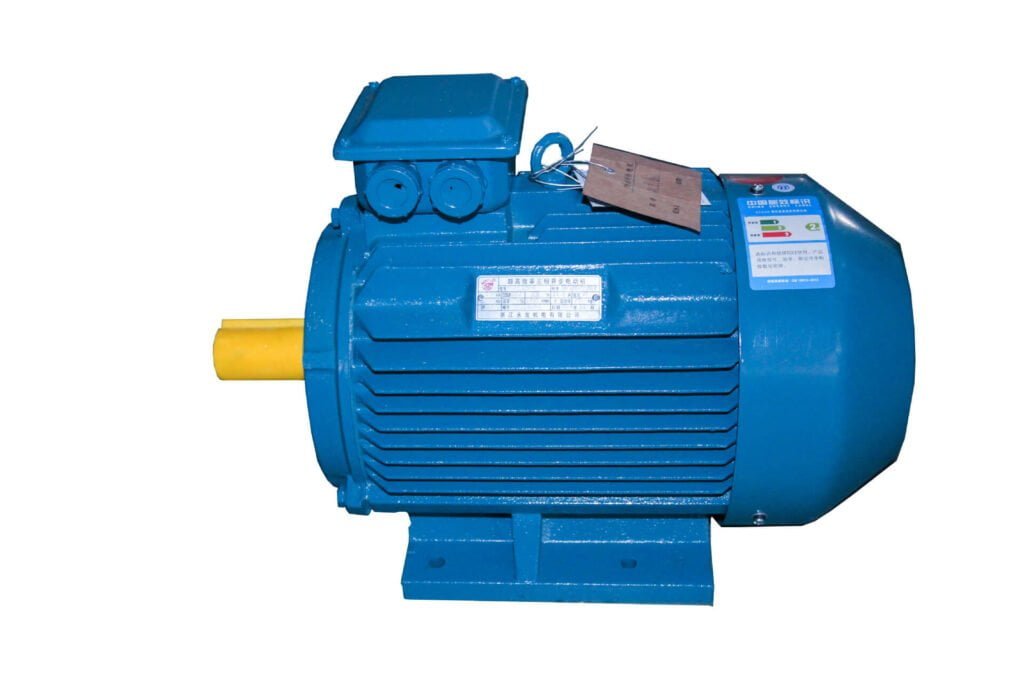
Should You Choose an Ultra-Efficient Asynchronous Motor?
빠른 답변
안 “ultra-efficient asynchronous (유도) 모터” has a hard efficiency ceiling at IE4 (슈퍼 프리미엄); the IE5 “울트라 프리미엄” tier defined in IEC TS 60034-30-2 is reached only by synchronous PMSM or SynRM machines with a VFD, which are no longer asynchronous. Choose IE4 super-premium induction when the motor runs 4,000+ 시간/년 or the electricity tariff is high — the price premium typically pays back in 1–2 years and the cooler, quieter operation also extends bearing and insulation life.
Step up to IE5 (PMSM/SynRM + 운전하다) only when a VFD is already required, the load is partial/variable, or footprint/weight matters; skip it for direct-on-line, simple-spare, or uncontrolled-shutdown duty. Base every decision on total cost of ownership, not the catalogue price — energy is 95–97 % 모터 수명 비용의.
What Is an Ultra-Efficient Asynchronous Motor?
안 비동기 모터 — more commonly called an 유도 전동기 — is a three-phase AC machine where the rotor never reaches the stator’s synchronous speed. The gap between the two, ~라고 불리는 슬립, is what induces current in the rotor and produces torque. It is the dominant industrial workhorse: 엄격한, low-cost, and direct-on-line (DOL) startable.
“Ultra-efficient” maps to the International Efficiency (즉) classes defined by IEC 60034-30-1 (line-operated) and IEC TS 60034-30-2 (VFD-operated). The classes are:
| IE 클래스 | 이름 | Typical 4-pole 22 kW efficiency | Topology |
|---|---|---|---|
| IE1 | 기준 | ~89.9 % | 유도 (기준선) |
| IE2 | 높은 | ~91.6 % | 유도 |
| IE3 | 프리미엄 | ~93.0 % | 유도 (US = NEMA Premium) |
| IE4 | 슈퍼 프리미엄 | ~94.5 % | Advanced induction / SynRM-capable |
| IE5 | 울트라 프리미엄 | ~96 %+ | PMSM or SynRM + VFD |
The key clarification most buyers miss: a conventional squirrel-cage 비동기식 induction motor plateaus at IE4. Because part of its input is always lost as rotor I²R (the machine must slip to make torque), it cannot reach IE5 broadly. The IE5 “ultra-efficient” tier requires a 동기식 영구자석 (PMSM) or synchronous-reluctance (SynRM) rotor plus a variable-frequency drive. So if you literally need an 비동기식 모터, “ultra-efficient” means IE4; going beyond it means leaving the asynchronous family.

How an Ultra-Efficient Induction Motor Achieves Higher Efficiency
Efficiency is the ratio of shaft power out to electrical power in. Every loss becomes heat, so a higher-efficiency motor simply wastes less energy as:
- Stator copper loss - I²R heating in the windings (cut by larger cross-section copper, lower-resistance connections).
- Rotor copper loss - I²R in the rotor bars; this scales with 슬립, so reducing slip (better rotors) directly raises efficiency.
- Core / iron loss — hysteresis and eddy currents in the laminated steel (cut by thinner, higher-grade electrical steel and optimized flux density).
- 마찰 & windage — bearing drag and fan losses (cut by better bearings and lower-noise, lower-loss fans).
- Stray load loss — leakage flux losses (cut by tighter manufacturing tolerances).
Step-by-step, an IE4 super-premium induction design gets there by:
- Using copper rotor bars (or optimized aluminium) to cut rotor I²R and slip.
- Applying thinner, low-loss silicon steel laminations to shrink core loss.
- Enlarging the active material (longer core, bigger frame) so current density and flux density both drop.
- Tightening the air gap and winding quality to reduce stray load loss.
- Fitting a low-loss fan and premium bearings (예를 들어. SKF-grade) to cut mechanical loss and extend life.
The result is a motor that runs cooler. Because insulation and bearing life roughly halve for every 10 °C of temperature rise, the efficiency upgrade also buys 신뢰할 수 있음 — a benefit the energy bill alone does not show.

IE3 vs IE4 vs IE5: Which “Ultra-Efficient” Tier Fits Your Duty?
| Attribute | IE3 (프리미엄) | IE4 (슈퍼 프리미엄) | IE5 (울트라 프리미엄) |
|---|---|---|---|
| Machine type | 유도 (비동기식) | Advanced induction / SynRM | PMSM or SynRM (동기식) |
| Direct-on-line start | 예 | 예 | No — needs VFD |
| 전형적인 22 kW, 4-pole η | 93.0 % | 94.5 % | 96 %+ |
| US / NEMA label | 프리미엄 없음 (= IE3) | 슈퍼 프리미엄 없음 | 슈퍼 프리미엄 없음 + 운전하다 |
| US legal minimum | 예 (에이사 / 암사슴) | Proposed for 2027–2029 | Not mandated |
| Price premium vs IE3 | 기준선 | +10–25 % | +25-60 % + VFD cost |
| Payback (high duty) | 기준선 | 1–2 years | 2–4 years (VFD already in) |
| 다음에 가장 적합 | General, 간헐적인, spares | 마디 없는 4000+ h/y | VFD duty, 가변 부하, 콤팩트 |
Real IEC 60034-30-1 Minimum Efficiencies (4-폴, 50 Hz)
Minimum full-load efficiency values from IEC 60034-30-1:2014 (the regulatory floor). Note the IE4 advantage is only 1–2 percentage points — but at 4000+ running hours that delta is real money.
| 힘 (kW) | IE1 | IE2 | IE3 | IE4 | ΔIE3→IE4 |
|---|---|---|---|---|---|
| 7.5 | 86.0 % | 88.7 % | 90.4 % | 92.6 % | +2.2 |
| 11 | 87.6 % | 89.8 % | 91.4 % | 93.3 % | +1.9 |
| 22 | 89.9 % | 91.6 % | 93.0 % | 94.5 % | +1.5 |
| 37 | 91.2 % | 92.7 % | 93.9 % | 95.2 % | +1.3 |
| 90 | 93.0 % | 94.2 % | 95.2 % | 96.1 % | +0.9 |
| 200 | 94.0 % | 95.1 % | 96.0 % | 96.7 % | +0.7 |
원천: IEC 60034-30-1:2014, Tables 3/5/7/9 (4-폴, 50 Hz). Efficiencies differ by pole count and frequency (60 Hz tables are separate) — do not apply these 4-pole numbers to 2- or 6-pole motors.
엔지니어링 데이터: 능률, 토크, 온도 & Payback Math
Core formulas
| 수량 | 공식 | 메모 |
|---|---|---|
| 능률 | η = P밖으로 / 피~에 | Mechanical out ÷ electrical in |
| Annual energy | E = P평가됨 / η × h년도 | kWh/yr |
| Annual saving (upgrade) | ΔE = P × h × (1/또는old − 1/ηnew) | Use realization factor ~0.85 for variable load |
| Payback (연령) | t = Price premium / (ΔE × tariff) | < 2 yr is strong; < 4 yr still worthwhile over 15-yr life |
| Shaft torque | 티 = 9550 ×피 / N | P in kW, n in RPM, T in N·m |
| 슬립 | 초 = (N에스 − n아르 자형) / N에스 | Smaller slip = lower rotor loss = higher η |
| Rotor copper loss | 피축차 = s × Pairgap | Why IE5 needs a synchronous (no-slip) 축차 |
Worked example — 22 kW IE3 → IE4 upgrade
Assumptions: 4-폴, 6000 h/y, electricity at $0.15/kWh, IE3 = 93.0 %, IE4 = 94.5 %, price premium = $500.
| 단계 | IE3 | IE4 | Saving |
|---|---|---|---|
| Input power | 22 / 0.930 = 23.66 kW | 22 / 0.945 = 23.28 kW | 0.38 kW |
| Annual energy | 141,935 kWh | 139,682 kWh | 2,253 kWh |
| Annual cost | $21,290 | $20,953 | $337 / 예멘 아랍 공화국 |
| Payback | - | - | $500 / $337 = 1.5 예멘 아랍 공화국 |
| 15-yr net saving | - | - | ≒ $5,060 |
Worked example — 7.5 kW, 오직 4000 h/y
Same logic at lower duty: 4000 h/y, $0.12/kWh, IE3 = 90.4 %, IE4 = 92.6 %, premium = $200.
| 단계 | IE3 | IE4 | Saving |
|---|---|---|---|
| Annual energy | 33,186 kWh | 32,397 kWh | 789 kWh |
| Annual cost | $3,982 | $3,888 | $94 / 예멘 아랍 공화국 |
| Payback | - | - | $200 / $94 = 2.1 예멘 아랍 공화국 |
Below ~2,000 h/yr the IE4 premium stretches to 3–5 years — still positive over a 15-year life, but less urgent. Above 4,000 h/y, IE4 almost always clears payback inside two years.
Temperature and insulation limits (IEC 60034-1)
High-efficiency motors run cooler, which is why their insulation and bearings last longer. Temperature rise is measured above a 40 °C ambient.
| 절연 등급 | 최대 권선 온도 | Allowed rise (IEC) | Typical service life rule |
|---|---|---|---|
| 클래스 B | 130 ° C | 80 °C rise | Life ≈ halves per +10 ° C |
| F급 | 155 ° C | 105 °C rise | |
| 클래스 h | 180 ° C | 125 °C rise |
NEMA Premium designs typically use Class F insulation with a Class B (80 ° C) 온도 상승 — a built-in margin that extends winding life well beyond the nameplate minimum.
Best Applications for Ultra-Efficient Induction Motors
| 애플리케이션 | Why efficiency matters | Recommended tier |
|---|---|---|
| 슬리퍼, 팬, 압축기 (마디 없는) | Run 6000–8000 h/yr; energy dominates cost | IE4 (IE5 + VFD if already variable-speed) |
| 공조 & 수처리 | Long duty, stable load | IE4 |
| 컨베이어 & general OEM | Mixed duty, spare-part simplicity needed | IE3 (IE4 if hours high) |
| Semiconductor / chemical process | High tariff, 24/7 | IE4, evaluate IE5 + VFD |
| 로봇공학 / servo axes | 콤팩트, 정밀한, 가변 속도 | IE5 PMSM + 운전하다 (not asynchronous) |
| 간헐적 / standby | Low hours; payback weak | IE3 |
단계별: Should You Choose Ultra-Efficient?
- Set the regulatory baseline. 미국에서는, EISA/DOE makes IE3 (프리미엄 없음) the legal floor for most three-phase motors; the EU requires IE3 from 2021 and IE4 for 75–200 kW from 2023. You cannot specify below IE3 for new installs.
- Count the running hours. > 4,000 h/yr almost always justifies IE4 on pure economics; < 2,000 h/yr favors IE3.
- Check the electricity tariff. High $/kWh shortens payback — IE4 can pay back in under a year at industrial rates above ~$0.20/kWh.
- Decide asynchronous vs synchronous. If you need true IE5, accept a PMSM/SynRM + VFD (no DOL start). If DOL start or simple spares matter, stay at IE4 induction.
- Run the payback math. Use ΔE = P·h·(1/또는old − 1/ηnew) and t = premium / (ΔE × tariff). Treat < 2 yr as a clear “예”.
- Confirm spares & 리드타임. For critical processes where downtime is costly, a readily-stocked IE3 with fast delivery can beat a longer-lead IE4/IE5 — weigh availability against the energy saving.
Common Engineering Mistakes When Specifying “Ultra-Efficient”
| 실수 | Why it backfires | Correct approach |
|---|---|---|
| Assuming “ultra-efficient” = IE5 asynchronous | Induction plateaus at IE4; IE5 needs PMSM/SynRM + VFD | Clarify topology; pick IE4 for asynchronous duty |
| Buying on catalogue price only | Purchase is 2–5 % of lifetime cost; energy is 95–97 % | Decide on TCO and payback, not sticker price |
| Oversizing the motor | Induction motors are least efficient at light load | Match rated power to the actual load |
| Specifying IE5 without a VFD | PMSM/SynRM cannot start DOL; back-EMF risks drive on shutdown | Only choose IE5 where a drive is already required |
| Ignoring part-load efficiency | Fans/pumps run 50–75 % load most of the time | Use NEMA Premium part-load ratings / VFD pairing |
| Rewinding instead of replacing | Rewind typically loses 1–3 % 능률 | Replace with a new high-efficiency unit |
Troubleshooting: 때 “Ultra-Efficient” Motor Under-Delivers
| 문제 | Typical cause | 해결책 |
|---|---|---|
| No energy saving vs IE3 | Motor oversized; runs at light load | Right-size to load; add VFD for variable duty |
| Overheating despite IE4 label | 전압 불균형 > 1 % (MG 없음 1) | Balance supply; > 5 % imbalance is unsafe |
| Low power factor | Light load on induction motor | Size correctly; consider IE5 PM (higher PF) VFD 포함 |
| IE5 drive trips on shutdown | PMSM back-EMF not managed | Brake circuit / controlled decel in the VFD |
| Bearing fails early | Misalignment, wrong lubrication | Align to spec; use SKF-grade bearings; follow lube interval |
| VFD harmonics heating windings | Long cable, no output filter | Add dV/dt filter; use inverter-rated (IE4) 굴곡 |
| Payback missed | Low running hours (< 2000 h/y) | IE3 was the right call; reserve IE4 for high-duty |
| Rewound motor lost efficiency | Core damage / higher resistance | Replace with new high-efficiency unit |
자주 묻는 질문
Can an asynchronous (유도) motor be IE5?
In practice, no — not broadly. The IEC IE5 “울트라 프리미엄” tier is defined for VFD-operated machines and is reached with synchronous PMSM or SynRM rotors. A conventional squirrel-cage induction motor tops out near IE4 because it must slip to produce torque, and that slip is an irreducible rotor loss.
Is IE4 worth the extra cost over IE3?
For motors running 4,000+ 시간/년, almost always yes: the premium typically pays back in 1–2 years, and the cooler operation extends bearing and insulation life. Below 2,000 h/yr the case weakens but is still positive over a 15-year life.
What does the US require — is IE4 mandatory?
US federal law (에이사 / 암사슴) sets IE3 (프리미엄 없음) as the minimum for most three-phase motors. IE4 (슈퍼 프리미엄 없음) is not yet federally mandated, but the DOE has proposed raising the floor toward IE4 for many categories around 2027–2029. The EU already requires IE4 for 75–200 kW motors.
Does a higher-efficiency motor really run cooler?
예. Less wasted energy means less heat. A motor with Class F insulation run at a Class B (80 ° C) rise has a large thermal margin, roughly doubling insulation life for every 10 °C saved — a reliability gain beyond the energy saving.
Should I pair an ultra-efficient motor with a VFD?
For variable-load fans, pumps and compressors, yes — IE3/IE4 + VFD captures part-load savings IE4 alone cannot. If you are already buying a VFD, also evaluate IE5 PMSM/SynRM, since the drive cost is already accounted for.
My motor is old and failing — repair or replace?
Replace with a new high-efficiency unit in almost all cases. Rewinding typically degrades efficiency by 1–3 %, and a new IE3/IE4 motor’s energy saving usually exceeds the rewind cost within a year or two of continuous duty.
Why Choose Greensky for High-Efficiency Motors?
Greensky is a Chinese B2B motor manufacturer supplying IE3 and IE4 super-premium induction motors (0.75-315kW, 2/4/6/8-폴) built to IEC 60034-30-1 그리고 NEMA MG 1, with Class F insulation run at Class B rise for long service life. For ultra-compact or variable-speed duties we pair IE5 PMSM/SynRM with matched VFDs and integrate them with our gearboxes, flanges (IEC B5/B14 and NEMA C-face) and braking options into a single OEM/ODM package.
Because energy is 95–97 % 모터 수명 비용의, our engineering team runs the payback math with you — matching rated power to your actual load, duty hours and tariff so you specify the right tier instead of over- or under-buying. Low MOQ and flexible mounting make Greensky a practical补充 to the tier-1 brands for custom and replacement drives.
관련 독서
참조
- IEC 60034-30-1:2014 — Efficiency classes IE1–IE4 for line-operated AC motors: https://webstore.iec.ch/publication/2376
- IEC TS 60034-30-2 — IE5 Ultra-Premium for VFD-operated motors: https://webstore.iec.ch/publication/59844
- IEC 60034-1 — Rotating electrical machines, insulation temperature classes: https://webstore.iec.ch/publication/5698
- MG 없음 1-2021 — 모터 및 발전기 (능률 & application guidance): https://www.nema.org/standards/view/mg-1-motors-and-generators
- 우리를. DOE — Electric Motor Priority Action Plan & EISA compliance: https://www.energy.gov/eere/amo/electric-motors
- IEEE 112-2017 — Standard Test Procedure for Polyphase Induction Motors: https://standards.ieee.org/ieee/112/6507/
- ABB — IEC 60034-30-1 efficiency classes technical note: https://library.e.abb.com/public/ea5c8669a89644158723ebb22994f5e4/TM025%20EN%2008-2014%20IEC60034-30-1_lowres.pdf
- Siemens — Energy-efficient motors & IE classes (SIMOTICS): https://www.siemens.com/global/en/products/drives/motors/low-voltage.html
- SKF — Electric motor bearing selection & life (L10h): https://www.skf.com/us/products/bearings-units-housings/roller-bearings
- IEA — Energy Efficiency: 모터 (global motor energy use ~45–50 % of electricity): https://www.iea.org/topics/energy-efficiency