
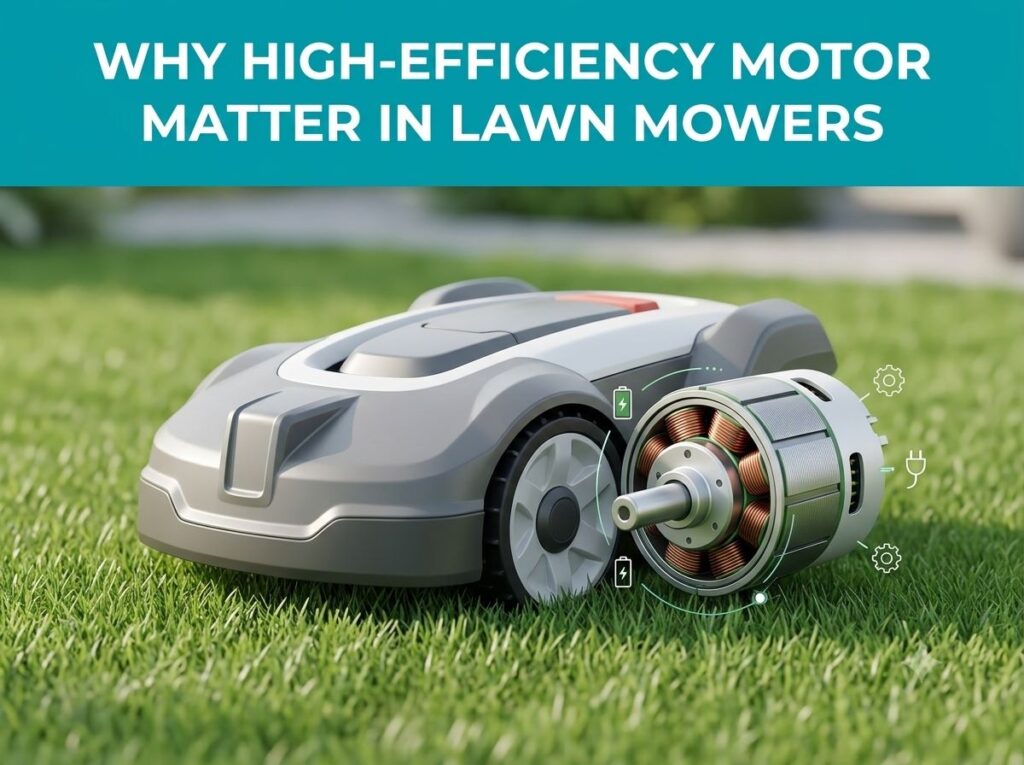
芝刈り機において高効率モーターが重要な理由
注目のスニペット:
High-efficiency motors are critical in robotic lawn mowers because they directly affect battery runtime, cutting performance, 熱管理, 信頼性, and total ownership cost. Compared with conventional brushed motors or low-efficiency drive systems, modern BLDC motors can achieve efficiency levels of 85–95%, allowing robotic mowers to operate longer, cover more lawn area, reduce charging frequency, and maintain consistent cutting quality. For OEM manufacturers and procurement teams, motor efficiency is not simply a technical specification—it is a major factor influencing product competitiveness, customer satisfaction, warranty costs, and long-term profitability.
As robotic lawn mower adoption accelerates worldwide, manufacturers increasingly focus on optimizing motor efficiency, トルク密度, intelligent control algorithms, そしてシステム統合. This article explains why high-efficiency motor matter in lawn mowers, how they impact robotic mower performance, and how engineers can select the best motor solutions for next-generation robotic mowing platforms.
What Is a High-Efficiency Motor in Lawn Mower?
A high-efficiency motor converts a greater percentage of electrical energy into useful mechanical output while minimizing losses caused by heat, friction, magnetic saturation, and electrical resistance. In robotic lawn mowers, efficiency directly determines how effectively battery energy is utilized.
Traditional brushed DC motors typically operate between 65% と 80% 効率. 最新のブラシレス DC (BLDC) motors commonly achieve 85% に 95% 効率, depending on design, controller strategy, 負荷条件, and operating speed.
Key Sources of Energy Loss
- Copper losses in windings
- Iron core losses
- ベアリングの摩擦
- Mechanical drag
- コントローラーのスイッチング損失
- Brush friction and sparking losses
Reducing these losses allows robotic lawn mowers to achieve greater productivity without increasing battery size or system weight.
芝刈り機において高効率モーターが重要な理由
Motor efficiency affects nearly every performance metric of a robotic mower. While consumers often focus on battery capacity, engineers understand that battery performance is only one side of the equation.
A mower equipped with a 90% efficient motor can significantly outperform a similar machine using a 75% 効率的なモーター, even when both utilize identical battery packs.
Direct Benefits of Higher Efficiency
- Longer operating runtime
- Reduced charging frequency
- 動作温度の低下
- Extended component lifespan
- Improved mowing coverage
- エネルギー消費量の削減
- Enhanced user satisfaction
For commercial robotic mower fleets, efficiency improvements can translate directly into reduced operating costs and higher productivity.
How Motor Efficiency Affects Battery Runtime
Battery runtime remains one of the most important purchasing criteria in robotic lawn mower markets. End users expect autonomous operation with minimal interruptions.
When motor efficiency increases, more battery energy becomes available for productive work rather than being dissipated as heat.
| モーター効率 | Battery Energy Utilized for Work | Energy Lost as Heat |
|---|---|---|
| 70% | 70% | 30% |
| 80% | 80% | 20% |
| 90% | 90% | 10% |
| 95% | 95% | 5% |
Even a 10% improvement in motor efficiency can significantly increase mowing area coverage per charge cycle. This benefit becomes particularly important for large residential lawns, commercial landscapes, golf courses, and municipal applications.
Efficiency vs Torque Density: Why Both Matter
Many engineers mistakenly evaluate motor efficiency and torque density independently. In robotic mower applications, both parameters must be optimized simultaneously.
What Is Torque Density?
Torque density measures how much torque a motor produces relative to its size and weight.
High torque density enables compact robotic mower designs while maintaining sufficient cutting power and traction capability.
Engineering Challenges
Robotic mowers must overcome:
- Wet grass resistance
- 凹凸のある地形
- Steep slopes
- Obstacle navigation
- Dense vegetation
Modern BLDC motors provide both high efficiency and high torque density, making them ideal for advanced robotic mower systems.
High-Efficiency BLDC Motors vs Brushed Motors vs AC Motors
| パラメーター | BLDCモーター | ブラシ付き DC モーター | ACモーター |
|---|---|---|---|
| 効率 | 85–95% | 65–80% | 75–88% |
| トルク密度 | 素晴らしい | 適度 | 適度 |
| メンテナンス | 非常に低い | 高い | 低い |
| ノイズ | 低い | 高い | 中くらい |
| 寿命 | 長さ | 短い | 中くらい |
| 制御精度 | 素晴らしい | 限定 | 適度 |
| バッテリーの互換性 | 素晴らしい | 良い | 限定 |
For robotic lawn mower applications, BLDC motors have become the dominant technology because they deliver superior efficiency, 正確な速度制御, and lower maintenance requirements.
熱性能: The Hidden Benefit of Efficient Motors
Heat is one of the biggest enemies of motor reliability. Every watt lost due to inefficiency becomes heat that must be dissipated.
Why Thermal Management Matters
Robotic lawn mowers operate in sealed outdoor environments exposed to:
- High ambient temperatures
- Dust and debris
- Moisture
- Continuous duty cycles
Excessive heat can damage:
- Magnets
- Windings
- ベアリング
- Electronic controllers
- Battery packs
High-efficiency motors generate less heat, simplifying cooling requirements and improving overall system reliability.
How Efficient Motors Improve Reliability and Lifespan
Reliability is a major concern for robotic mower manufacturers because service costs can quickly erode profitability.
High-efficiency BLDC motors reduce wear mechanisms commonly associated with traditional motor technologies.
Factors Contributing to Longer Life
- ブラシの磨耗なし
- Reduced bearing stress
- 巻線温度の低下
- Improved controller stability
- Lower vibration levels
Many high-quality BLDC systems exceed 10,000 operating hours when properly designed and maintained.
This longevity directly reduces warranty claims and field service costs for OEM manufacturers.
制御システム: Maximizing Motor Efficiency Through Intelligent Electronics
Motor efficiency depends not only on motor design but also on control strategy.
フィールド指向制御 (FOC)
Modern robotic mowers increasingly use FOC controllers to optimize motor performance.
メリットとしては以下が挙げられます:
- より高い効率
- Smoother operation
- Reduced acoustic noise
- Improved torque response
- Enhanced battery utilization
Adaptive Load Management
Advanced controllers dynamically adjust motor output according to:
- Grass density
- 地形条件
- Battery state-of-charge
- Cutting load
- Wheel traction requirements
These capabilities maximize system-level efficiency beyond the motor itself.
How to Choose a High-Efficiency Motor for Robotic Lawn Mower Applications
Motor selection should begin with application requirements rather than catalog specifications alone.
電圧範囲
- 24V systems for compact robotic mowers
- 36V systems for mid-sized platforms
- 48V systems for premium residential mowers
- 72V systems for commercial robotic mowing equipment
パワーレンジ
| 応用 | 標準的なモーター出力 |
|---|---|
| Small Residential | 100W–500W |
| Premium Residential | 500W–1500W |
| Commercial Robotic Mower | 1.5kW–5kW+ |
速度とトルクの要件
Evaluate:
- Blade speed requirements
- Slope climbing capability
- Drive wheel traction needs
- Obstacle handling performance
冷却方法
- Natural convection cooling
- Aluminum housing heat dissipation
- 強制空冷
- Integrated thermal management systems
コントローラーの互換性
Ensure compatibility with FOC controllers, regenerative braking systems, and intelligent battery management platforms.
OEM buyers should evaluate complete motor-controller systems rather than standalone motors.
Applications Beyond Robotic Lawn Mowers
High-efficiency motor technologies developed for robotic mowers are increasingly used across multiple industries.
産業用途
- 自律移動ロボット
- 倉庫用AGV
- Automated material handling systems
自動車およびEVアプリケーション
- 電動スクーター
- ハブモーター
- 多用途EV
- Delivery robots
HVAC およびポンプ システム
- 可変速ファン
- スマートポンプ
- Energy-efficient air handling units
ロボティクスとオートメーション
- Service robots
- 農業用ロボット
- 検査ロボット
- Collaborative robotic systems
Future Trends in High-Efficiency Robotic Mower Motors
Several technological developments are shaping the future of robotic mower design.
- High-voltage 72V platforms
- AI-based energy optimization
- 先端磁性材料
- Integrated motor-controller architectures
- 予知保全システム
- Digital twin simulation
- Higher torque-density motor topologies
Manufacturers that invest in motor efficiency today will gain significant competitive advantages as robotic mowing technology continues to evolve.
よくある質問: 芝刈り機において高効率モーターが重要な理由
Why are BLDC motors used in robotic lawn mowers?
BLDC motors offer high efficiency, 正確な制御, メンテナンスの手間がかからない, and excellent reliability. These characteristics make them ideal for battery-powered autonomous mowing systems that require long runtime and minimal servicing.
How much efficiency improvement can BLDC motors provide?
Compared with brushed motors, BLDC motors can improve efficiency by 10–25%, depending on operating conditions. This improvement translates directly into longer runtime and reduced energy consumption.
Does motor efficiency affect battery life?
はい. Higher motor efficiency reduces energy waste and heat generation, allowing batteries to deliver more useful work while experiencing lower thermal stress.
What is the ideal efficiency range for robotic mower motors?
Premium robotic mower motors typically operate between 85% と 95% 効率, depending on load, スピード, controller strategy, and motor design.
Can efficient motors reduce maintenance costs?
絶対に. Efficient motors operate at lower temperatures and experience less wear, reducing maintenance requirements and extending system lifespan.
Are high-efficiency motors worth the higher initial cost?
For most OEMs and fleet operators, はい. Reduced warranty claims, improved runtime, エネルギー消費量の削減, and longer service life often generate significant long-term savings.
結論
High-efficiency motors have become a fundamental requirement for modern robotic lawn mowers. They directly improve runtime, cutting performance, 熱挙動, 信頼性, and user experience while reducing operational costs and maintenance requirements.
Among available technologies, BLDC motors provide the best combination of efficiency, トルク密度, インテリジェントな制御機能, そして長いサービスライフ. As robotic mowing systems become more sophisticated, motor efficiency will continue to play a critical role in product differentiation and market competitiveness.
Greensky Power develops high-efficiency BLDC motor solutions for robotic lawn mower メーカー, including 24V, 36V, 48V, および 72V プラットフォーム, integrated FOC controllers, custom drive systems, and complete OEM motor development services.
データシートをリクエストする, OEM ソリューションを入手する, or contact our engineers to discuss your robotic lawn mower motor requirements.
参照
- https://ieeexplore.ieee.org
- https://www.ieee.org
- https://www.nrel.gov/docs/fy19osti/73396.pdf
- https://www.energy.gov/eere/vehicles/articles/fact-861-february-23-2015-electric-vehicle-efficiency
- https://www.mdpi.com/1996-1073/14/3/655
- https://www.sciencedirect.com/topics/engineering/brushless-dc-motor
- https://www.sciencedirect.com/topics/engineering/electric-motor-efficiency
- https://www.energy.gov/eere/amo/articles/premium-efficiency-motor-selection-and-application-guide