
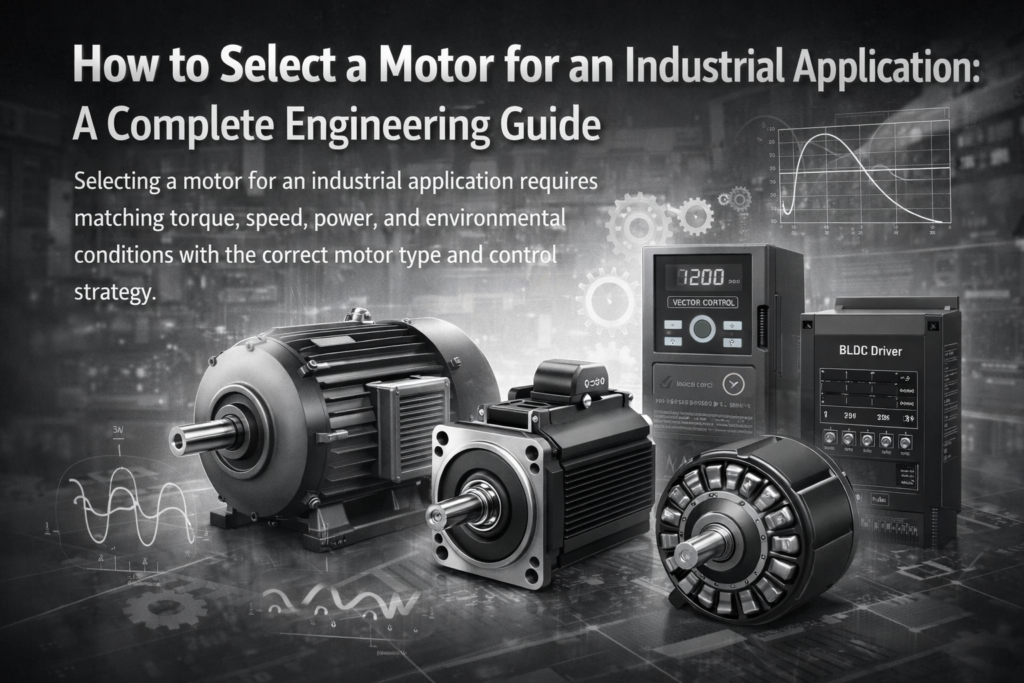
産業用途向けのモーターの選択方法: A Complete Engineering Guide
注目のスニペット:
Selecting a motor for an industrial application requires matching torque, スピード, 力, and environmental conditions with the correct motor type and control strategy. Engineers must evaluate efficiency, 熱性能, デューティサイクル, and load characteristics to ensure reliability and cost-effectiveness. The best motor selection balances performance, 寿命, 総所有コスト (TCO), rather than focusing only on upfront price. For OEMs and procurement teams, proper motor sizing and compatibility with controllers (such as VFD or BLDC drivers) are critical to achieving optimal system efficiency and long-term operational stability.
What Is Industrial Motor Selection and Why It Matters
Industrial motor selection is the engineering process of choosing the correct motor type, サイズ, and control method for a specific application. It directly impacts system performance, エネルギー消費, 信頼性, and maintenance cost. 産業環境において, motors are often responsible for over 60% of total electricity consumption, making efficiency a key factor in operational cost.
Improper motor selection can lead to overheating, excessive wear, or insufficient torque, all of which reduce equipment lifespan. 例えば, undersized motors may stall under peak load, while oversized motors operate inefficiently at partial load. Engineers must consider not only mechanical load requirements but also electrical supply conditions, duty cycles, and environmental factors.
From a B2B perspective, OEM customers increasingly prioritize energy-efficient and customizable solutions. This is why many systems now integrate advanced motor technologies such as BLDC motors (見る BLDC モーター ソリューション) or inverter-driven AC motors for optimized performance.
Why Choosing the Right Motor Impacts Efficiency and Cost
The choice of motor significantly affects both energy efficiency and lifecycle cost. Industrial motors typically operate for thousands of hours annually, so even small efficiency improvements can translate into substantial energy savings. 例えば, ある 5% efficiency gain in a continuously running motor can reduce electricity costs by thousands of dollars over its lifetime.
Efficiency is influenced by motor design, load matching, および制御方法. BLDC motors offer high efficiency due to the absence of rotor copper losses, while induction motors are robust but may suffer from slip-related losses. さらに, motors operating far below their rated load tend to have poor efficiency and power factor.
From a procurement standpoint, focusing solely on initial purchase cost is a common mistake. その代わり, engineers should evaluate Total Cost of Ownership (TCO), これにはエネルギー消費も含まれます, メンテナンス, ダウンタイムのリスク, そして交換費用. In many industrial applications, energy cost accounts for over 90% of a motor’s lifecycle expense.
Types of Motors Used in Industrial Applications
誘導モーター
Induction motors are the most widely used in industrial applications due to their simplicity, 堅牢性, そして低コスト. They are ideal for constant-speed applications such as pumps, ファン, およびコンベア. しかし, their efficiency decreases under variable load conditions unless paired with a VFD.
BLDCモーター
ブラシレスDC (BLDC) motors offer higher efficiency, 正確な速度制御, and superior torque density. They are increasingly used in robotics, EV systems (見る EV motor solutions), and automation equipment. Their main limitation is higher initial cost and the need for electronic controllers.
同期モーター
Synchronous motors provide constant speed regardless of load and are often used in high-power applications requiring precise control. They typically have higher efficiency than induction motors but are more complex and expensive.
DCモーター
Traditional brushed DC motors offer simple control and high starting torque but require frequent maintenance due to brush wear. They are gradually being replaced by BLDC alternatives in modern industrial systems.
BLDC 対 誘導モーター: Performance and Cost Comparison
| パラメーター | BLDCモーター | 誘導電動機 |
|---|---|---|
| 効率 | 85–95%, high across load range | 75–90%, 部分負荷では低い |
| トルク密度 | 高い, コンパクトなデザイン | 適度, larger size required |
| コントロール | コントローラーが必要です (正確な) | 単純, VFD オプション |
| 料金 | 初期費用が高い | 初期費用の削減 |
| メンテナンス | 低い | 低から中程度 |
エンジニアリングの観点から, BLDC motors are preferred when efficiency and compactness are critical, while induction motors are chosen for cost-sensitive, rugged environments. OEMプロジェクト向け, the decision often depends on whether energy savings justify the higher upfront investment.
Key Engineering Factors: 効率, トルク密度, 熱性能
効率
Efficiency determines how much electrical energy is converted into mechanical output. High-efficiency motors reduce heat generation and energy loss, improving system reliability. BLDC motors excel in efficiency due to reduced rotor losses, while induction motors may require optimization through VFD control.
トルク密度
Torque density refers to the amount of torque produced per unit volume. High torque density allows for smaller, lighter motors, which is critical in space-constrained applications such as robotics or EV systems. BLDC motors typically offer superior torque density compared to induction motors.
熱性能
Thermal management is essential for maintaining motor lifespan. Excessive heat degrades insulation and reduces reliability. Engineers must consider cooling methods such as air cooling, liquid cooling, or forced ventilation. Proper thermal design ensures consistent performance under continuous operation.
制御システム: VFD と BLDC コントローラーの比較
Control systems play a critical role in motor performance. Induction motors are often paired with Variable Frequency Drives (VFD) to enable speed control and improve efficiency. VFDs adjust the frequency and voltage supplied to the motor, allowing precise control of speed and torque.
BLDC motors require electronic controllers that manage commutation and speed control using sensors or sensorless algorithms. These controllers provide higher precision and faster response, making them suitable for dynamic applications.
From a system integration perspective, controller compatibility is a key selection factor. OEM customers often require customized control solutions, which can be explored via custom motor development.
How to Choose a Motor for Industrial Applications
電圧範囲
利用可能な電源に適合するモーターを選択してください (例えば, 24V, 48V, 72V, or 380V AC). For mobile or battery-powered systems, low-voltage BLDC motors are common.
パワーレンジ
Determine required power based on load calculations. Oversizing increases cost and reduces efficiency, while undersizing risks failure.
速度とトルク
Match motor speed (回転数) and torque to application requirements. High-torque applications such as mixers require gear reduction or high-torque motors.
冷却方法
Choose between natural air cooling, forced air, or liquid cooling depending on operating conditions and duty cycle.
コントローラーの互換性
Ensure the motor works with the intended control system (VFD, BLDC controller). Integration complexity can affect project cost and timeline.
アプリケーション固有の考慮事項
粉塵などの環境要因を考慮する, 湿度, と温度. 過酷な環境向け, IP-rated motors and sealed designs are recommended.
CTA: 適切なモーターを選択するのに助けが必要です? データシートをリクエストする また 当社のエンジニアにお問い合わせください for application-specific recommendations.
Industrial Applications and Use Cases
Industrial motors are used across a wide range of applications, each with unique requirements. 製造業, motors drive conveyors, コンプレッサー, および工作機械, where reliability and continuous operation are critical. HVAC システム内, motors power fans and pumps, where energy efficiency directly impacts operating cost.
ロボット工学とオートメーションの分野, BLDC motors are preferred for their precision and high torque density. 電気自動車の場合, hub motors and high-efficiency BLDC motors enable compact and efficient propulsion systems. For heavy-duty applications such as mixers or crushers, induction motors are often selected for their durability and ability to handle overload conditions.
Advantages and Disadvantages of Different Motor Types
| モーターの種類 | 利点 | 短所 |
|---|---|---|
| BLDC | 高効率, メンテナンスの手間がかからない, コンパクト | より高いコスト, コントローラーが必要です |
| 誘導 | 低コスト, 屈強, simple design | 変動負荷時の効率の低下 |
| DC | 高い始動トルク, 単純なコントロール | High maintenance (ブラシの摩耗) |
Future Trends in Industrial Motor Selection
The future of industrial motor selection is driven by energy efficiency regulations, 電化, そして自動化. High-efficiency motors such as IE4 and IE5 are becoming standard in many regions. さらに, the adoption of smart motor systems with integrated sensors and IoT connectivity enables predictive maintenance and real-time performance monitoring.
BLDC motors are gaining popularity due to their efficiency and compatibility with digital control systems. パワーエレクトロニクスのコストが低下するにつれて, more industrial applications are transitioning from traditional induction motors to electronically controlled solutions.
よくある質問: Industrial Motor Selection
1. How do I calculate the required motor power?
Motor power is calculated based on torque and speed requirements. Use the formula P = T × ω, where T is torque and ω is angular velocity. Engineers must also account for efficiency losses and safety factors to ensure reliable operation.
2. Which motor is best for industrial applications?
The best motor depends on the application. Induction motors are ideal for general-purpose use, while BLDC motors are better for high-efficiency and precision applications. The choice depends on cost, パフォーマンス, および制御要件.
3. Why is motor efficiency important?
Motor efficiency directly affects energy consumption and operating cost. High-efficiency motors reduce electricity usage, 発熱, and environmental impact, making them essential for modern industrial systems.
4. What is the lifespan of an industrial motor?
Motor lifespan depends on design, operating conditions, そしてメンテナンス. High-quality motors can last 10–20 years with proper care. Factors such as overheating, overloading, and poor lubrication can significantly reduce lifespan.
5. How do I choose between BLDC and induction motors?
Choose BLDC motors for high efficiency, コンパクトサイズ, そして正確なコントロール. Choose induction motors for cost-sensitive and rugged applications. Evaluate total cost of ownership rather than just initial price.
結論: Engineering-Driven Motor Selection for Better ROI
Selecting the right motor for an industrial application requires a balance between performance, 料金, そして信頼性. Engineers must evaluate efficiency, トルク密度, 熱性能, and control strategy to ensure optimal system operation. For OEMs and procurement teams, focusing on lifecycle cost and application-specific requirements is key to achieving long-term value.
CTA: Looking for the right motor solution? OEM ソリューションを入手する, データシートをリクエストする, また 当社のエンジニアにお問い合わせください today to optimize your industrial application.
参照
- IEC 60034 – Rotating Electrical Machines Standards
- IEEE モーター効率ガイドライン
- European Commission – Motor Efficiency Regulations (IE Classes)
- Boldea, I., “Electric Machines: Steady-State, Transients, and Design”