
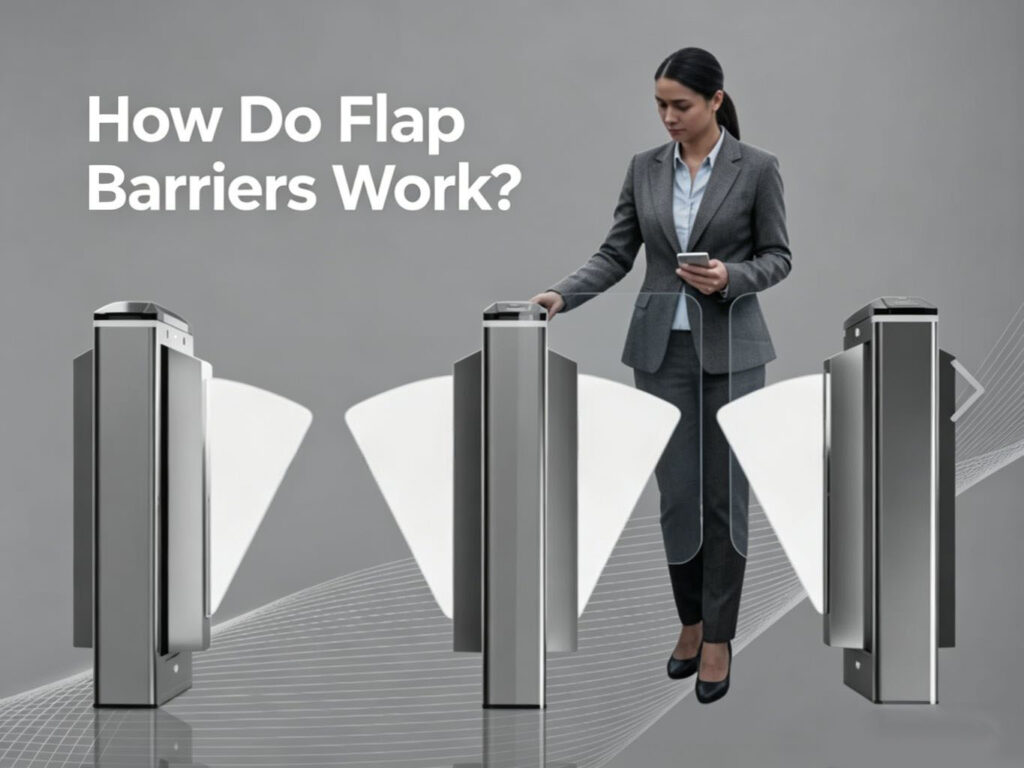
フラップバリアの仕組み?
Flap barriers work by combining motor-driven mechanical movement, intelligent control systems, infrared sensors, and authentication technologies to regulate pedestrian access in commercial and industrial facilities. When a user is authorized through RFID, QR code, biometric recognition, or ticket validation, the controller activates the motor system, retracting the flap panels to allow passage. After passage detection, the flaps automatically close to restore access restriction.
Modern flap barrier systems primarily use BLDC motors because they provide high efficiency, rapid response speed, 低い動作音, そして長期的な信頼性. Compared with traditional tripod turnstiles and mechanical gates, flap barriers deliver faster throughput, improved anti-tailgating capability, and better integration with intelligent building infrastructure.
OEMメーカーおよび調達エンジニア向け, understanding how flap barriers work is critical because system performance depends heavily on motor selection, 熱管理, コントローラのアーキテクチャ, and sensor coordination. This guide explains the complete engineering logic behind flap barrier systems while helping buyers evaluate the best motor and control solutions for industrial applications.
What Is a Flap Barrier System?
A flap barrier system is an intelligent pedestrian access control device designed to regulate entry and exit in environments requiring high security, efficient traffic management, and automated authentication. Unlike swing gates that rotate outward, flap barriers use retractable panels that open and close rapidly inside a compact housing structure.
The system consists of several integrated subsystems:
- Motor drive system
- 電子コントローラー
- Infrared sensor array
- Authentication interface
- Mechanical transmission structure
- Emergency safety module
Modern flap barriers are commonly installed in:
- 地下鉄の駅
- 空港
- Commercial office buildings
- 産業施設
- データセンター
- Government buildings
- Smart city infrastructure
Compared with conventional access systems, flap barriers provide higher traffic throughput and stronger anti-tailgating performance while maintaining compact architectural integration.
関連産業用モーターソリューション:
フラップバリア用BLDCモーター
How Do Flap Barriers Work Step by Step?
Understanding flap barrier operation requires analyzing the interaction between authentication systems, コントローラー, モーター, センサー, and mechanical movement.
ステップ 1: User Authentication
The process begins when a user presents credentials through:
- RFID card readers
- QR code scanners
- Biometric systems
- Facial recognition terminals
- Mobile applications
The access controller validates authorization before triggering gate movement.
ステップ 2: Controller Signal Processing
After authorization, the controller processes:
- User direction
- Traffic logic
- Safety conditions
- Sensor status
- Motor operating state
The controller then sends drive commands to the motor system.
ステップ 3: モーターの活性化
The motor generates rotational torque that is transmitted through gears or linkage mechanisms to retract the flap panels. Most modern systems use BLDC motors with encoder feedback for precise motion control.
ステップ 4: Passage Detection
Infrared sensors monitor user movement through the lane to prevent tailgating and accidental closure.
ステップ 5: Automatic Closing
Once the user passes completely, the controller commands the motor to close the flaps and restore access restriction.
Why BLDC Motors Are Used in Flap Barrier Systems
BLDC motors have become the preferred technology for premium flap barriers because they provide superior control precision, 効率, and operational lifespan compared with brushed motors and traditional AC motors.
高効率
BLDC motors commonly achieve efficiency levels above 85%, reducing energy consumption and internal heat generation. Lower thermal losses improve system reliability inside compact barrier cabinets.
高速な動的応答
Flap barriers require rapid acceleration and deceleration cycles. BLDC motors provide stable low-speed torque and fast electronic response for smooth flap operation.
低騒音動作
Commercial environments increasingly require quiet operation. FOC-controlled BLDC systems significantly reduce vibration and acoustic noise.
Long Operational Lifespan
ブラシ付きモーターとは異なります, BLDC motors eliminate brush wear through electronic commutation, greatly extending maintenance intervals.
Compact High Torque Density
Modern architectural designs favor slim barrier structures. BLDC motors provide high torque output within compact dimensions, supporting smaller system footprints.
Flap Barrier vs Swing Barrier vs Tripod Turnstile
| パラメーター | フラップバリア | Swing Barrier | Tripod Turnstile |
|---|---|---|---|
| Traffic Throughput | 高い | 中くらい | 適度 |
| Opening Speed | Very Fast | 適度 | Slower |
| Anti-tailgating | 素晴らしい | 良い | 基本 |
| Accessibility | 適度 | 素晴らしい | 限定 |
| Mechanical Complexity | より高い | 適度 | より低い |
| Installation Space | コンパクト | Larger | コンパクト |
| Best Applications | Metro & Offices | コマーシャル & ADA | Basic Security |
Flap barriers are generally preferred for high-speed access control environments requiring rapid throughput and strong anti-tailgating capability. Swing barriers provide superior accessibility, while tripod turnstiles remain suitable for lower-cost security installations.
Core Components Inside a Flap Barrier Gate
The performance of a flap barrier system depends on the integration quality of several critical components.
Motor Drive System
The motor converts electrical energy into controlled mechanical movement. Most industrial systems use:
- 24V BLDC モーター
- 48V industrial motors
- 72V 高性能システム
The motor must provide stable torque during repeated start-stop cycles.
電子コントローラー
The controller manages:
- Motor commutation
- Acceleration profiles
- Current limiting
- 障害物検出
- Emergency release behavior
Infrared Sensor System
Multiple infrared beams monitor user movement and prevent unauthorized passage.
Mechanical Transmission Structure
Gearboxes and linkages transfer motor torque to the flap panels. Mechanical precision directly affects vibration and positioning stability.
Power Supply System
Stable DC power is essential for maintaining motor performance and sensor accuracy.
Control System Logic in Modern Flap Barriers
The controller is the intelligence center of the flap barrier system. Modern systems increasingly use microcontroller-based architectures with advanced motion algorithms.
FOC Motor Control
Field-Oriented Control enables smooth motor operation by regulating current vectors electronically. Compared with trapezoidal commutation, FOC reduces torque ripple and acoustic noise.
Encoder Feedback
Encoders provide real-time position feedback, 改善する:
- Position accuracy
- Opening synchronization
- 障害物検出
- 動きの滑らかさ
Anti-tailgating Logic
Infrared sensor arrays detect multiple pedestrians attempting unauthorized passage.
Emergency Evacuation Mode
In power failure or emergency conditions, many systems automatically retract flaps for free pedestrian movement.
Cloud Connectivity
Modern smart buildings increasingly integrate flap barriers into cloud-based access management systems for remote diagnostics and monitoring.
効率, 熱性能, フラップバリアモーターの信頼性と信頼性
Motor efficiency directly influences system stability, 熱挙動, and long-term operating cost. Poor thermal management is one of the primary causes of premature motor and controller failure.
効率に関する考慮事項
BLDC motors reduce:
- 銅損
- Mechanical friction loss
- Switching inefficiency
- 熱応力
Higher efficiency also reduces enclosure temperature, improving controller lifespan.
熱管理
Flap barriers operate under frequent acceleration cycles, creating periodic current peaks. Industrial-grade systems use:
- Aluminum heat dissipation structures
- Optimized airflow paths
- Efficient MOSFET driver systems
- Thermal protection logic
信頼性と寿命
System reliability depends on:
- ベアリングの品質
- コントローラーのチューニング
- Motor insulation class
- 機械的アライメント
- Environmental sealing
Industrial BLDC flap barrier motors can operate continuously for years when properly designed and thermally managed.
How to Choose a Flap Barrier System for Industrial Applications
OEMメーカーおよび調達エンジニア向け, selecting the right flap barrier system involves balancing performance, security, メンテナンス要件, and integration capability.
電圧範囲
一般的な産業用構成には次のものがあります。:
- 24V systems for compact gates
- 48V systems for commercial applications
- 72V systems for high-performance industrial environments
パワーレンジ
Typical motor power ranges from 40W to 300W depending on:
- Flap size
- Opening speed
- デューティサイクル
- Traffic throughput
Torque and Speed Matching
Insufficient torque causes unstable flap movement and excessive current draw. Engineers must consider:
- Flap inertia
- 加速要件
- 減速比
- 機械的摩擦
冷却方法
High-frequency operation requires optimized thermal dissipation through aluminum motor housing and airflow management.
コントローラーの互換性
OEM buyers should verify compatibility with:
- RFIDシステム
- Facial recognition terminals
- Cloud access platforms
- 産業オートメーションシステム
アプリケーション固有の考慮事項
Outdoor systems may require:
- IP-rated protection
- Corrosion resistance
- Wide temperature operation
- Humidity protection
Custom industrial motor support:
カスタム BLDC モーター
Industrial Applications of Flap Barrier Systems
Flap barriers are widely used across commercial, 工業用, and intelligent infrastructure sectors.
地下鉄および鉄道システム
High-speed throughput and anti-tailgating capability make flap barriers ideal for transportation hubs.
商業ビル
Modern offices prioritize aesthetics, low-noise operation, and intelligent access integration.
工場および産業施設
Industrial environments require durable motor systems capable of continuous-duty operation with minimal maintenance.
Data Centers
Secure facilities increasingly integrate biometric authentication with intelligent flap barrier systems.
スマートシティインフラ
IoT-based urban infrastructure increasingly uses connected access systems for intelligent traffic management and remote diagnostics.
Related industrial solutions:
電気自動車のモーター
Future Trends in Flap Barrier Technology
The access control industry is evolving rapidly toward smarter, quieter, and more energy-efficient systems.
AI-Based Access Analytics
Future systems increasingly use AI algorithms for:
- Traffic optimization
- Behavior analysis
- Predictive maintenance
- Security enhancement
Integrated Smart Diagnostics
Modern systems increasingly include:
- Motor temperature monitoring
- Current analysis
- クラウド診断
- リモートファームウェアアップデート
Compact High-Torque Motor Platforms
Architectural trends favor slim gate systems with high-performance compact motors.
エネルギー効率の高いインフラストラクチャ
Global sustainability requirements continue pushing OEMs toward high-efficiency BLDC motor platforms with reduced standby power consumption.
よくある質問: フラップバリアの仕組み?
How does a flap barrier gate operate?
A flap barrier operates by using a motor-driven mechanism controlled by electronic logic and infrared sensors. Authorized users trigger the system through RFID cards, QR codes, or biometric authentication, causing the flap panels to retract temporarily.
Why are BLDC motors used in flap barriers?
BLDC motors provide higher efficiency, メンテナンスの軽減, より静かな動作, and more precise control than brushed motors. These advantages improve reliability in high-frequency access control systems.
What sensors are used in flap barrier systems?
Most systems use infrared sensor arrays to detect user passage, prevent tailgating, and improve operational safety during opening and closing cycles.
What is the difference between flap barriers and swing barriers?
Flap barriers use retractable panels for fast throughput and compact installation, while swing barriers use rotating panels and provide better accessibility for wheelchairs and large luggage.
How do I choose the best flap barrier system for industrial applications?
Engineers should evaluate motor technology, コントローラのアーキテクチャ, 熱管理, security requirements, 環境を守ること, and integration compatibility based on application needs.
結論
Flap barriers work through the integration of intelligent control systems, 高効率モーター, sensor networks, and precision mechanical structures to deliver fast, secure, and reliable pedestrian access management. Compared with traditional access control systems, modern flap barriers provide higher throughput, improved anti-tailgating performance, and superior compatibility with smart building infrastructure.
OEMメーカーおよび調達エンジニア向け, understanding the interaction between motor systems, コントローラー, 熱性能, and sensor logic is essential for selecting reliable long-term solutions. BLDC motor platforms continue to dominate the flap barrier industry because they provide the best balance between efficiency, トルク密度, メンテナンスの手間がかからない, と動作寿命.
Greensky Power provides customized BLDC motor solutions for flap barriers, スイングゲート, intelligent access control systems, 世界中の産業オートメーションアプリケーション.
✔ データシートをリクエストする
✔ OEM モーター ソリューションを入手
✔ 技術的な相談については当社のエンジニアにお問い合わせください
参照
1. https://ieeexplore.ieee.org/
2. https://www.sciencedirect.com/topics/engineering/brushless-dc-motor
3. https://www.nidec.com/en/technology/motor/basic/
4. https://www.motioncontroltips.com/
5. https://www.controleng.com/
6. https://www.automationworld.com/
7. https://www.engineeringtoolbox.com/
8. https://www.mdpi.com/topics/Brushless_DC_Motor
9. https://www.analog.com/en/technical-articles/field-owned-control-for-pmsms-utilizing-a-dynamic-voltage-vector.html