
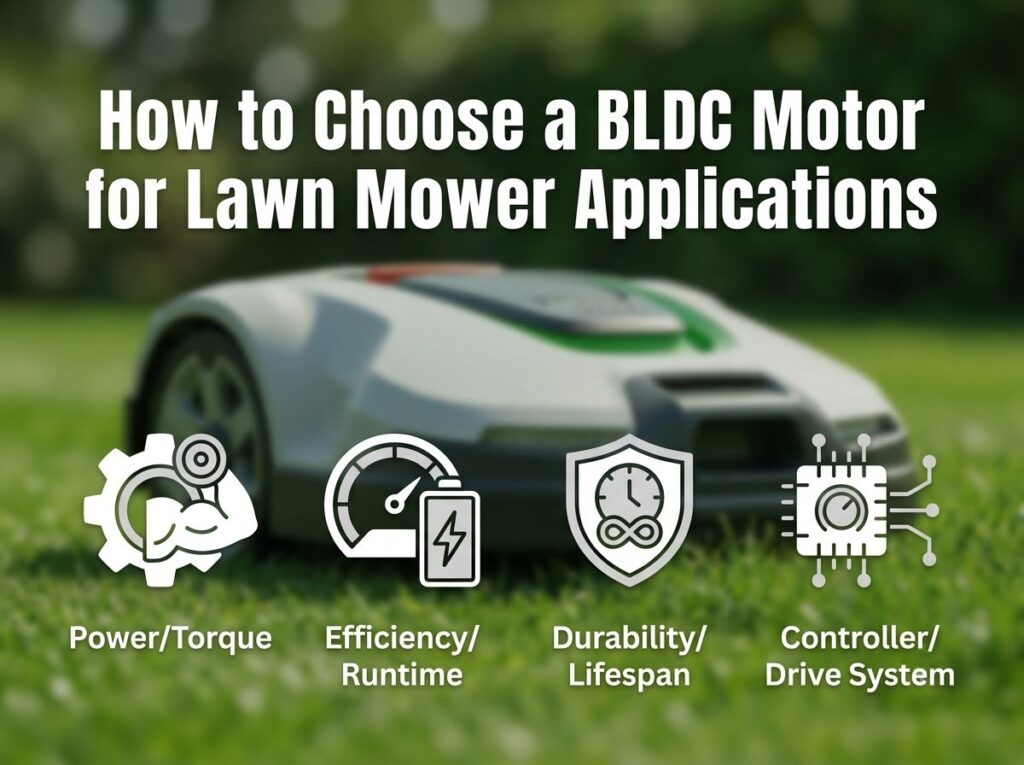
芝刈り機用途向けの BLDC モーターの選び方
Selecting the right BLDC motor for a lawn mower is one of the most critical engineering decisions in modern outdoor power equipment design. The motor directly influences cutting performance, バッテリー稼働時間, 熱挙動, 信頼性, 音響ノイズ, and overall product competitiveness. OEMメーカー向け, 調達チーム, and design engineers, choosing a motor based solely on power rating is a common mistake that often leads to overheating, insufficient torque, reduced runtime, and poor user experience.
The best BLDC motor for lawn mower applications should be selected based on multiple engineering factors including voltage platform, power requirements, torque characteristics, 効率, cooling method, コントローラーの互換性, and intended duty cycle. Commercial mowing systems typically prioritize torque density and reliability, while residential products often focus on cost, 重さ, and battery runtime.
This engineering guide explains how to choose a BLDC motor for lawn mower applications, compares motor technologies, analyzes performance factors, and provides practical OEM selection criteria used by leading mower manufacturers.
What Is a BLDC Motor for Lawn Mower Applications?
ブラシレスDCモーター (BLDCモーター) is an electronically commutated motor that uses permanent magnets on the rotor and controlled electromagnetic fields in the stator to generate rotational motion. ブラシ付きモーターとは異なります, BLDC motors eliminate mechanical commutation, より高い効率を実現, メンテナンスの軽減, and superior reliability.
芝刈り機用途で, BLDC motors are typically integrated with lithium battery systems and electronic motor controllers. This combination enables intelligent power management and adaptive cutting performance.
Why BLDC Motors Have Become the Industry Standard
As battery technology improves and environmental regulations become stricter, manufacturers are moving away from gasoline engines and brushed motor systems. Modern BLDC motors offer significant advantages:
- より高い効率
- メンテナンスの軽減
- 長寿命
- Reduced noise
- Superior torque control
- Improved battery runtime
These characteristics make BLDC motors ideal for residential, 商業, and robotic lawn mower platforms.
Why Motor Selection Matters in Lawn Mower Design
Many mower performance problems originate from incorrect motor selection. Engineers often focus on nominal power ratings while overlooking real-world operating conditions such as wet grass, uneven terrain, prolonged duty cycles, and thermal loading.
A motor that performs well in laboratory testing may fail to deliver acceptable results in actual mowing environments if torque reserves or cooling capacity are insufficient.
Common OEM Challenges
- Short battery runtime
- モーターの過熱
- Blade speed instability
- 過剰な電流引き込み
- Noise and vibration issues
- ベアリングの早期故障
Proper motor selection ensures stable cutting performance while minimizing warranty costs and maintenance requirements.
How to Determine the Required Power for a Lawn Mower Motor
Power rating is typically the first parameter evaluated during motor selection. しかし, selecting the highest power motor is not always the best solution.
Typical Power Ranges
| Lawn Mower Type | 標準的な電力範囲 |
|---|---|
| Compact Residential | 500W~1000W |
| Medium Residential | 1000W – 2000W |
| Premium Residential | 2kW – 3kW |
| 商業用ウォークビハインド | 3kW – 5kW |
| Commercial Ride-On | 5kW – 10kW+ |
Peak Power vs Continuous Power
OEM engineers should always distinguish between continuous power and peak power ratings. Lawn mowers frequently experience transient overload conditions when encountering dense vegetation.
A properly designed BLDC motor should maintain stable blade speed during these peak load events without excessive temperature rise.
Choosing the Right Voltage Platform: 36V, 48V, 60V, or 72V?
Voltage selection significantly affects efficiency, current consumption, 熱性能, 配線要件, and controller design.
36V Systems
Suitable for lightweight residential lawn mowers. Lower cost but limited power capability.
48V Systems
One of the most common platforms for modern cordless mowers. A 48V BLDC motor offers an excellent balance between cost, 効率, そしてパフォーマンス.
Many Greensky OEM customers choose 48V motor systems for mid-range consumer products because component availability is strong and battery costs remain competitive.
60V and 72V Systems
Commercial applications increasingly utilize 60V and 72V architectures.
利点としては次のものが挙げられます。:
- Lower current draw
- Reduced copper losses
- Improved thermal behavior
- Higher sustained power capability
- Smaller cable requirements
For demanding professional applications, 72V systems often provide the best overall performance.
How Important Is Torque in Lawn Mower Applications?
Torque is arguably more important than power in many mowing scenarios. While power determines the total energy available, torque determines the motor’s ability to maintain blade speed under load.
Why Torque Matters
Lawn mower blades experience constantly changing loads. Thick grass, 湿った植物, 葉, and uneven terrain can significantly increase cutting resistance.
If torque reserve is insufficient, blade speed drops, その結果:
- Poor cutting quality
- Increased battery consumption
- モーターの過熱
- Reduced productivity
BLDC Torque Advantages
BLDC motors provide high torque density because permanent magnet rotors and electronic control systems maximize torque production throughout the operating range.
This allows manufacturers to use smaller motors while maintaining excellent cutting performance.
Efficiency and Battery Runtime Considerations
Motor efficiency directly impacts runtime, 運営コスト, and thermal performance.
効率が重要な理由
Every percentage point of efficiency improvement reduces battery energy waste and heat generation.
例えば:
- 80% efficient motor = 20% エネルギー損失
- 92% efficient motor = 8% エネルギー損失
Over hundreds of charging cycles, this difference becomes substantial.
BLDC Motor Efficiency Advantages
Modern BLDC motors typically achieve efficiencies between 85% と 95%, significantly outperforming brushed alternatives.
メリットとしては以下が挙げられます:
- Longer runtime
- Smaller battery packs
- 動作温度の低下
- Reduced energy cost
For OEM product development, efficiency improvements often translate directly into market differentiation.
Thermal Management and Cooling Method Selection
Thermal design is one of the most overlooked aspects of lawn mower motor selection.
Many field failures occur not because motors lack power, but because thermal performance was inadequately evaluated during development.
Common Cooling Methods
| 冷却方法 | 応用 |
|---|---|
| Natural Air Cooling | Small Residential Mowers |
| Forced-Air Cooling | Medium Power Systems |
| Aluminum Housing Cooling | Commercial Equipment |
| 液体冷却 | High-Power Industrial Applications |
温度監視
Commercial-grade BLDC systems increasingly incorporate:
- NTC temperature sensors
- サーマルシャットダウン保護
- Current derating algorithms
- Controller-based thermal management
These features significantly improve reliability and lifespan.
BLDC Motor vs Brushed Motor vs AC Motor for Lawn Mowers
| パラメーター | BLDCモーター | ブラシ付きモーター | ACモーター |
|---|---|---|---|
| 効率 | 85–95% | 60–80% | 70–85% |
| トルク密度 | 高い | 適度 | 適度 |
| メンテナンス | 非常に低い | 高い | 適度 |
| コントローラーの複雑さ | 高度な | 単純 | 単純 |
| ノイズ | 低い | 高い | 中くらい |
| 寿命 | 長さ | 短い | 中くらい |
| バッテリーの互換性 | 素晴らしい | 良い | 貧しい |
For modern cordless lawn mower applications, BLDC motors deliver the best overall balance of performance, 信頼性, とエネルギー効率.
芝刈り機用途向けの BLDC モーターの選び方
This is the most important decision-making framework for OEM buyers and engineering teams.
ステップ 1: Define Voltage Range
Choose 36V, 48V, 60V, or 72V based on target market and performance requirements.
ステップ 2: Define Continuous and Peak Power
Evaluate mowing area, 草の密度, blade size, とデューティサイクル.
ステップ 3: Analyze Torque Requirements
Determine minimum torque needed to maintain blade speed under maximum load.
ステップ 4: Verify Cooling Strategy
Ensure thermal design supports sustained operation.
ステップ 5: Evaluate Controller Compatibility
Confirm compatibility with:
- FOCコントローラー
- Battery management systems
- ホールセンサー
- Sensorless operation
- CAN communication protocols
ステップ 6: Consider Reliability Requirements
Commercial landscaping equipment should prioritize durability over minimum cost.
Request datasheet and testing reports before finalizing motor selection.
Applications of BLDC Motors Beyond Lawn Mowers
The same characteristics that make BLDC motors ideal for lawn mowers also drive adoption across multiple industries.
産業用途
- 自動化システム
- Conveyor equipment
- Industrial fans
- Material handling systems
自動車およびEVアプリケーション
- 電動スクーター
- Electric motorcycles
- Hub motor systems
- Light EV platforms
HVAC アプリケーション
- EC fans
- Variable-speed blowers
- Energy-efficient pumps
ロボット工学の応用
- Autonomous robots
- AGV
- Service robots
- 農業用ロボット
The rapid adoption of BLDC technology across these sectors validates its long-term advantages in efficiency and controllability.
芝刈り機のモーター技術の将来の動向
Several technology trends are reshaping lawn mower design.
- 72V商用プラットフォーム
- Smart connected controllers
- Wireless diagnostics
- Predictive maintenance
- AI-assisted load optimization
- Higher-efficiency motor topologies
- Robotic mowing systems
Future lawn mower platforms will increasingly resemble electric vehicle systems, combining intelligent electronics, 高効率モーター, and advanced battery management.
Manufacturers investing in scalable BLDC motor architectures today will be better positioned for future market demands.
よくある質問: 芝刈り機用途向けの BLDC モーターの選び方
What size BLDC motor is needed for a lawn mower?
Most residential lawn mowers use BLDC motors ranging from 1kW to 3kW, while commercial equipment often requires 3kW to 8kW or higher. The exact requirement depends on blade size, grass conditions, とデューティサイクル.
Is a 48V or 72V BLDC motor better for lawn mowers?
A 48V platform is often ideal for residential products, while 72V systems provide higher efficiency and lower current draw for commercial applications. The best choice depends on performance requirements and battery architecture.
Why is torque more important than power in lawn mowers?
Torque determines the motor’s ability to maintain blade speed when cutting dense vegetation. A motor with strong torque reserves can deliver more consistent cutting performance even if its power rating is not exceptionally high.
How long does a BLDC lawn mower motor last?
A properly designed BLDC motor can operate for thousands of hours with minimal maintenance. 寿命は熱管理に依存します, ベアリングの品質, コントローラーの設計, and operating conditions.
Can BLDC motors be customized for OEM lawn mower projects?
はい. Manufacturers can customize voltage, winding configuration, シャフト寸法, housing design, 冷却システム, and controller integration to meet specific application requirements.
What controller is best for a lawn mower BLDC motor?
フィールド指向制御 (FOC) controllers are generally preferred because they provide smoother torque delivery, より高い効率, 低いノイズ, and improved battery utilization.
結論
Choosing the right BLDC motor for lawn mower applications requires more than selecting a power rating. Engineers must evaluate voltage architecture, トルク要件, 効率, 熱性能, コントローラーの互換性, そして長期的な信頼性.
For most modern mower platforms, high-efficiency BLDC motors provide the best combination of performance, 寿命, そして運営コスト. Whether designing a 48V residential mower or a 72V commercial landscaping platform, careful motor selection significantly influences market success.
Greensky Power provides customized BLDC motor solutions for lawn mower OEMs, including high-efficiency 48V and 72V motor systems, 統合コントローラ, industrial-grade motors, and complete custom motor development services.
データシートをリクエストする, OEM ソリューションを入手する, or contact our engineers to discuss your lawn mower motor project.
参照
- https://www.energy.gov/eere/vehicles/articles/fact-861-february-23-2015-electric-vehicle-efficiency
- https://www.sciencedirect.com/topics/engineering/brushless-dc-motor
- https://ieeexplore.ieee.org/document/9099627
- https://www.mdpi.com/1996-1073/14/3/655
- https://www.nrel.gov/docs/fy19osti/73396.pdf
- https://www.energy.gov/energysaver/lawn-and-garden-equipment
- https://www.iea.org/reports/energy-efficiency-2024
- https://www.britannica.com/technology/electric-motor