
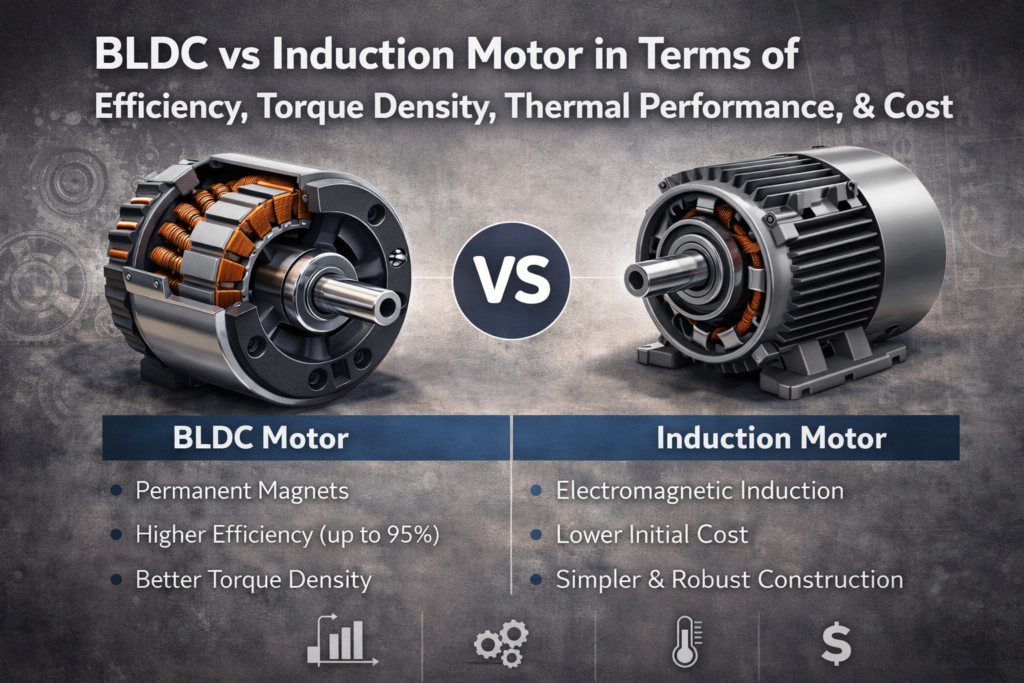
効率の観点から見た BLDC と誘導モーターの比較, トルク密度, 熱性能, とコスト
注目のスニペット:
BLDC motors outperform induction motors in efficiency (まで 95%), トルク密度, and thermal performance due to permanent magnet design and electronic commutation. 誘導電動機, しかし, offer lower upfront cost, より簡単な構造, and strong robustness for industrial environments. In applications such as biomass boilers, HVAC システム, and electric drives, the choice depends on lifecycle cost, control requirements, and operating conditions. OEM および産業用バイヤー向け, BLDC motors are increasingly preferred for energy efficiency and precision control, while induction motors remain a cost-effective solution for standard-duty systems.
What is BLDC Motor and Induction Motor?
BLDC (ブラシレスDC) motors and induction motors are two dominant technologies in industrial motor applications. Understanding their working principles is essential before comparing efficiency, トルク密度, 熱性能, そしてコスト.
BLDC Motor Definition
BLDC motors use permanent magnets on the rotor and electronic commutation to control current flow. This eliminates mechanical brushes and reduces energy loss, making them highly efficient and precise.
Induction Motor Definition
Induction motors operate using electromagnetic induction. The rotor is energized through induced current, which leads to inherent energy losses but offers robust and simple construction.
BLDC ソリューションを探索する: BLDC Motor Portfolio
Why Compare BLDC vs Induction Motor?
エンジニアおよび調達マネージャー向け, choosing between BLDC and induction motors directly affects system performance, operational cost, そして長期的な信頼性. This comparison is particularly critical in continuous-duty systems such as biomass boilers, パンプス, および産業オートメーション.
主要な意思決定要因
- Energy efficiency in 24/7 手術
- さまざまな負荷下でのトルク性能
- Thermal behavior and cooling requirements
- 総所有コスト (TCO)
Industry Reality
While induction motors dominate legacy systems, the shift toward energy efficiency is accelerating the adoption of BLDC motors in modern designs.
効率: BLDC 対 誘導モーター
Efficiency determines how much electrical energy is converted into mechanical output, directly affecting operating cost.
BLDC モーターの効率
- 通常 90 ~ 95%
- Minimal rotor losses
- No brush friction
誘導電動機の効率
- 通常は 75 ~ 90%
- Rotor copper losses
- Slip-related inefficiencies
エンジニアリングの洞察
In continuous applications such as biomass boiler fans or pumps, even a 5% efficiency difference can translate into significant annual energy savings. Over a 5–10 year lifecycle, this becomes a major cost factor.
トルク密度: BLDC 対 誘導モーター
Torque density refers to how much torque a motor can produce relative to its size and weight.
BLDCモーター
- High torque density due to permanent magnets
- Compact and lightweight
- 高い始動トルク
誘導モーター
- 適度なトルク密度
- Larger size for equivalent torque
- Lower starting torque without control systems
アプリケーションインサイト
In biomass boiler systems, fuel feeding mechanisms require high torque at low speed, where BLDC or geared solutions outperform standard induction motors.
熱性能と熱管理
Thermal performance is critical in industrial environments where motors operate continuously under load.
BLDCモーター
- 発熱量の低減
- Higher efficiency reduces thermal stress
- Improved lifespan
誘導モーター
- Higher heat due to rotor losses
- Requires robust cooling systems
エンジニアリングの洞察
Better thermal performance not only improves reliability but also allows higher power density in compact systems, reducing installation footprint.
制御システム: BLDC 対 誘導モーター
Control capability significantly affects performance and flexibility.
BLDC モーター制御
- フィールド指向制御 (FOC)
- 正確な速度とトルクの調整
- 高い動的応答性
Induction Motor Control
- 可変速度には VFD が必要です
- Less precise control compared to BLDC
エンジニアリングの洞察
Advanced control is essential for optimizing airflow and fuel feeding in biomass systems, making BLDC motors more suitable for modern automated systems.
信頼性と寿命の比較
Reliability determines maintenance cost and system uptime.
BLDCモーター
- No brushes → less wear
- 長寿命 (20,000–50,000 hours)
誘導モーター
- Robust mechanical design
- ベアリングや絶縁などのメンテナンスが必要
エンジニアリングの洞察
While both motor types are reliable, BLDC motors offer lower maintenance due to reduced mechanical components.
コスト分析: BLDC 対 誘導モーター
| パラメーター | BLDCモーター | 誘導電動機 |
|---|---|---|
| 初期費用 | より高い | より低い |
| 効率 | 90–95% | 75–90% |
| 維持費 | 低い | 適度 |
| エネルギーコスト | 低い | より高い |
| ライフサイクルコスト | より低い | より高い |
エンジニアリング解釈
Although BLDC motors have higher upfront cost, their lower energy consumption and maintenance requirements result in lower total cost of ownership over time.
Advantages and Disadvantages of BLDC vs Induction Motor
BLDC モーターの利点
- 高効率
- 高いトルク密度
- Excellent control
- メンテナンスの手間がかからない
BLDC モーターの欠点
- より高いコスト
- コントローラーが必要です
Induction Motor Advantages
- 低コスト
- シンプルなデザイン
- High durability
Induction Motor Disadvantages
- 効率の低下
- より高い発熱量
- 制限された制御
How to Choose Between BLDC vs Induction Motor for Industrial Applications
Motor selection should align with system requirements and long-term operational goals.
電圧範囲
- BLDC: 24V~72V以上
- 誘導: 220V–380V standard
パワーレンジ
- Small systems: 0.5kW~5kW
- 産業用システム: 5kW–100kW+
スピード / トルク
Match torque requirements to application load, especially for conveyors and fans.
冷却方法
- Air cooling for standard use
- 高温環境向けの強化された冷却
コントローラーの互換性
BLDC には専用のコントローラーが必要です; induction motors require VFD for variable speed.
アプリケーション固有の考慮事項
- 連続動作と断続動作
- エネルギーコストに対する感度
- 自動化レベル
CTA: カスタマイズされたモーター ソリューションについては、データシートをリクエストするか、当社のエンジニアにお問い合わせください。.
Applications of BLDC and Induction Motors
産業用途
- バイオマスボイラー
- 製造システム
HVAC とポンプ
- ファンと送風機
- Water circulation systems
電気自動車
- 48V / 72V drive motors
- ハブモーター
Explore EV solutions: Electric Vehicle Motors
将来の傾向: Will BLDC Replace Induction Motors?
The motor industry is evolving toward higher efficiency and smarter systems.
主要な傾向
- Adoption of BLDC in industrial applications
- Integration with IoT and smart control
- エネルギー効率と持続可能性に重点を置く
While induction motors will remain in use, BLDC motors are expected to dominate high-efficiency applications.
よくある質問: BLDC 対 誘導モーター
1. どのモーターがより効率的ですか?
BLDC motors are more efficient due to reduced electrical and mechanical losses.
2. Which motor has higher torque density?
BLDC motors provide higher torque density, allowing more compact designs.
3. Are induction motors cheaper?
はい, induction motors have lower upfront cost but higher operating cost.
4. どのモーターが長持ちするか?
BLDC motors typically have longer lifespan due to reduced wear.
5. Which motor is better for industrial use?
It depends on the application—BLDC for efficiency and control, induction for cost-sensitive systems.
結論: Which Motor is Better?
BLDC motors outperform induction motors in efficiency, トルク密度, and thermal performance, 現代の産業用途に最適です. しかし, induction motors remain relevant due to their simplicity and lower initial cost.
OEM および産業用バイヤー向け, the decision should be based on lifecycle cost, パフォーマンス要件, and system integration needs.
次のステップ: Contact our engineering team to develop a customized motor solution tailored to your application.
参照
- IEEE Motor Efficiency Studies
- IEA Energy Reports
- Industrial Motor Design Journals
- Electric Drive Engineering Textbooks