
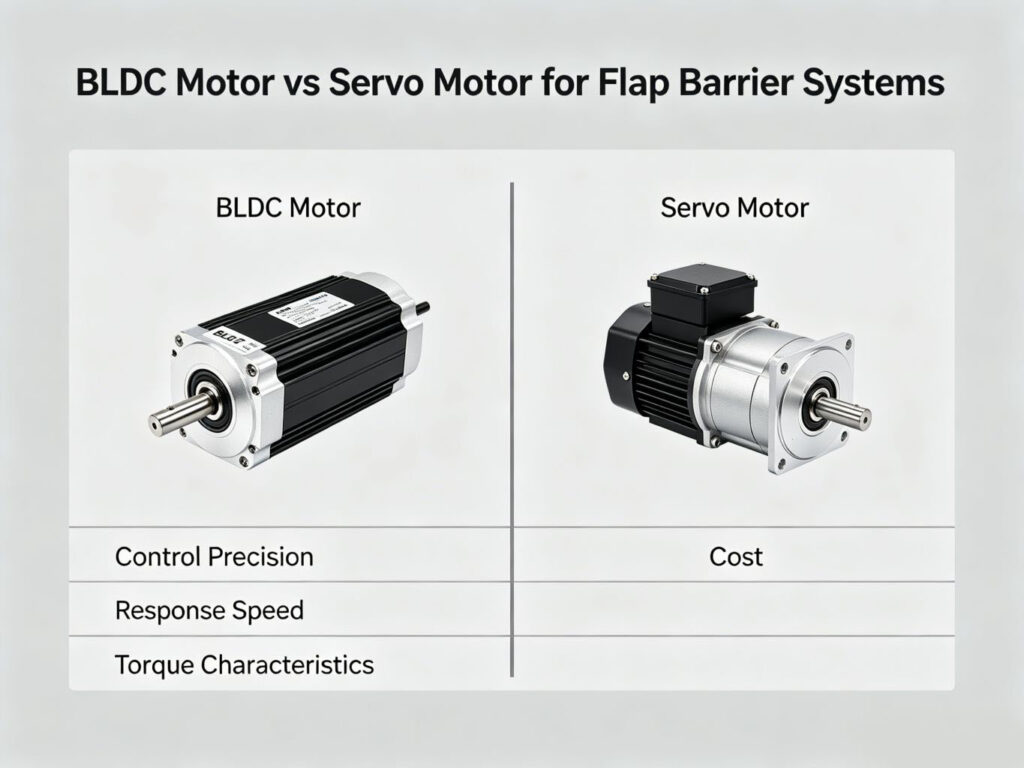
フラップバリアシステム用の BLDC モーターとサーボモーターの比較
BLDC motors and servo motors are the two most common motion control technologies used in modern flap barrier systems. Both provide precise control, rapid response, そして確実な動作, but they differ significantly in cost structure, 複雑さを制御する, 熱性能, torque characteristics, and long-term maintenance requirements.
For most industrial flap barrier systems, high-performance BLDC motors provide the best balance between speed, トルク密度, 効率, 信頼性, OEMコストの最適化. Servo motors offer extremely high positioning accuracy and dynamic control performance, but their higher system cost and control complexity are often unnecessary for standard access control applications.
Understanding the engineering differences between BLDC motors and servo motors is essential for OEM manufacturers, 調達エンジニア, and system integrators selecting motors for flap barriers, スイングゲート, インテリジェントアクセスシステム, and high-cycle pedestrian control equipment. This guide explains the complete technical comparison while helping buyers make better long-term procurement decisions.
What Is a BLDC Motor for Flap Barrier Systems?
BLDCモーター (ブラシレス DC モーター) is an electronically commutated motor widely used in modern flap barrier systems because of its high efficiency, コンパクトな構造, fast dynamic response, メンテナンスの必要性が低い.
BLDC モーターの仕組み
ブラシ付きモーターとは異なります, BLDC モーターは機械的ブラシの代わりに電子整流を使用します. The controller continuously switches current through the stator windings according to rotor position feedback.
This creates:
- Smooth rotational motion
- Rapid acceleration
- 正確な速度制御
- Lower mechanical wear
- Higher operating efficiency
Why BLDC Motors Are Popular in Flap Barriers
Modern flap barriers require:
- Fast opening and closing
- Low noise operation
- Compact installation size
- Continuous-duty capability
- Minimal maintenance
BLDC motors satisfy these requirements efficiently while maintaining lower overall system cost compared with servo systems.
関連産業用モーターソリューション:
フラップバリア用BLDCモーター
What Is a Servo Motor in Flap Barrier Applications?
Servo motors are closed-loop motion systems designed for highly precise position, スピード, そしてトルク制御. Servo systems commonly include:
- モーター
- エンコーダ
- Servo drive
- Advanced control algorithms
How Servo Motors Operate
Servo motors continuously monitor position and speed using encoder feedback. The servo drive dynamically adjusts current output to maintain precise motion profiles.
Advantages of Servo Systems
Servo systems offer:
- Extremely accurate positioning
- 高い動的応答性
- 正確なトルク制御
- Advanced synchronization capability
- Excellent low-speed stability
Why Servo Motors Are Less Common in Standard Flap Barriers
Although servo motors provide excellent precision, many flap barrier applications do not require ultra-high positioning accuracy. In these cases, servo systems may increase:
- System cost
- コントローラーの複雑さ
- Integration difficulty
- メンテナンス要件
For many OEM manufacturers, BLDC motors provide a more commercially balanced solution.
BLDCモーターとサーボモーターの比較: Core Engineering Differences
| パラメーター | BLDCモーター | サーボモーター |
|---|---|---|
| 制御方法 | 電子整流 | Closed-Loop Servo Control |
| 位置精度 | 高い | 非常に高い |
| システムコスト | 適度 | より高い |
| トルク密度 | 高い | 高い |
| 効率 | 85–92% | 88–94% |
| コントローラーの複雑さ | 適度 | 高い |
| メンテナンス | 低い | 低い |
| 熱性能 | 素晴らしい | 素晴らしい |
| OEM Integration | Easier | More Complex |
| Industrial Flap Barrier Suitability | 素晴らしい | 特殊なアプリケーション |
エンジニアリングの観点から, both technologies perform well, but BLDC motors usually provide the best balance between performance and procurement efficiency for access control systems.
効率の比較: BLDCモーターとサーボモーターの比較
Motor efficiency directly affects energy consumption, 発熱, operating stability, and long-term lifecycle cost.
BLDC モーターの効率
Modern BLDC motors typically achieve:
- 85–92% operating efficiency
- Low copper loss
- Reduced friction loss
- Excellent partial-load performance
In flap barriers operating continuously throughout the day, high efficiency significantly reduces thermal stress and electricity consumption.
Servo Motor Efficiency
Servo motors may achieve slightly higher peak efficiency under dynamic load conditions, especially in highly precise motion systems.
しかし, flap barriers rarely require the extreme positioning precision that justifies servo system cost premiums.
Why Efficiency Matters for OEM Buyers
Efficiency affects:
- Operating cost
- Power supply sizing
- 熱管理
- Cabinet ventilation design
- Long-term reliability
In high-cycle transportation or commercial installations, improved efficiency can significantly reduce maintenance and operational expenses.
Torque Density and Dynamic Performance Comparison
Torque density is one of the most important factors in compact flap barrier system design.
BLDC Motor Torque Characteristics
BLDC motors offer:
- 高い始動トルク
- Rapid acceleration
- Compact dimensions
- Smooth continuous rotation
This enables slim flap barrier cabinet structures without sacrificing performance.
Servo Motor Torque Characteristics
Servo motors provide:
- 正確なトルク制御
- Exceptional low-speed stability
- Dynamic load compensation
- Accurate position holding
These advantages are critical in robotics and precision automation but may exceed the practical needs of most flap barrier systems.
Dynamic Response in Access Control Systems
Modern flap barriers require rapid opening cycles combined with smooth deceleration to prevent:
- 機械的衝撃
- ノイズ
- パネル振動
- Premature wear
Both motor technologies can achieve this, but BLDC systems typically provide simpler implementation and lower total system cost.
Thermal Performance and Reliability Comparison
Thermal behavior directly influences motor lifespan, system stability, and maintenance frequency.
BLDC Motor Thermal Advantages
BLDC motors eliminate mechanical brushes, 削減:
- Friction heat
- Electrical arcing
- ブラシの摩耗
- Maintenance intervals
Their efficient structure supports long continuous-duty operation inside compact barrier cabinets.
Servo Motor Thermal Characteristics
Servo motors also provide strong thermal performance, 特に変動負荷条件下では. しかし, servo drives may generate additional heat due to advanced signal processing and higher switching frequencies.
Reliability Under High Duty Cycles
Transportation hubs and industrial facilities often require millions of operating cycles annually.
Reliability depends on:
- Motor bearing quality
- Cooling design
- コントローラーのチューニング
- Current stability
- 機械的アライメント
Well-designed BLDC systems commonly provide operational lifespans exceeding 5–10 years with minimal maintenance.
制御システム: BLDC vs Servo Motion Control
The control architecture significantly affects system integration complexity and total OEM development cost.
BLDC Motor Control Systems
Modern BLDC motors commonly use:
- FOC (フィールド指向制御)
- Hall sensor feedback
- Encoder systems
- Current monitoring algorithms
FOC control enables smooth torque output and highly stable motion performance.
Servo Motor Control Systems
Servo systems require:
- High-resolution encoders
- Advanced servo drives
- Closed-loop PID tuning
- High-speed communication systems
These systems provide superior precision but increase commissioning complexity.
Which Control System Is Better for Flap Barriers?
For standard pedestrian access systems, modern BLDC controllers provide sufficient precision while simplifying:
- OEM integration
- Software development
- Maintenance procedures
- Production scalability
BLDC Motor vs Servo Motor Cost Comparison
Cost is a major decision factor for OEM buyers and procurement managers.
| コスト要因 | BLDCモーター | サーボモーター |
|---|---|---|
| モーターのコスト | 適度 | より高い |
| コントローラーのコスト | より低い | より高い |
| Integration Cost | より低い | より高い |
| 維持費 | 低い | 適度 |
| ライフサイクルコスト | 素晴らしい | より高い |
| OEM Scalability | 素晴らしい | 適度 |
Why Cost Optimization Matters
Flap barrier manufacturers often deploy thousands of systems annually. Even small component cost differences significantly affect:
- Project profitability
- Market competitiveness
- Lifecycle maintenance cost
- Service inventory requirements
BLDC motors generally provide stronger cost-performance value for large-scale deployment.
How to Choose Between BLDC and Servo Motors for Flap Barrier Systems
Choosing the correct motor depends on application requirements, performance targets, and system architecture.
電圧範囲
Common configurations include:
- 24Vコンパクトシステム
- 48V industrial systems
- 72V 高性能システム
Higher voltage systems reduce current load and improve thermal efficiency.
パワーレンジ
Typical flap barrier systems use motors between 40W and 300W depending on:
- パネルサイズ
- デューティサイクル
- Traffic flow
- Opening speed requirements
速度とトルクの要件
High-throughput systems prioritize:
- Rapid acceleration
- Smooth deceleration
- Low vibration
- Stable torque output
冷却方法
Continuous-duty industrial systems require:
- Efficient aluminum housings
- 温度センサー
- Optimized airflow
- 効率的なMOSFETドライバー
コントローラーの互換性
Modern access control systems must integrate with:
- RFID readers
- Biometric systems
- クラウドプラットフォーム
- Industrial automation networks
Custom motor solutions:
Custom bldc motor
Industrial Applications for BLDC Motor vs Servo Motor for Flap Barrier Systems
Different industries require different performance priorities.
Metro and Transportation Systems
Transportation hubs prioritize:
- High throughput
- メンテナンスの手間がかからない
- Continuous-duty capability
- Fast anti-tailgating response
BLDC systems are widely preferred in these environments.
商業オフィスビル
Office installations emphasize:
- 低ノイズ
- スムーズな動き
- コンパクトな設計
- Elegant operation
Industrial Factories
Factories require durable motors capable of operating under dust, 振動, and heavy traffic conditions.
High-Security Facilities
Certain military or research facilities may use servo systems for enhanced synchronization and precision positioning.
スマートシティインフラ
IoT-connected access systems increasingly integrate intelligent BLDC controllers with cloud-based diagnostics and predictive maintenance systems.
関連する産業用途:
電気自動車のモーター
Future Trends in Flap Barrier Motor Technology
The future of access control systems will increasingly focus on energy efficiency, intelligent diagnostics, and compact high-torque motor platforms.
Advanced BLDC Algorithms
Future BLDC systems will use:
- AI-assisted motion optimization
- Adaptive torque control
- Predictive maintenance analytics
- Real-time thermal management
統合型スマートコントローラー
最新のコントローラーはますます統合されています:
- Cloud connectivity
- 無線通信
- Remote firmware upgrades
- Performance diagnostics
Higher Torque Density Designs
New magnetic materials and winding optimization continue improving motor compactness while increasing torque output.
Sustainability and Energy Regulations
Global efficiency regulations are accelerating the transition toward high-efficiency BLDC motor platforms with lower standby power consumption.
よくある質問: フラップバリアシステム用の BLDC モーターとサーボモーターの比較
Which is better for flap barriers: BLDC motor or servo motor?
For most flap barrier systems, BLDC motors provide the best balance between performance, 効率, 信頼性, そしてコスト. Servo motors are mainly used in applications requiring extremely high positioning precision.
Why are BLDC motors widely used in access control systems?
BLDC motors offer high torque density, rapid response, メンテナンスの手間がかからない, コンパクトサイズ, 優れた効率性, making them ideal for modern intelligent access systems.
Are servo motors more accurate than BLDC motors?
はい. Servo systems provide higher positioning precision due to advanced encoder feedback and closed-loop control architecture. しかし, many flap barrier applications do not require such extreme accuracy.
Do BLDC motors have lower maintenance requirements?
はい. Because BLDC motors eliminate brushes and mechanical commutation, they experience less wear and require significantly lower maintenance than many traditional motor systems.
How do engineers choose the correct flap barrier motor?
Engineers evaluate voltage, パワーレンジ, トルク要求, opening speed, 熱性能, control compatibility, 動作環境, and lifecycle cost when selecting motors for flap barrier systems.
結論
BLDC motors and servo motors both provide excellent motion control performance for flap barrier systems, but their practical value depends heavily on application requirements and cost-performance priorities.
Servo motors deliver exceptional positioning precision and dynamic control capability, making them suitable for highly specialized motion systems. しかし, for most commercial and industrial flap barrier applications, modern BLDC motors provide the ideal balance between efficiency, トルク密度, 信頼性, コンパクトな構造, OEMコストの最適化.
As intelligent access control systems continue evolving toward smarter, もっと早く, and more energy-efficient architectures, high-performance BLDC motor platforms are expected to remain the dominant solution across transportation, 商業, 工業用, and smart city applications.
Greensky Power provides customized BLDC motor solutions for flap barriers, スイングゲート, インテリジェントアクセスシステム, 世界中の産業オートメーションアプリケーション.
✔ データシートをリクエストする
✔ OEM ソリューションを入手
✔ 技術的な相談については当社のエンジニアにお問い合わせください
参照
1. https://ieeexplore.ieee.org/
2. https://www.motioncontroltips.com/
3. https://www.controleng.com/
4. https://www.nidec.com/en/technology/motor/basic/
5. https://www.ti.com/motor-drivers/brushless-dc-bldc-drivers/overview.html
6. https://www.analog.com/en/technical-articles/field-owned-control-for-pmsms-utilizing-a-dynamic-voltage-vector.html
7. https://www.mdpi.com/topics/Brushless_DC_Motor
8. https://www.automationworld.com/
9. https://www.sciencedirect.com/topics/engineering/servo-motor