
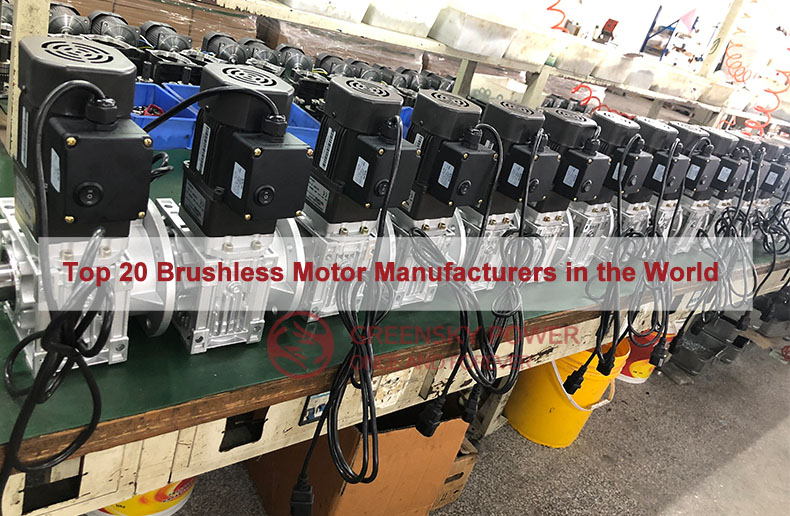
Haut 20 Fabricants de moteurs sans balais dans le monde 2025: Un guide complet du marché
Réponse rapide
Le DC sans balais mondial (BLDC) motor market is projected to grow from USD 14.02 milliards en 2025 to USD 20.68 milliards 2030, at a CAGR of 8.1%, driven by electric vehicle adoption, l'automatisation industrielle, and energy-efficiency regulations. Haut 20 brushless motor manufacturers in the world include Société Nidec, Siemens, ABB, Moteur Maxon, Faulhaber, AMÉTEK, Mouvement allié (Allient), Johnson Électrique, Bonjour, and Portescap, alongside emerging leaders from China such as Greensky Power. When selecting a BLDC motor supplier, engineers should evaluate efficiency ratings per CEI 60034-30-1 (IE2–IE5 classes), torque constants, thermal limits per CEI 60034-1, and compliance with PAS DE MG 1 et BICHE 10 Partie CFR 431 normes d'efficacité. The Asia-Pacific region dominates production with over 50% of global output, while European and American manufacturers lead in high-precision and aerospace-grade BLDC technologies.
What Is a Brushless DC Motor?
A brushless DC (BLDC) motor is a synchronous electric motor that uses direct current (CC) power and electronic commutation—instead of mechanical brushes and a commutator—to achieve rotation. The stator contains wound coils (typically three-phase), while the rotor carries permanent magnets (usually neodymium-iron-boron or samarium-cobalt). An electronic controller sequentially energizes the stator windings based on rotor position feedback from Hall-effect sensors or encoders, creating a rotating magnetic field that drives the permanent-magnet rotor.
According to CEI 60034-1 (Rotating Electrical Machines – Rating and Performance), BLDC motors are classified as permanent-magnet synchronous machines. Contrairement aux moteurs à courant continu à balais, the absence of physical brush-commutator contact eliminates friction wear, reduces EMI, and extends service life to 10,000–30,000+ hours compared to 1,000–3,000 hours for brushed equivalents. Les États-Unis. Ministère de l'Énergie (BICHE) recognizes BLDC motors as a key technology for meeting the IE3 and IE4 efficiency mandates under 10 Partie CFR 431, which govern general-purpose electric motors rated 1–500 HP.
Key BLDC Motor Configurations
| Configuration | Rotor Position | Key Advantage | Application typique |
|---|---|---|---|
| Inner Rotor (Outrunner) | Rotor inside stator | Grande vitesse (jusqu'à 100,000 tr/min), faible inertie, une réponse rapide | Drones, medical handpieces, CNC spindles |
| Outer Rotor (Inrunner) | Rotor outside stator | Higher torque density, smoother rotation at low speed | Vélos électriques, Ventilateurs, pompes, articulations robotiques |
| Slotless | Ironless stator core | Zero cogging torque, ultra-smooth motion | Precision optics, semiconductor handling |
| Linear BLDC | Plat “unrolled” conception | Direct linear motion without conversion | Pick-and-place, laser cutting, l'imagerie médicale |
How Brushless DC Motors Work: Étape par étape
Étape 1 — DC Power Input
A DC power supply (batterie, CA redressé, or DC bus) provides voltage to the motor controller. The controller typically operates at 12V, 24V, 48V, or 72V for commercial BLDC motors, with industrial variants reaching 300–600V DC bus levels. The input current is filtered and conditioned to minimize ripple per IEEE 519-2022 harmonic limits.
Étape 2 — Rotor Position Sensing
Capteurs à effet Hall (typically three, spaced 120° electrical apart) detect the rotor’s magnetic pole position. Dans les conceptions sans capteur, the controller infers position from back-EMF zero-crossing detection in the unenergized winding. High-precision applications use optical or magnetic encoders with 17–26 bit resolution, as seen in Yaskawa Sigma-X servomoteurs (26-bit batteryless absolute encoder).
Étape 3 — Electronic Commutation
Based on rotor position feedback, the controller’s power stage—usually a 3-phase MOSFET or IGBT inverter bridge—sequentially energizes two of the three stator phases. This creates a rotating magnetic field (B-field) that stays approximately 90° ahead of the rotor’s permanent-magnet field, maximizing torque production. The commutation sequence repeats every 60 electrical degrees for a 6-step trapezoidal drive, or continuously for sinusoidal (FOC) commutation.
Étape 4 — Electromagnetic Torque Generation
The interaction between the stator’s rotating B-field and the rotor’s permanent magnets produces electromagnetic torque. The torque magnitude follows the fundamental equation:
T = KT × je
Where T = torque (N·m), KT = torque constant (N·m/A), and I = phase current (UN). Par exemple, le Faulhaber 2264W048BP4 BLDC motor has KT = 23.6 mNm/A, produire 57.9 mNm rated torque at 2.45 A rated current with up to 90% efficacité.
Étape 5 — Mechanical Output and Speed Regulation
The rotor converts electromagnetic torque into rotational mechanical power. Speed is regulated by adjusting the average voltage applied via pulse-width modulation (MLI), typically at 8–20 kHz switching frequency. The back-EMF constant (KE) relates speed to voltage: n = (V − I×R) / KE. Closed-loop control maintains speed within ±0.1% in servo-grade BLDC systems, compared to ±2–5% in open-loop brushed motors.
BLDC Motor Type Comparison Table
Different BLDC motor architectures serve distinct application requirements. The following table compares four primary types across eight engineering parameters:
| Paramètre | Inner Rotor BLDC | Outer Rotor BLDC | Slotless BLDC | BLDC with Integrated Gearbox |
|---|---|---|---|---|
| Plage de vitesse | 3,000–100,000 rpm | 500–15,000 rpm | 1,000–80,000 rpm | 1–500 rpm (sortir) |
| Densité de couple | Moyen | Haut | Faible à moyen | Très élevé (orienté) |
| Efficacité (lemaximum) | 85–92% | 82–89% | 75–90% | 70–85% (système) |
| Cogging Torque | Modéré | Modéré | Zéro | N / A (smoothed by gears) |
| Response Time | Rapide (faible inertie) | Slower (high inertia) | Le plus rapide | Moyen |
| Niveau de bruit | Faible à moyen | Faible | Ultra-low | Moyen (gear noise) |
| Coût | $$ | $$ | $$$ | $$$ |
| Best Application | Drones, médical, CNC | Vélos électriques, Ventilateurs, pompes | Optics, semi-conducteurs | Automatisation industrielle, AGV |
Données d'ingénierie: Efficacité, Thermal Limits, and Torque Formulas
CEI 60034-30-1 Efficiency Classes for BLDC Motors
Le CEI 60034-30-1 standard defines efficiency classes for single-speed, triphasé, moteurs à induction à cage, increasingly applied to BLDC and permanent-magnet synchronous motors in industrial settings:
| Classe CEI | Designation | Plage d'efficacité (4-pôle, 5.5 kW) | Équivalent NEMA | Status |
|---|---|---|---|---|
| IE1 | Efficacité standard | ~86% | Efficacité standard | Phase-out in EU/China |
| IE2 | Haute efficacité | ~89% | Energy Efficient | Minimum in many regions |
| IE3 | Efficacité supérieure | ~91% | PAS de prime | Mandatory in EU (≥7.5 kW) & US (1–500 HP) |
| IE4 | Efficacité super premium | ~93% | — | Mandatory in EU from 2025 (75–200 kW) |
| IE5 | Ultra Premium Efficiency | ~95% | — | EU target 2026+; reduces losses ~20% vs IE4 |
Thermal Limits per IEC 60034-1
Insulation class defines the maximum allowable winding temperature for continuous operation. Exceeding these limits reduces insulation life by 50% for every 10°C rise (Arrhenius rule):
| Classe d'isolation | Température maximale d'enroulement (°C) | Ambient Temp (°C) | Temp Rise Allowance (K) | Typical BLDC Application |
|---|---|---|---|---|
| Classe A (105) | 105 | 40 | 60 | Low-cost consumer electronics |
| Classe B (130) | 130 | 40 | 80 | General-purpose BLDC (Yaskawa Sigma-7) |
| Classe F (155) | 155 | 40 | 105 | Industriel & automotive BLDC |
| Classe H (180) | 180 | 40 | 125 | Haute température / aérospatial (maxon EC-max) |
| Class N (200) | 200 | 40 | 150 | Specialty high-temp applications |
Exemple: The maxon EC-max30 BLDC motor has a maximum winding temperature of 155°C (Classe F), operating from −40°C to +100°C ambient, with a maximum efficiency of 75%. The Faulhaber 4490H048BS operates up to 125°C winding temperature with 88% efficacité maximale.
Core Torque and Power Formulas for BLDC Motor Selection
| Paramètre | Formule | Unités | Remarques |
|---|---|---|---|
| Couple (from current) | T = KT × je | N·m = (N·m/A) × A | KT from manufacturer datasheet |
| Vitesse (from voltage) | n = (V − I×R) / KE | rpm = (V − Vdrop) / (V/krpm) | KE = back-EMF constant |
| Mechanical Power | P = T × ω = T × (2πn/60) | W = N·m × rad/s | ω = angular velocity |
| Electrical Input Power | Pdans = V × I × η−1 | O | η = motor efficiency (0.7–0.92) |
| Efficacité du système | lesys = ηmoteur ×nmanette ×nboîte de vitesses | % | Typique: 0.90 × 0.95 × 0.85 = 72.7% |
| SKF Bearing L10H Life | L10H = (C/P)p × (1,000,000 / 60n) × aSKF | heures | p=3 for ball bearings; C=dynamic load, P=equivalent load |
PAS DE MG 1 Service Factor for BLDC Motors
Par PAS DE MG 1-2024, the service factor (SF) indicates the permissible overload above nameplate rating. For BLDC motors used in continuous-duty industrial applications:
- SF 1.0: Standard continuous duty (most BLDC motors)
- SF 1.15: General-purpose industrial motors (allows 15% overload at reduced temperature rise)
- SF 1.25–1.35: Special applications with intermittent overload requirements
Operating above the service factor voids warranties and accelerates insulation degradation per IEC 60034-1 thermal aging rules.
Haut 20 Fabricants de moteurs sans balais dans le monde 2025
The following ranking is based on market presence, innovation technologique, product portfolio breadth, certification compliance (ISO 9001, IATF 16949, UL, CE), and global distribution capabilities. Market data is sourced from MarketsandMarkets BLDC motor market research (2025).
1. Nidec Corporation — Japan
Fondé: 1973 | Quartier général: Kyoto, Japon | Employés: ~120,000

Nidec is the world’s largest comprehensive motor manufacturer, producing everything from miniature spindle motors for hard disk drives to industrial-grade BLDC motors for automotive and automation. The company holds the largest global market share in BLDC motors for consumer electronics and has expanded aggressively into EV traction motors through acquisitions. Nidec’s BLDC products achieve IE4 efficiency class in industrial ratings and the company operates manufacturing facilities across Japan, Chine, Viêt Nam, Inde, and Mexico. In June 2025, Nidec inaugurated a new manufacturing campus in Hubli, Karnataka, Inde, further expanding BLDC production capacity. Nidec’s portefeuille de produits spans brushless DC fans, souffler, pompes, and spindle motors, all of which are widely used in BLDC motor applications across multiple industries.
2. Siemens AG — Germany
Fondé: 1847 | Quartier général: Munich, Allemagne | Employés: ~311,000

Siemens is a global technology leader in electrification, automatisation, and digitalization. La société SIMOTICS series includes high-efficiency BLDC and permanent-magnet synchronous motors compliant with CEI 60034-30-1 Iai4 / soit 0 efficiency classes. Siemens motors integrate seamlessly with the company’s SINAMICS drive family, enabling predictive maintenance through MindSphere IoT connectivity. Le SIMOTICS portfolio covers power ratings from 0.12 kW to over 1 MW, serving industrial automation, building technology, and transportation sectors. Siemens’ BLDC motors meet PAS DE MG 1 et CEI 60034 standards and are certified per UL, CE, and CSA. For applications requiring moteurs à haut rendement, Siemens’ IE5-class permanent-magnet motors reduce energy losses by up to 20% compared to IE3 equivalents.
3. ABB Group — Switzerland
Fondé: 1988 (merger of ASEA & BBC) | Quartier général: Zurich, Suisse | Employés: ~105,000
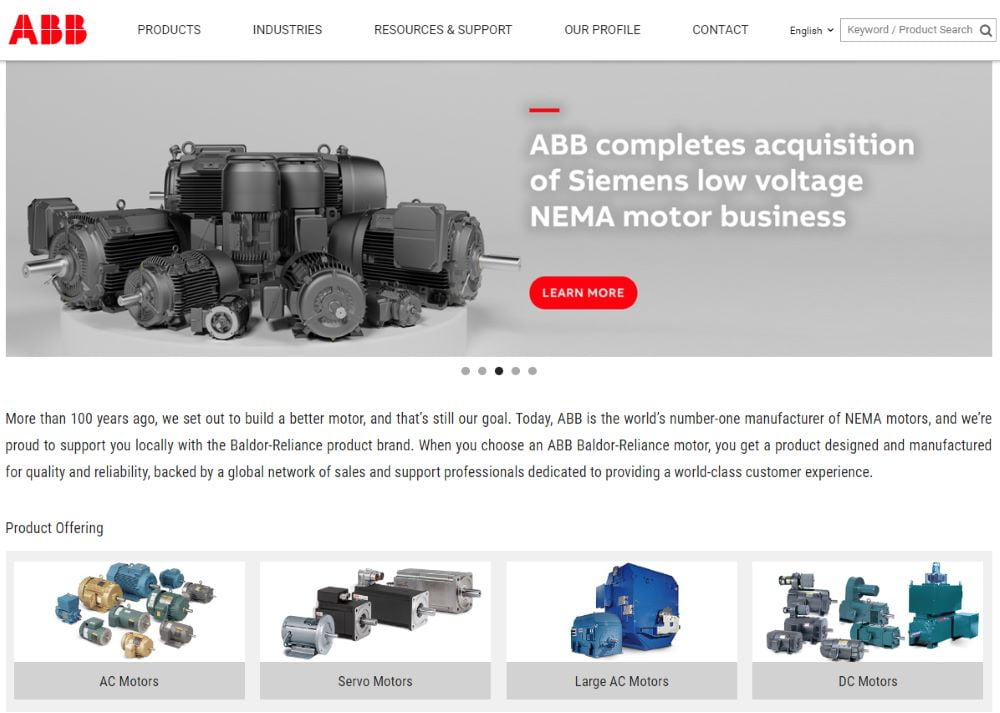
ABB is a pioneer in robotics and industrial automation, offering BLDC motors through its Motion division. ABB’s permanent-magnet and BLDC motor portfolio serves industrial automation, robotique (IRB series robot joints), et production d'électricité. The company’s motors are designed for IE4/IE5 efficiency and integrate with ABB drives for variable-speed control. ABB’s smart motor technology enables IoT-connected monitoring for predictive maintenance, reducing unplanned downtime by up to 50%. La société motor portfolio includes IE5 synchronous reluctance motors (SynRM) that combine BLDC-like efficiency with induction-motor robustness.
4. Maxon Motor AG — Switzerland
Fondé: 1961 | Quartier général: Sachseln, Suisse | Employés: ~3,000+

Maxon is the gold standard for precision BLDC motors in aerospace, médical, et robotique. La société EC series brushless motors feature ironless windings (System maxon), delivering zero cogging torque, efficiencies up to 89% (EC-4pole 22), and speeds up to 100,000 tr/min. Maxon BLDC product line includes the EC-i (industriel), EC-max (cost-optimized), and EC Flat (compact) série. Maxon motors have powered NASA Mars rovers and are specified in FDA-approved surgical robots. The EC-max30 delivers 40 W continuous power at 75% efficiency with a maximum winding temperature of 155°C (Classe F). Maxon precision motor expertise makes it the preferred supplier for applications demanding ±0.1° positioning accuracy.
5. Faulhaber Group — Germany
Fondé: 1947 | Quartier général: Schönaich, Allemagne | Employés: ~2,000+
Faulhaber specializes in miniature and micro BLDC motors using its proprietary ironless FAULHABER winding technologie. The company’s motors achieve efficiencies up to 91% (2264W048BP4) in packages as small as 6 mm de diamètre. Faulhaber’s product range spans 12–44 mm diameter BLDC motors with rated torques from 0.96 mNm to 183 mNm and stall torques up to 1,724 mNm. Le 2264BP4 series delivers 150 W continuous output in a 22 mm package, representing industry-leading power density. Faulhaber motors are specified in semiconductor manufacturing equipment, miniature pumps, and aerospace actuators. Leur coreless winding technology eliminates iron losses, making them ideal for battery-powered 12Moteur V CC applications.
6. AMÉTEK, Inc.. — USA
Fondé: 1930 | Quartier général: Berwyn, Pennsylvania, Etats-Unis | Employés: ~20,000

AMETEK is a leading manufacturer of electronic instruments and electromechanical devices, offering BLDC motors through its Electromechanical Group (EMG). The Precision Motion Control division includes Le moteur Dunker, Bison, Haydon Kerk, and Pittman Motors—each serving distinct BLDC market segments. Le moteur Dunker (acquired 2022) is a German specialist in industrial BLDC motors with integrated gearboxes, encodeurs, et contrôleurs. AMETEK’s BLDC motors achieve efficiencies of 85–90% and operate across wide temperature ranges (−55°C to +125°C). The company serves defense, aérospatial (UAV propulsion, satellite actuators), and industrial automation markets. AMETEK operates in 31 countries with manufacturing facilities in the US, ROYAUME-UNI, Chine, Allemagne, France, and Italy. Pour industrial fan motor applications requiring high reliability, AMETEK’s Pittman BLDC series offers IP65 protection and ball-bearing construction.
7. Technologies de mouvement allié (Allient, Inc.) — USA
Fondé: 1962 | Quartier général: Amherst, New York, Etats-Unis | Employés: ~1,950
Rebranded as Allient, Inc.. dans 2023, Allied Motion designs and manufactures precision BLDC motors, servomoteurs, moteurs couples, and integrated motor drives. La société BLDC product line features high torque density designs optimized for medical equipment, robotique, aérospatial, and defense applications. Allient’s motors include integrated electronics (moteur + conduire + controller in one housing), reducing wiring complexity and improving EMI performance. The company operates 18 manufacturing facilities across the US, L'Europe , et l'Asie. Allient’s BLDC motors meet MIL-STD-810 environmental standards for defense applications and are used in automotive electric power steering (PSE) systèmes, motorized curtain systems, et smart car power tailgates.
8. Johnson Electric Holdings Limited — China (Hong Kong)
Fondé: 1959 | Quartier général: Shenzen, Chine | Employés: ~35,000

Johnson Electric is a global leader in motion products, including BLDC motors for automotive, industriel, and medical applications. The company’s annual revenue exceeds USD 3.45 milliard, with operations in 22 des pays. Johnson Electric’s BLDC motors are specified in automotive window lifts, seat adjusters, Souffleurs CVC, and industrial conveyor systems. The company follows ISO/TS 16949 (now IATF 16949) quality management and offers extensive customization capabilities including application-specific winding configurations, gear integration, and electronic control modules. Johnson Electric’s vertical integration—from magnet manufacturing to final assembly—enables cost-effective high-volume production for appareil électroménager and automotive markets.
9. Kollmorgen — USA
Fondé: 1916 | Quartier général: Radford, Virginia, Etats-Unis | Employés: ~2,500
Kollmorgen is a premier manufacturer of precision motion control solutions, including BLDC (CC sans balais) moteurs, servomoteurs, moteurs pas à pas, and linear actuators. La société AKM and KBM series BLDC motors deliver high continuous torque with low ripple, serving semiconductor manufacturing, machines d'emballage, et robotique. Kollmorgen’s motors feature premium-grade neodymium magnets and are available with integrated encoders up to 22-bit resolution. La société Goldline series offers the highest torque density in its class, with frame sizes from 60 mm to 190 millimètre. Kollmorgen’s expertise in precision motion control makes it a preferred supplier for applications requiring sub-arc-minute positioning accuracy.
10. Portescap — USA/Switzerland
Fondé: 1931 | Quartier général: Chester Ouest, Pennsylvania, Etats-Unis | Parent: Royal Rexnord

Portescap specializes in miniature Moteurs BLDC as small as 8 mm de diamètre, using ironless winding technology for zero cogging torque and smooth operation. The company’s motors serve medical surgical tools, portable diagnostic devices, dental handpieces, and aerospace actuators. Portescap’s Ultra EC series delivers up to 70 W in 22 mm packages, with maximum speeds exceeding 100,000 tr/min. The company’s sterilizable BLDC motors withstand autoclave cycles up to 134°C, meeting ISO 13485 medical device manufacturing standards. Portescap’s micromoteur expertise positions it as the leading supplier for minimally invasive surgical robotics.
11. Bosch (Robert Bosch GmbH) — Germany
Fondé: 1886 | Quartier général: Gerlingen, Allemagne | Employés: ~460,000
Bosch is a global automotive and industrial technology leader, producing BLDC motors for electric power steering (PSE), e-bike drives, outils électroportatifs, and automotive thermal management. Bosch’s BLDC motors meet ISO 26262 functional safety and IATF 16949 automotive quality standards. The company’s eBike Systems division is the world’s largest supplier of BLDC drive systems for electric bicycles, with motors delivering up to 340% pedal assistance. Bosch’s power tool division uses high-performance BLDC motors with brushless EC technology achieving 3× longer runtime compared to brushed equivalents. La société trolling motor and e-mobility BLDC products serve both consumer and commercial markets.
12. Moog Inc. — USA
Fondé: 1951 | Quartier général: East Aurora, New York, Etats-Unis | Employés: ~13,000

Moog is a premier designer and manufacturer of high-performance BLDC motors and servo systems for aerospace, défense, et applications industrielles. The company’s BLDC motors are specified in flight control surfaces, satellite pointing systems, and industrial robotics where MIL-SPEC reliability is mandatory. Moog’s brushless motors feature advanced control algorithms for high-bandwidth torque response, with frameless designs that integrate directly into customer housings for weight-critical aerospace applications. The company’s products comply with DO-160G environmental conditions and AS9100D aerospace quality management.
13. TECO Electric & Machinery Co. — China (Taïwan)
Fondé: 1956 | Quartier général: Taipei, Taïwan | Employés: ~8,000
TECO is a major industrial motor manufacturer producing BLDC and permanent-magnet motors achieving IE4/IE5 efficiency classes. The company’s motors feature built-in variable-frequency drives for pompe and HVAC applications. TECO’s BLDC products serve HVAC systems, water treatment plants, and industrial fan applications, with power ratings from 0.75 kw à 500 kW. The company holds UL, CE, and CNS certifications and operates manufacturing facilities in Taiwan, Chine, and Vietnam.
14. WEG Equipamentos Elétricos — Brazil
Fondé: 1961 | Quartier général: Jaraguá do Sul, Brésil | Employés: ~35,000

WEG is the largest electric motor manufacturer in Latin America, offering BLDC and permanent-magnet motors for industrial, agricole, and mining applications. La société W22 Magnet line achieves IE4/IE5 efficiency with permanent-magnet technology. WEG motors are certified per UL, ASC, CE, and INMETRO and serve harsh-environment applications in mining, métallurgie, and oil & gaz. WEG’s global footprint includes manufacturing in Brazil, Mexique, Portugal, Chine, and India.
15. Regal Rexnord — USA
Fondé: 1955 (Rexnord) / 1955 (Récompense royale) | Quartier général: Rosemont, Illinois, Etats-Unis | Employés: ~30,000

Royal Rexnord (merged 2021) is a major manufacturer of industrial motors, including BLDC and ECM (electronically commutated motor) produits. La société Marathon et LEESON brands offer BLDC motors for HVAC, ventilateurs industriels, et manutention du matériel. In November 2024, Regal Rexnord introduced the PCR 56/06 EC SD, an advanced integrated hardware and software motion controller designed specifically for BLDC motors. The company’s motors meet PAS DE MG 1 et CEI 60034 standards and serve commercial HVAC, VFD-compatible systèmes, and industrial automation markets.
16. Mabuchi Motor — Japan
Fondé: 1954 | Quartier général: Chiba, Japon | Employés: ~20,000
Mabuchi Motor is the world’s largest manufacturer of small DC motors, producing over 1.4 billion units annually. While historically focused on brushed DC motors, Mabuchi has expanded into BLDC motors for automotive actuators, électronique grand public, and home appliances. The company’s BLDC products emphasize cost-effective mass production with automated winding and assembly lines in China, Viêt Nam, and Mexico. Mabuchi’s motors achieve efficiencies of 75–85% in small form factors (10–40 mm diameter) and serve automotive mirror actuators, essuie-glaces, et automotive electric armrests.
17. Bühler Motor GmbH — Germany
Fondé: 1928 | Quartier général: Nuremberg, Allemagne | Employés: ~1,800
Bühler Motor specializes in small BLDC motors for automotive, médical, et applications industrielles. The company’s motors feature CAN bus connectivity, sustainable design principles, et facteurs de forme compacts. Bühler’s BLDC products serve automotive HVAC blowers, medical infusion pumps, and industrial valve actuators. La société détient l'IATF 16949 et ISO 14001 certifications and emphasizes eco-friendly manufacturing with recyclable materials.
18. Greensky Power Co., Ltd. — China
Fondé: 2012 | Quartier général: Shenzen, Chine | Spécialisation: Moteurs BLDC, moteurs à engrenages, moteurs pas à pas
Greensky Power is a vertically integrated Chinese motor manufacturer specializing in moteurs à courant continu sans balais, moteurs à engrenages planétaires, et moteurs pas à pas for global B2B markets. The company’s BLDC motors feature IP65-rated housings, torque outputs up to 5 Nm, and operating voltages from 12V to 72V. Greensky’s motor manufacturing capabilities include in-house CNC machining, automated winding, assemblage d'aimants, et 100% dynamometer testing of every production unit. The company holds CE, UL, and RoHS certifications and serves electric bicycle, industrial tool, robotique, and automation markets across 60+ des pays. Greensky’s BLDC portefeuille de produits includes 12V brushless DC motor controllers, 48V BLDC controllers, et moteur à engrenage planétaire combinations with custom gear ratios.
19. Danfoss — Denmark
Fondé: 1933 | Quartier général: Nordborg, Danemark | Employés: ~40,000

Danfoss produces BLDC motors for renewable energy, Marin, and industrial refrigeration applications. The company’s motors feature ISO 12944 C5-M corrosion protection coatings for marine environments and power ratings up to 100 kW. Danfoss’s variable-speed BLDC drive systems optimize energy consumption in HVAC compressors, pompes industrielles, and refrigeration systems. The company’s drives comply with CEI 61800-2 et DANS 50598-2 efficiency standards for power drive systems.
20. Bonjour / SANYO DENKI — Japan
SANYO DENKI Founded: 1947 | Quartier général: Tokyo, Japon | Employés: ~3,500

SANYO DENKI is a specialist in servo motors, ventilateurs de refroidissement, et systèmes de commande de moteur. La société Sanmotion AC servo and BLDC motor series delivers high-precision motion control for semiconductor manufacturing equipment, des machines-outils, et robotique. SANYO DENKI’s BLDC cooling fans achieve industry-leading airflow-to-noise ratios and are specified in data center cooling systems worldwide. The company holds ISO 9001, ISO 14001, and UL certifications, with manufacturing facilities in Japan, Chine, and the Philippines.
Haut 5 Brushless Motor Manufacturers — Quick Comparison
| Fabricant | Core Strength | Best BLDC Product Category | Certifications clés | Plage de puissance |
|---|---|---|---|---|
| Nidec | Global scale & miniaturisation | Electronique grand public / EV traction | ISO 9001, IATF 16949, UL | 0.1 W – 300 kW |
| Maxon | Précision & aerospace heritage | Micro BLDC (6–90 mm) | ISO 9001, DANS 9100, FDA | 0.3–250 W |
| Faulhaber | Ironless winding technology | Miniature high-speed BLDC | ISO 9001, ISO 14001 | 0.1–200 W |
| Siemens | System integration & IdO | Industrial IE4/IE5 motors | CEI 60034, PAS DE MG 1, UL, CE | 0.12 kW – 1+ MW |
| Puissance Greensky | Cost-effective customization | BLDC + gearbox integrated solutions | CE, UL, RoHS, ISO 9001 | 5–500 W |
Best Applications for Brushless DC Motors
1. Electric Vehicles and E-Mobility
BLDC motors dominate e-bike, e-scooter, and light EV markets due to their high efficiency (85–92%), taille compacte, and regenerative braking capability. Hub motors for e-bikes typically deliver 250–750 W at 36–48V, with planetary gear reduction for torque multiplication. Par BICHE 10 Partie CFR 431, EV traction motors must meet IE3 minimum efficiency. Understanding electric motor specifications is critical for EV powertrain design.
2. Automatisation industrielle et robotique
BLDC motors power servo axes in CNC machines, gear reducer systems, pick-and-place robots, and AGV (Véhicule à guidage automatisé) disques. Precision BLDC servo motors from Kollmorgen and Yaskawa achieve positioning accuracy of ±0.001° with 20–26 bit encoders. CEI 60034-1 cycles de service (S1–S9) define thermal limits for continuous versus intermittent operation in these applications.
3. Dispositifs médicaux
Robots chirurgicaux, dental handpieces, pompes à perfusion, and diagnostic imaging equipment rely on sterilizable BLDC motors from Portescap and maxon. These motors meet ISO 13485 medical device quality management and withstand autoclave sterilization at 134°C. Maxon’s EC-4pole motors power surgical robotic arms with sub-millimeter positioning accuracy, while Faulhaber’s 0615 série (6 mm de diamètre) enables minimally invasive surgical tools.
4. HVAC and Building Automation
BLDC ECM (Electronically Commutated Motor) technology has replaced PSC (Permanent Split Capacitor) motors in HVAC fans, souffler, et des pompes, livrer 30–70% energy savings per DOE estimates. Regal Rexnord’s PCR 56/06 EC SD controller and Siemens’ SIMOTICS motors serve this market. Reducing electric motor noise is a key engineering requirement in residential and commercial HVAC.
5. Aéronautique et Défense
BLDC motors in aerospace must meet MIL-STD-810 environmental, DO-160G EMC, et AS9100D quality standards. AMETEK’s BLDC motors power UAV propulsion systems and satellite actuators, while Moog’s frameless BLDC motors integrate into flight control surfaces. These motors operate at −55°C to +125°C and withstand 100g shock loads per MIL-STD-810H.
Step-by-Step BLDC Motor Selection Guide
Étape 1 — Define Application Requirements
Document the required torque (continuous and peak), plage de vitesse, supply voltage, cycle de service (selon CEI 60034-1 S1–S9), température ambiante, and any size or weight constraints. Par exemple, an AGV drive may require 15 Nm continuous torque at 200 tr/min, 24V supply, S1 duty (continu), and IP54 protection.
Étape 2 — Calculate Required Motor Specifications
Using the torque formula T = KT × je and power equation P = T × (2πn/60), determine the minimum rated torque, vitesse, et le pouvoir. Add a safety margin of 1.5–2× for peak torque and 1.2× for continuous torque to account for load variations. For geared BLDC systems, divide the output torque by the gearbox ratio and multiply by gearbox efficiency (typically 85–95%).
Third Step — Select Motor Type and Configuration
Choose between inner-rotor (grande vitesse, faible inertie), outer-rotor (couple élevé, smooth low-speed operation), or slotless (zero cogging) based on application priorities. For applications below 1,000 rpm output, select a BLDC motor with integrated gearbox to multiply torque and reduce speed.
Étape 4 — Verify Thermal Performance
Calculate the temperature rise using the motor’s thermal resistance values (Rth1 = winding-to-housing, Rth2 = housing-to-ambient) from the manufacturer datasheet: ΔT = Pperte × (Rth1 + Rth2). Ensure the calculated winding temperature does not exceed the insulation class limit per CEI 60034-1. Par exemple, a Faulhaber 2057BA dissipating 2 W with Rth1 = 1.1 K/W and Rth2 = 15 K/W rises 32.2 K above ambient, safely within Class F (155°C) limits at 40°C ambient.
Étape 5 — Evaluate Controller and Feedback Compatibility
Match the motor’s electrical constants (phase resistance, inductance, pole count) to the controller’s current and voltage ratings. Verify Hall sensor or encoder compatibility. For sinusoidal commutation (FOC), ensure the controller supports the motor’s pole pair count and phase sequence. Contrôle de vitesse accuracy depends on feedback resolution: Capteurs à effet Hall (60° Résolution) for general applications, 17+ bit encoders for servo-grade precision.
Étape 6 — Validate Compliance and Certifications
Confirm the motor meets required certifications for the target market: UL 1004-1/1004-6 (US motor safety), CE EN 60034-1/60034-5 (UE), CEI 60034-30-1 classe d'efficacité, PAS DE MG 1 (US industrial), et BICHE 10 Partie CFR 431 (US efficiency mandate). For automotive applications, verify IATF 16949 conformité; for medical, ISO 13485; for aerospace, AS9100D.
Common Engineering Mistakes in BLDC Motor Selection
Erreur 1 — Confusing Rated Torque with Stall Torque
Many engineers select motors based on stall torque (the maximum torque at zero speed), which can be 5–10× the rated continuous torque. Operating near stall torque for extended periods rapidly exceeds thermal limits. Correct approach: Always size based on the maximum continuous torque rating from the manufacturer datasheet, using stall torque only for brief acceleration/deceleration transients.
Erreur 2 — Ignoring Thermal Derating at High Ambient Temperature
Motor torque ratings are specified at 22–40°C ambient. At 60°C ambient, the continuous torque must be derated by 15–25% to stay within insulation class limits. Correct approach: Calculate the actual temperature rise using thermal resistance values and derate the torque proportionally: Tactual =Tnoté × √((Tmaximum − Tambient) / (Tmaximum - 40)).
Erreur 3 — Overlooking Controller Current Limit
A BLDC motor can only produce torque if the controller supplies sufficient current. Selecting a high-KT motor with an undersized controller results in torque starvation. Correct approach: Verify that the controller’s peak and continuous current ratings exceed the motor’s requirements by at least 20% to allow for control loop headroom.
Erreur 4 — Neglecting Cogging Torque in Precision Applications
Slotted BLDC motors exhibit cogging torque (typically 1–5% of rated torque), causing position ripple and acoustic noise in precision motion applications. Correct approach: For sub-arc-minute positioning, select slotless (ironless) BLDC motors from Faulhaber or maxon, or apply skewing techniques per IEEE design optimization papers (DOI: 10.1109/IEEECONF52705.2021.9467459).
Erreur 5 — Specifying Incorrect Pole Pair Count for Commutation
Mismatched pole pair counts between motor and controller cause commutation errors, efficacité réduite, and potential damage. Correct approach: Always verify the motor’s pole pair count (from the datasheet) matches the controller configuration. Most industrial BLDC motors use 2–8 pole pairs, while high-torque designs may use 10+ paires.
Erreur 6 — Underestimating Gearbox Efficiency Losses
When using a BLDC motor with a gearbox, the system efficiency is the product of motor and gearbox efficiencies: lesystème = ηmoteur ×nboîte de vitesses. UN 90% efficient motor with a 75% efficient worm gearbox yields only 67.5% efficacité du système. Correct approach: Specify planetary gearboxes (90–95% d'efficacité) instead of worm gears (60–75%) for BLDC applications where energy efficiency matters.
BLDC Motor Troubleshooting: Problème → Cause → Solution
| Problème | Cause probable | Solution |
|---|---|---|
| Motor does not start or jerks erratically | Incorrect Hall sensor wiring or phase sequence mismatch | Verify Hall sensor signal order matches controller phase output; swap any two motor phase wires to reverse direction |
| Excessive noise and vibration at all speeds | Misaligned coupling or worn bearings; also check for mechanical resonance | Realign coupling per manufacturer tolerance; remplacer les roulements (check réduction du bruit techniques); add damping |
| Motor overheats under rated load | Inadequate ventilation, wrong duty cycle, or controller current limit set too high | Verify S1 vs S3 duty cycle per IEC 60034-1; reduce load or improve cooling; check controller current limit matches motor Inoté |
| Reduced torque output at high speed | Back-EMF approaching supply voltage limit (voltage saturation) | Increase supply voltage; select motor with lower KE; reduce load at high speed |
| Position drift in servo mode | Encoder resolution too low or feedback loop gain incorrectly tuned | Upgrade to higher-resolution encoder (17+ peu); tune PID gains; verify encoder coupling integrity |
| Controller faults on acceleration | Peak current exceeds controller’s overcurrent protection threshold | Reduce acceleration ramp time; increase controller current rating; verify motor phase-to-phase resistance |
| Inconsistent speed under varying load | Open-loop control or insufficient PID tuning in closed-loop mode | Switch to closed-loop speed control; tune speed loop PID gains; verify Hall sensor or encoder feedback |
| Défaillance prématurée des roulements | Excessive radial/axial load beyond manufacturer specification | Verify loads against SKF L10H bearing life calculation; add external bearing support; reduce belt tension |
Foire aux questions (FAQ)
Q1: What is the average efficiency of a brushless DC motor?
BLDC motors typically achieve 85–92% efficiency, compared to 75–80% for brushed DC motors and 70–85% for AC induction motors. Premium BLDC motors from manufacturers like Faulhaber (2264BP4: 91%) and maxon (EC-4pole: 89%) approach the IE4/IE5 efficiency classes defined in IEC 60034-30-1. The higher efficiency results from eliminating brush friction losses and using optimized permanent-magnet rotors.
Q2: How long do brushless DC motors last?
Les moteurs BLDC durent généralement 10,000–30,000+ hours of continuous operation, compared to 1,000–3,000 hours for brushed DC motors. The primary wear items are bearings and insulation. Bearing life can be calculated using the SKF L10H formula: L10H = (C/P)3 × (1,000,000 / 60n), where C is the bearing dynamic load rating and P is the equivalent applied load. With proper sizing and maintenance, industrial BLDC motors can exceed 50,000 hours of service life.
T3: Can I use a BLDC motor without a controller?
Non. BLDC motors require an electronic controller for commutation—unlike brushed DC motors that self-commutate via mechanical brushes. The controller reads rotor position from Hall sensors or back-EMF and sequentially energizes the stator phases. Attempting to apply DC directly to a BLDC motor will not produce rotation and may damage the windings.
Q4: What is the difference between BLDC and PMSM motors?
BLDC motors and PMSM (Moteurs synchrones aimant permanent) are both permanent-magnet synchronous machines per IEC 60034-1. The key difference is commutation: BLDC motors use trapezoidal (6-step) commutation with rectangular back-EMF, while PMSM motors use sinusoidal commutation (FOC) with sinusoidal back-EMF. PMSM provides smoother torque and is preferred for servo applications; BLDC is simpler and more cost-effective for general-purpose applications.
Q5: Which countries dominate BLDC motor manufacturing?
Japon (Nidec, Mabuchi, SANYO DENKI), Allemagne (Siemens, Faulhaber, Bosch, Bühler), Suisse (ABB, Maxon), les États Unis (AMÉTEK, Mouvement allié, Bonjour, Moog), and China (Johnson Électrique, Puissance Greensky) are the primary manufacturing nations. The Asia-Pacific region accounts for over 50% of global BLDC production, driven by electronics manufacturing and EV supply chains. La Chine FR 18613 standard now mandates IE3 efficiency for industrial motors, accelerating BLDC adoption.
Q6: How do I choose between a Chinese and a European BLDC motor manufacturer?
European manufacturers (Maxon, Faulhaber, Siemens) excel in precision, aerospace-grade, and ultra-high-efficiency BLDC motors but command premium pricing. Fabricants chinois (Puissance Greensky, Johnson Électrique) offer competitive BLDC solutions with strong OEM/ODM customization, shorter lead times, and cost advantages of 30–50% for equivalent specifications. For applications requiring IEC 60034 et NEMAMG 1 compliance with cost optimization, Chinese manufacturers like Greensky Power provide CE- and UL-certified BLDC motors that meet international standards while offering flexible manufacturing partnerships.
Why Choose Greensky Power for Your BLDC Motor Needs?
Greensky Power combines vertical manufacturing integration with engineering-driven design to deliver BLDC motor solutions that compete with global brands on quality while offering significant cost advantages:
- In-House Manufacturing: CNC machining, automated winding, assemblage d'aimants, and gearbox production under one roof—eliminating supply chain delays and ensuring consistent quality across all motor product lines.
- Engineering-Driven Customization: Our application engineers work directly with your design team to specify optimal KT, KE, thermal parameters, and gear ratios per IEC 60034-1 et NEMAMG 1 normes. Custom winding configurations, shaft designs, et OEM hybrid solutions are available with MOQs as low as 100 unités.
- 100% Dynamometer Testing: Every production BLDC motor undergoes full-load testing for torque, vitesse, efficacité, augmentation de la température, and noise—ensuring zero defect delivery. Test reports are available per customer request.
- Conformité mondiale: CE, UL, RoHS, et ISO 9001 certifications ensure our motors meet regulatory requirements in North America, L'Europe , and Asia-Pacific markets. Rare-earth permanent magnet materials comply with conflict mineral regulations.
- Global Trade Show Presence: Greensky Power exhibits at major industry trade shows including Canton Fair, Hannover Messe, and CES, maintaining direct relationships with B2B customers in 60+ des pays.
- Scalable Production Capacity: Monthly capacity exceeds 200,000 units across BLDC motor, boîte de vitesses, and controller product lines, with lead times of 15–25 days for standard configurations and 30–45 days for custom designs.
References and Authoritative Sources
- CEI 60034-30-1:2020 — Machines électriques tournantes — Partie 30-1: Classes de rendement des moteurs à courant alternatif fonctionnant en ligne. Commission électrotechnique internationale. https://webstore.iec.ch/publication/67502
- CEI 60034-1:2022 — Machines électriques tournantes — Partie 1: Notation et performances. Commission électrotechnique internationale. https://webstore.iec.ch/publication/679
- PAS DE MG 1-2024 — Moteurs et générateurs. Association nationale des fabricants d'électricité. https://www.nema.org/standards/view/motors-and-generators
- NOUS. Department of Energy — Normes d'économie d'énergie pour les moteurs électriques (10 Partie CFR 431). https://www.energy.gov/eere/buildings/electric-motors
- MarketsandMarkets — Brushless DC Motor Market — Global Forecast to 2030. https://www.marketsandmarkets.com/Market-Reports/brushless-dc-motor-market-1087173.html
- IEEE — Ozturk Tosun, N.F. Oyman Serteller, g. Yalcin, “Comprehensive Design and Optimization of Brushless Direct Current Motor for the Desired Operating Conditions,” 2021 25th International Conference Electronics, DOI: 10.1109/IEEECONF52705.2021.9467459
- IEEE — Park, Oui. et al., “Efficiency Improvement of Permanent Magnet BLDC With Halbach Magnet Array for Drone,” Transactions IEEE sur la supraconductivité appliquée, Vol. 30, Non. 4, 2020, DOI: 10.1109/TASC.2020.2971672
- SKF Group — Bearing Life Calculation — L10h and SKF Generalized Bearing Life Model. https://www.skf.com/group/products/bearings-units-housings/principles/bearing-life
- Siemens AG — SIMOTICS Electric Motors — Product Catalog and Technical Specifications. https://www.siemens.com/global/en/products/automation/motor-systems.html
- IEA — Efficacité énergétique 2024: Opportunities for Energy Efficiency in Electric Motor Systems. Agence internationale de l'énergie. https://www.iea.org/reports/energy-efficiency-2024
HAUT 10 Fabricants chinois de moteurs BLDC
HAUT 30 Fabricants de moteurs électriques en Chine
HAUT 10 Fabricant chinois de moteurs à engrenages hélicoïdaux
HAUT 10 Fabricants de moteurs à courant continu en Chine
HAUT 10 Fabricants de moteurs à courant alternatif en Chine
HAUT 15 Fabricants et fournisseurs de moteurs à engrenages en Chine