
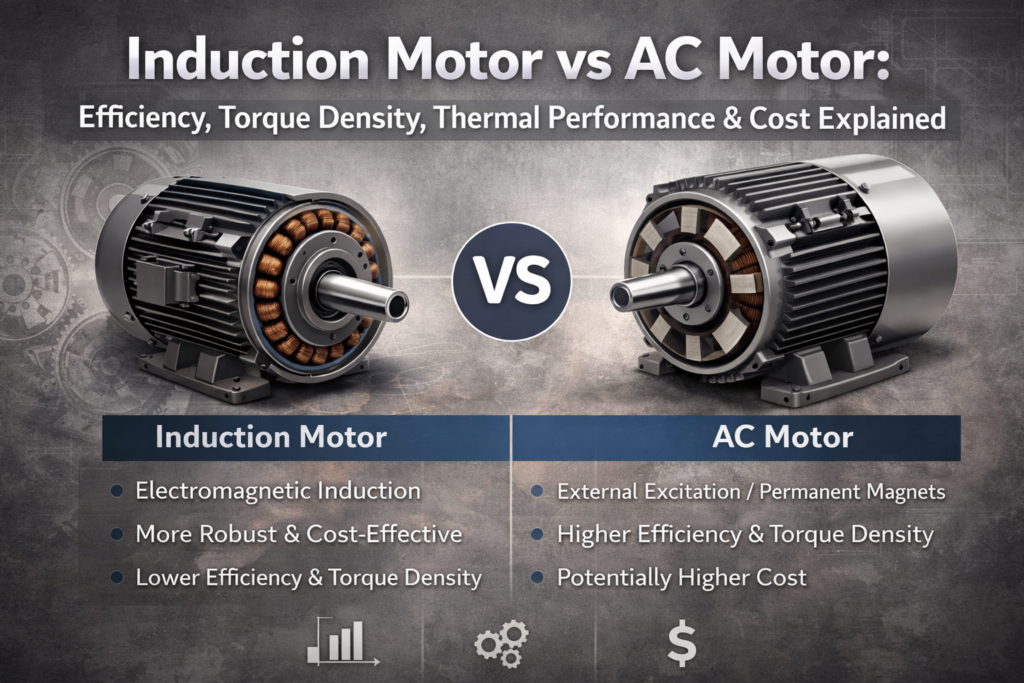
Moteur à induction vs moteur à courant alternatif: Efficacité, Densité de couple, Performance thermique & Coût expliqué
Extrait en vedette:
An induction motor is a type of AC motor, but not all AC motors are induction motors. The main difference lies in how torque is generated: induction motors use electromagnetic induction, while other AC motors (such as synchronous motors) rely on external excitation or permanent magnets. In industrial applications, induction motors are widely used due to their robustness, faible coût, et fiabilité, while other AC motor types offer higher efficiency and torque density in specific use cases. Understanding these differences is critical for engineers and procurement managers selecting motors for performance, coût, and lifecycle optimization.
Qu'est-ce qu'un moteur à courant alternatif?
Un Moteur à courant alternatif is any electric motor driven by alternating current. It includes multiple categories such as induction motors, moteurs synchrones, and permanent magnet AC motors. The defining characteristic is that the stator generates a rotating magnetic field using AC power, which interacts with the rotor to produce motion.
AC motors dominate industrial applications because they are compatible with grid power, scalable across a wide power range, and relatively simple in construction. From pumps and compressors to conveyors and HVAC systems, AC motors form the backbone of industrial motion systems.
Types of AC Motors
- Moteurs à induction (moteurs asynchrones)
- Moteurs synchrones
- Permanent magnet AC motors
- Universal AC/DC motors
Parmi ces, induction motors account for over 70% of industrial motor usage due to their cost-effectiveness and durability.
What Is an Induction Motor?
An induction motor is a specific type of AC motor where the rotor current is induced by the stator’s magnetic field, eliminating the need for brushes or external excitation. This design results in a rugged, maintenance-friendly motor widely used in industrial environments.
The rotor typically consists of a squirrel cage structure, making it mechanically robust and resistant to harsh conditions such as dust, vibration, and high temperatures.
How Induction Motors Work
When AC current flows through the stator windings, il crée un champ magnétique tournant. This field induces current in the rotor conductors, generating torque. Because the rotor must lag behind the stator field to induce current, induction motors always operate at slightly less than synchronous speed.
Moteur à induction vs moteur à courant alternatif: Key Differences Overview
| Paramètre | Moteur à induction | Other AC Motors (par ex., Synchrone) |
|---|---|---|
| Principe de fonctionnement | Electromagnetic induction | External excitation or permanent magnets |
| Vitesse | Variable (slip present) | Constante (vitesse synchrone) |
| Efficacité | Modéré à élevé | Haut (especially PM motors) |
| Densité de couple | Modéré | Haut (PM motors) |
| Coût | Faible | Plus haut |
| Entretien | Faible | Modéré |
| Applications typiques | Pompes, Ventilateurs, convoyeurs | VÉ, robotique, precision systems |
Why Induction Motors Are Widely Used in Industry
Induction motors are preferred in industrial applications because they offer a balanced trade-off between cost, fiabilité, et performances. For procurement managers, the lower initial investment and minimal maintenance requirements make them ideal for large-scale deployments.
En outre, induction motors are highly tolerant of voltage fluctuations and harsh environments. Dans des applications telles que les chaudières à biomasse, cement mixers, et systèmes CVC, where reliability is more critical than peak efficiency, induction motors remain the dominant choice.
Comparaison d'efficacité: Induction Motor vs Other AC Motors
Efficiency is a critical factor affecting operational cost, en particulier dans les applications à service continu. Induction motors typically achieve efficiencies between 85% et 93%, depending on load and design. Cependant, synchronous AC motors—particularly permanent magnet motors—can exceed 95% efficacité.
Aperçu de l'ingénierie
The efficiency difference arises from rotor losses. Induction motors generate rotor current through induction, which leads to I²R losses. En revanche, permanent magnet AC motors eliminate these losses, ce qui entraîne une plus grande efficacité.
For applications running 24/7, even a 2–3% efficiency gain can significantly reduce energy costs over the motor’s lifespan.
Densité de couple: Which Motor Performs Better?
Torque density refers to the amount of torque produced per unit volume. In this aspect, induction motors generally have lower torque density compared to permanent magnet AC motors.
This is due to the absence of permanent magnets, which limits the magnetic flux density in the rotor. Par conséquent, induction motors are typically larger and heavier for the same output torque.
Application Impact
In space-constrained applications such as electric vehicles or robotics, higher torque density is critical. Cependant, in industrial equipment like boilers or pumps, size is less critical, making induction motors a cost-effective option.
Performance thermique et gestion de la chaleur
Thermal performance directly affects motor lifespan and reliability. Induction motors tend to generate more heat due to rotor losses, requiring robust cooling systems such as air or liquid cooling.
Méthodes de refroidissement
- Refroidissement naturel par air (TEFC)
- Refroidissement par air forcé
- Refroidissement liquide (high-power systems)
En revanche, synchronous AC motors, especially permanent magnet types, operate with lower heat generation, improving thermal stability and reducing cooling requirements.
Différences du système de contrôle (VFD Compatibility)
Modern motor systems rely heavily on control strategies. Induction motors are commonly paired with variable frequency drives (VFD) to control speed and torque.
While VFDs improve efficiency and flexibility, they also introduce harmonic losses and require careful tuning. Moteurs synchrones, especially those with permanent magnets, often use more advanced control methods such as field-oriented control (FOC).
Pour les OEM, controller compatibility is a key consideration. If you are integrating motors into automated systems, selecting the right control architecture is as important as the motor itself.
Analyse des coûts: Initial vs Lifecycle Cost
| Facteur de coût | Moteur à induction | Other AC Motors |
|---|---|---|
| Coût initial | Faible | Haut |
| Coût énergétique | Modéré | Faible |
| Entretien | Faible | Modéré |
| Durée de vie | Long | Long |
Induction motors are cheaper upfront, making them attractive for large installations. Cependant, higher efficiency motors can reduce energy costs over time, making them more economical in long-term applications.
How to Choose Between Induction Motor and AC Motor for Your Application
Plage de tension
Induction motors typically operate on standard industrial voltages (220V, 380V, 415V), while advanced AC motors may require specialized drives.
Plage de puissance
Induction motors are available from fractional horsepower to multi-megawatt systems, making them highly versatile.
Exigences de vitesse et de couple
For constant speed applications, synchronous motors are preferred. For variable load applications, induction motors with VFDs are more flexible.
Méthode de refroidissement
Harsh environments require TEFC or IP-rated enclosures. High-power systems may need liquid cooling.
Compatibilité du contrôleur
Ensure compatibility with your control system. Induction motors work well with standard VFDs, while PM motors require advanced controllers.
Considérations spécifiques à l'application
In biomass boilers, cement mixers, and industrial conveyors, robustness and cost often outweigh efficiency, making induction motors the preferred choice.
Besoin d'aide pour choisir le bon moteur? Request a datasheet or obtenez une solution OEM tailored to your application.
Applications: Where Each Motor Type Is Used
Applications industrielles
Induction motors dominate in pumps, Ventilateurs, compresseurs, and conveyors due to their durability and cost-effectiveness.
Automobile / VE
Permanent magnet AC motors are preferred for their high efficiency and torque density.
HVAC and Pump Systems
Induction motors with VFDs are widely used for energy-efficient operation.
Robotique et automatisation
Synchronous AC motors provide precise control and high performance.
Explore more motor solutions: Moteurs BLDC | Moteurs VE
Tendances futures: AC Motor Technology Evolution
The future of AC motors is driven by efficiency regulations, électrification, et automatisation. Permanent magnet motors are gaining popularity due to their superior performance, but induction motors continue to evolve with improved materials and control technologies.
Hybrid systems combining induction motors with advanced drives are becoming more common, offering a balance between cost and efficiency.
FAQ: Moteur à induction vs moteur à courant alternatif
Is an induction motor an AC motor?
Oui, an induction motor is a type of AC motor. Cependant, not all AC motors are induction motors, as the category also includes synchronous and permanent magnet motors.
Ce qui est plus efficace: induction motor or AC motor?
Induction motors are efficient, but permanent magnet AC motors generally offer higher efficiency due to reduced rotor losses.
Why are induction motors cheaper?
Induction motors use simpler construction without permanent magnets, reducing material and manufacturing costs.
Quel moteur est le meilleur pour un usage industriel?
Induction motors are better for most industrial applications due to their robustness, faible coût, and ease of maintenance.
Can induction motors be used with VFDs?
Oui, induction motors are widely used with VFDs for speed control and energy savings in industrial systems.
Conclusion: Quel moteur choisir?
The choice between induction motor and other AC motor types depends on your application priorities. If cost, durabilité, and simplicity are critical, induction motors remain the best option. If efficiency, taille compacte, and performance are more important, advanced AC motors may be worth the investment.
For OEMs and procurement managers, the optimal solution often lies in balancing upfront cost with lifecycle performance.
Looking for the right motor for your project?
Contactez nos ingénieurs, request a datasheet, or explore our solutions de moteur personnalisées to optimize your system performance.
Références
- CEI 60034 – Rotating Electrical Machines Standard
- IEEE Motor Efficiency Guidelines
- Energy Efficiency in Industrial Motor Systems – IEA
- Electric Motor Handbook – H. Wayne Beaty