
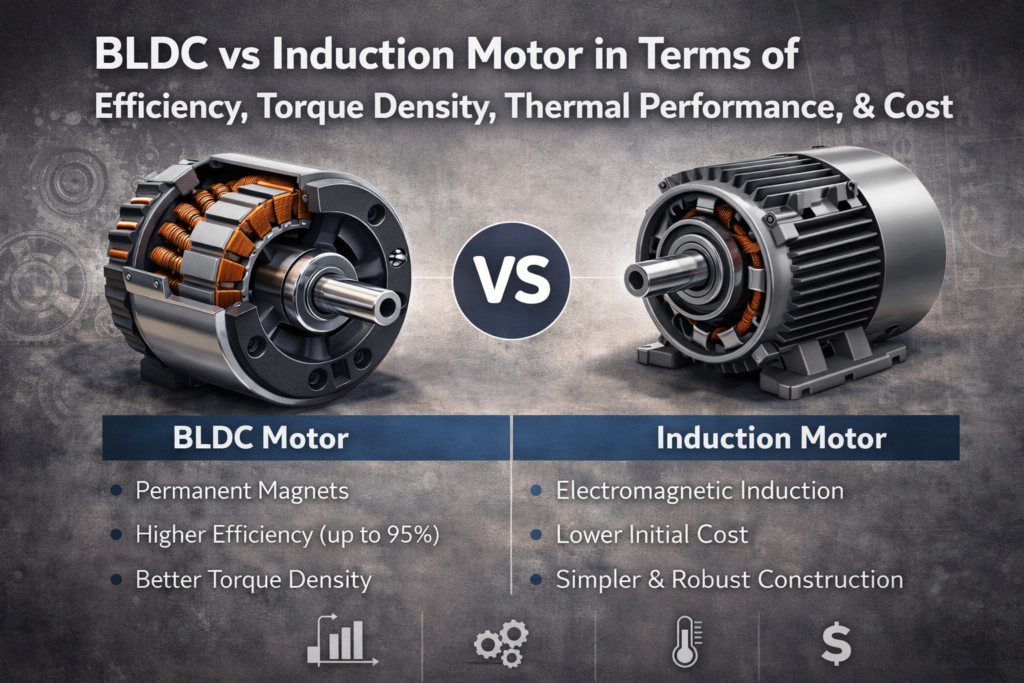
BLDC vs moteur à induction en termes d'efficacité, Densité de couple, Performance thermique, et coût
Extrait en vedette:
Les moteurs BLDC surpassent les moteurs à induction en termes d'efficacité (jusqu'à 95%), densité de couple, et performances thermiques grâce à la conception à aimant permanent et à la commutation électronique. Moteurs à induction, cependant, offrir un coût initial inférieur, construction plus simple, et une forte robustesse pour les environnements industriels. Dans des applications telles que les chaudières à biomasse, Systèmes CVC, et entraînements électriques, le choix dépend du coût du cycle de vie, exigences de contrôle, et conditions de fonctionnement. Pour les OEM et les acheteurs industriels, Les moteurs BLDC sont de plus en plus préférés pour leur efficacité énergétique et leur contrôle de précision, tandis que les moteurs à induction restent une solution rentable pour les systèmes à service standard.
Qu'est-ce que le moteur BLDC et le moteur à induction?
BLDC (CC sans balais) les moteurs et les moteurs à induction sont deux technologies dominantes dans les applications de moteurs industriels. Comprendre leurs principes de fonctionnement est essentiel avant de comparer l’efficacité, densité de couple, performances thermiques, et le coût.
Définition du moteur BLDC
Les moteurs BLDC utilisent des aimants permanents sur le rotor et une commutation électronique pour contrôler le flux de courant. Cela élimine les brosses mécaniques et réduit les pertes d'énergie, ce qui les rend très efficaces et précis.
Définition du moteur à induction
Les moteurs à induction fonctionnent par induction électromagnétique. Le rotor est alimenté par un courant induit, ce qui entraîne des pertes d'énergie inhérentes mais offre une construction robuste et simple.
Explorez les solutions BLDC: Gamme de moteurs BLDC
Pourquoi comparer BLDC et moteur à induction?
Pour les ingénieurs et responsables des achats, le choix entre BLDC et les moteurs à induction affecte directement les performances du système, coût opérationnel, et fiabilité à long terme. Cette comparaison est particulièrement critique dans les systèmes à service continu tels que les chaudières à biomasse., pompes, et automatisation industrielle.
Facteurs de décision clés
- L'efficacité énergétique dans 24/7 opération
- Performances de couple sous différentes charges
- Comportement thermique et exigences de refroidissement
- Coût total de possession (TCO)
Réalité de l'industrie
Alors que les moteurs à induction dominent les systèmes existants, la transition vers l'efficacité énergétique accélère l'adoption des moteurs BLDC dans les conceptions modernes.
Efficacité: BLDC vs moteur à induction
L'efficacité détermine la quantité d'énergie électrique qui est convertie en production mécanique, affectant directement les coûts d’exploitation.
Efficacité du moteur BLDC
- Généralement 90 à 95 %
- Pertes de rotor minimales
- Pas de frottement des brosses
Efficacité du moteur à induction
- Généralement 75 à 90 %
- Pertes de cuivre du rotor
- Inefficacités liées aux glissades
Aperçu de l'ingénierie
Dans les applications continues telles que les ventilateurs ou les pompes de chaudières à biomasse, même un 5% la différence d'efficacité peut se traduire par des économies d'énergie annuelles significatives. Sur un cycle de vie de 5 à 10 ans, cela devient un facteur de coût majeur.
Densité de couple: BLDC vs moteur à induction
La densité de couple fait référence au couple qu'un moteur peut produire par rapport à sa taille et à son poids..
Moteurs BLDC
- Densité de couple élevée grâce aux aimants permanents
- Compact et léger
- Couple de démarrage élevé
Moteurs à induction
- Densité de couple modérée
- Taille plus grande pour un couple équivalent
- Couple de démarrage inférieur sans systèmes de contrôle
Aperçu des applications
Dans les systèmes de chaudières à biomasse, les mécanismes d'alimentation en carburant nécessitent un couple élevé à basse vitesse, où les solutions BLDC ou à engrenages surpassent les moteurs à induction standard.
Performance thermique et gestion de la chaleur
Les performances thermiques sont essentielles dans les environnements industriels où les moteurs fonctionnent en permanence sous charge.
Moteurs BLDC
- Production de chaleur réduite
- Une efficacité plus élevée réduit le stress thermique
- Durée de vie améliorée
Moteurs à induction
- Chaleur plus élevée en raison des pertes du rotor
- Nécessite des systèmes de refroidissement robustes
Aperçu de l'ingénierie
De meilleures performances thermiques améliorent non seulement la fiabilité, mais permettent également une densité de puissance plus élevée dans les systèmes compacts, réduisant l'encombrement de l'installation.
Systèmes de contrôle: BLDC vs moteur à induction
La capacité de contrôle affecte considérablement les performances et la flexibilité.
Contrôle du moteur BLDC
- Contrôle orienté champ (FOC)
- Régulation précise de la vitesse et du couple
- Réponse dynamique élevée
Contrôle du moteur à induction
- Nécessite un VFD pour une vitesse variable
- Contrôle moins précis par rapport au BLDC
Aperçu de l'ingénierie
Un contrôle avancé est essentiel pour optimiser le flux d’air et l’alimentation en carburant dans les systèmes à biomasse, rendre les moteurs BLDC plus adaptés aux systèmes automatisés modernes.
Comparaison de fiabilité et de durée de vie
La fiabilité détermine le coût de maintenance et la disponibilité du système.
Moteurs BLDC
- Pas de brosses → moins d'usure
- Longue durée de vie (20,000–50 000 heures)
Moteurs à induction
- Conception mécanique robuste
- Entretien requis pour les roulements et l'isolation
Aperçu de l'ingénierie
Bien que les deux types de moteurs soient fiables, Les moteurs BLDC offrent moins d'entretien en raison de la réduction des composants mécaniques.
Analyse des coûts: BLDC vs moteur à induction
| Paramètre | Moteur BLDC | Moteur à induction |
|---|---|---|
| Coût initial | Plus haut | Inférieur |
| Efficacité | 90–95% | 75–90% |
| Coût de maintenance | Faible | Modéré |
| Coût énergétique | Faible | Plus haut |
| Coût du cycle de vie | Inférieur | Plus haut |
Interprétation technique
Bien que les moteurs BLDC aient un coût initial plus élevé, leur consommation d'énergie et leurs besoins de maintenance réduits se traduisent par un coût total de possession inférieur au fil du temps.
Avantages et inconvénients du BLDC par rapport au moteur à induction
Avantages du moteur BLDC
- Haute efficacité
- Densité de couple élevée
- Excellent contrôle
- Faible entretien
Inconvénients du moteur BLDC
- Coût plus élevé
- Nécessite un contrôleur
Avantages du moteur à induction
- Faible coût
- Conception simple
- Haute durabilité
Inconvénients du moteur à induction
- Efficacité inférieure
- Génération de chaleur plus élevée
- Contrôle limité
Comment choisir entre BLDC et moteur à induction pour les applications industrielles
La sélection du moteur doit correspondre aux exigences du système et aux objectifs opérationnels à long terme.
Plage de tension
- BLDC: 24V–72 V ou supérieur
- Induction: 220Norme V–380 V
Plage de puissance
- Petits systèmes: 0.5kW–5 kW
- Systèmes industriels: 5kW–100 kW+
Vitesse / Couple
Adaptez les exigences de couple à la charge de l'application, spécialement pour les convoyeurs et les ventilateurs.
Méthode de refroidissement
- Refroidissement par air pour usage standard
- Refroidissement amélioré pour les environnements à haute température
Compatibilité du contrôleur
BLDC nécessite des contrôleurs dédiés; les moteurs à induction nécessitent un VFD pour une vitesse variable.
Considérations spécifiques à l'application
- Fonctionnement continu ou intermittent
- Sensibilité au coût de l’énergie
- Niveau d'automatisation
Appel à l'action: Demandez une fiche technique ou contactez nos ingénieurs pour des solutions de moteur personnalisées.
Applications des moteurs BLDC et asynchrones
Applications industrielles
- Chaudières à biomasse
- Systèmes de fabrication
CVC et pompes
- Ventilateurs et soufflantes
- Systèmes de circulation d'eau
Véhicules électriques
- 48V / 72Moteurs d'entraînement en V
- Moteurs de moyeu
Explorez les solutions pour véhicules électriques: Moteurs de véhicules électriques
Tendances futures: BLDC remplacera-t-il les moteurs à induction?
L'industrie automobile évolue vers une plus grande efficacité et des systèmes plus intelligents.
Tendances clés
- Adoption du BLDC dans les applications industrielles
- Intégration avec l'IoT et le contrôle intelligent
- Focus sur l’efficacité énergétique et la durabilité
Tandis que les moteurs à induction resteront utilisés, Les moteurs BLDC devraient dominer les applications à haut rendement.
FAQ: BLDC vs moteur à induction
1. Quel moteur est le plus efficace?
Les moteurs BLDC sont plus efficaces en raison de pertes électriques et mécaniques réduites.
2. Quel moteur a une densité de couple plus élevée?
Les moteurs BLDC offrent une densité de couple plus élevée, permettant des conceptions plus compactes.
3. Les moteurs à induction sont-ils moins chers?
Oui, les moteurs à induction ont un coût initial inférieur mais un coût d'exploitation plus élevé.
4. Quel moteur dure plus longtemps?
Les moteurs BLDC ont généralement une durée de vie plus longue en raison d'une usure réduite.
5. Quel moteur est le meilleur pour un usage industriel?
Cela dépend de l'application : BLDC pour l'efficacité et le contrôle., induction pour les systèmes sensibles aux coûts.
Conclusion: Quel moteur est le meilleur?
Les moteurs BLDC surpassent les moteurs à induction en termes d'efficacité, densité de couple, et performances thermiques, ce qui les rend idéaux pour les applications industrielles modernes. Cependant, les moteurs à induction restent pertinents en raison de leur simplicité et de leur coût initial inférieur.
Pour les OEM et les acheteurs industriels, la décision doit être basée sur le coût du cycle de vie, exigences de performance, et les besoins d'intégration du système.
Étape suivante: Contactez notre équipe d'ingénierie pour développer une solution moteur personnalisée adaptée à votre application.
Références
- Études d'efficacité des moteurs IEEE
- Rapports sur l'énergie de l'AIE
- Revues de conception de moteurs industriels
- Manuels d'ingénierie des entraînements électriques