

Haut 20 Producteurs de moteurs électriques aux États-Unis
Réponse rapide
Haut 20 electric motor manufacturers in the USA for 2026 include industry leaders such as ABB (Baldor), Siemens États-Unis, Nidec Motor Corporation, Royal Rexnord, et WEG Electric, collectively accounting for over 60% of the U.S. industrial motor market. Les États-Unis. electric motor market was valued at approximately $38.6 milliards en 2026 and is projected to grow at a 7.8% CAGR through 2035, driven by DOE efficiency mandates requiring IE3 minimum efficiency for all 1–500 HP three-phase motors effective December 1, 2026. Key selection factors include NEMA MG 1 conformité, CEI 60034-30-1 classe d'efficacité (IE3/IE4/IE5), IEEE 112 testing certification, and application-specific torque-speed characteristics. For B2B buyers sourcing motors globally, understanding each manufacturer’s certifications, product range, and lead times is critical to optimizing total cost of ownership.
What Is an Electric Motor?
An electric motor is an electromechanical device that converts electrical energy into mechanical energy through the interaction of magnetic fields and current-carrying conductors. According to CEI 60034-1, electric motors are classified by their operating principle (Induction CA, synchronous, CC brossé, CC sans balais), puissance nominale (fractional to integral horsepower), and efficiency class (IE1 through IE5 as defined in IEC 60034-30-1). Les États-Unis. market predominantly follows PAS DE MG 1 standards for frame sizes, mounting dimensions, and performance ratings, while international manufacturers align with IEC equivalents. Les États-Unis. Ministère de l'Énergie (BICHE) estimates that electric motors consume approximately 70% of all industrial electricity aux Etats-Unis, making motor efficiency a primary target for energy conservation regulations under 10 Partie CFR 431.
How Electric Motors Work: Étape par étape
Understanding the operating principle helps in evaluating manufacturer capabilities and selecting the right motor type for specific applications:
- Electrical Input — AC or DC power is supplied to the motor terminals. AC motors receive alternating current that creates a rotating magnetic field in the stator; DC motors receive direct current that energizes the field winding or permanent magnets.
- Stator Field Generation — In AC induction motors, the stator windings produce a rotating magnetic field at synchronous speed (ns = 120f/p, where f = frequency in Hz, p = number of poles). In DC motors, the stator field is stationary, generated by permanent magnets or field windings.
- Rotor Interaction — In induction motors, the rotating stator field induces current in the rotor bars (cage à écureuil), producing a secondary magnetic field that interacts with the stator field to generate torque. In PMDC and BLDC motors, the rotor’s permanent magnets interact directly with the stator field.
- Commutation — DC brushed motors use mechanical brushes and a commutator to reverse current direction in rotor windings. BLDC motors use electronic commutation via Hall-effect sensors or back-EMF detection, eliminating brush wear. AC induction motors require no commutation.
- Mechanical Output — The electromagnetic torque overcomes load resistance and rotational inertia, producing shaft rotation at a speed determined by the motor’s design, supply frequency, and load characteristics. The relationship follows T = P/ω, where T = torque (N·m), P = mechanical power (O), and ω = angular velocity (rad/s).
For a deeper comparison of AC and DC motor architectures, voir notre detailed guide on AC vs DC motor differences.
Electric Motor Type Comparison Table
Different motor types serve distinct applications. The following table compares the five primary motor categories used in U.S. applications industrielles:
| Fonctionnalité | CA à induction | PMSM / BLDC | DC Brushed | Servomoteur (AC/DC) | Pas à pas |
|---|---|---|---|---|---|
| Plage d'efficacité | 85–96% (IE3/IE4) | 92–97% (Iai4 / soit 0) | 75–88% | 90–95% | 60–80% |
| Contrôle de vitesse | VFD required | Contrôleur électronique | Voltage/ARM control | Closed-loop precise | Open/closed loop |
| Entretien | Très faible (pas de pinceaux) | Faible (pas de pinceaux) | Haut (usure des brosses) | Faible à modéré | Faible |
| Densité de couple | Moyen | Haut | Moyen | Très élevé | Low at speed |
| Coût (relative) | Faible | Moyen-élevé | Faible | Haut | Faible |
| Plage de puissance typique | 0.25–500+ HP | 0.1–500 kW | 0.01–200 HP | 0.1–50 kW | 0.01–1 kW |
| NEMA/IEC Standard | PAS DE MG 1, CEI 60034 | CEI 60034-30-1 | PAS DE MG 1 Partie 10 | CEI 60034-1 | CEI 60034-1 |
| Best Application | Pompes, Ventilateurs, convoyeurs | VÉ, robotique, CVC | Simple drives, faible coût | CNC, robotique, automatisation | Positionnement, indexage |
Données d'ingénierie: Efficiency Standards, Limites de température & Formules de couple
CEI 60034-30-1 Classes d'efficacité
The International Electrotechnical Commission defines efficiency classes that are now globally recognized. Les États-Unis. BICHE 2026 final rule mandates IE3 as the minimum for most industrial motors:
| Classe CEI | Équivalent NEMA | Plage d'efficacité (4-pôle, 50 hertz) | NOUS. Statut réglementaire (2026) |
|---|---|---|---|
| IE1 | Efficacité standard | 80–87% | Non-compliant for general purpose |
| IE2 | Energy Efficient | 86–89% | Non-compliant for 1–500 HP |
| IE3 | PAS de prime | 89–93% | Minimum required (BICHE 2026) |
| IE4 | Super prime | 92–95% | Voluntary (recommended for high-duty) |
| IE5 | Ultra-Premium | 95–97%+ | Voluntary (emerging technology) |
Limites de température de la classe d'isolation (CEI 60034-1 / PAS DE MG 1 Partie 12)
| Classe d'isolation | Max Hot Spot Temp (°C) | Average Winding Temp Rise (°C) | Application typique |
|---|---|---|---|
| Classe A (105°C) | 105 | 60 | Obsolète / legacy |
| Classe B (130°C) | 130 | 80 | Moteurs industriels standards |
| Classe F (155°C) | 155 | 105 | Most NEMA Premium motors |
| Classe H (180°C) | 180 | 125 | Haute température / robuste |
Key Motor Formulas
- Vitesse synchrone: ns = 120 ×f / p (RPM), where f = supply frequency (hertz), p = number of poles
- Couple: T = 9550 ×P / n (N·m), where P = power (kW), n = speed (RPM)
- Slip: s = (ns − n) / ns × 100%, typically 2–5% for induction motors at full load
- Efficacité du moteur: η = Pout / Pdans × 100%, tested per IEEE 112 Method B or IEC 60034-2-1
- Facteur de service (PAS DE MG 1): SF = 1.15 for most NEMA Premium motors (allows 15% overload continuously)
- Bearing L10H Life (SKF method): L10H = a1 × (C/P)p × (16667/n), where C = dynamic load rating, P = equivalent load, p = 3 for ball bearings
For detailed torque calculations related to load capacity, voir notre DC motor weight carrying capacity guide.
Haut 20 Producteurs de moteurs électriques aux États-Unis 2026
Les États-Unis. electric motor manufacturing landscape includes multinational giants, specialized domestic producers, and regional suppliers. Below is a detailed analysis of the top 20 fabricants, ranked by market presence, product breadth, and industry reputation.
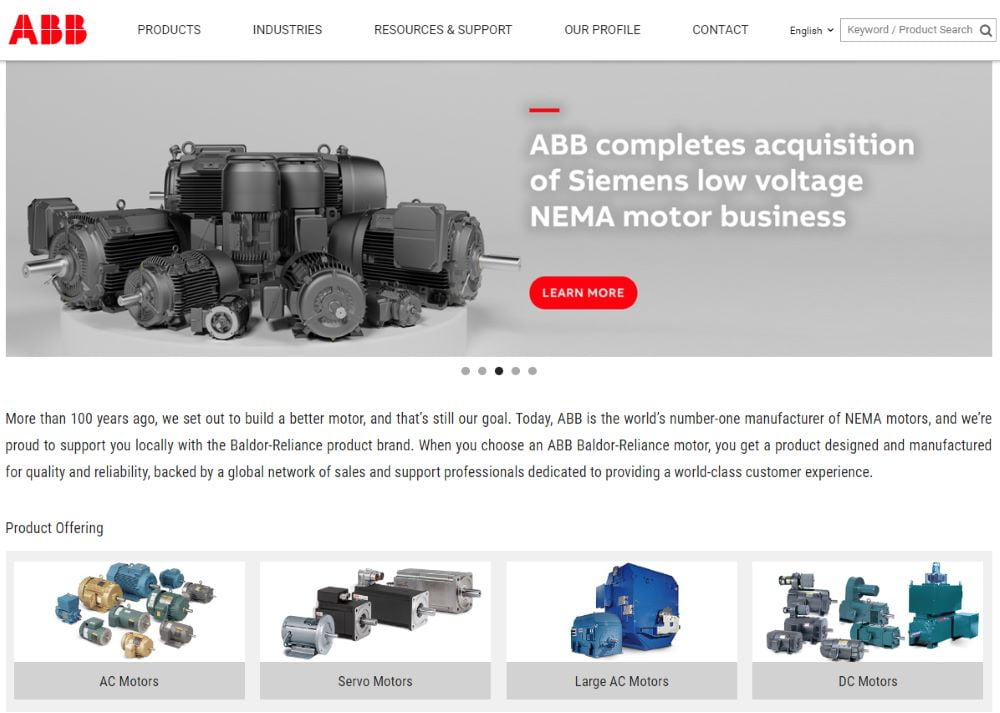
1. ABB Motors and Mechanical Inc. (formerly Baldor Electric)
Fondé: 1920 (as Baldor Electric), acquired by ABB in 2011, rebranded 2018
Quartier général: Fort Smith, Arkansas
Gamme de produits: NEMA Premium AC induction motors (0.25–15,000 HP), Moteurs à courant continu, moteurs synchrones, servomoteurs, mechanical power transmission (Dodge brand), disques, and controls
Certifications: PAS DE MG 1 Tableau 12-12 (PAS de prime), ISO 9001, CEI 60034-30-1 IE3/IE4, UL, ASC
Market Position: ABB operates 15+ manufacturing plants in the U.S. and holds over 50% market share in NEMA-frame industrial motors. The Baldor-Reliance product line covers general purpose, severe duty, antidéflagrant, and washdown motors. ABB’s IE4 Super Premium motors exceed current DOE requirements and are positioned for the 2027 compliance horizon.
Key Industries: Huile & gaz, exploitation minière, CVC, water/wastewater, nourriture & boisson, emballage
2. Siemens États-Unis (SIMOTICS Division)

Fondé: 1847 (global), early 1900s (NOUS. opérations)
Quartier général: Washington, D.C. (NOUS. headquarters)
Gamme de produits: SIMOTICS low-voltage and high-voltage AC motors, servomoteurs, moteurs synchrones, moteurs à engrenages, integrated drive systems, digitalization solutions (MindSphere platform)
Certifications: PAS DE MG 1, CEI 60034, UL, ASC, DOE compliant, ISO 50001 energy management
Market Position: Siemens’ NEMA motor lineup (GP100A series) includes innovative die-cast copper rotor technology that exceeds NEMA Premium efficiency by 1–2 percentage points. The SIMOTICS portfolio covers frame sizes 140–440 (1–400 HP) and meets EISA, ASC, and NOM minimum efficiency requirements simultaneously. Their digital twin technology enables motor lifecycle monitoring and predictive maintenance.
Key Industries: Automobile, aérospatial, énergie renouvelable, process industries, Infrastructure
3. Nidec Motor Corporation
Fondé: 1900 (as U.S. Electrical Motors), acquired by Nidec Corporation (Japon) dans 2010
Quartier général: St. Louis, Missouri
Gamme de produits: Moteurs à induction à courant alternatif, Moteurs à courant continu, moteurs à courant continu sans balais, servomoteurs, moteurs pas à pas, moteurs à engrenages, moteurs de pompage, fan motors (under U.S. Motors and Magneteq brands)
Certifications: PAS de prime, CEI 60034-30-1 IE3/IE4, UL, ASC, ISO 9001
Market Position: One of the largest motor manufacturers globally, Nidec’s U.S. division produces motors from fractional to 2,000+ CV. Les États-Unis. Motors brand is particularly strong in commercial HVAC, pool/spa, and agricultural irrigation markets. Nidec’s E+ (Energy Efficient) product line meets all DOE 2026 exigences.
Key Industries: Automatisation industrielle, CVC, traitement de l'eau, huile & gaz, agriculture, transport
4. Société Regal Rexnord
Fondé: 1955 (as Regal-Beloit), merged with Rexnord in 2023
Quartier général: Milwaukee, Wisconsin (NYSE: RRX)
Gamme de produits: AC/DC motors (Marathon, Léson, Genteq brands), gear drives, accouplements, VFD, démarreurs progressifs, générateurs, HVAC solutions
Certifications: PAS de prime (IE3), IE4/IE5 compliant options, ISO 9001, UL, ASC
Market Position: Avec 2024 revenue of $5.9 billion and 30,800 employés, Regal Rexnord is the third-largest U.S. constructeur de moteurs. The company’s Marathon and Leeson brands cover 1–500 HP NEMA motors with IE3–IE5 efficiency ratings. Their Genteq brand dominates the residential HVAC motor segment.
Key Industries: CVC, l'automatisation industrielle, manipulation du matériel, réfrigération commerciale
5. Société électrique WEG
Fondé: 1961 (Brésil), NOUS. operations since 1980s
Quartier général: Duluth, Géorgie (NOUS. headquarters)
Gamme de produits: Faible- and high-voltage AC motors (fractional to 50,000 CV), moteurs antidéflagrants, moteurs personnalisés, VFD, démarreurs progressifs, transformateurs, générateurs, Automates, HMIs
Certifications: PAS de prime, CEI 60034-30-1 IE3/IE4, UL, ASC, ATEX, ISO 9001, ISO 14001
Market Position: WEG is the largest motor manufacturer in Latin America and a top-5 player in the U.S. marché. Their W22 motor line achieves IE4 efficiency with a patented cooling system design. WEG’s vertically integrated manufacturing (cast iron, enroulements, roulements) enables competitive pricing for OEM accounts.
Key Industries: Huile & gaz, exploitation minière, traitement de l'eau, acier, ciment, sugar/ethanol
6. Toshiba International Corporation
Fondé: 1967 (NOUS. opérations)
Quartier général: Houston, Texas
Gamme de produits: High-efficiency AC motors (1–2,000+ HP), medium-voltage motors, adjustable-speed drives, électronique de puissance (UPS, onduleurs), industrial automation systems
Certifications: PAS de prime, CEI 60034, UL, ASC, IEEE 841 (severe duty), ISO 9001
Market Position: Toshiba’s EQP Global motor series is engineered for harsh environments and meets IEEE 841 standards for petroleum/chemical service. Their medium-voltage motor division is a leading supplier to U.S. power generation and petrochemical facilities.
Key Industries: Huile & gaz, pétrochimique, la production d'énergie, exploitation minière, water/wastewater
7. Électricité générale (GE Industrial Motors)
Fondé: 1892
Quartier général: Boston, Massachusetts (NYSE: GE)
Gamme de produits: Medium-voltage AC induction motors, Moteurs à courant continu, moteurs synchrones, motor controls (GE’s small industrial motor division was acquired by Wolong Electric in 2017)
Certifications: PAS DE MG 1, CEI 60034, IEEE 841, API 541/547, ISO 9001
Market Position: GE retains its position in large industrial motor manufacturing, particularly for power generation, huile & gaz, and mining applications. Their API-compliant motors (meeting API 541 et 547 normes) are specified by major U.S. refineries and petrochemical plants. GE’s medium-voltage motor designs incorporate advanced thermal management for continuous duty in S1 service per IEC 60034-1.
Key Industries: Production d'énergie, huile & gaz, exploitation minière, metals, Marin
8. Franklin Electric Co., Inc..
Fondé: 1944
Quartier général: Fort Wayne, Indiana (NASDAQ: FELE)
Gamme de produits: Submersible motors, fractional HP motors, pump systems, VFD, constant-pressure controllers, fueling systems, water treatment systems
Certifications: IL N'Y A PAS, CEI, UL, ASC, NSF/ANSI 61 (drinking water), ISO 9001
Market Position: Franklin Electric is the global leader in submersible motor technology for groundwater and fueling applications. Avec 2024 revenue of $2.1 billion and 6,300 employés, the company holds an estimated 60%+ share of the U.S. submersible motor market. Their 4-inch submersible motors (4-inch well diameter) are the industry standard for residential water systems.
Key Industries: Water/wastewater, agriculture, fueling systems, industrial fluid handling
9. Marathon Électrique (Royal Rexnord)
Fondé: 1913
Quartier général: Wausau, Wisconsin
Gamme de produits: NEMA Premium AC induction motors (1–500 HP), single-phase and three-phase motors, moteurs personnalisés, moteurs antidéflagrants, générateurs, industrial brake motors
Certifications: PAS DE MG 1 Tableau 12-12, CEI 60034-30-1 IE3, UL, ASC, IEEE 841
Market Position: As a Regal Rexnord brand, Marathon Electric is one of the most recognized motor names in U.S. industrie. Their MaxMount series integrates motor, conduire, and gearbox in a single package. Marathon’s premium efficiency line meets all DOE 2026 requirements and offers IE4 upgrades for high-duty-cycle applications.
Key Industries: CVC, pompes, manipulation du matériel, préparation des aliments, emballage
10. Moteurs américains (Nidec Motor Corporation)
Fondé: 1900
Quartier général: Corinth, Mississippi
Gamme de produits: Single-phase and three-phase AC motors, moteurs personnalisés, démarreurs progressifs, VFD, générateurs, transformateurs, pool/spa motors
Certifications: PAS de prime, CEI 60034-30-1, UL, ASC, ISO 9001
Market Position: Les États-Unis. Motors brand (part of Nidec) is particularly strong in commercial pool/spa, agricole, and general-purpose industrial applications. Their Premium Efficiency product line (E+ series) covers NEMA frame sizes 143–449 (1–300 HP) with full DOE 2026 conformité.
Key Industries: Pool/spa, agriculture, commercial HVAC, general industrial
11. Emerson Electric Co..
Fondé: 1890
Quartier général: St. Louis, Missouri (NYSE: EMR)
Gamme de produits: Automation solutions, HVAC technologies, systèmes de réfrigération, power distribution, measurement and analytical instrumentation, valve and control systems
Certifications: ISO 9001, IL N'Y A PAS, CEI, UL, ASC
Market Position: Emerson is a diversified technology and engineering company with 2024 revenue of $17.3 milliard. While not primarily a motor manufacturer, their Copeland brand produces hermetic motors for HVAC/commercial refrigeration, and their automation division provides motor control and drive systems. Emerson’s Plantweb digital ecosystem integrates motor monitoring with predictive maintenance analytics.
Key Industries: CVC, réfrigération, process automation, huile & gaz
12. Brook Crompton Amériques (Groupe électrique Wolong)
Fondé: 1904 (Brook Crompton), acquired by Wolong Electric (Chine) dans 2011
Quartier général: Charlotte, Caroline du Nord (NOUS. opérations)
Gamme de produits: Single-phase and three-phase AC induction motors, IEC-frame motors, VFD, démarreurs progressifs, générateurs, alternators
Certifications: CEI 60034-30-1 IE2/IE3, NEMA equivalents, UL, ASC, ISO 9001
Market Position: Brook Crompton brings over a century of British motor engineering heritage, now backed by Wolong Electric’s manufacturing scale. Les États-Unis. division serves OEM customers needing IEC-frame motors for imported equipment and specialty applications. Their W series motors achieve IE3 efficiency with aluminum frame construction for weight-sensitive applications.
Key Industries: OEM machinery, traitement de l'eau, préparation des aliments, manipulation du matériel
13. Louis Allis Co..
Fondé: 1901
Quartier général: Cuyahoga Falls, Ohio
Gamme de produits: AC and DC motors, custom-engineered motors, VFD, générateurs, transformateurs, large motor repair and remanufacturing services
Certifications: PAS DE MG 1, CEI 60034, IEEE 841, EASA AR100 (repair standard)
Market Position: Louis Allis specializes in large custom motors (jusqu'à 10,000+ CV) for heavy industrial applications. Their motor remanufacturing division is one of the largest in the U.S., providing cost-effective alternatives to new motor purchases for aging infrastructure. The company’s engineering team designs motors to meet specific customer specifications, including non-standard voltages, vitesses, and mounting configurations.
Key Industries: Acier, exploitation minière, pulp & papier, ciment, utilitaires
14. Société électrique Leeson (Royal Rexnord)
Fondé: 1972
Quartier général: Grafton, Wisconsin
Gamme de produits: Sur 6,000 motor models including AC/DC motors, moteurs à engrenages, disques, réducteurs de vitesse; power range from fractional HP to 350 CV
Certifications: PAS de prime (IE3), CEI 60034-30-1, UL, ASC, IEEE 841, ISO 9001
Market Position: Leeson is known for its extensive catalog breadth—offering one of the widest standard motor selections in the industry. Their stock motor program enables same-week shipping for common NEMA frame sizes. Leeson’s Premium Efficiency line meets DOE 2026 exigences, and their Phase Converter-compatible motors serve agricultural and remote industrial applications.
Key Industries: Agriculture, préparation des aliments, emballage, manipulation du matériel, general industrial
15. Systèmes d'entraînement NORD
Fondé: 1965 (Allemagne), NOUS. operations since 1980s
Quartier général: Waunakee, Wisconsin (NOUS. headquarters)
Gamme de produits: Gear units (hélicoïdal, bevel, ver, planétaire), Moteurs à courant alternatif, IE3/IE4/IE5 motors, distributed drive electronics, mechatronic drive systems
Certifications: CEI 60034-30-1 IE3/IE4/IE5, NEMA equivalents, UL, ASC, ISO 9001, ATEX
Market Position: NORD is a leader in integrated drive systems, combining gearboxes and motors in optimized packages. Their DuoDrive series integrates a high-efficiency IE5 motor directly into a single-stage gear unit, achieving system efficiency up to 92%. NORD’s U.S. facility in Wisconsin provides local assembly, modification, and technical support for North American customers.
Key Industries: Food & boisson, emballage, intralogistics, pharmaceutical, traitement de l'eau
16. Groschopp, Inc..
Fondé: 1930s
Quartier général: Sioux Center, Iowa
Gamme de produits: Moteurs à courant alternatif, Moteurs DC avec et sans balais, moteurs à engrenages, boîtes de vitesses, motor controls, custom engineering and design services
Certifications: IL N'Y A PAS, CEI, UL, ASC, ISO 9001
Market Position: Groschopp specializes in fractional HP motors (jusqu'à 1.5 CV) pour les applications OEM, with particular strength in customized motor-gearbox assemblies. Their design engineering team works directly with OEM customers to optimize motor specifications for specific duty cycles, Conditions environnementales, et exigences de performance. Groschopp’s motoréducteur expertise extends to parallel shaft, angle droit, and planetary configurations.
Key Industries: Équipement médical, préparation des aliments, commercial appliances, l'automatisation industrielle
17. Technologies de mouvement allié, Inc..
Fondé: 1962
Quartier général: Amherst, New York (NASDAQ: AIM)
Gamme de produits: Moteurs CC sans balais, moteurs pas à pas, servomoteurs, moteurs à engrenages, actionneurs linéaires, motor controls and drives
Certifications: CEI 60034, ISO 9001, AS9100D (aérospatial), ITAR registered
Market Position: Allied Motion focuses on precision motion control for high-performance applications. Their brushless DC motor product line includes frameless and housed designs for aerospace, médical, and defense applications. The company’s acquisition strategy (including Heidrive and Mectron) has expanded their European and U.S. manufacturing capabilities. Allied Motion’s BLDC motors achieve efficiencies of 90–95% with neodymium magnet rotors.
Key Industries: Aérospatial & défense, médical, robotique, autonomous vehicles, l'automatisation industrielle
18. Solutions de fluide dynamique Ametek
Fondé: 1930 (predecessor), AMETEK Inc. depuis 1986
Quartier général: Kent, Ohio (NYSE: AME parent company)
Gamme de produits: Moteurs CC sans balais, Moteurs à courant alternatif, blowers and fans, fluid handling solutions (diaphragm pumps, pompes péristaltiques, liquid cooling systems), regulators and valves
Certifications: CEI 60034, ISO 9001, UL, ASC, NSF
Market Position: AMETEK DFS specializes in motors and blowers for air and fluid movement applications. Their brushless DC motor technology powers medical respirators, laboratory fume hoods, and fuel cell systems. The parent company AMETEK had 2024 revenue of $6.9 milliard, with the DFS division contributing specialized motor-blower assemblies to OEM customers globally.
Key Industries: Medical/respiratory, laboratory equipment, fuel cells, industrial air handling
19. Moog Inc.
Fondé: 1951
Quartier général: East Aurora, New York (NYSE: MOG.A)
Gamme de produits: Servomoteurs (AC and DC), moteurs pas à pas, moteurs à courant continu sans balais, moteurs linéaires, contrôleurs de moteur, systèmes de contrôle de mouvement
Certifications: CEI 60034, ISO 9001, AS9100D, ITAR registered, MIL-Spec compliant
Market Position: Moog is the premier manufacturer of high-performance servo motors for aerospace, défense, et automatisation industrielle. Their slip ring and brushless motor technologies power flight control surfaces on military and commercial aircraft. Moog’s industrial servo motors achieve torque densities up to 15 Nm/kg with rare-earth magnet designs optimized through finite element analysis (FEA) methods documented in IEEE publications.
Key Industries: Aérospatial & défense, l'automatisation industrielle, robotique médicale, énergie
20. WorldWide Electric Corporation
Fondé: 1998
Quartier général: Rochester, New York
Gamme de produits: Moteurs à induction à courant alternatif (1–300 HP), moteurs à engrenages, VFD, motor controls, démarreurs progressifs, IEC-frame motors
Certifications: PAS de prime (IE3), CEI 60034-30-1, UL, ASC, EISA compliant, ISO 9001
Market Position: WorldWide Electric is one of the fastest-growing independent motor distributors in the United States, offering a comprehensive product line that competes directly with the major manufacturers. Their import program sources IE3/IE4 motors from qualified Asian manufacturers (including partner facilities in China), providing cost-effective alternatives for price-sensitive applications. WorldWide Electric’s motors meet all DOE 2026 requirements and are stocked in multiple U.S. distribution centers for rapid delivery.
Key Industries: CVC, pompes, manipulation du matériel, general industrial, agricole
Haut 5 NOUS. Electric Motor Manufacturers: Quick Comparison
| Fabricant | Core Strength | Best Product Category | Certifications clés | Plage de puissance |
|---|---|---|---|---|
| ABB (Baldor) | NEMA-frame dominance | Severe duty AC motors | PAS de prime, IE3/IE4, IEEE 841 | 0.25–15,000 HP |
| Siemens États-Unis | Digital integration | SIMOTICS smart motors | IL N'Y A PAS, CEI, ISO 50001 | 1–400 HP (IL N'Y A PAS) |
| Nidec (NOUS. Moteurs) | Broad product portfolio | Commercial HVAC motors | PAS de prime, IE3, UL | Fractional–2,000 HP |
| Royal Rexnord | Brand portfolio depth | Marathon/Leeson IE3–IE5 | PAS de prime, IE3–IE5 | Fractional–500 HP |
| WEG Electric | Cost-performance ratio | W22 IE4 high-efficiency | IL N'Y A PAS, CEI, ATEX, IE3/IE4 | Fractional–50,000 HP |
Best Applications for U.S.-Made Electric Motors
Selecting the right motor type for each application is critical for efficiency, fiabilité, et coût total de possession. The following categories represent the primary U.S. industrial motor applications:
1. Industrial Pumps and Fans
Moteurs à induction à courant alternatif (NEMA Premium IE3) dominate pump and fan applications, which account for approximately 65% of industrial motor energy consumption per DOE estimates. Centrifugal pumps typically use 4-pole, 1,800 RPM TEFC (Refroidi par ventilateur totalement fermé) motors in the 5–100 HP range. Variateurs de fréquence (VFD) are increasingly paired with these motors for variable-load applications, achieving 20–50% energy savings.
2. HVAC and Refrigeration
The HVAC sector uses both standard efficiency motors for small blowers and ECM (Electronically Commutated Motor) technology for high-efficiency systems. Genteq (Royal Rexnord) and U.S. Moteurs (Nidec) are dominant suppliers. ECM motors, essentially BLDC motors with integrated controls, achieve 60–80% efficiency compared to 50–60% for PSC (Permanent Split Capacitor) moteurs.
3. Material Handling and Conveyors
Conveyor systems require motors with high starting torque and reliable continuous duty. Motoréducteurs are commonly used to achieve the required torque-speed combination. NEMA Design C motors (couple de démarrage élevé) or Design B motors with VFDs cover most conveyor applications. For precise positioning, Moteurs BLDC with encoder feedback provide closed-loop control.
4. Electric Vehicle Traction
The EV sector is the fastest-growing motor application segment, with a projected 16.92% CAGR through 2031 (Mordor Intelligence). Moteurs synchrones aimant permanent (PMSMs) are the dominant traction motor type due to their high power density (3–5 kW/kg) et efficacité (95–97%). IEEE research on PMSM optimization (DOI: 10.1109/TVT.2020.3040313) demonstrates that V-shaped interior magnet topologies achieve the best torque-speed-efficiency maps for EV applications.
5. Precision Automation and Robotics
Servo motors from Moog, Mouvement allié, and Siemens provide the positioning accuracy and dynamic response required for CNC machining, pick-and-place robotics, et fabrication de semi-conducteurs. AC servo motors with 23-bit absolute encoders achieve positioning resolution of 0.0002°, alors que moteurs pas à pas provide cost-effective open-loop positioning for lighter-duty applications.
Guide de sélection de moteur étape par étape
Selecting the right electric motor from a U.S. manufacturer involves a systematic evaluation process:
- Define Load Requirements — Determine the required torque (T = 9550 × P/n), plage de vitesse, cycle de service (S1–S10 per IEC 60034-1), couple de démarrage, et les conditions environnementales (température, humidité, altitude, hazardous atmosphere). Calculate the required power: P = T × n / 9550 (kW).
- Verify Efficiency Compliance — For motors sold or installed in the U.S. after December 1, 2026, verify IE3 minimum efficiency per DOE 10 Partie CFR 431. Request manufacturer efficiency data tested per IEEE 112 Method B or CSA C390. Compare IE3 vs. IE4 lifecycle cost using the DOE motor energy savings calculator.
- Check Certifications and Standards — Confirm NEMA MG 1 compliance for frame dimensions, montage, et performances. For hazardous locations, verify Class I/II Division 1/2 notes (NEC Article 500). For oil & gaz, verify IEEE 841 (severe duty) or API 541 (form-wound) conformité. Request UL and CSA certification documentation.
- Evaluate Total Cost of Ownership — TCO = Purchase Price + Coût énergétique + Coût de maintenance + Coût des temps d'arrêt. Pour un 50 HP motor running 6,000 hours/year at $0.12/kWh: an IE3 motor (93% efficacité) costs ~$28,800/year in energy vs. an IE4 motor (95%) at ~$28,200/year—a $600/year difference that typically pays back the IE4 premium in 2–3 years.
- Request Samples and Test Data — For critical applications, request a sample motor for dynamometer testing. Verify efficiency, augmentation de la température (selon CEI 60034-1 classe thermique), vibration (per ISO 10816), et les niveaux de bruit. Compare test results against manufacturer datasheet claims.
- Assess Supplier Capability — Evaluate the manufacturer’s lead time, minimum order quantity (MOQ), capacité de personnalisation, assistance technique, warranty terms, and after-sales service network. For OEM accounts, assess their engineering support for application-specific motor design modifications.
Common Engineering Mistakes When Selecting U.S. Motor Manufacturers
- Specifying IE2 motors for U.S. installations — After December 1, 2026, all 1–500 HP three-phase general-purpose motors must meet IE3 minimum. Installing non-compliant motors risks DOE penalties and customs seizure. Correction: Always specify “PAS de prime / IE3 minimum” in purchase orders.
- Ignoring service factor in sizing — Selecting a motor at exactly the required load without margin leads to overheating. PAS DE MG 1 specifies a service factor of 1.15 for most Premium motors, but this should not be used for continuous operation. Correction: Size motors to operate at 75–90% of rated load for optimal efficiency and longevity.
- Mismatching motor and VFD — Not all motors are VFD-rated. Standard motors operated on VFDs at low speeds (<30 hertz) experience reduced cooling and bearing current damage. Correction: Specify “inverter-duty” motors with Class F or H insulation, shaft grounding rings, and enhanced winding insulation per NEMA MG 1 Partie 31.
- Overlooking altitude and temperature derating — Motors installed above 1,000 m elevation or in ambient temperatures above 40°C require derating per IEC 60034-1. Correction: Apply a 3% power derating per 500 m above 1,000 m, et 1% per °C above 40°C ambient.
- Neglecting bearing current mitigation — VFD-driven motors generate common-mode voltages that cause bearing currents, leading to premature bearing failure (EDM pitting). Correction: Install shaft grounding rings (AEGIS or equivalent) and use insulated bearings on the non-drive end for motors >100 HP on VFDs.
- Choosing price over lifecycle cost — A motor that costs 20% less upfront but operates 3% less efficiently will cost thousands more in energy over its 15–20 year service life. Correction: Use lifecycle cost analysis: for a 50 HP motor, un 2% efficiency improvement saves ~$600/year, far exceeding any purchase price difference.
Motor Troubleshooting Guide: Problème → Cause → Solution
| Problème | Cause probable | Solution |
|---|---|---|
| Surchauffe du moteur (temp >Limite de classe F) | Surcharge, insufficient ventilation, high ambient, VFD harmonic losses | Check actual load vs. nameplate rating; verify cooling fan operation; reduce ambient or derate per IEC 60034-1; install line reactor on VFD |
| Excessive vibration (ISO 10816 Zone D) | Misalignment, rotor déséquilibré, worn bearings, resonance | Laser align coupling; balance rotor to ISO 1940 G2.5; replace bearings per L10h calculation; check for structural resonance |
| Bearing failure (fluting/EDM marks) | VFD-induced bearing currents, inadequate lubrication | Install shaft grounding ring; use insulated bearings (NDE); follow SKF relubrication interval: t = (0.014 × d × B) / (n × √L10h) |
| Le moteur ne démarre pas / hums | Single-phasing (lost phase), basse tension, locked rotor, open winding | Check all three phases with voltmeter; verify voltage within ±10% of nameplate; measure insulation resistance (should be >1 MΩ per IEC 60034-27) |
| Low efficiency vs. nameplate | Undersized load, rewound motor (efficiency loss 0.5–2%), distorsion harmonique | Right-size motor to 75–90% load; replace rewound motors with new IE3/IE4; install harmonic filters (THD <5%) |
| Noisy operation (squealing/grinding) | Roulements usés, montage lâche, fan rubbing, magnetic noise from VFD | Remplacer les roulements; tighten mounting bolts; inspect fan clearance; raise VFD switching frequency to 4–8 kHz |
| Breaker trips on start | Inrush current 6–8× FLA, undersized breaker, NEMA Design D motor | Use soft starter or VFD for reduced-voltage starting; verify breaker sizing per NEC 430.52 (250% of FLA for inverse-time breakers) |
| Premature winding failure | Voltage unbalance >1%, cyclage thermique, pénétration d'humidité, harmonic heating | Correct voltage unbalance (NEMA derating: 1% unbalance → 90% derating); install space heaters for storage; use inverter-duty insulation per NEMA MG 1 Partie 31 |
Foire aux questions
1. What are the DOE efficiency requirements for electric motors in 2026?
As of December 1, 2026, les Etats Unis. Department of Energy requires all 1–500 HP three-phase general-purpose electric motors to meet IE3 (PAS de prime) minimum efficiency levels, as specified in 10 Partie CFR 431. This rule extends coverage to previously exempt motor types including small motors (down to 0.5 CV), footless motors (C-face and D-flange), and vertical motors. The regulation impacts approximately 68% of U.S. industrial motor sales, representing $2.1 billion in annual wholesale value.
2. Who is the largest electric motor manufacturer in the USA?
ABB Motors and Mechanical Inc. (formerly Baldor Electric) is the largest U.S. electric motor manufacturer by market share, retenue 50% of the NEMA-frame industrial motor market. The company operates 15+ manufacturing plants across the United States and produces motors ranging from 0.25 HP à 15,000 CV. Regal Rexnord and Nidec Motor Corporation round out the top three by revenue and production volume.
3. What is the difference between NEMA and IEC motor standards?
PAS DE MG 1 (Association nationale des fabricants d'électricité) et CEI 60034 (Commission électrotechnique internationale) are the two primary motor standards systems. NEMA standards are used primarily in North America and specify frame sizes in inches with different mounting dimensions. IEC standards are used globally (except North America) with metric frame sizes. Key differences: NEMA uses horsepower ratings and service factors; IEC uses kilowatt ratings and thermal classes. Both align on efficiency through the IEC 60034-30-1 IE classification system (IE1 à IE5), which NEMA maps to its own efficiency tiers (Standard, Energy Efficient, Prime, Super prime, Ultra-Premium).
4. How do I verify a motor meets NEMA Premium efficiency?
Check the motor nameplate for “PAS de prime” ou “IE3” designation. The nameplate should also display the nominal full-load efficiency percentage, which must meet or exceed the values in NEMA MG 1 Tableau 12-12. For verification, request the manufacturer’s efficiency test certificate performed per IEEE 112 Method B (input-output method with dynamometer) or CSA C390. The DOE maintains a compliance certification database where manufacturers must register their motor models.
5. Can I import motors from China that comply with U.S. DOE standards?
Oui. Motors manufactured in China can comply with U.S. DOE standards if they meet the IE3 efficiency requirements per 10 Partie CFR 431, carry UL/CSA certifications, and are tested per IEEE 112 Method B. Many Chinese manufacturers, y compris Puissance Greensky, produce IE3/IE4 motors with NEMA-frame dimensions specifically for the U.S. marché. Importers must ensure proper customs documentation and DOE compliance certification. Request third-party test reports from accredited laboratories before placing bulk orders.
6. What is the expected lifespan of an industrial electric motor?
Under proper operating conditions, a NEMA Premium industrial motor has an expected lifespan of 15–20 years. The primary failure mode is bearing wear, which accounts for approximately 51% of motor failures per IEEE motor reliability studies. Winding failures represent 16% and other causes 33%. Factors that reduce lifespan include: continuous operation above nameplate temperature, voltage unbalance >2%, frequent starts (>6 per hour), VFD operation without proper filtering, and inadequate maintenance. Following SKF bearing life calculations (L10h) and maintaining proper lubrication intervals can extend motor life to 25+ années.
Pourquoi choisir Greensky Power?
While the manufacturers listed above represent the established U.S. motor industry, Greensky Power offers a compelling alternative for B2B buyers seeking cost-effective, certified motor solutions without compromising on quality or compliance:
- IE3/IE4 Certified Efficiency — All Greensky motors are manufactured to meet IEC 60034-30-1 IE3 minimum efficiency, with IE4 options available for high-duty-cycle applications. Test reports from accredited laboratories (per IEEE 112 Method B) accompany every shipment.
- NEMA and IEC Frame Compatibility — Greensky produces motors in both NEMA frame sizes (143T–449T) and IEC frame sizes (56–355), enabling direct replacement of U.S.-manufactured motors without modification to mounting or coupling arrangements.
- Comprehensive Product Range - Depuis AC and DC motors pour Moteurs BLDC, moteurs pas à pas, moteurs à engrenages, et contrôleurs de moteur, Greensky covers the full spectrum of motion control products for industrial applications.
- 100% Tests individuels — Every motor undergoes individual dynamometer testing at our factory, including efficiency verification, temperature rise measurement, analyse vibratoire (per ISO 10816), and noise level testing. This contrasts with the statistical sampling approach used by many large manufacturers.
- Certifications mondiales — Greensky motors carry UL, CE, RoHS, et ISO 9001:2015 certifications. DOE compliance documentation and customs-ready certificates of origin are provided for all U.S.-bound shipments.
- Engineering-Driven Customization — Notre R&L'équipe D de 8 PhD-level engineers provides application-specific motor design, including custom winding configurations, modifications de l'arbre, special mounting arrangements, et intégré motor-controller solutions. Typical customization lead time is 3–4 weeks from specification approval.
Contacter Greensky Power to discuss your motor requirements with our technical team.
Références
- NOUS. Ministère de l'Énergie. “Small Electric Motors.” Énergie.gov. https://www.energy.gov/cmei/buildings/small-electric-motors
- Commission électrotechnique internationale. “CEI 60034-30-1: Machines électriques tournantes — Partie 30-1: Efficiency classes of line operated AC motors.” https://webstore.iec.ch/publication/38800
- Institute of Electrical and Electronics Engineers. “IEEE 112-2017: Standard Test Procedure for Polyphase Induction Motors and Generators.” https://standards.ieee.org/ieee/112/3551/
- Association nationale des fabricants d'électricité. “PAS DE MG 1-2024: Motors and Generators.” https://www.nema.org/standards/view/motors-and-generators
- Agence internationale de l'énergie. “Efficacité énergétique 2024: Motor Systems and Industrial Energy Use.” https://www.iea.org/reports/energy-efficiency-2024
- Groupe SKF. “Calcul de la durée de vie des roulements: L10h Method and Application Guide.” https://www.skf.com/group/products/bearings
- Siemens AG. “SIMOTICS NEMA Motors — Technical Catalog D81.2.” Siemens Industry Online Support. https://cache.industry.siemens.com/dl/files/390/109763390/att_1023414/v1/2019_NEMA_Catalog_D81-2_Online_May2020.pdf
- NOUS. Ministère de l'Énergie. “Programme d'économie d'énergie: Energy Conservation Standards for Electric Motors.” 10 Partie CFR 431, Federal Register, 91 FR 6743 (Février 13, 2026). https://www.federalregister.gov/citation/76-FR-666
- Candelo-Zuluaga, C., Garcia Espinosa, UN., Riba, J.-R., & Blanch, P. T. (2020). “PMSM Design for Achieving a Target Torque-Speed-Efficiency Map.” Transactions IEEE sur la technologie automobile, 69(12), 14448–14457. DOI: 10.1109/TVT.2020.3040313
- IL N'Y A PAS. “NEMA Premium Efficiency Motors Program: Efficiency Levels and Compliance.” https://www.nema.org/technical-references/nema-premium
HAUT 10 Fabricants chinois de moteurs BLDC
HAUT 30 Fabricants de moteurs électriques en Chine
HAUT 10 Fabricant chinois de moteurs à engrenages hélicoïdaux
HAUT 10 Fabricants de moteurs à courant continu en Chine
HAUT 10 Fabricants de moteurs à courant alternatif en Chine
HAUT 15 Fabricants et fournisseurs de moteurs à engrenages en Chine