
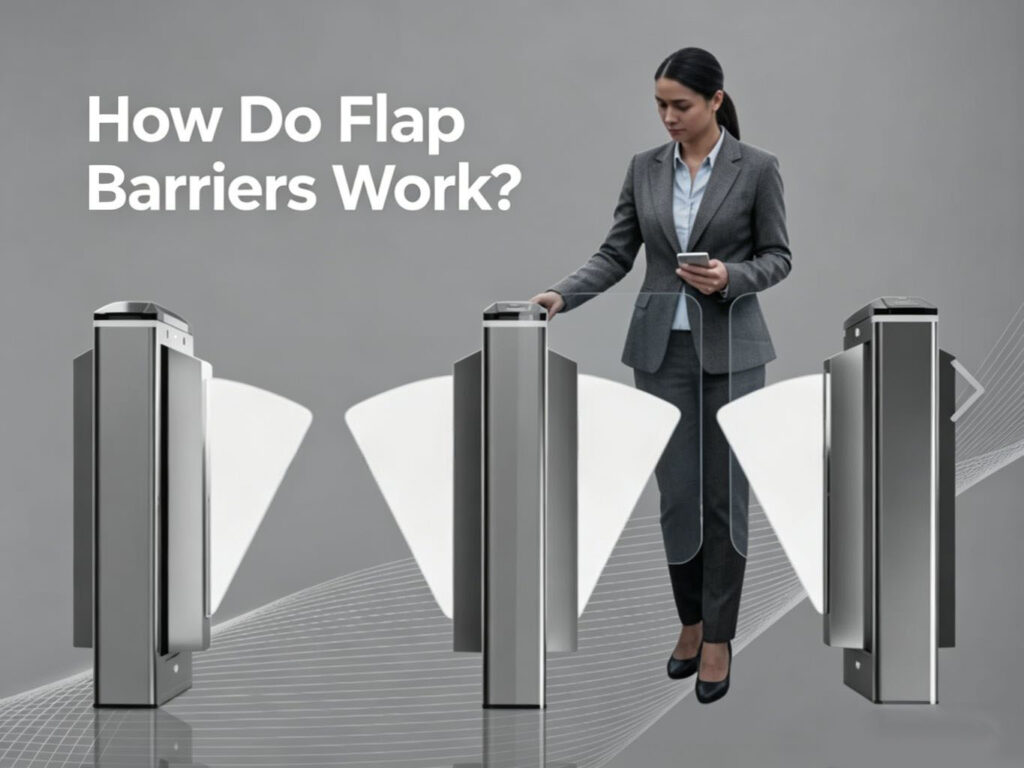
¿Cómo funcionan las barreras con solapas??
Las barreras abatibles funcionan combinando un movimiento mecánico impulsado por motor., sistemas de control inteligentes, sensores infrarrojos, y tecnologías de autenticación para regular el acceso de peatones en instalaciones comerciales e industriales. Cuando un usuario es autorizado a través de RFID, código qr, reconocimiento biométrico, o validación de billetes, El controlador activa el sistema del motor., retraer los paneles de las solapas para permitir el paso. Después de la detección del paso, las trampillas se cierran automáticamente para restablecer la restricción de acceso.
Los sistemas de barrera de aletas modernos utilizan principalmente motores BLDC porque proporcionan una alta eficiencia., velocidad de respuesta rápida, bajo ruido de funcionamiento, y confiabilidad a largo plazo. En comparación con los torniquetes de trípode tradicionales y las puertas mecánicas, Las barreras con solapas ofrecen un rendimiento más rápido, capacidad anti-seguimiento mejorada, y una mejor integración con la infraestructura de edificios inteligentes.
Para fabricantes OEM e ingenieros de adquisiciones, Comprender cómo funcionan las barreras de aletas es fundamental porque el rendimiento del sistema depende en gran medida de la selección del motor., gestión térmica, arquitectura del controlador, y coordinación de sensores. Esta guía explica la lógica de ingeniería completa detrás de los sistemas de barrera de aletas y al mismo tiempo ayuda a los compradores a evaluar las mejores soluciones de motor y control para aplicaciones industriales..
¿Qué es un sistema de barrera con solapas??
Un sistema de barrera abatible es un dispositivo inteligente de control de acceso de peatones diseñado para regular la entrada y salida en entornos que requieren alta seguridad., gestión eficiente del tráfico, y autenticación automatizada. A diferencia de las puertas batientes que giran hacia afuera, Las barreras con solapa utilizan paneles retráctiles que se abren y cierran rápidamente dentro de una estructura de carcasa compacta..
El sistema consta de varios subsistemas integrados.:
- Sistema de accionamiento del motor
- controlador electrónico
- Matriz de sensores infrarrojos
- Interfaz de autenticación
- Estructura de transmisión mecánica
- Módulo de seguridad de emergencia
Las barreras de trampillas modernas se instalan habitualmente en:
- Estaciones de metro
- Aeropuertos
- Edificios de oficinas comerciales
- Instalaciones industriales
- Centros de datos
- Edificios gubernamentales
- Infraestructura de ciudad inteligente
En comparación con los sistemas de acceso convencionales, Las barreras abatibles proporcionan un mayor rendimiento del tráfico y un rendimiento anti-seguimiento más fuerte al tiempo que mantienen una integración arquitectónica compacta..
Soluciones de motores industriales relacionadas:
Motor BLDC para barrera de trampilla
¿Cómo funcionan las barreras de solapa paso a paso??
Comprender el funcionamiento de la barrera de solapa requiere analizar la interacción entre los sistemas de autenticación, controladores, motores, sensores, y movimiento mecánico.
Paso 1: Autenticación de usuario
El proceso comienza cuando un usuario presenta sus credenciales a través de:
- Lectores de tarjetas RFID
- Escáneres de códigos QR
- Sistemas biométricos
- Terminales de reconocimiento facial
- Aplicaciones móviles
El controlador de acceso valida la autorización antes de activar el movimiento de la puerta..
Paso 2: Procesamiento de señales del controlador
Después de la autorización, el controlador procesa:
- Dirección del usuario
- Lógica de tráfico
- Condiciones de seguridad
- Estado del sensor
- Estado de funcionamiento del motor
Luego, el controlador envía comandos de accionamiento al sistema del motor..
Paso 3: Activación motora
El motor genera un par de rotación que se transmite a través de engranajes o mecanismos de articulación para retraer los paneles de las aletas.. La mayoría de los sistemas modernos utilizan motores BLDC con retroalimentación de codificador para un control de movimiento preciso..
Paso 4: Detección de paso
Los sensores infrarrojos monitorean el movimiento del usuario a través del carril para evitar que lo sigan demasiado cerca y lo cierren accidentalmente..
Paso 5: Cierre Automático
Una vez que el usuario pasa por completo, el controlador ordena al motor que cierre las trampillas y restablezca la restricción de acceso.
Por qué se utilizan motores BLDC en sistemas de barrera de aletas
Los motores BLDC se han convertido en la tecnología preferida para las barreras de aletas premium porque brindan una precisión de control superior., eficiencia, y vida útil operativa en comparación con los motores con escobillas y los motores de CA tradicionales.
Alta eficiencia
Los motores BLDC comúnmente alcanzan niveles de eficiencia superiores 85%, Reducir el consumo de energía y la generación interna de calor.. Las menores pérdidas térmicas mejoran la confiabilidad del sistema dentro de gabinetes de barrera compactos.
Respuesta dinámica rápida
Las barreras abatibles requieren ciclos rápidos de aceleración y desaceleración.. Los motores BLDC proporcionan un par estable a baja velocidad y una respuesta electrónica rápida para un funcionamiento suave de las aletas..
Operación de bajo ruido
Los entornos comerciales requieren cada vez más un funcionamiento silencioso. Los sistemas BLDC controlados por FOC reducen significativamente la vibración y el ruido acústico.
Larga vida útil operativa
A diferencia de los motores cepillados, Los motores BLDC eliminan el desgaste de las escobillas mediante conmutación electrónica, ampliando enormemente los intervalos de mantenimiento.
Alta densidad de par compacta
Los diseños arquitectónicos modernos favorecen las estructuras de barrera delgadas. Los motores BLDC proporcionan una salida de alto par en dimensiones compactas., compatible con espacios de sistema más pequeños.
Barrera con solapa, barrera abatible y torniquete trípode
| Parámetro | Barrera de solapa | Barrera oscilante | Torniquete trípode |
|---|---|---|---|
| Rendimiento del tráfico | Alto | Medio | Moderado |
| Velocidad de apertura | muy rapido | Moderado | Más lento |
| Anti-seguimiento | Excelente | Bien | Básico |
| Accesibilidad | Moderado | Excelente | Limitado |
| Complejidad mecánica | Más alto | Moderado | Más bajo |
| Espacio de instalación | Compacto | Más grande | Compacto |
| Mejores aplicaciones | Metro & Oficinas | Comercial & ADA | Seguridad básica |
Las barreras abatibles generalmente se prefieren para entornos de control de acceso de alta velocidad que requieren un rendimiento rápido y una fuerte capacidad anti-seguimiento.. Las barreras abatibles proporcionan una accesibilidad superior, mientras que los torniquetes de trípode siguen siendo adecuados para instalaciones de seguridad de menor costo.
Componentes principales dentro de una puerta de barrera abatible
El rendimiento de un sistema de barrera con solapas depende de la calidad de la integración de varios componentes críticos..
Sistema de accionamiento del motor
El motor convierte la energía eléctrica en movimiento mecánico controlado.. La mayoría de los sistemas industriales utilizan:
- 24V motores BLDC
- 48V motores industriales
- 72V sistemas de alto rendimiento
El motor debe proporcionar un par estable durante ciclos repetidos de arranque y parada..
Controlador electrónico
El controlador gestiona:
- Conmutación de motores
- Perfiles de aceleración
- Limitación de corriente
- Detección de obstáculos
- Comportamiento de liberación de emergencia
Sistema de sensores infrarrojos
Múltiples haces de infrarrojos monitorean el movimiento del usuario e impiden el paso no autorizado.
Estructura de transmisión mecánica
Las cajas de cambios y los varillajes transfieren el par del motor a los paneles de trampilla.. La precisión mecánica afecta directamente a la vibración y a la estabilidad del posicionamiento..
Sistema de suministro de energía
La alimentación de CC estable es esencial para mantener el rendimiento del motor y la precisión del sensor.
Lógica del sistema de control en barreras de trampilla modernas
El controlador es el centro de inteligencia del sistema de barrera de trampillas.. Los sistemas modernos utilizan cada vez más arquitecturas basadas en microcontroladores con algoritmos de movimiento avanzados..
FOC Motor Control
El control orientado al campo permite un funcionamiento suave del motor regulando electrónicamente los vectores de corriente. Comparado con la conmutación trapezoidal, FOC reduce la ondulación del par y el ruido acústico.
Comentarios del codificador
Los codificadores proporcionan información de posición en tiempo real, mejorando:
- Precisión de posición
- Sincronización de apertura
- Detección de obstáculos
- Suavidad de movimiento
Lógica anti-seguimiento
Conjuntos de sensores infrarrojos detectan múltiples peatones que intentan un paso no autorizado.
Modo de evacuación de emergencia
En caso de corte de energía o condiciones de emergencia, Muchos sistemas retraen automáticamente las aletas para permitir el libre movimiento de los peatones..
Conectividad en la nube
Los edificios inteligentes modernos integran cada vez más barreras de trampilla en sistemas de gestión de acceso basados en la nube para diagnóstico y supervisión remotos..
Eficiencia, Rendimiento térmico, y Confiabilidad en Motores de Barrera de Flaps
La eficiencia del motor influye directamente en la estabilidad del sistema., comportamiento térmico, y costo operativo a largo plazo. La mala gestión térmica es una de las principales causas de fallos prematuros del motor y del controlador..
Consideraciones de eficiencia
Los motores BLDC reducen:
- Pérdida de cobre
- Pérdida por fricción mecánica
- Ineficiencia en el cambio
- Estrés térmico
Una mayor eficiencia también reduce la temperatura del gabinete, mejorando la vida útil del controlador.
Gestión térmica
Las barreras de aletas funcionan bajo frecuentes ciclos de aceleración., creando picos de corriente periódicos. Uso de sistemas de grado industrial:
- Estructuras de disipación de calor de aluminio.
- Rutas de flujo de aire optimizadas
- Sistemas de controlador MOSFET eficientes
- Lógica de protección térmica
Fiabilidad y vida útil
La confiabilidad del sistema depende de:
- Calidad del rodamiento
- Ajuste del controlador
- Clase de aislamiento del motor
- Alineación mecánica
- Sellado ambiental
Los motores industriales de barrera de aletas BLDC pueden funcionar de forma continua durante años si se diseñan y gestionan térmicamente correctamente.
Cómo elegir un sistema de barrera con solapas para aplicaciones industriales
Para fabricantes OEM e ingenieros de adquisiciones, Seleccionar el sistema de barrera de aletas adecuado implica equilibrar el rendimiento., seguridad, requisitos de mantenimiento, y capacidad de integración.
Rango de voltaje
Las configuraciones industriales comunes incluyen:
- 24Sistemas en V para cancelas compactas
- 48Sistemas V para aplicaciones comerciales
- 72Sistemas V para entornos industriales de alto rendimiento.
Rango de poder
La potencia típica del motor varía de 40 W a 300 W dependiendo de:
- Tamaño de la solapa
- Velocidad de apertura
- ciclo de trabajo
- Rendimiento del tráfico
Coincidencia de par y velocidad
Un par insuficiente provoca un movimiento inestable de la aleta y un consumo excesivo de corriente. Los ingenieros deben considerar:
- Inercia del flap
- Requisitos de aceleración
- Relación de reducción de engranajes
- Fricción mecánica
Método de enfriamiento
El funcionamiento de alta frecuencia requiere una disipación térmica optimizada a través de la carcasa del motor de aluminio y la gestión del flujo de aire..
Compatibilidad del controlador
Los compradores OEM deben verificar la compatibilidad con:
- Sistemas RFID
- Terminales de reconocimiento facial
- Plataformas de acceso a la nube
- Sistemas de automatización industrial
Consideraciones específicas de la aplicación
Los sistemas exteriores pueden requerir:
- Protección con clasificación IP
- Resistencia a la corrosión
- Operación de temperatura amplia
- Protección contra la humedad
Soporte de motor industrial personalizado:
Motor BLDC personalizado
Aplicaciones industriales de los sistemas de barrera con solapas
Las barreras abatibles se utilizan ampliamente en el ámbito comercial., industrial, y sectores de infraestructura inteligente.
Sistemas de Metro y Ferrocarriles
El rendimiento de alta velocidad y la capacidad anti-tailgating hacen que las barreras de solapa sean ideales para centros de transporte.
Edificios Comerciales
Las oficinas modernas priorizan la estética, funcionamiento silencioso, e integración de acceso inteligente.
Fábricas e instalaciones industriales
Los entornos industriales requieren sistemas de motores duraderos capaces de funcionar de forma continua con un mantenimiento mínimo..
Centros de datos
Las instalaciones seguras integran cada vez más la autenticación biométrica con sistemas de barrera inteligentes.
Infraestructura de ciudad inteligente
La infraestructura urbana basada en IoT utiliza cada vez más sistemas de acceso conectados para la gestión inteligente del tráfico y el diagnóstico remoto.
Soluciones industriales relacionadas:
motor de vehículo eléctrico
Tendencias futuras en la tecnología de barrera con solapas
La industria del control de acceso está evolucionando rápidamente hacia sistemas más inteligentes., más silencioso, y sistemas más eficientes energéticamente.
Análisis de acceso basado en IA
Los sistemas futuros utilizan cada vez más algoritmos de IA para:
- Optimización del tráfico
- Análisis de comportamiento
- Mantenimiento predictivo
- Mejora de la seguridad
Diagnóstico inteligente integrado
Los sistemas modernos incluyen cada vez más:
- Monitoreo de temperatura del motor
- Análisis actual
- Diagnóstico en la nube
- Actualizaciones remotas de firmware
Plataformas compactas de motor de alto par
Las tendencias arquitectónicas favorecen los sistemas de puertas delgadas con motores compactos de alto rendimiento.
Infraestructura energéticamente eficiente
Los requisitos de sostenibilidad global continúan empujando a los fabricantes de equipos originales hacia plataformas de motores BLDC de alta eficiencia con un consumo de energía en espera reducido..
Preguntas frecuentes: ¿Cómo funcionan las barreras con solapas??
¿Cómo funciona una barrera abatible??
Una barrera de solapa funciona mediante el uso de un mecanismo motorizado controlado por lógica electrónica y sensores infrarrojos.. Los usuarios autorizados activan el sistema a través de tarjetas RFID., códigos QR, o autenticación biométrica, provocando que los paneles de las solapas se retraigan temporalmente.
¿Por qué se utilizan motores BLDC en barreras de trampilla??
Los motores BLDC proporcionan mayor eficiencia, menor mantenimiento, funcionamiento más silencioso, y control más preciso que los motores con escobillas. Estas ventajas mejoran la confiabilidad en los sistemas de control de acceso de alta frecuencia.
¿Qué sensores se utilizan en los sistemas de barrera de trampillas??
La mayoría de los sistemas utilizan conjuntos de sensores infrarrojos para detectar el paso del usuario., evitar el seguimiento cercano, y mejorar la seguridad operativa durante los ciclos de apertura y cierre.
¿Cuál es la diferencia entre barreras abatibles y barreras abatibles??
Las barreras abatibles utilizan paneles retráctiles para un rendimiento rápido y una instalación compacta., mientras que las barreras abatibles utilizan paneles giratorios y proporcionan una mejor accesibilidad para sillas de ruedas y equipaje grande..
¿Cómo elijo el mejor sistema de barrera de solapas para aplicaciones industriales??
Los ingenieros deberían evaluar la tecnología de los motores., arquitectura del controlador, gestión térmica, requisitos de seguridad, protección del medio ambiente, y compatibilidad de integración según las necesidades de la aplicación.
Conclusión
Las barreras abatibles funcionan mediante la integración de sistemas de control inteligentes., motores de alta eficiencia, redes de sensores, y estructuras mecánicas de precisión para entregar rápidamente, seguro, y gestión fiable del acceso de peatones. Comparado con los sistemas tradicionales de control de acceso, Las modernas barreras de solapas proporcionan un mayor rendimiento., rendimiento anti-seguimiento mejorado, y compatibilidad superior con la infraestructura de edificios inteligentes.
Para fabricantes OEM e ingenieros de adquisiciones, comprender la interacción entre los sistemas motores, controladores, rendimiento térmico, y la lógica del sensor es esencial para seleccionar soluciones confiables a largo plazo. Las plataformas de motor BLDC continúan dominando la industria de las barreras de aletas porque proporcionan el mejor equilibrio entre eficiencia y, densidad de par, bajo mantenimiento, y vida útil operativa.
Greensky Power proporciona soluciones de motores BLDC personalizadas para barreras de solapas, puertas batientes, sistemas inteligentes de control de acceso, y aplicaciones de automatización industrial en todo el mundo.
✔ Solicitar hoja de datos
✔ Obtenga una solución de motor OEM
✔ Póngase en contacto con nuestros ingenieros para consulta técnica
Referencias
1. https://ieeexplore.ieee.org/
2. https://www.sciencedirect.com/topics/engineering/brushless-dc-motor
3. https://www.nidec.com/en/technology/motor/basic/
4. https://www.motioncontroltips.com/
5. https://www.controleng.com/
6. https://www.automationworld.com/
7. https://www.ingenieríatoolbox.com/
8. https://www.mdpi.com/topics/Brushless_DC_Motor
9. https://www.analog.com/en/technical-articles/control-orientado-al-campo-para-pmsms-utilizando-un-vector-de-voltaje-dinámico.html