
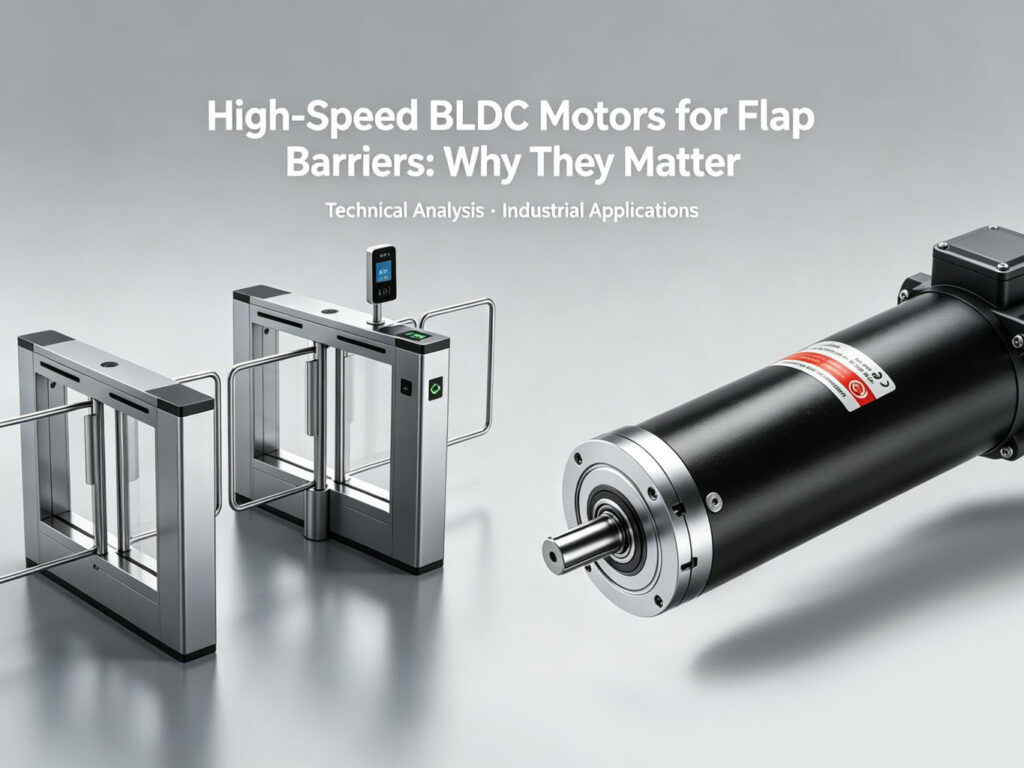
Motores BLDC de alta velocidad para barreras de aletas: Por qué son importantes
Los motores BLDC de alta velocidad se han convertido en la tecnología de accionamiento central detrás de los sistemas modernos de barreras de aletas porque brindan una respuesta rápida., control de movimiento preciso, bajo mantenimiento, y alta confiabilidad operativa. En entornos de control de acceso inteligente como estaciones de metro, edificios de oficinas, aeropuertos, e instalaciones industriales, Las barreras de solapa deben completar miles de ciclos de apertura y cierre diariamente mientras mantienen un funcionamiento suave y bajas tasas de falla..
En comparación con motores de CC con escobillas y sistemas de accionamiento de CA convencionales, Los motores BLDC de alta velocidad proporcionan una eficiencia superior, mayor densidad de par, menor pérdida térmica, y una mejor integración del control electrónico. Estas ventajas mejoran directamente el rendimiento de la barrera de solapas., rendimiento anti-seguimiento, y costo del ciclo de vida a largo plazo.
Para fabricantes OEM, ingenieros de adquisiciones, e integradores de sistemas, Comprender la importancia de ingeniería de los motores BLDC de alta velocidad es esencial para seleccionar soluciones confiables de barrera de aletas.. Esta guía explica cómo funcionan estos motores., ¿Por qué superan a las tecnologías tradicionales?, y cómo elegir la mejor configuración de motor para aplicaciones de control de acceso industrial.
¿Qué son los motores BLDC de alta velocidad para barreras de aletas??
Los motores BLDC de alta velocidad para barreras de aletas son motores de CC sin escobillas con conmutación electrónica diseñados específicamente para un control rápido del movimiento de arranque y parada en sistemas inteligentes de acceso para peatones.. Estos motores convierten la energía eléctrica en un movimiento de rotación altamente controlado que impulsa el mecanismo de apertura y cierre de los paneles de barrera con solapas..
A diferencia de los motores con escobillas tradicionales, Los motores BLDC utilizan conmutación electrónica en lugar de cepillos mecánicos. Esto elimina el desgaste por fricción., reduce los requisitos de mantenimiento, y mejora la vida útil operativa.
En aplicaciones de barrera de solapa, Los motores BLDC de alta velocidad normalmente funcionan con:
- Sistemas de retroalimentación de codificador
- Control orientado al campo (FOC)
- Sistemas de reducción de engranajes de precisión
- Lógica de sensor integrada
- Perfiles de aceleración rápida
Las barreras de solapa modernas requieren tiempos de apertura extremadamente rápidos y al mismo tiempo mantienen un movimiento estable y una baja vibración.. Las plataformas BLDC de alta velocidad están optimizadas específicamente para estas condiciones operativas dinámicas..
Soluciones de motores industriales relacionadas:
Motor BLDC para barrera de trampilla
Por qué son importantes los motores BLDC de alta velocidad en los sistemas de barrera con solapas
El rendimiento de un sistema de barrera de aletas está directamente influenciado por el comportamiento motor.. En entornos de mucho tráfico, Los motores lentos o inestables reducen la eficiencia del rendimiento y aumentan la tensión mecánica..
Rendimiento peatonal rápido
Los motores BLDC de alta velocidad permiten que las barreras de aletas se abran y cierren rápidamente con un control de sincronización preciso. Esto mejora el flujo de tráfico en las estaciones de metro., torres de oficinas, y centros de transporte.
Rendimiento mejorado contra el seguimiento de vehículos
La rápida respuesta de las trampillas reduce el tiempo disponible para el paso no autorizado. La rápida aceleración del motor mejora significativamente el rendimiento de la seguridad.
Operación de bajo ruido
Los motores BLDC controlados por FOC minimizan la ondulación y la vibración del par, creando un funcionamiento más silencioso adecuado para edificios comerciales e instalaciones premium.
Mayor confiabilidad operativa
Las barreras de aletas suelen realizar cientos de miles de ciclos al año.. La arquitectura sin escobillas reduce el desgaste de los componentes, mejorar la estabilidad a largo plazo.
Costo de mantenimiento reducido
Porque los motores BLDC eliminan las escobillas, Requieren menos mantenimiento que los motores DC con escobillas., Reducir el costo operativo del ciclo de vida para los operadores de instalaciones..
Cómo funcionan los motores BLDC de alta velocidad en puertas de barrera abatibles
El funcionamiento de un motor de barrera de trampilla BLDC de alta velocidad implica conmutación electrónica, retroalimentación del codificador, y algoritmos de control inteligentes trabajando juntos.
Conmutación Electrónica
En lugar de cepillos mecánicos que cambian el flujo de corriente, El controlador energiza electrónicamente los devanados del estator en secuencia para crear un campo magnético giratorio..
Detección de posición del rotor
Los codificadores o sensores Hall proporcionan información de la posición del rotor en tiempo real, permitiendo una sincronización de conmutación precisa.
Control de movimiento de precisión
El controlador regula:
- velocidad de aceleración
- Salida de par
- Precisión de posición
- Limitación de corriente
- Lógica de detección de obstáculos
Transmisión Mecánica
El par del motor se transmite a través de engranajes o sistemas de correas para mover los paneles de las trampillas con suavidad y precisión..
Integración de sensores
Los sensores infrarrojos se sincronizan con el funcionamiento del motor para monitorear el movimiento de los peatones y evitar cierres accidentales..
Motores BLDC frente a motores CC con escobillas para barreras de aletas
| Parámetro | Motor BLDC de alta velocidad | Motor de CC cepillado |
|---|---|---|
| Eficiencia | 85–92% | 60–75% |
| Mantenimiento | Muy bajo | Reemplazo frecuente del cepillo |
| Ruido | Bajo | Más alto |
| Densidad de par | Alto | Moderado |
| Rendimiento térmico | Excelente | Limitado |
| Esperanza de vida | Largo | más corto |
| Precisión de control | Excelente | Básico |
| Idoneidad industrial | Excelente | Limitado |
Los motores con escobillas siguen siendo atractivos para sistemas de bajo costo debido a que tienen controladores más simples y un menor costo inicial.. Sin embargo, en aplicaciones de barrera de solapa de alta frecuencia, El desgaste de las escobillas se convierte en un importante problema de fiabilidad..
Los motores BLDC de alta velocidad ofrecen una economía de ciclo de vida superior porque el mantenimiento reducido y la vida útil operativa más larga compensan el mayor costo inicial del sistema..
Motores BLDC frente a servomotores para sistemas de acceso inteligentes
| Parámetro | Motor BLDC de alta velocidad | servomotor |
|---|---|---|
| Costo | Moderado | Más alto |
| Controlar la complejidad | Moderado | Alto |
| Precisión de posición | Alto | muy alto |
| Densidad de par | Alto | Alto |
| Idoneidad de la aplicación | Excelente para barreras con solapas | Sistemas industriales de precisión |
| Mantenimiento | Bajo | Bajo |
| Eficiencia energética | Excelente | Excelente |
Los servomotores proporcionan un posicionamiento extremadamente preciso, pero a menudo introducen costos innecesarios y complejidad del sistema para aplicaciones de barrera de aletas estándar..
Los motores BLDC de alta velocidad proporcionan el equilibrio óptimo entre rendimiento, fiabilidad, y costo para la mayoría de los sistemas de control de acceso.
Eficiencia, Densidad de par, y rendimiento térmico en motores BLDC de alta velocidad
La eficiencia del motor y la estabilidad térmica son factores críticos en la confiabilidad de la barrera de aletas porque estos sistemas operan bajo ciclos frecuentes de aceleración y desaceleración..
Ventajas de eficiencia
Los motores BLDC de alta eficiencia reducen:
- Pérdidas de cobre
- Fricción mecánica
- Pérdidas por conmutación
- Generación de calor
Una menor tensión térmica mejora directamente la vida útil del controlador y de los rodamientos.
Alta densidad de par
Los sistemas de barrera de aletas requieren motores compactos capaces de generar un fuerte par en un espacio de instalación limitado.. Los motores BLDC de alta velocidad proporcionan excelentes relaciones entre par y tamaño., permitiendo diseños de gabinetes de puerta más delgados.
Gestión térmica
El rendimiento térmico es cada vez más importante en:
- Estaciones de tránsito de alta frecuencia
- Instalaciones industriales
- Instalaciones exteriores
- Entornos de servicio continuo
Los sistemas industriales BLDC utilizan comúnmente:
- Carcasas de motor de aluminio
- Controladores MOSFET eficientes
- Sensores térmicos
- Protección inteligente de la temperatura
Fiabilidad en funcionamiento continuo
Los ciclos repetidos de arranque y parada generan picos de corriente periódicos. El ajuste adecuado del controlador y el diseño térmico son esenciales para evitar la degradación prematura del motor..
Tecnologías de sistemas de control en motores de barrera de aletas de alta velocidad
Las barreras de aletas modernas dependen en gran medida de sistemas inteligentes de control de motores para mantener un funcionamiento suave y un rendimiento de seguridad..
Control orientado al campo (FOC)
Los algoritmos FOC regulan con precisión los vectores de corriente del motor, reduciendo la ondulación del par y mejorando la suavidad del movimiento.
Comparado con el control trapezoidal, FOC proporciona:
- Menor ruido
- Mayor eficiencia
- Mejor par a baja velocidad
- Aceleración más suave
Sistemas de retroalimentación de codificador
Los codificadores permiten un seguimiento preciso de la posición del rotor para:
- Posicionamiento preciso de las solapas
- Detección de obstáculos
- Control de sincronización
- Regulación dinámica de velocidad
Funciones de diagnóstico inteligentes
Los controladores modernos son cada vez más compatibles:
- Monitoreo actual
- Análisis de temperatura
- Diagnóstico remoto
- Mantenimiento predictivo
Integración de acceso basada en la nube
Los edificios inteligentes requieren cada vez más barreras abatibles para integrarse con sistemas de gestión de acceso basados en la nube y plataformas de IoT.
Cómo elegir motores BLDC de alta velocidad para barreras de aletas
Seleccionar la configuración correcta del motor requiere un rendimiento de equilibrio, comportamiento térmico, fiabilidad, y requisitos específicos de la aplicación.
Rango de voltaje
Uso típico de sistemas de barrera con solapas:
- 24V sistemas compactos
- 48V sistemas industriales
- 72V sistemas de alto rendimiento
Los sistemas de mayor voltaje reducen la demanda actual y mejoran la eficiencia.
Rango de poder
La mayoría de los motores de barrera de trampilla funcionan entre 40 W y 300 W, dependiendo de:
- Tamaño de la solapa
- Frecuencia de tráfico
- Requisitos de aceleración
- Carga mecánica
Requisitos de par y velocidad
Los ingenieros deben evaluar:
- Par de aceleración máximo
- Par de funcionamiento continuo
- Objetivos de velocidad de apertura
- Inercia mecánica
Método de enfriamiento
Las aplicaciones de alto rendimiento requieren una refrigeración optimizada mediante:
- Convección natural
- Disipación de calor de aluminio
- Optimización del flujo de aire térmico
Compatibilidad del controlador
Los compradores OEM deben verificar la compatibilidad con:
- Controladores FOC
- Sistemas RFID
- Terminales biométricas
- Plataformas en la nube
- Sistemas de automatización industrial
Consideraciones específicas de la aplicación
Los sistemas exteriores pueden requerir:
- Protección con clasificación IP
- Amplia capacidad de temperatura
- Resistencia a la corrosión
- Protección contra la humedad
Soluciones de motores OEM personalizadas:
Motor BLDC personalizado
Aplicaciones industriales de motores de barrera de aletas BLDC de alta velocidad
Los motores BLDC de alta velocidad se utilizan ampliamente en múltiples industrias de infraestructura inteligente..
Sistemas de Metro y Ferrocarriles
Los sistemas de transporte requieren un rendimiento extremadamente alto y un funcionamiento confiable y continuo.
Edificios de oficinas comerciales
Los edificios modernos priorizan el funcionamiento silencioso, estética, e integración de acceso inteligente.
Fábricas e instalaciones industriales
Los entornos industriales requieren motores duraderos capaces de manejar operaciones de alta frecuencia con bajo mantenimiento..
Centros de datos
Las instalaciones seguras integran cada vez más la autenticación biométrica con sistemas de barrera con solapas de alta velocidad.
Infraestructura de ciudad inteligente
Las barreras abatibles conectadas a IoT se están convirtiendo en parte de los sistemas inteligentes de gestión del acceso urbano.
Aplicaciones industriales relacionadas:
motor de vehículo eléctrico
Tendencias futuras en motores BLDC de alta velocidad para barreras de aletas
La industria de las barreras con solapas continúa evolucionando hacia soluciones más inteligentes., más silencioso, y sistemas de motores más eficientes energéticamente.
Mayor densidad de par
Los motores del futuro seguirán reduciéndose de tamaño y al mismo tiempo aumentarán la capacidad de torsión para soportar diseños arquitectónicos compactos..
Mantenimiento predictivo basado en IA
Los algoritmos de IA analizan cada vez más:
- Patrones de corriente del motor
- Comportamiento térmico
- Vibración del rodamiento
- Ciclos operativos
Esto permite un mantenimiento predictivo y un tiempo de inactividad reducido..
Electrónica inteligente integrada
Los controladores de motor están cada vez más integrados con:
- Plataformas en la nube
- Diagnóstico remoto
- Comunicación inalámbrica
- Análisis en tiempo real
Infraestructura energéticamente eficiente
Los requisitos de sostenibilidad global continúan impulsando la demanda de sistemas BLDC de alta eficiencia con menor consumo de energía en espera..
Preguntas frecuentes: Motores BLDC de alta velocidad para barreras de aletas
¿Por qué son importantes los motores BLDC de alta velocidad en las barreras de trampilla??
Los motores BLDC de alta velocidad brindan una respuesta de apertura rápida, alta eficiencia, control preciso, y larga vida útil operativa. Estas ventajas mejoran el tránsito de peatones, rendimiento anti-seguimiento, y confiabilidad del sistema.
¿Qué voltaje se usa comúnmente en los motores BLDC con barrera de aleta??
La mayoría de los sistemas utilizan 24 V., 48V, o configuraciones de 72 V según los requisitos de rendimiento, tamaño de instalación, y condiciones del ciclo de trabajo.
¿Son los motores BLDC mejores que los motores con escobillas para barreras de trampilla??
Sí. Los motores BLDC ofrecen mayor eficiencia, menor mantenimiento, funcionamiento más silencioso, y una vida útil más larga en comparación con los motores de CC con escobillas, especialmente en aplicaciones de alta frecuencia.
¿Qué método de control se utiliza en los motores de barrera de trampillas modernos??
La mayoría de los sistemas premium utilizan control orientado al campo (FOC) combinado con retroalimentación del codificador para un control de movimiento suave, ruido reducido, y precisión de posicionamiento mejorada.
¿Cómo eligen los ingenieros el mejor motor BLDC para barreras de trampilla??
Los ingenieros evalúan el voltaje, requisitos de par, rendimiento térmico, compatibilidad del controlador, espacio de instalación, y entorno de aplicación al seleccionar motores de barrera de trampilla industriales.
Conclusión
Los motores BLDC de alta velocidad se han convertido en la tecnología de accionamiento dominante para los sistemas modernos de barreras de aletas porque proporcionan la combinación óptima de eficiencia., respuesta dinámica rápida, bajo mantenimiento, tamaño compacto, y confiabilidad a largo plazo. A medida que los sistemas de control de acceso inteligentes continúan evolucionando hacia un mayor rendimiento y una integración de infraestructura más inteligente, El rendimiento del motor determina cada vez más la calidad general del sistema..
Para fabricantes OEM, ingenieros de adquisiciones, e integradores de sistemas, La selección de la plataforma de motor BLDC correcta requiere una evaluación cuidadosa de la densidad de par., gestión térmica, arquitectura del controlador, y condiciones de funcionamiento específicas de la aplicación. Los sistemas BLDC de alta calidad reducen significativamente el costo del ciclo de vida al tiempo que mejoran el rendimiento del control de acceso y la estabilidad operativa..
Greensky Power proporciona soluciones personalizadas de motores BLDC de alta velocidad para barreras de aletas, puertas batientes, sistemas de acceso inteligentes, y aplicaciones de automatización industrial en todo el mundo.
✔ Solicitar hoja de datos
✔ Obtenga una solución de motor OEM
✔ Póngase en contacto con nuestros ingenieros para consulta técnica
Referencias
1. https://ieeexplore.ieee.org/
2. https://www.sciencedirect.com/topics/engineering/brushless-dc-motor
3. https://www.nidec.com/en/technology/motor/basic/
4. https://www.motioncontroltips.com/
5. https://www.controleng.com/
6. https://www.automationworld.com/
7. https://www.mdpi.com/topics/Brushless_DC_Motor
8. https://www.analog.com/en/technical-articles/control-orientado-al-campo-para-pmsms-utilizando-un-vector-de-voltaje-dinámico.html
9. https://www.ti.com/motor-drivers/brushless-dc-bldc-drivers/overview.html