
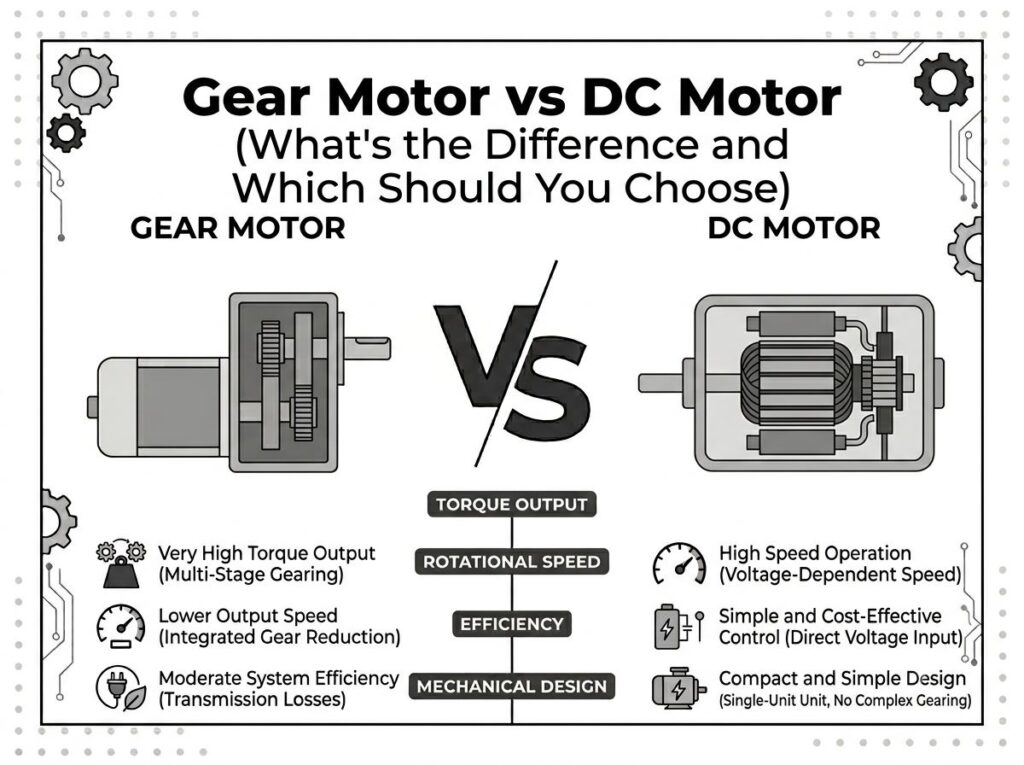
Getriebemotor vs. Gleichstrommotor: Was ist der Unterschied und wofür sollten Sie sich entscheiden??
Schnelle Antwort:
EIN Getriebemotor ist ein Gleich- oder Wechselstrommotor kombiniert mit einem Getriebe, während a Gleichspannungs Motor bezieht sich nur auf den Elektromotor selbst. Getriebemotoren bieten durch den Einsatz einer mechanischen Getriebeuntersetzung ein deutlich höheres Drehmoment und eine geringere Ausgangsdrehzahl, Daher eignen sie sich ideal für Förderbänder, Robotik, Automatisierungsausrüstung, und Bewegungssteuerungssysteme. Im Gegensatz, Gleichstrommotoren liefern typischerweise eine höhere Drehzahl und werden häufig in Direktantriebsanwendungen wie Pumpen eingesetzt, Fans, und Schneidmesser.
Viele industrielle Getriebemotoren verwenden heute tatsächlich Permanentmagnet-Gleichstrommotoren oder bürstenlose Gleichstrommotoren gepaart mit Planetengetrieben, Sporn, Wurm, oder Stirnradgetriebe, um das gewünschte Gleichgewicht zwischen Geschwindigkeit zu erreichen, Drehmoment, Effizienz, und Positionierungsgenauigkeit.
Was ist ein Gleichstrommotor??
EIN Gleichstrom (Gleichstrom) Motor- ist ein mit Gleichstrom betriebener Elektromotor. Es wandelt elektrische Energie durch elektromagnetische Wechselwirkung zwischen Stator und Rotor in mechanische Rotationsenergie um.
Aufgrund ihrer einfachen Konstruktion, schnelle Antwort, kompakte Größe, und relativ einfache Geschwindigkeitsregelung, Gleichstrommotoren werden seit Jahrzehnten in großem Umfang in der industriellen Automatisierung eingesetzt, medizinische Geräte, Haushaltsgeräte, elektrische Fahrzeuge, Robotik, Elektrowerkzeuge, und batteriebetriebene Geräte.
Im Gegensatz zu Getriebemotoren, Ein Standard-Gleichstrommotor verringert von Natur aus weder die Drehzahl noch erhöht er das Drehmoment. Stattdessen, Es liefert seine Leistung direkt von der Motorwelle. Wenn eine niedrigere Drehzahl oder ein höheres Drehmoment erforderlich ist, Ein Getriebe kann extern hinzugefügt werden, um einen Gleichstrom-Getriebemotor zu erstellen.
Grundaufbau eines Gleichstrommotors
Obwohl es unterschiedliche DC-Motortechnologien gibt, Die meisten haben mehrere grundlegende Komponenten gemeinsam:
- Rotor (Anker) – die rotierende Komponente, die mechanische Leistung erzeugt.
- Stator – erzeugt das stationäre Magnetfeld um den Rotor.
- Permanentmagnete oder Feldwicklungen — Erzeugen Sie einen magnetischen Fluss, der für die Drehmomenterzeugung erforderlich ist.
- Lager — Stützen Sie die rotierende Welle und minimieren Sie gleichzeitig die Reibung.
- Abtriebswelle – überträgt Rotationskraft auf die angetriebene Ausrüstung.
Durch die Wechselwirkung zwischen den Magnetfeldern von Rotor und Stator entsteht ein elektromagnetisches Drehmoment, Dadurch dreht sich der Rotor kontinuierlich.
Arten von Gleichstrommotoren
Moderne Industriesysteme verwenden im Allgemeinen zwei Hauptkategorien von Gleichstrommotoren.
1. Gebürsteter Gleichstrommotor
Bürstenbehaftete Gleichstrommotoren verwenden Kohlebürsten und einen mechanischen Kommutator, um den Strom durch die Rotorwicklungen während der Drehung zu schalten.
Zu ihren Vorteilen gehören:
- Einfache Controller-Anforderungen
- Niedrige Anschaffungskosten
- Einfache Installation
- Hervorragendes Anlaufdrehmoment
- Weltweit weit verbreitet
Jedoch, Bürsten nutzen sich mit der Zeit allmählich ab, regelmäßige Wartung erfordern. Mechanische Kommutierung erzeugt auch elektrisches Rauschen, Funken, und Reibung, Begrenzung der Lebensdauer in anspruchsvollen Industrieumgebungen.
Typische Anwendungen
- Elektrowerkzeuge
- Automobilzubehör
- Haushaltsgeräte
- Kleine Aktoren
- Tragbare Geräte
2. Bürstenloser Gleichstrommotor (BLDC)
Bürstenlose Gleichstrommotoren machen mechanische Bürsten vollständig überflüssig. Stattdessen, Elektronische Steuerungen führen die Kommutierung basierend auf der Rotorposition durch, die von Hall-Sensoren oder Encoder-Feedback erfasst wird.
Im Vergleich zu Bürstenmotoren, BLDC-Motoren bieten zahlreiche technische Vorteile:
- Höhere Effizienz
- Längere Lebensdauer
- Geringerer Wartungsaufwand
- Höhere Leistungsdichte
- Hervorragende Geschwindigkeitsregulierung
- Geringeres Betriebsgeräusch
- Bessere thermische Leistung
Denn es gibt keine Bürsten, die Reibung oder Verschleiß erzeugen, BLDC-Motoren ersetzen zunehmend herkömmliche Bürstenmotoren in der industriellen Automatisierung und intelligenten Geräten.
Gängige BLDC-Anwendungen
- Industrieroboter
- AGVs
- Autonome mobile Roboter (AMRs)
- Elektrische Rasenmäher
- Medizinische Ausrüstung
- Servosysteme
- Intelligente Logistikausrüstung
Permanentmagnet-Technologie
Die meisten modernen Gleichstrommotoren verwenden Permanentmagnete statt gewickelter Feldspulen, um das Statormagnetfeld zu erzeugen.
Permanentmagnet-Gleichstrommotoren bieten mehrere wichtige technische Vorteile:
- Höhere Effizienz
- Geringere elektrische Verluste
- Kompakte Abmessungen
- Reduziertes Gewicht
- Verbesserte Drehmomentdichte
- Geringerer Energieverbrauch
Hochleistungsmagnete aus seltenen Erden, insbesondere Neodym-Eisen-Bor (NdFeB), haben die Leistung moderner Gleichstrommotoren im letzten Jahrzehnt deutlich verbessert, Dadurch können kompakte Motoren ein viel höheres Drehmoment liefern als frühere Generationen.
Wie ein Gleichstrommotor Drehmoment erzeugt
Das Funktionsprinzip eines Gleichstrommotors basiert auf elektromagnetischer Kraft.
Wenn elektrischer Strom durch die Motorwicklungen fließt, Es entsteht ein Magnetfeld. Die Wechselwirkung zwischen diesem Magnetfeld und dem vom Stator erzeugten Magnetfeld erzeugt eine Rotationskraft auf den Rotor.
Da die Magnetpole durch mechanische Kommutierung kontinuierlich ihre Position ändern (Bürstenmotoren) oder elektronische Kommutierung (BLDC-Motoren), Der Rotor dreht sich weiter und liefert mechanische Leistung an die Abtriebswelle.
Die Leistung des Motors wird hauptsächlich beeinflusst durch:
- Versorgungsspannung
- Aktuell
- Motorwicklungsdesign
- Magnetstärke
- Controller-Leistung
- Kühlfähigkeit
Vorteile von Gleichstrommotoren
| Vorteil | Technischer Vorteil |
|---|---|
| Hohe Geschwindigkeit | Geeignet für Anwendungen mit Direktantrieb |
| Kompakte Größe | Einfache Integration in Geräte |
| Einfache Geschwindigkeitsregelung | Spannungs- oder PWM-Regelung |
| Schnelle dynamische Reaktion | Schnelle Beschleunigung und Verzögerung |
| Großer Geschwindigkeitsbereich | Typischerweise 500–10.000 U/min |
| Hohe Effizienz (BLDC) | Geringerer Energieverbrauch |
Einschränkungen von Standard-Gleichstrommotoren
Trotz ihrer vielen Vorteile, Standard-Gleichstrommotoren sind nicht für jede Anwendung ideal.
Weil sie mit relativ hoher Geschwindigkeit rotieren und gleichzeitig ein begrenztes Ausgangsdrehmoment erzeugen, Sie können schwere mechanische Lasten oft nicht direkt antreiben.
Zu den typischen Einschränkungen gehören::
- Geringeres Ausgangsdrehmoment ohne Untersetzungsgetriebe
- Reduzierte Haltefähigkeit
- Schlechte Stabilität bei niedriger Geschwindigkeit unter hoher Last
- Für viele Industrieanlagen ist ein zusätzliches Getriebe erforderlich
Aus diesem Grund, Ingenieure kombinieren häufig Gleichstrommotoren mit Getrieben, um ein höheres Drehmoment zu erzielen, niedrigere Geschwindigkeit, und verbesserte Bewegungssteuerung. Das Ergebnis wird als a bezeichnet DC-Getriebemotor, was im nächsten Abschnitt erläutert wird.
Was ist ein Getriebemotor??
EIN Getriebemotor ist eine integrierte Antriebseinheit bestehend aus einem Elektromotor und einem mechanischen Getriebe. Im Gegensatz zu einem Standard-Gleichstrommotor, der die Leistung direkt von seiner Abtriebswelle liefert, Ein Getriebemotor reduziert die Drehzahl über einen Getriebezug und erhöht gleichzeitig proportional das Ausgangsdrehmoment.
Es ist wichtig, das zu verstehen Ein Getriebemotor ist keine eigenständige Motortechnologie. Stattdessen, Es handelt sich um eine Baugruppe, die zwei Hauptkomponenten vereint:
- Elektromotor – Erzeugt Rotationskraft.
- Getriebe (Geschwindigkeitsreduzierer) – Konvertiert mit hoher Geschwindigkeit, Ausgabe von niedrigem Drehmoment in niedrige Drehzahl, hohe Drehmomentabgabe.
Abhängig von der Anwendung, Der Motor kann ein bürstenbehafteter Gleichstrommotor sein, bürstenloser Gleichstrom (BLDC) Motor-, AC-Induktionsmotor, Servomotor, oder Schrittmotor. Das Getriebe wird entsprechend der erforderlichen Untersetzung ausgewählt, Effizienz, Geräuschpegel, und Abtriebsdrehmoment.
Grundstruktur eines Getriebemotors
Ein typischer Industriegetriebemotor besteht aus den folgenden Komponenten:
| Komponente | Funktion |
|---|---|
| Elektromotor | Erzeugt Rotationskraft |
| Eingangswelle | Überträgt die Kraft vom Motor zum Getriebe |
| Räderwerk | Reduziert die Geschwindigkeit und vervielfacht das Drehmoment |
| Lager | Unterstützen Sie rotierende Wellen und reduzieren Sie die Reibung |
| Getriebegehäuse | Schützt Innenzahnräder und hält Schmiermittel zurück |
| Abtriebswelle | Liefert Drehmoment an die angetriebene Ausrüstung |
Denn Motor und Getriebe sind als aufeinander abgestimmtes System konzipiert, Getriebemotoren bieten im Allgemeinen eine höhere Zuverlässigkeit, geringerer Installationsaufwand, und bessere mechanische Ausrichtung als separat montierte Motor-Getriebe-Kombinationen.
Wie erhöht ein Getriebe das Drehmoment??
Ein Getriebe funktioniert nach dem Prinzip der mechanischen Drehzahluntersetzung.
Wenn der Motor ein kleineres Zahnrad antreibt, das mit einem größeren Zahnrad kämmt, die Drehzahl nimmt ab, während das verfügbare Drehmoment zunimmt. Dadurch können relativ kleine Motoren schwere Lasten effizient bewegen.
Technische Beziehung:
Übersetzungsverhältnis ↑
↓
Ausgangsgeschwindigkeit ↓
↓
Ausgangsdrehmoment ↑
Zum Beispiel, ein Gleichstrommotor, der mit arbeitet 3,000 U/min mit einem Ausgangsdrehmoment von 0.4 N·m kann mit a gepaart werden 30:1 Getriebe. Kleinere Übertragungsverluste werden ignoriert, die Ausgangsgeschwindigkeit wird ungefähr 100 U/min, während das Ausgangsdrehmoment auf ca. ansteigt 12 N·m.
Dieses einfache Prinzip erklärt, warum Getriebemotoren häufig in Anwendungen eingesetzt werden, die ein hohes Anlaufdrehmoment erfordern, kontrollierte Bewegung, oder die Fähigkeit, schwere Lasten zu bewegen.
Gängige Arten von Getriebemotoren
Unterschiedliche Getriebekonstruktionen bieten unterschiedliche Vorteile. Die Auswahl des geeigneten Getriebes hängt von den Drehmomentanforderungen ab, Installationsraum, Effizienz, Geräuschpegel, und Budget.
1. Stirnradgetriebemotor
Stirnradgetriebemotoren verwenden gerade Zahnräder, die auf parallelen Wellen montiert sind. Sie gehören zu den einfachsten und wirtschaftlichsten Getriebemotorkonstruktionen.
Vorteile:
- Einfache Konstruktion
- Niedrige Herstellungskosten
- Hohe mechanische Zuverlässigkeit
- Einfache Wartung
- Geeignet für Anwendungen mit mittlerem Drehmoment
Typische Anwendungen:
- Verpackungsmaschinen
- Automatiktüren
- Büroausstattung
- Materialtransportsysteme
2. Planetengetriebemotor
Planetengetriebemotoren gelten weithin als bevorzugte Lösung für die präzise Bewegungssteuerung. Ihr Getriebe besteht aus einem zentralen Sonnenrad, mehrere Planetenräder, und einen Innenzahnkranz.
Denn mehrere Planetenräder teilen sich gleichzeitig die übertragene Last, Planetengetriebe erreichen eine außergewöhnlich hohe Drehmomentdichte bei gleichzeitig kompakten Abmessungen.
Vorteile:
- Hohe Drehmomentkapazität
- Kompakte Größe
- Hervorragende Lastverteilung
- Hohe Übertragungseffizienz
- Optionen mit geringem Spiel
- Reibungsloser Betrieb
Typische Anwendungen:
- Industrieroboter
- AGVs und AMRs
- Servosysteme
- Medizinische Geräte
- Elektrische Radantriebe
- Intelligente Automatisierungsausrüstung
Moderne Robotersysteme kommen häufig zum Einsatz BLDC-Planetengetriebemotoren weil sie die Effizienz der bürstenlosen Technologie mit dem hohen Drehmoment der Planetenuntersetzung kombinieren.
3. Schneckengetriebemotor
Schneckengetriebemotoren verwenden eine Schneckenwelle, die mit einem im rechten Winkel angeordneten Schneckenrad kämmt. Diese Konfiguration ermöglicht große Untersetzungsverhältnisse in einem kompakten Paket.
Eine der wertvollsten Eigenschaften von Schneckengetriebemotoren ist ihre Fähigkeit, eine teilweise oder vollständige Selbsthemmung zu gewährleisten, Verhindert in vielen Anwendungen eine Rückwärtsbewegung unter Last.
Vorteile:
- Sehr hohe Untersetzungsverhältnisse
- Kompakter rechtwinkliger Ausgang
- Leiser Betrieb
- Gute Stoßdämpfung
- Selbsthemmung in vielen Ausführungen möglich
Typische Anwendungen:
- Hebemechanismen
- Torbetreiber
- Drehkreuze
- Positionierungssysteme für Förderbänder
- Industrielle Aktoren
4. Stirnradgetriebemotor
Stirnradgetriebemotoren verwenden abgewinkelte Zahnradzähne, die schrittweise und nicht gleichzeitig ineinandergreifen. Durch diese Konstruktion werden Vibrationen und Betriebsgeräusche erheblich reduziert und gleichzeitig die Tragfähigkeit verbessert.
Vorteile:
- Sehr hohe Effizienz
- Reibungsloser und leiser Betrieb
- Hohe Tragfähigkeit
- Lange Lebensdauer
- Geeignet für den Dauerbetrieb
Typische Anwendungen:
- Schwerlastförderer
- Bergbauausrüstung
- Industrielle Produktionslinien
- Lebensmittelverarbeitungsmaschinen
- Große Automatisierungssysteme
Vorteile von Getriebemotoren
| Vorteil | Technischer Vorteil |
|---|---|
| Hohes Ausgangsdrehmoment | Bewegt schwere Lasten effizient |
| Niedrige Ausgabegeschwindigkeit | Verbessert die Bewegungssteuerung und Positionierung |
| Kompaktes integriertes Design | Vereinfacht die Installation |
| Verbesserte Tragfähigkeit | Geeignet für Industriemaschinen |
| Große Untersetzungsverhältnisse | Flexible Geschwindigkeitsauswahl |
| Hohe Zuverlässigkeit | Lange Lebensdauer im Dauerbetrieb |
Typische industrielle Anwendungen von Getriebemotoren
Getriebemotoren werden immer dann eingesetzt, wenn Anwendungen eine kontrollierte Bewegung anstelle einer maximalen Drehzahl erfordern.
Häufige Beispiele sind::
- Fördersysteme
- Industrieroboter
- Fahrerlose Transportfahrzeuge (AGVs)
- Autonome mobile Roboter (AMRs)
- Lagerautomatisierung
- Elektrische Radantriebe
- Flügeltore
- Drehkreuze
- Automatiktüren
- Antriebsräder für Rasenmäher
- Materialtransportgeräte
- Verpackungsmaschinen
Obwohl viele dieser Systeme allgemein einfach als bezeichnet werden “Getriebemotoren,” Der Motor im Inneren ist häufig ein hocheffizienter Permanentmagnet-Gleichstrommotor oder BLDC-Motor. Das Getriebe sorgt dafür, dass der Motor langsam läuft, Antriebslösung mit hohem Drehmoment.
Kann ein Gleichstrommotor ein Getriebemotor sein??
Ja. In der Tat, Viele Industriegetriebemotoren werden durch die Kombination eines Gleichstrommotors mit einem Getriebe gebaut. Dies ist eine der am häufigsten verwendeten Antriebskonfigurationen in modernen Automatisierungsgeräten.
Gleichspannungs Motor
+
Getriebe
=
DC-Getriebemotor
Diese einfache Kombination ermöglicht es Ingenieuren, die hohe Drehzahl und die kompakte Größe eines Gleichstrommotors zu nutzen und gleichzeitig die niedrige Drehzahl zu erzielen, hohes Drehmoment, das von den meisten Industriemaschinen benötigt wird.
Warum nicht nur einen Gleichstrommotor verwenden??
Ein Standard-Gleichstrommotor dreht sich häufig mit Geschwindigkeiten zwischen 500 zu 10,000 U/min, je nach Bauform und Betriebsspannung. Dies ist zwar ideal für Direktantriebsanwendungen wie Lüfter oder Pumpen, Für Geräte, die eine kontrollierte Bewegung oder eine hohe Zugkraft erfordern, ist es normalerweise zu schnell.
Zum Beispiel, Ein Förderband läuft normalerweise nur mit einigen Dutzend Umdrehungen pro Minute. Bei direktem Antrieb durch einen Hochgeschwindigkeits-Gleichstrommotor, Der Förderer würde viel zu schnell laufen und kein ausreichendes Drehmoment erzeugen, um schwere Produkte zu bewegen.
Durch den Einbau eines Getriebes wird dieses Problem gelöst, indem die Geschwindigkeit reduziert und das Drehmoment vervielfacht wird, Dadurch kann ein relativ kleiner Motor viel größere Lasten bewältigen.
Gängige DC-Getriebemotorkonfigurationen
| Motorentyp | Getriebetyp | Typische Anwendung |
|---|---|---|
| Gebürsteter Gleichstrommotor | Stirnradgetriebe | Büroausstattung, kleine Maschinen |
| Gebürsteter Gleichstrommotor | Schneckengetriebe | Torbetreiber, Aktoren |
| BLDC-Motor | Planetengetriebe | Robotik, AGVs, AMRs |
| BLDC-Motor | Stirnradgetriebe | Industrielle Automatisierung |
| Permanentmagnet-Gleichstrommotor | Planetengetriebe | Medizinische Ausrüstung, Radantriebe |
Heute, Die meisten leistungsstarken industriellen Bewegungssysteme berücksichtigen diese Wahl nicht mehr Getriebemotor versus Gleichstrommotor. Stattdessen, Sie integrieren beide Technologien, um eine Antriebslösung zu schaffen, die die optimale Geschwindigkeitsbalance bietet, Drehmoment, Effizienz, Präzision, und Haltbarkeit.
Getriebemotor vs. Gleichstrommotor: Hauptunterschiede
Das Verständnis der grundlegenden Unterschiede zwischen einem Getriebemotor und einem Gleichstrommotor ist für die Auswahl des richtigen Antriebssystems im Industriedesign von entscheidender Bedeutung. Obwohl beide zur Erzeugung einer Rotationsbewegung verwendet werden, sie unterscheiden sich deutlich in der Struktur, Ausgangseigenschaften, und Anwendungseignung.
Ein Gleichstrommotor ist ein eigenständiges elektromagnetisches Gerät, das eine hohe Rotationsleistung erzeugt. Ein Getriebemotor, auf der anderen Seite, ist ein komplettes mechanisches System, das einen Motor mit einem Getriebe kombiniert, um die Geschwindigkeit zu reduzieren und das Drehmoment zu erhöhen.
In praktischer Ingenieurssprache, Der Unterschied ist nicht nur struktureller Natur – er wirkt sich direkt auf die Drehmomentdichte aus, Geschwindigkeitsbereich, Wirkungsgradverhalten unter Last, und Komplexität der Systemintegration.
| Besonderheit | Gleichspannungs Motor | Getriebemotor |
|---|---|---|
| Definition | Nur Elektromotor | Motor + Getriebebaugruppe |
| Geschwindigkeit | Hoch (direkte Ausgabe) | Niedrig (nach Reduktion) |
| Drehmoment | Am Schaft absenken | Aufgrund des Übersetzungsverhältnisses höher |
| Effizienz | Hoher elektrischer Wirkungsgrad | Abhängig vom Getriebetyp |
| Kosten | Niedrigere Systemkosten | Höhere Systemkosten (zusätzliches Getriebe) |
| Präzise Kontrolle | Medium (Hängt vom Controller ab) | Hoch (mechanische Reduzierung verbessert die Stabilität) |
| Typische Anwendungen | Fans, Pumps, Gebläse | Förderer, Robotik, Automatisierungssysteme |
Drehmomentvergleich
Das Drehmoment ist einer der wichtigsten Entscheidungsfaktoren bei der Wahl zwischen einem Gleichstrommotor und einem Getriebemotor. Während Gleichstrommotoren ein ausreichendes Drehmoment für leichte oder Hochgeschwindigkeitsanwendungen erzeugen können, Bei hoher Belastung oder niedrigen Geschwindigkeiten sind sie oft nicht ausreichend.
Getriebemotoren lösen diese Einschränkung durch die mechanische Untersetzung durch ein Getriebe, Effektive Vervielfachung des Ausgangsdrehmoments ohne Vergrößerung des Motors.
Wie sich das Übersetzungsverhältnis auf das Drehmoment auswirkt
Die Beziehung zwischen Übersetzungsverhältnis, Geschwindigkeit, und Drehmoment sind im Maschinenbau von grundlegender Bedeutung:
Übersetzungsverhältnis ↑
↓
Ausgangsgeschwindigkeit ↓
↓
Ausgangsdrehmoment ↑
Dies bedeutet, dass ein Motor mit einem Getriebe gekoppelt ist, Das System tauscht Drehzahl gegen Drehmoment. Zum Beispiel, a 10:1 Das Getriebe reduziert die Drehzahl um den Faktor zehn und erhöht gleichzeitig das Drehmoment um etwa den gleichen Faktor (minus Effizienzverluste).
In realen Anwendungen, Dadurch kann ein kleiner Gleichstrommotor Aufgaben ausführen, für die bei Verwendung ohne Getriebe sonst ein viel größerer Motor erforderlich wäre.
Ingenieurbeispiel
Betrachten Sie einen Gleichstrommotor mit den folgenden Spezifikationen:
- Geschwindigkeit: 3000 U/min
- Drehmoment: 0.5 N·m
In Kombination mit einem 20:1 Planetengetriebe:
- Ausgangsgeschwindigkeit: ~150 U/min
- Ausgangsdrehmoment: ~10 N·m (minus Getriebeverluste)
Dies zeigt, warum Getriebemotoren in Anwendungen bevorzugt werden, die ein hohes Anlaufdrehmoment erfordern, wie z. B. Förderbänder, Robotergelenke, und automatisierte Hebesysteme.
Geschwindigkeitsvergleich
Die Geschwindigkeit ist ein weiteres wichtiges Unterscheidungsmerkmal zwischen Gleichstrommotoren und Getriebemotoren. Gleichstrommotoren sind von Natur aus Hochgeschwindigkeitsgeräte, Getriebemotoren hingegen sind für den Betrieb mit reduzierten Drehzahlen ausgelegt, die für mechanische Belastungen optimiert sind.
Typische Geschwindigkeitsbereiche
- Gleichspannungs Motor: 500–10.000 U/min
- Ausgang des Getriebemotors: 5–500 U/min
Die starke Reduzierung der Geschwindigkeit ist kein Nachteil, sondern eine funktionale Anforderung für die meisten industriellen Systeme. Viele mechanische Lasten können bei hoher Geschwindigkeit nicht effizient arbeiten und erfordern stattdessen eine kontrollierte Bewegung.
Zum Beispiel:
- Roboterarme erfordern Präzision, langsame Bewegung
- Förderer müssen bei wechselnden Belastungen eine stabile Geschwindigkeit beibehalten
- Drehkreuze erfordern eine sanfte Beschleunigung und Verzögerung
In diesen Fällen, Ein Getriebemotor bietet eine deutlich bessere Steuerung im Vergleich zu einem Gleichstrommotor mit Direktantrieb.
Effizienzvergleich
Ein weit verbreitetes Missverständnis ist, dass Getriebemotoren aufgrund von Energieverlusten im Getriebe immer ineffizient sind. In Wirklichkeit, Moderne Getriebetechnologien – insbesondere Planeten- und Stirnradgetriebe – bieten einen sehr hohen mechanischen Wirkungsgrad.
Der Wirkungsgrad hängt stark vom Getriebetyp ab, Schmierqualität, Lastbedingungen, und Fertigungspräzision.
Getriebeeffizienz nach Typ
| Getriebetyp | Typischer Effizienzbereich | Technische Hinweise |
|---|---|---|
| Planetengetriebe | 95% – 98% | Hohe Effizienz, kompaktes Design, weit verbreitet in der Robotik und AGVs |
| Stirnradgetriebe | 96% – 98% | Reibungslose Übertragung, wenig Lärm, hohe Belastbarkeit |
| Stirnradgetriebe | 90% – 95% | Einfaches Design, mäßiger Wirkungsgrad, kostengünstig |
| Schneckengetriebe | 50% – 90% | Hohes Untersetzungsverhältnis, aber erhebliche Gleitreibungsverluste |
Während Gleichstrommotoren bei der Umwandlung elektrischer Energie hocheffizient sind (insbesondere BLDC-Typen), Getriebemotoren verursachen mechanische Verluste. Jedoch, in richtig ausgewählten Anwendungen, Das verbesserte Drehmoment und die geringere Systembelastung überwiegen häufig die Effizienzeinbußen.
In Robotik und Automatisierung, Planetengetriebesysteme sind weit verbreitet, da sie ein optimales Gleichgewicht zwischen Effizienz bieten, Drehmomentdichte, und kompakte Größe.
Kostenvergleich
Die Kosten sind ein wichtiger Faktor bei industriellen Beschaffungsentscheidungen. Jedoch, Es ist wichtig, zwischen Komponentenkosten und Kosten auf Systemebene zu unterscheiden.
Ein Gleichstrommotor allein ist im Allgemeinen kostengünstiger als ein komplettes Getriebemotorsystem. Jedoch, wenn ein Getriebe, Montagestruktur, und mechanische Kopplung erforderlich, Die Gesamtsystemkosten können erheblich steigen.
| Kostenelement | Gleichstrommotorsystem | Getriebemotorsystem |
|---|---|---|
| Motorkosten | Untere | Medium |
| Getriebekosten | Nicht erforderlich | Erforderlich |
| Controller-Kosten | Erforderlich (insbesondere BLDC) | Erforderlich (abhängig vom Motortyp) |
| Mechanische Integration | Höherer technischer Aufwand | Vorintegriertes System |
| Gesamtsystemkosten | Niedriger für einfache Anwendungen | Höher, aber optimierter für drehmomentkritische Systeme |
In vielen OEM-Projekten, Getriebemotoren reduzieren die gesamten Konstruktionskosten, selbst wenn die Komponentenkosten höher sind, weil sie die mechanische Konstruktion vereinfachen, reduzieren Sie die Montagezeit, und die Systemzuverlässigkeit verbessern.
Was ist besser für die Robotik??
Beim Vergleich von Getriebemotoren und Gleichstrommotoren ist die Robotik eines der wichtigsten Anwendungsgebiete. Zu den zentralen Anforderungen in der Robotik gehört die präzise Positionierung, hohes Drehmoment bei niedriger Drehzahl, kompakte Struktur, und reibungslose Bewegungssteuerung.
Für Robotergelenke oder lasttragende Bewegungen reicht ein Standard-Gleichstrommotor allein selten aus, da er mit hoher Drehzahl und relativ geringem Drehmoment an der Welle arbeitet. Ohne Reduktionssystem, Es kann unter wechselnden Belastungen keine stabile Bewegung aufrechterhalten.
Aus diesem Grund, Die meisten modernen Robotersysteme verwenden eine Kombination aus einem Gleichstrom- oder BLDC-Motor mit einem Planetengetriebe, bilden a Gleichstrom-Planetengetriebemotor oder BLDC -Zahnradmotor.
Beste Lösung: DC/BLDC-Planetengetriebemotor
Was ist besser für Fördersysteme??
Förderanlagen erfordern einen kontinuierlichen Betrieb, stabile geschwindigkeit, und ausreichendes Drehmoment, um Materialien unter wechselnden Lastbedingungen zu bewegen.
Ein Getriebemotor ist in der Regel die bessere Wahl, da er eine konstante Leistung bei niedriger Drehzahl und ein hohes Drehmoment bietet, ohne dass eine komplexe externe mechanische Konstruktion erforderlich ist.
Gleichstrommotoren ohne Getriebeuntersetzung sind nicht ideal, da sie zu schnell drehen und schwere Lasten bei niedriger Drehzahl nicht effizient bewältigen können.
Beste Lösung: Getriebemotor (je nach Belastungsbedingungen insbesondere Stirnrad- oder Schneckengetriebetypen)
Was ist besser für Pumpen??
Pumpen erfordern im Allgemeinen eher eine hohe Drehzahl als ein hohes Drehmoment. Die Fluiddynamik von Pumpsystemen hängt stark von der Laufradgeschwindigkeit ab, Dies macht Gleichstrommotoren mit Direktantrieb zu einer geeigneteren Wahl.
In den meisten Pumpenanwendungen, Der Einbau eines Getriebes würde die Effizienz unnötig verringern und die Systemkomplexität erhöhen.
BLDC-Motoren erfreuen sich aufgrund ihres hohen Wirkungsgrades vor allem in modernen Pumpensystemen großer Beliebtheit, kompakte Größe, und die Fähigkeit, unter wechselnden Lastbedingungen eine stabile Geschwindigkeit aufrechtzuerhalten.
Beste Lösung: Gleichstrommotor oder BLDC-Motor (Direktantrieb)
Was ist besser für Rasenmäher??
Rasenmähersysteme erfordern typischerweise zwei unterschiedliche Bewegungsanforderungen: Klingenrotation und Radantrieb. Diese beiden Subsysteme haben sehr unterschiedliche mechanische Anforderungen.
Klingensystem
Für eine effektive Schneidleistung ist eine hohe Rotationsgeschwindigkeit des Schneidmessers erforderlich. In diesem Fall, Ein Gleichstrom- oder BLDC-Motor mit Direktantrieb wird bevorzugt.
Der Einbau eines Getriebes würde die Klingengeschwindigkeit verringern und sich negativ auf die Schneideffizienz auswirken.
Beste Lösung: BLDC-Motor mit Direktantrieb
Antriebsradsystem
Das Radantriebssystem erfordert ein hohes Drehmoment bei niedriger Geschwindigkeit, insbesondere beim Erklimmen von Hängen oder beim Bewegen über unebenes Gelände.
Hier bietet sich ein Getriebemotor an, der für die nötige Drehmomentvervielfachung und eine stabile Regelung bei niedrigen Drehzahlen sorgt.
Beste Lösung: DC-Getriebemotor oder BLDC-Planetengetriebemotor
Was ist besser für Drehkreuze??
Drehkreuzsysteme erfordern eine kontrollierte Rotation, sanfte Beschleunigung, und zuverlässige Drehmomentabgabe, um Sicherheit und konsistenten Betrieb in öffentlichen Zugangssystemen zu gewährleisten.
Ein Planetengetriebemotor ist die am weitesten verbreitete Lösung in modernen Drehkreuzkonstruktionen, da er Folgendes bietet:
- Hohe Drehmomentdichte
- Kompakte Einbaugröße
- Präzise Positionskontrolle
- Hohe Haltbarkeit für Dauerbetrieb
Aufgrund der Selbsthemmungsfähigkeit werden in manchen Ausführungen auch Schneckengetriebemotoren eingesetzt, Planetensysteme bieten jedoch eine bessere Effizienz und eine sanftere Bewegungssteuerung.
Beste Lösung: Planetengetriebemotor (DC- oder BLDC-basiertes System)
So wählen Sie zwischen Getriebemotoren und Gleichstrommotoren
Die Wahl zwischen einem Getriebemotor und einem Gleichstrommotor hängt vollständig von den Anwendungsanforderungen wie dem Drehmomentbedarf ab, Geschwindigkeitsbereich, Arbeitszyklus, Raumbeschränkungen, und Kontrollpräzision.
Die folgende Anwendungsmatrix bietet eine vereinfachte technische Richtlinie:
| Anwendung | Empfohlene Lösung |
|---|---|
| Lüfter | Gleichspannungs Motor |
| Pumpe | Gleichspannungs Motor / BLDC-Motor |
| Förderer | Getriebemotor (Spiralförmig / Sporn) |
| AGV | BLDC-Planetengetriebemotor |
| Robotergelenk | BLDC-Planetengetriebemotor |
| Rasenmähermesser | BLDC-Direktantriebsmotor |
| Antriebsrad für Rasenmäher | DC-Getriebemotor / BLDC-Getriebemotor |
| Drehkreuz | Planetengetriebemotor |
Im modernen Industriedesign, Die Entscheidung fällt selten “Getriebemotor vs. Gleichstrommotor” allein. Stattdessen, Ingenieure kombinieren zunehmend beide Konzepte, indem sie einen Gleichstrom- oder BLDC-Motor mit integriertem Präzisionsgetriebe verwenden, um eine optimale Systemleistung zu erzielen.
Warum sich OEM-Käufer für Greensky Power entscheiden
Für OEM-Hersteller und Unternehmen der industriellen Automatisierung, Bei der Auswahl eines zuverlässigen Motorenlieferanten geht es nicht nur um die Produktspezifikation, sondern auch um die Fähigkeit zur Systemintegration, Anpassungsflexibilität, und Produktionsstabilität.
Greensky Power bietet integrierte Bewegungslösungen für industrielle Anwendungen, die eine Drehmomentoptimierung erfordern, kompakte Struktur, und lange Lebensdauer.
- Planetengetriebemotoren
- Stirnradgetriebemotoren
- Wurmgetriebemotoren
- BLDC-Getriebemotoren
- Kundenspezifische Getriebetechnik
- Motor + Getriebeintegrierte Lösungen
- OEM/ODM-Designunterstützung
- Niedrige Mindestbestellmenge für technische Muster
- Schnelle Prototypenerstellung und Validierung
Diese Funktionen ermöglichen es OEM-Kunden, die Entwicklungszeit zu verkürzen, Verbesserung der mechanischen Zuverlässigkeit, und Beschleunigung der Produkteinführungszyklen in wettbewerbsintensiven Industriemärkten.
FAQ
Ist ein Getriebemotor dasselbe wie ein Gleichstrommotor??
Nein. Ein Gleichstrommotor ist ein eigenständiger Elektromotor, Während ein Getriebemotor ein Motor ist, der mit einem Getriebe kombiniert ist, um die Geschwindigkeit zu reduzieren und das Drehmoment zu erhöhen.
Kann ein Gleichstrommotor ein Getriebe haben??
Ja. Wenn einem Gleichstrommotor ein Getriebe hinzugefügt wird, Das Ergebnis wird als DC-Getriebemotor bezeichnet, Wird häufig in der industriellen Automatisierung und Robotik verwendet.
Ist ein Getriebemotor stärker als ein Gleichstrommotor??
Ein Getriebemotor bietet aufgrund der Untersetzung ein höheres Ausgangsdrehmoment, aber es erzeugt nicht von Natur aus mehr Strom. Es tauscht Geschwindigkeit gegen Drehmoment.
Warum einen Planetengetriebemotor verwenden??
Planetengetriebemotoren bieten eine hohe Drehmomentdichte, kompakte Größe, hohe Effizienz, und hervorragende Lastverteilung, Damit sind sie ideal für Robotik und AGVs.
Welcher Motor eignet sich am besten für die Robotik??
Die meisten Robotersysteme verwenden BLDC-Motoren in Kombination mit Planetengetrieben, um eine präzise Bewegungssteuerung und ein hohes Drehmoment zu erreichen.
Welcher Motor eignet sich am besten für Förderbänder??
Getriebemotoren, insbesondere Spiral- oder Sporntypen, werden häufig verwendet, da sie einen stabilen Betrieb bei niedriger Drehzahl und hohem Drehmoment ermöglichen.
Referenzen
1. IEEE-Transaktionen zur Industrieelektronik – Antriebssysteme für Elektromotoren
2. Grundlagen elektrischer Maschinen – Stephen J. Chapman
3. Maschinenbaudesign – Shigleys Prinzipien des Maschinenbaudesigns
4. Handbuch für industrielle Getriebesysteme – Gear Technology Journal
5. Anwendungen von bürstenlosen Gleichstrommotoren in Automatisierungssystemen – Überprüfung der Leistungselektronik