
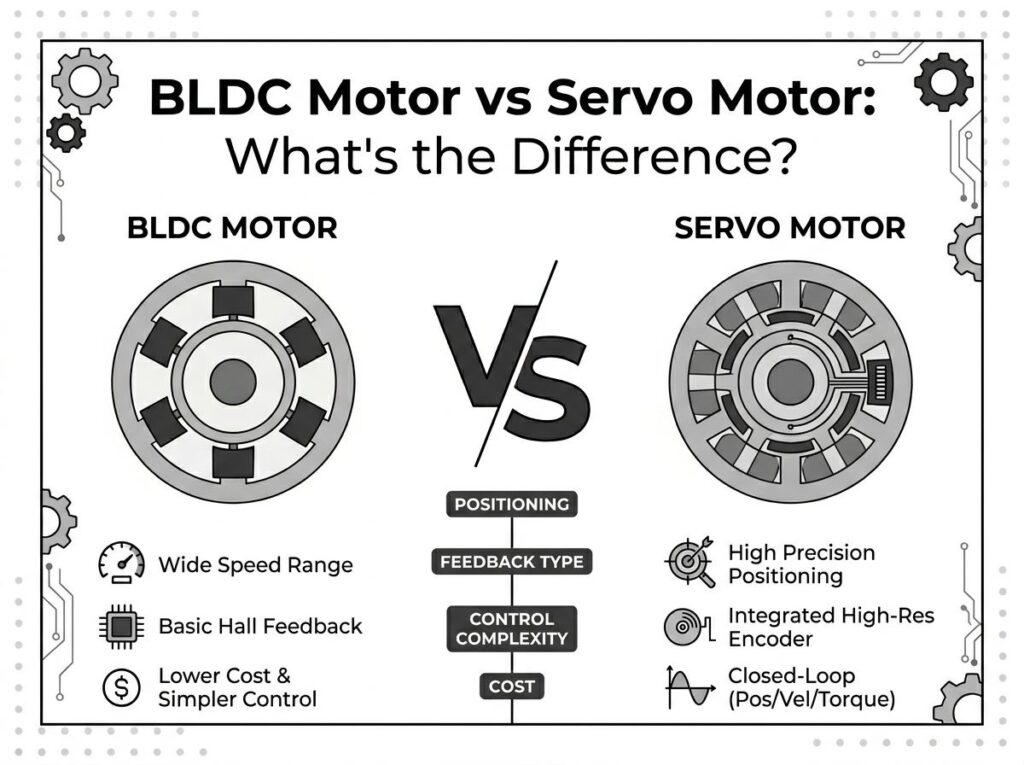
محرك BLDC مقابل محرك سيرفو: ما هو الفرق?
Selecting the right motor technology is one of the most important decisions in modern equipment design. Whether developing a robotic arm, an automated guided vehicle (AGV), an industrial conveyor, a lawn mower, or a precision manufacturing machine, engineers must carefully evaluate performance requirements, control complexity, دقة, كفاءة, and total system cost.
Among the most commonly compared technologies are Brushless DC (BLDC) motors and servo motors. While both are widely used in motion control applications, they are not direct equivalents. حقيقة, one of the biggest misconceptions in the motor industry is assuming that a servo motor is simply another type of motor.
The reality is that a BLDC motor is a motor technology, while a servo motor is a complete motion control system that combines a motor, feedback device, and controller to achieve highly precise positioning and dynamic performance.
This guide provides a detailed engineering comparison of BLDC motors and servo motors, helping OEM manufacturers, المهندسين, and procurement teams determine which solution best fits their application requirements.
محرك BLDC مقابل محرك سيرفو
BLDC motors and servo motors are both used for precise motion control, but a BLDC motor is a motor type, while a servo motor is a complete motion control system that includes a motor, المشفر, and controller. Servo motors provide higher positioning accuracy and dynamic response, whereas BLDC motors offer lower cost and simpler implementation.
على العموم, servo systems are preferred for robotics, معدات CNC, and precision automation, while BLDC motors are often selected for lawn mowers, أنظمة HVAC, مضخات, industrial drives, and cost-sensitive OEM products.
ما هو محرك BLDC؟?
محرك DC بدون فرش (محرك BLDC) is an electronically commutated motor that eliminates the brushes and commutator used in traditional DC motors. Instead of mechanical switching, electronic controllers energize stator windings according to rotor position.
BLDC motors have become one of the fastest-growing motor technologies due to their high efficiency, حجم مضغوط, عمر خدمة طويل, and excellent power density.
BLDC Motor Structure
A typical BLDC motor consists of:
- الدوار المغناطيس الدائم
- Laminated stator core
- Multi-phase stator windings
- Hall-effect sensors (خياري)
- وحدة تحكم إلكترونية
- Power inverter stage
على عكس المحركات المصقولة, no physical contact exists between stationary and rotating electrical components.
التبديل الإلكتروني
The key innovation behind BLDC motors is electronic commutation.
The motor controller continuously monitors rotor position and energizes stator windings in a sequence that generates a rotating magnetic field. The rotor follows this field and produces rotational motion.
Electronic commutation provides several advantages:
- لا ارتداء فرشاة
- Lower maintenance requirements
- Reduced electrical noise
- كفاءة أعلى
- Longer operational life
Hall Sensors
Many BLDC motors use Hall-effect sensors to determine rotor position.
These sensors detect magnetic field changes as the rotor rotates and provide position feedback to the controller.
Hall sensors enable:
- Reliable startup performance
- Accurate commutation timing
- Improved low-speed control
- Enhanced torque production
Modern sensorless BLDC systems can estimate rotor position through back-EMF detection, eliminating the need for Hall sensors in certain applications.
وحدة تحكم المحرك BLDC
The controller acts as the brain of the motor system.
Functions include:
- تنظيم السرعة
- Current control
- Torque management
- Protection functions
- PWM generation
- Communication interfaces
The simplicity of BLDC control is one reason these motors are widely used in commercial products requiring a balance between performance and affordability.
Common BLDC Applications
- جزازات العشب الكهربائية
- Robotic lawn mowers
- منفاخ التدفئة والتهوية وتكييف الهواء (HVAC).
- مضخات المياه
- Industrial fans
- AGVs
- Turnstile systems
- دراجات كهربائية
- الأجهزة الطبية
- Consumer appliances
ما هو محرك سيرفو?
One of the most misunderstood concepts in motion control is the definition of a servo motor.
Many people believe that a servo motor is a specific motor type. في الواقع, a servo system is a complete closed-loop motion control solution.
Servo System Architecture
A servo system consists of:
Servo System =
محرك
+
Encoder
+
مراقب
The motor itself may be:
- PMSM motor
- محرك BLDC
- AC synchronous motor
- Direct drive motor
The defining characteristic is not the motor technology but the use of continuous feedback and closed-loop control.
Core Components of a Servo System
1. محرك
The motor generates rotational motion and torque.
Modern industrial servo systems most commonly use PMSM motors because of their smooth torque characteristics and high efficiency.
2. Encoder
The encoder continuously measures:
- Position
- سرعة
- Direction
- Angular displacement
Encoder feedback allows the controller to make real-time corrections.
3. Servo Drive
The servo drive processes feedback signals and adjusts current, الجهد االكهربى, and switching patterns to achieve target motion profiles.
The drive ensures:
- تحديد المواقع بدقة
- Stable speed control
- Dynamic torque response
- Accurate acceleration and deceleration
Why Servo Systems Are Different
Unlike standard BLDC motor systems that may operate open-loop or semi-closed-loop, servo systems constantly compare commanded motion with actual motion.
If an error occurs, the controller immediately compensates.
This feedback mechanism enables:
- Micron-level positioning
- High-speed dynamic response
- Exceptional repeatability
- Precise trajectory control
Typical Servo Applications
- الروبوتات الصناعية
- مراكز التصنيع باستخدام الحاسب الآلي
- Semiconductor equipment
- Packaging machinery
- Automated assembly systems
- Medical robots
- Precision inspection equipment
- Aerospace motion systems
BLDC vs Servo Motor: الاختلافات الرئيسية
Although BLDC motors and servo systems can sometimes use similar motor technologies internally, their intended functions and performance levels differ significantly.
| ميزة | محرك BLDC | محرك سيرفو |
|---|---|---|
| ردود الفعل الموقف | Optional | Required |
| دقة | واسطة | عالية جدًا |
| التحكم في السرعة | جيد | ممتاز |
| التحكم في عزم الدوران | جيد | ممتاز |
| يكلف | أدنى | أعلى |
| تعقيد | أدنى | أعلى |
| طريقة التحكم | Open Loop / Semi Closed Loop | Closed Loop |
| Encoder | Optional | Mandatory |
| تطبيق نموذجي | جزازات العشب, مضخات, التدفئة والتهوية وتكييف الهواء | علم الروبوتات, CNC, Precision Automation |
The most important distinction is that servo systems prioritize precision and feedback control, while BLDC systems prioritize efficiency, بساطة, and cost effectiveness.
Working Principle Comparison
Understanding the operating principles of BLDC motors and servo systems helps clarify why their performance characteristics differ.
How BLDC Motors Work
BLDC motors rely on electronic commutation to replace mechanical brushes.
The controller energizes stator windings in a predefined sequence based on rotor position information.
Key operating characteristics:
- Electronic commutation
- Hall sensor feedback (خياري)
- PWM speed control
- Open-loop or semi-closed-loop operation
Most BLDC applications focus on maintaining speed rather than achieving precise position control.
How Servo Systems Work
Servo systems continuously monitor actual motor position and compare it with commanded position.
Any deviation immediately triggers corrective action by the controller.
This closed-loop architecture enables:
- High-precision positioning
- Accurate trajectory tracking
- Rapid response to load changes
- Superior torque control
The encoder serves as the critical feedback device that makes servo control possible.
Open Loop vs Closed Loop
| نوع التحكم | BLDC | مضاعفات |
|---|---|---|
| Open Loop Operation | Common | رقم |
| Closed Loop Operation | Optional | معيار |
| Feedback Dependency | قليل | عالي |
| Position Correction | محدود | Continuous |
Position Accuracy Comparison
For engineers evaluating motion control systems, position accuracy is often the most important factor.
This is where servo systems demonstrate their greatest advantage.
BLDC Position Accuracy
Standard BLDC motors are typically designed for speed control and torque generation rather than precision positioning.
Without encoder feedback, positional accuracy is inherently limited.
Typical BLDC characteristics include:
- Moderate positioning capability
- Good speed regulation
- Suitable for continuous rotation applications
- Limited positioning precision
Servo Position Accuracy
Servo systems are specifically engineered for accurate positioning.
High-resolution encoders enable the controller to track rotor movement continuously and apply corrections in real time.
Typical servo advantages include:
- Sub-degree positioning accuracy
- Excellent repeatability
- Precise trajectory control
- High-speed response
- Minimal positioning error
This capability explains why robotics, ماكينات CNC, semiconductor equipment, and automated manufacturing systems overwhelmingly rely on servo technology.
الاستمرار في الجزء 2: مقارنة عزم الدوران, Speed Control Comparison, مقارنة الكفاءة, مقارنة التكلفة, تطبيقات الروبوتات, AGV & AMR Applications, تطبيقات جزازة العشب, Industrial Automation Selection Guide, لماذا يختار مشترو OEM شركة Greensky Power, التعليمات, Internal Link Strategy, والمراجع.
مقارنة عزم الدوران
Torque is one of the most critical parameters when evaluating motion control systems. It determines a motor’s ability to accelerate loads, overcome resistance, maintain position, and perform dynamic movements under varying operating conditions.
In mechanical systems, torque can be expressed as:
τ = rFsin(أنا)
أين:
- ر = عزم الدوران (ن · م)
- ص = Distance from pivot point (م)
- F = القوة المطبقة (ن)
- أنا = Angle between force and lever arm
على سبيل المثال:
ر = (3)(6)sin(90°) = 18 ن · م
Only the force component perpendicular to the lever arm contributes to torque generation.
عزم الدوران المستمر
Continuous torque represents the amount of torque a motor can produce indefinitely without overheating.
| Characteristic | محرك BLDC | محرك سيرفو |
|---|---|---|
| Continuous Torque Density | عالي | عالية جدًا |
| الإدارة الحرارية | جيد | ممتاز |
| Long-Term Stability | جيد | ممتاز |
Peak Torque
Peak torque refers to the maximum short-duration torque a motor can deliver.
Servo motors are specifically designed to provide significantly higher peak torque during acceleration, positioning, and sudden load changes.
This is especially important in robotics, معدات CNC, and automated assembly systems.
عزم الدوران المماطلة
Stall torque is the torque produced when the motor shaft is not rotating.
Servo systems generally offer superior stall torque management because encoder feedback allows precise current regulation while maintaining shaft position.
Torque Performance Summary
| Torque Factor | BLDC | مضاعفات |
|---|---|---|
| عزم الدوران المستمر | عالي | عالية جدًا |
| Peak Torque | جيد | ممتاز |
| Stall Torque Control | محدود | ممتاز |
| Torque Accuracy | معتدل | عالية جدًا |
| تموج عزم الدوران | أعلى | أدنى |
For demanding motion-control applications, servo systems typically outperform standard BLDC motors in torque control and dynamic response.
Speed Control Comparison
Speed regulation is another major difference between BLDC motors and servo systems.
BLDC Speed Control
BLDC motors typically use:
- التحكم في الحلقة المفتوحة
- Semi-closed-loop control
- PWM speed regulation
- Hall sensor commutation
Speed control performance is generally sufficient for applications where exact positioning is not required.
Examples include:
- جزازات العشب
- المشجعين
- مضخات
- أنظمة HVAC
- الناقلات
Servo Speed Control
Servo systems utilize full closed-loop control.
The controller continuously compares:
- Commanded speed
- Actual speed
- شروط التحميل
- Position feedback
Real-time corrections enable highly stable speed regulation even under rapidly changing loads.
Speed Control Comparison Table
| عامل | BLDC | مضاعفات |
|---|---|---|
| Speed Stability | جيد | ممتاز |
| الاستجابة الديناميكية | جيد | ممتاز |
| Load Compensation | محدود | Automatic |
| Low-Speed Control | معتدل | ممتاز |
BLDC vs Servo Efficiency Comparison
Efficiency directly affects operating costs, عمر البطارية, thermal performance, and overall equipment reliability.
Both technologies offer significantly higher efficiency than brushed DC motors.
BLDC Motor Efficiency
- Typically 85–95%
- Low rotor losses
- Excellent battery utilization
- كثافة طاقة عالية
Servo Motor Efficiency
Modern servo systems often use PMSM motors internally, تمكين:
- 90–98% efficiency
- التحكم الحالي الأمثل
- Reduced harmonic losses
- Superior energy utilization
Efficiency Comparison Table
| نوع المحرك | الكفاءة النموذجية |
|---|---|
| نحى محرك DC | 70-85% |
| المحرك التعريفي | 80-93% |
| محرك BLDC | 85-95% |
| Servo Motor System | 90-98% |
For most commercial equipment, BLDC efficiency is already excellent. لكن, servo systems maintain an advantage in precision applications requiring maximum performance.
BLDC vs Servo Cost Comparison
Cost is often the decisive factor for OEM buyers.
Although servo systems provide superior performance, they require additional hardware and software components.
| Cost Item | BLDC | مضاعفات |
|---|---|---|
| محرك | أدنى | أعلى |
| مراقب | أدنى | أعلى |
| Encoder | Optional | Required |
| محرك الالكترونيات | Simpler | More Complex |
| Total System Cost | أدنى | أعلى |
For applications where ultra-high precision is unnecessary, BLDC motors often provide the best return on investment.
Which Is Better for Robotics?
Robotics is one of the highest-value markets for motion control technologies.
Most robotic systems require:
- تحديد المواقع بدقة
- Smooth trajectory control
- Fast acceleration
- التكرار العالي
- Closed-loop feedback
بسبب هذه المتطلبات, servo systems dominate industrial robotics.
Why Servo Motors Win in Robotics
- Encoder feedback
- Micron-level positioning capability
- استجابة ديناميكية متفوقة
- High precision trajectory control
- Excellent repeatability
الفائز للروبوتات: محرك سيرفو
Which Is Better for AGV and AMR?
المركبات الموجهة الآلية (AGVs) and Autonomous Mobile Robots (AMRs) occupy a unique middle ground.
When BLDC Is Preferred
- Cost-sensitive AGVs
- Warehouse transportation
- Basic navigation systems
- Long battery life requirements
When Servo Is Preferred
- High-speed navigation
- Precision docking
- Collaborative robots
- Advanced autonomous systems
Many modern AGVs successfully utilize BLDC drive motors with encoder feedback, creating a hybrid solution between traditional BLDC and servo architectures.
Winner for AGVs: Depends on navigation precision requirements.
Which Is Better for Lawn Mowers?
Lawn mowers require:
- ارتفاع الناتج عزم الدوران
- المتانة في الهواء الطلق
- كفاءة البطارية
- القدرة التنافسية من حيث التكلفة
- Reliable operation
Unlike robotics, lawn mowers rarely require sub-degree positioning accuracy.
بدلاً من, manufacturers prioritize efficiency, مصداقية, and affordability.
Why BLDC Motors Are Ideal for Lawn Mowers
- انخفاض تكلفة النظام
- Excellent efficiency
- عزم دوران عالي عند الانطلاق
- Simple electronic architecture
- Proven outdoor reliability
This is one reason why modern cordless lawn mowers and robotic lawn mowers increasingly rely on BLDC technology.
الفائز لجزازات العشب: محرك BLDC
Which Is Better for Industrial Automation?
Industrial automation encompasses a wide range of equipment types.
| طلب | Recommended Solution |
|---|---|
| الناقلات | BLDC |
| ماكينات التعبئة والتغليف | مضاعفات |
| Turnstiles | BLDC |
| CNC Equipment | مضاعفات |
| Industrial Fans | BLDC |
| Pick-and-Place Systems | مضاعفات |
على العموم, the choice depends on whether the application prioritizes precision or cost efficiency.
How to Choose Between BLDC and Servo Motors
The following selection guide can simplify motor technology decisions.
| طلب | Best Choice |
|---|---|
| علم الروبوتات | مضاعفات |
| CNC | مضاعفات |
| جزازة العشب | BLDC |
| التدفئة والتهوية وتكييف الهواء | BLDC |
| مضخة | BLDC |
| الباب الدوار | BLDC |
| AGV | Depends |
Choose a servo system when precision, positioning accuracy, and dynamic response are critical.
Choose a BLDC motor when efficiency, مصداقية, بساطة, and lower cost are primary priorities.
لماذا يختار مشترو OEM شركة Greensky Power
Greensky Power specializes in customized motion solutions for OEM manufacturers worldwide.
محفظة المنتجات الأساسية
- بي إل دي سي موتورز
- جير موتورز
- محركات التروس الكوكبية
- Worm Gear Motors
- Customized Motor Solutions
OEM Engineering Capabilities
- Encoder Integration
- Controller Matching
- Planetary Gearbox Design
- النماذج الأولية السريعة
- Custom Performance Optimization
الصناعات الرئيسية المقدمة
- معدات الحديقة
- أنظمة التدفئة والتهوية وتكييف الهواء
- الأتمتة الصناعية
- علم الروبوتات
- الأجهزة الطبية
- Security Systems
الأسئلة المتداولة
Is a servo motor a BLDC motor?
ليس بالضرورة. A servo motor is a complete closed-loop control system. Many modern servo motors use PMSM or BLDC motor technology internally.
Which motor is better for robotics?
Servo motors are generally preferred because they provide superior positioning accuracy, dynamic response, والتكرار.
Which motor is cheaper?
BLDC motors typically have lower motor costs, controller costs, and overall system costs.
Do BLDC motors need encoders?
رقم. Many BLDC motors operate successfully using Hall sensors or sensorless control methods. Encoders are optional unless precise positioning is required.
Can a BLDC motor be used as a servo motor?
نعم. When combined with an encoder and a closed-loop controller, a BLDC motor can function as part of a servo system.
Related Articles
مراجع
- https://www.ieee.org
- https://ieeexplore.ieee.org
- https://www.energy.gov
- https://www.iea.org
- https://www.iec.ch
- https://www.mathworks.com
- https://www.microchip.com
- https://www.ti.com
- https://www.nidec.com
- https://www.siemens.com
- https://global.abb
- https://www.weg.net