
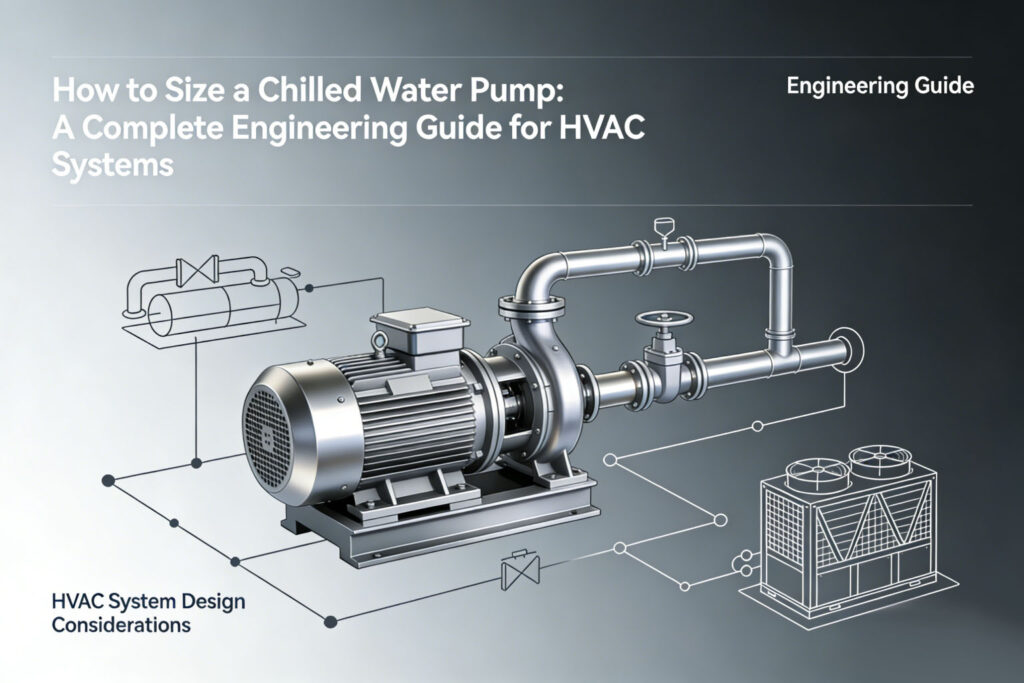
如何確定冷凍水泵的尺寸: HVAC 系統完整工程指南
Proper pump sizing is one of the most critical steps in designing an efficient chilled water system. 是否用於商業暖通空調系統, 資料中心, 或工業冷卻過程, 選擇正確的泵浦尺寸直接影響系統性能, 能源消耗, 和長期可靠性.
If you are searching for how to size a chilled water pump, this guide provides a complete engineering approach, including formulas, calculation methods, system considerations, and practical selection tips.
This article is designed for engineers, HVAC contractors, and OEM manufacturers who need accurate and reliable pump sizing solutions. It also explains how modern high-efficiency motors such as BLDC motors can significantly improve pump performance.
精選片段: 如何確定冷凍水泵的尺寸
To size a chilled water pump, you need to calculate the required flow rate and total dynamic head (TDH).
- Flow rate is based on cooling load (GPM or m³/h)
- Head is determined by system resistance
- Select pump based on performance curve
- Match with high-efficiency motor for optimal performance
Accurate pump sizing ensures efficient operation, reduced energy consumption, and long system lifespan.
Why Pump Sizing Matters in HVAC Systems
Incorrect pump sizing can lead to serious system issues.
Oversized Pumps
- Excess energy consumption
- Higher operating costs
- Increased wear and tear
Undersized Pumps
- Insufficient cooling capacity
- Poor system performance
- Temperature instability
Proper sizing ensures optimal balance between performance and efficiency.
Key Parameters for Chilled Water Pump Sizing
1. 流量 (問)
Flow rate determines how much chilled water must circulate through the system.
2. Total Dynamic Head (TDH)
TDH represents the total resistance the pump must overcome.
3. Cooling Load
Measured in tons of refrigeration (TR) or kW.
4. Pipe System Design
Includes pipe length, fittings, and elevation changes.
一步一步: How to Calculate Flow Rate
Basic Formula
Flow rate (GPM) = Cooling Load (BTU/hr) ÷ (500 × ΔT)
Where ΔT is the temperature difference between supply and return water.
計算示例
For a 100-ton system:
- 1 ton = 12,000 BTU/hr
- Total load = 1,200,000 BTU/hr
- Assuming ΔT = 10°F
Flow rate = 1,200,000 ÷ (500 × 10) = 240 GPM
一步一步: How to Calculate Total Dynamic Head (TDH)
Components of TDH
- Friction loss in pipes
- Losses in fittings and valves
- Elevation differences
Friction Loss Calculation
Based on pipe diameter, flow rate, and length.
Typical TDH Range
- 小型系統: 10–30 meters
- Medium systems: 30–60 meters
- Large systems: 60+ 米
Understanding Pump Performance Curves
After calculating flow rate and head, select a pump using performance curves.
Key Curve Elements
- Flow vs head
- Efficiency curve
- Power consumption
Choose a pump operating near its best efficiency point (BEP).
Primary vs Secondary Pump Sizing
Primary Pump
Handles chiller flow requirements.
Secondary Pump
Distributes chilled water to different zones.
Each pump must be sized based on its specific function.
Constant Flow vs Variable Flow Systems
Constant Flow
Fixed flow rate regardless of load.
Variable Flow
Adjusts flow based on demand, improving efficiency.
Variable flow systems require advanced control strategies.
Motor Selection for Chilled Water Pumps
The motor plays a critical role in pump performance.
Common Motor Types
- 交流感應電機
- 永磁電機
- 無刷直流電機
Why Motor Efficiency Matters
Motor efficiency directly impacts system energy consumption.
Advantages of BLDC Motors in Pump Applications
BLDC motors are increasingly used in modern HVAC systems.
- Efficiency up to 95%
- 精確的速度控制
- Lower energy consumption
- 使用壽命長
- 低維護成本
Combined with variable speed control, BLDC motors significantly improve system efficiency.
Practical Pump Selection Tips
1. Always Calculate Before Selecting
Avoid selecting pumps based on assumptions.
2. Choose High-Efficiency Equipment
Reduces long-term operating costs.
3. Consider Future Expansion
Allow for system growth.
4. Optimize Control Strategy
Use variable speed drives for efficiency.
5. Work with Reliable Suppliers
Ensure product quality and support.
Common Pump Sizing Mistakes
- Ignoring system resistance
- Overestimating safety margins
- Neglecting motor efficiency
- Improper control configuration
These mistakes can lead to poor performance and high costs.
Energy Efficiency and Cost Optimization
Energy consumption is a major cost factor in HVAC systems.
Proper pump sizing combined with high-efficiency motors reduces operational expenses.
Variable flow systems and advanced controls provide additional savings.
Future Trends in Chilled Water Pump Design
- Smart HVAC systems
- IoT-based monitoring
- High-efficiency BLDC motors
- 先進的控制演算法
結論
Knowing how to size a chilled water pump is essential for designing efficient HVAC and industrial cooling systems. By accurately calculating flow rate and total dynamic head, engineers can select the right pump for optimal performance.
Modern systems increasingly rely on high-efficiency motors such as BLDC motors to reduce energy consumption and improve reliability.
For OEM manufacturers and HVAC professionals, proper pump sizing and motor selection are key to achieving long-term system efficiency and cost savings.
參考
https://www.ashrae.org/technical-resources
https://www.energy.gov/eere/buildings/articles/chilled-water-systems
https://www.sciencedirect.com/topics/engineering/chilled-water-system
https://www.engineeringtoolbox.com/pumps-d_637.html
https://www.carrier.com/commercial/en/us/products/chillers/