
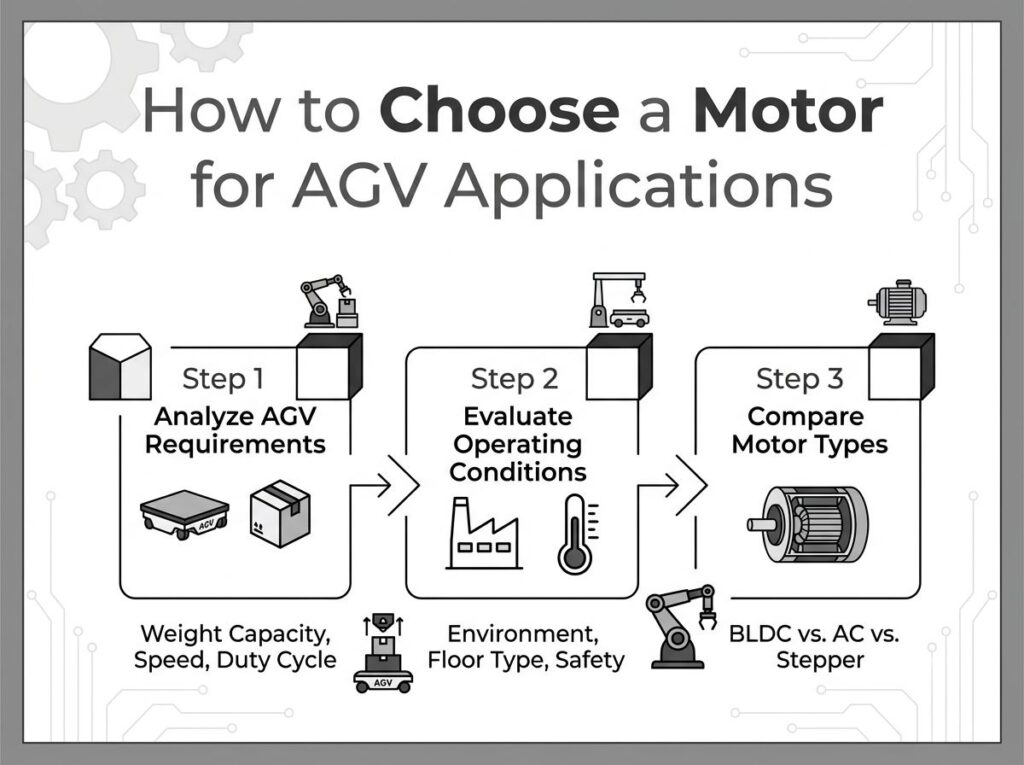
如何為 AGV 應用選擇電機: Complete Selection Guide — Types, Torque Calculation & 規格
選擇正確的 motor for AGV (自動導引車) systems is one of the most consequential design decisions in mobile robotics. The drive motor directly determines traction performance, 電池運轉時間, 定位精度, 熱行為, and maintenance intervals — all of which feed into the total cost of ownership over a multi-year deployment.
This guide consolidates selection methodology used by AGV/AMR manufacturers worldwide. It covers motor type comparison, torque calculation formulas, gearbox matching, payload-based sizing, 環境保護, and controller integration — with reference data from industrial motor platforms.
What Is an AGV Motor?
An AGV motor is an electric motor that provides propulsion, steering, and lifting force for automated guided vehicles and autonomous mobile robots. Unlike industrial motors that run at fixed speeds on mains power, AGV motors operate from battery voltage (typically 24V or 48V DC), must handle frequent start-stop cycles, and require closed-loop feedback for positioning accuracy.
The motor works as part of an integrated drive system that includes a gearbox, 編碼器, 制動, and motor controller. Each component must be matched to the vehicle’s payload, 輪徑, target speed, slope requirements, and operating environment. A mismatched motor — even one with adequate rated power — can cause overheating, wheel slip, positioning drift, or premature bearing failure.
Key Functions of an AGV Motor
| 功能 | 描述 | Motor Requirement |
|---|---|---|
| 牽引力 / 駕駛 | Propels the vehicle forward, 落後, and up slopes | High continuous torque at low RPM; adequate peak torque for acceleration |
| 操舵 | Controls direction via differential speed or articulated steering | Precise speed matching between left/right motors; responsive torque control |
| Lifting / Fork | Raises and lowers loads on forklift AGVs | High holding torque; integrated brake for power-off safety |
| 定位 | Stops the vehicle at docking stations with repeatable accuracy | Closed-loop encoder feedback; low-speed smoothness |
AGV Motor Types: 無刷直流電機, 伺服, 步進機, and Brushed DC
Four motor technologies compete in the AGV drive space. Each has distinct efficiency, 成本, 維護, and control characteristics that make it suitable for specific payload classes and precision requirements.
1. 無刷直流 (無刷直流電機) Motor — The Dominant Choice
BLDC motors have become the mainstream drive solution for AGVs and AMRs due to their combination of high efficiency (85–92%), 使用壽命長 (10,000–20,000+ hours), and low acoustic noise. They use electronic commutation instead of mechanical brushes, eliminating the primary wear component found in brushed motors.
適用於 AGV 應用, BLDC motors are typically paired with planetary gearboxes to multiply torque at the wheel. The integrated BLDC planetary gear motor — where motor and gearbox are supplied as a single unit — is the most common configuration for warehouse AMRs and logistics AGVs in the 50–500 kg payload range.
Key advantages for AGV deployment:
- 電池效率: 85–92% efficiency vs. 60–75% for brushed DC, directly extending operating time per charge
- Maintenance-free operation: No brush replacement; bearing life is the limiting factor
- 低噪聲: 48–55 dB typical, suitable for hospital and office environments
- Closed-loop control: Compatible with Hall sensors and encoders for FOC (磁場定向控制)
- 熱管理: Lower resistive losses reduce heat generation in enclosed chassis
- Compact form factor: High torque density in 42mm, 56毫米, and 80mm frame sizes
For BLDC motor product specifications and configurations, 看看我們的 BLDC motor product page.
2. DC Servo Motor — For Precision Applications
DC servo motors use closed-loop control with high-resolution encoder feedback to achieve millimeter-level positioning accuracy (repeatable error < ±0.1 mm with 17-bit absolute encoders). They offer 300% instantaneous overload capacity and superior dynamic response compared to standard BLDC motors.
Servo motors are typically specified for heavy-load AGVs (>1 ton payload), high-speed precision docking (≥2 m/s with ±5 mm stopping accuracy), and complex path control scenarios such as S-curve obstacle avoidance or synchronized multi-axis movement.
3. Stepper Motor — For Light-Load Precision
Stepper motors provide open-loop position control without encoder feedback, making them cost-effective for light-load AGVs and AGCs (Automated Guided Carts) where positioning accuracy requirements are moderate (±1–5 mm). They deliver high holding torque at zero speed and simple integration with stepper drivers.
然而, steppers lose torque rapidly at higher speeds and are susceptible to step loss under sudden load changes. Closed-loop stepper variants (hybrid steppers with encoder feedback) address these limitations for applications requiring higher reliability. For a detailed comparison of servo and stepper motor characteristics, 看看我們的 Servo Motor vs Stepper Motor guide.
4. Brushed DC Motor — The Legacy Option
Brushed DC motors remain in use for low-cost AGV platforms due to their simple two-wire control and low upfront cost (30–50% cheaper than BLDC). They provide high starting torque and respond well to PWM speed control.
The trade-offs are significant: brush wear limits service life to 2,000–5,000 hours, efficiency is 60–75%, and brush arcing generates electrical noise and acoustic noise. For AGV fleets operating multiple shifts, the maintenance cost of brush replacement quickly exceeds the initial savings.
Motor Type Comparison Table
| 範圍 | 無刷直流電機 | 直流伺服電機 | 步進電機 | 有刷直流電機 |
|---|---|---|---|---|
| 效率 | 85–92% | 90–95% | 70–80% | 60–75% |
| 使用壽命 (小時) | 10,000–20,000+ | 10,000–20,000+ | 10,000+ | 2,000–5,000 |
| 定位精度 | ±0.5–2 mm (with encoder) | ±0.1 mm | ±1–5 mm (開環) | ±5–10 mm |
| 速度範圍 | 寬的 (0–6,000+ RPM) | Very wide (0–10,000+ RPM) | Narrow (torque drops above 1,000 轉速) | 寬的 (0–5,000 RPM) |
| 噪音水平 | 48–55 dB | 50–60 dB | 55–65 dB | 60–70 dB |
| 成本 (相對的) | 中等的 | 高的 | 低-中 | 低的 |
| 維護 | 沒有任何 (軸承限制) | 沒有任何 (軸承限制) | 沒有任何 | Brush replacement |
| Overload Capacity | 150–200% | 300% | 不推薦 | 200–300% |
| 典型電壓 | 24V / 48V | 48V / 72V | 12V / 24V | 24V / 48V |
| Best AGV Application | Warehouse AMR, logistics AGV (50–500公斤) | Forklift AGV, heavy-load (>1 ton) | AGC, light cart (<100 公斤) | Low-cost platforms, legacy systems |
Torque Calculation for AGV Drive Motors
Torque calculation is the foundation of AGV motor selection. Estimating torque from catalog data without calculating actual wheel-side requirements leads to either undersized motors (過熱, 攤位) 或超大電機 (wasted battery capacity, 成本更高).
Wheel Torque Formula
The required torque at each drive wheel is the sum of rolling resistance torque and acceleration torque:
時間車輪 = (m × g × μ × r) + (m × a × r)
| 象徵 | 範圍 | 典型值 | 單元 |
|---|---|---|---|
| 米 | 總質量 (vehicle + maximum payload) | 50–2,000 | 公斤 |
| G | 重力加速度 | 9.81 | 米/秒² |
| 米 | Rolling friction coefficient | 0.01–0.03 (smooth floor) | 無量綱 |
| r | 車輪半徑 | 0.05–0.15 | 米 |
| A | Target acceleration | 0.3–1.0 | 米/秒² |
工作範例: 150 kg Warehouse AMR
對於 150 kg AMR with 75 mm wheel radius (150 直徑毫米), smooth warehouse floor (μ = 0.02), 和 0.5 m/s² acceleration:
- Rolling resistance torque: 150 × 9.81 × 0.02 × 0.075 = 2.21 牛頓·米
- Acceleration torque: 150 × 0.5 × 0.075 = 5.63 牛頓·米
- Total wheel torque (two wheels): 7.84 牛頓·米
- Per motor (dual drive): 3.92 牛頓·米
- With safety factor 1.5–2.0×: 5.9–7.8 N·m per motor
Torque Requirements by Operating Scenario
AGV drive motors face different torque demands depending on the maneuver being performed. Data from automotive manufacturing logistics applications shows the following patterns for a two-wheel differential AGV:
| 設想 | Torque Demand | Key Consideration |
|---|---|---|
| Linear travel | ~30 N·m (example: heavy AGV) | Consistent torque to overcome friction; stability for constant speed |
| Arc turning | 36.8 牛頓·米 / 9.9 牛頓·米 (inner/outer wheel) | Uneven load distribution; independent per-wheel torque control required |
| Zero-turn (pivot) | ~16.2 N·m per wheel | High resistance; motor must overcome tire scrub torque |
| Slope climbing (5°) | 1.5–2× flat-ground torque | Must verify thermal margin for sustained climb |
| Emergency braking | Peak regenerative torque | Brake resistor or regenerative capacity must absorb energy |
The safety factor of 1.5–2.0× applied to calculated torque accounts for floor irregularities, wheel wear, payload distribution asymmetry, and transient acceleration peaks. For slope-climbing AGVs, verify that the motor can sustain the higher torque without exceeding its thermal limit over the expected climb duration.
Voltage and Power Specifications
AGV motors operate on DC battery power, with 24V and 48V being the dominant voltage platforms. The choice of voltage affects motor current draw, wiring gauge, controller sizing, and battery configuration.
Voltage Platform Comparison
| 範圍 | 24V系統 | 48V系統 |
|---|---|---|
| Typical payload | 50–300 kg | 300–2,000+ kg |
| Motor power range | 50–400W | 400W–2kW+ |
| Current at rated power (example) | ~17A at 400W | ~17A at 800W |
| Wiring gauge | 10–12 AWG | 14–16 AWG |
| Battery configuration | 2S LiFePO₄ / 12S Li-ion | 4S LiFePO₄ / 24S Li-ion |
| Safety classification | SELV (Safe Extra Low Voltage) | Approaching ELV limit |
| 最適合 | Compact AMRs, light AGCs | Forklift AGVs, heavy platform AGVs |
Power Sizing by Load Class
| Payload Class | Recommended Motor Power | 電壓 | 馬達機座尺寸 |
|---|---|---|---|
| Light (< 300 公斤) | 150–400W | 24V | 42毫米無刷直流電機 |
| 中等的 (300–800 kg) | 400W–1kW | 48V | 56毫米無刷直流電機 |
| Heavy (800–1,500 kg) | 1–1.5kW | 48V | 80mm BLDC or servo |
| Very heavy (> 1,500 公斤) | ≥1.5kW servo | 48V / 72V | Servo with planetary gearbox |
When sizing motor power, verify that the motor’s continuous torque rating (不僅僅是峰值扭矩) exceeds the calculated RMS torque over the duty cycle. Peak torque covers acceleration transients; continuous torque determines whether the motor can sustain operation without thermal shutdown.
Gearbox Selection for AGV Motors
The gearbox multiplies motor torque and reduces output speed to match wheel RPM requirements. For a motor spinning at 3,000 RPM and a wheel needing 100 轉速, A 30:1 reduction ratio is required. The gearbox type directly affects torque density, 反彈, 噪音, 和成本.
Gearbox Type Comparison for AGV Applications
| 範圍 | 行星齒輪箱 | Spur Gearbox | Harmonic Drive |
|---|---|---|---|
| Torque density | 高的 | 低-中 | 非常高 |
| 反彈 | 5–15 arc-min | 15–30 arc-min | < 1 弧分 |
| 噪音水平 | 低的 (螺旋齒輪) | 更高 (straight teeth) | 很低 |
| 效率 | 90–95% | 92–96% | 80–85% |
| 成本 (相對的) | 1× | 0.5–0.8× | 4–6× |
| 服務壽命 | 10,000–20,000 h | 5,000–10,000 h | 8,000–15,000 h |
| Typical ratio range | 3:1 – 100:1 | 3:1 – 50:1 | 50:1 – 300:1 |
| Best AGV fit | Wheel drive (all payload classes) | Low-cost AGC, light carts | 操舵, lift (rarely for traction) |
For AGV wheel drive applications, planetary gearboxes provide the best balance of torque density, 耐用性, 和成本. The 5–15 arc-min backlash is sufficient for traction — sub-arc-min precision is unnecessary when the wheel itself has tire deformation of several millimeters. For a deeper comparison of spur vs planetary gear motor characteristics, 看看我們的 Spur Gear Motor vs Planetary Gear Motor analysis.
Common Gear Ratios for AGV Applications
| AGV Type | Wheel Speed (轉速) | Motor Speed (轉速) | 齒輪比 |
|---|---|---|---|
| Compact AMR (1–2 m/s) | 120–250 | 3,000–4,000 | 15:1 – 25:1 |
| Warehouse AGV (1.5–2 m/s) | 150–300 | 3,000 | 10:1 – 20:1 |
| Forklift AGV (0.5–1.5 m/s) | 60–180 | 2,500–3,000 | 15:1 – 40:1 |
| 重型AGV (0.3–0.8 m/s) | 40–100 | 2,000–3,000 | 20:1 – 50:1 |
For gearbox product options compatible with AGV drive systems, 看看我們的 gearbox product page.
Motor Sizing by Payload Class
AGV motor specifications should be selected based on the total vehicle mass (chassis + 電池 + maximum payload). The following matrix provides a starting point for motor selection, with specific configurations depending on drive layout (2WD vs 4WD), floor conditions, and slope requirements.
AGV Motor Selection Matrix
| Payload | 馬達類型 | 框架尺寸 | 變速箱 | 電壓 | Approx. Torque/Motor | 典型的速度 |
|---|---|---|---|---|---|---|
| 50–150 kg | BLDC planetary | 42毫米 | 精密行星輪 (螺旋狀的) | 24V | 3–6 N·m | 1.0–2.0 公尺/秒 |
| 100–300 kg | BLDC planetary | 56毫米 | Heavy-duty planetary | 24V / 48V | 6–15 N·m | 1.0–2.0 公尺/秒 |
| 300–500公斤 | BLDC planetary | 56–80mm | Industrial planetary | 48V | 15–30牛頓米 | 0.8–1.5 m/s |
| 500–1,000 kg | BLDC or servo | 80mm+ | Industrial planetary | 48V | 30–60 N·m | 0.5–1.2 m/s |
| 1,000–2,000 kg | DC servo | Servo frame | 行星 + hub | 48V | 60–120牛頓米 | 0.3–1.0 公尺/秒 |
| > 2,000 公斤 | DC servo (dual) | Large servo | Hub gearbox | 48V / 72V | >100 牛頓·米 | 0.3–0.8 m/s |
筆記: Payload ranges overlap because the correct selection depends on drive configuration (number of driven wheels), floor friction coefficient, maximum slope angle, 和占空比. A 4WD configuration distributes torque across four motors, allowing smaller individual motor sizes for the same payload.
For custom motor configurations tailored to specific AGV platforms, 看看我們的 custom electric motor services.
Environmental Protection and Noise
IP Rating Requirements
| IP等級 | 防護等級 | Recommended AGV Environment |
|---|---|---|
| IP44 | Solid objects > 1毫米; no water protection | Clean, dry indoor environments only (not recommended for production) |
| IP54 | Dust-protected; splash water | Minimum for indoor warehouse AGVs |
| IP65 | Dust-tight; 水刀 | Recommended for any AGV deployed > 12 months in real environments |
| IP66+ | Dust-tight; powerful water jets | Wash-down environments (食物, pharma, outdoor) |
Proper sealing addresses the two most common BLDC motor failure modes in AGV service: bearing contamination and winding corrosion. For AGVs operating in food processing or pharmaceutical environments, stainless steel housings and food-grade grease may be required in addition to IP66+ sealing.
Noise Requirements
| 應用環境 | Max Noise Level | Gear Requirement |
|---|---|---|
| Hospital / office corridor | < 55 DB(A) @ 1m | Helical planetary + ground gear teeth |
| Warehouse / logistics center | < 65 DB(A) | Standard planetary (acceptable) |
| Outdoor / heavy industrial | < 75 DB(A) | Noise rarely a limiting factor |
The single most effective noise reduction method is using helical (angled) gear teeth instead of straight (支線) teeth. Ground gear profiles further reduce noise by 3–5 dB compared to powder-metal gears.
煞車, 編碼器, and Controller Integration
The AGV motor does not operate in isolation — it must integrate with a brake (for safety holding), 編碼器 (for feedback), and a motor controller (for commutation and motion control). Mismatches between these components are a common source of AGV performance issues.
Brake Requirements
| Brake Function | 要求 | When Required |
|---|---|---|
| Parking hold | Hold vehicle stationary when powered off | All AGVs (safety requirement) |
| Emergency stop | Engage within < 100ms of E-stop signal | All AGVs (safety standard) |
| Slope holding | Maintain position on incline without power | AGVs operating on ramps or slopes |
| Power-fail safety | Fail-safe (brake engages on power loss) | All AGVs with lifting or slope operation |
Encoder and Feedback Options
| Feedback Type | 解決 | AGV Use Case |
|---|---|---|
| 霍爾傳感器 | 60–120 pulses/rev (commutation only) | Basic speed control, low-cost AGCs |
| Incremental encoder | 1,000–10,000 pulses/rev | Standard AGV speed/position control |
| Absolute encoder (single-turn) | 17–23 bit | 精準定位, docking |
| Absolute encoder (多圈) | 17–23 bit + 12–16 turns | Continuous position tracking without homing |
Controller Communication Protocols
AGV motor controllers must interface with the vehicle’s central control system. Common communication protocols include:
| Protocol | 使用案例 | AGV Suitability |
|---|---|---|
| CANopen | Multi-axis coordination, fleet management | Industry standard for AGV/AMR |
| Modbus RTU | Simple speed/torque commands | Basic AGV platforms |
| RS485 | Point-to-point motor control | Small AGV fleets |
| EtherCAT | High-speed synchronized multi-axis | Advanced AMR platforms |
| 脈寬調製 / Analog | Direct speed/voltage control | Legacy or simple systems |
For motor controller products compatible with AGV drive systems, 看看我們的 motor controller product page.
Drive Configurations: 2西數, 4西數, Differential, and Hub
The number and placement of drive motors affects torque distribution, steering method, and motor sizing. Each configuration has different implications for motor selection.
| 配置 | Motor Count | Steering Method | Motor Torque per Wheel | 最適合 |
|---|---|---|---|---|
| Differential drive (2西數 + caster) | 2 | Speed differential between left/right | 高的 (each carries ~50% of load) | Compact AMRs, light AGVs |
| 4WD skid-steer | 4 | Speed differential (skid steering) | 低的 (each carries ~25% of load) | Outdoor AGVs, heavy platforms |
| 4西數 + steering | 4 駕駛 + 1 steering | Articulated steering motor | 低的 (牽引力) + steering motor | Forklift AGVs, precision docking |
| Hub motor (direct in-wheel) | 2–4 | Differential or articulated | Direct wheel torque (no gearbox) | Compact AGVs with space constraints |
Motor Selection Impact by Configuration
In a differential drive configuration, each motor must provide approximately half the total required wheel torque. In a 4WD configuration, each motor provides roughly one-quarter, allowing smaller frame sizes. 然而, 4WD systems require tighter speed synchronization between motors to prevent wheel slip during skid steering.
Hub motor configurations eliminate the external gearbox by integrating the gear reduction inside the wheel hub. This simplifies mechanical layout but makes motor replacement more complex. For a comparison of direct drive vs gearbox approaches, 看看我們的 Direct Drive Motor vs Gear Motor guide.
Seven-Step AGV Motor Selection Framework
The following framework synthesizes best practices from AGV manufacturers and motor suppliers into a structured selection process:
步 1: Define Vehicle Parameters
Document total mass (chassis + 電池 + max payload), 輪徑, 驅動輪數量, target speed, and maximum slope angle. These parameters are the inputs for all subsequent calculations.
步 2: Calculate Required Wheel Torque
Apply the torque formula: 時間車輪 = (m × g × μ × r) + (m × a × r). Apply a safety factor of 1.5–2.0× to account for real-world conditions. Divide by the number of drive wheels to get per-motor torque.
步 3: Select Motor Type
Choose BLDC for most warehouse/logistics AGVs (50–500公斤). Select servo for heavy-load (>1 ton) or precision docking (±0.1 mm). Consider stepper for light AGCs (<100 公斤) with moderate accuracy needs. See the motor types section above.
步 4: Determine Voltage Platform
Use 24V for payloads under 300 公斤. Use 48V for payloads above 300 kg or when motor current at 24V would exceed 20A continuously. Verify battery configuration supports the selected voltage.
步 5: Select Gearbox and Ratio
Calculate required gear ratio: motor RPM ÷ required wheel RPM. Choose planetary gearbox for AGV traction (best torque density and noise). Verify gearbox continuous torque rating exceeds calculated wheel torque.
步 6: Specify Environmental Protection
Minimum IP54 for indoor warehouse. IP65 recommended for any AGV with >12 month deployment. IP66+ for wash-down environments. Select helical gears for noise-sensitive applications.
步 7: Integrate Brake, 編碼器, and Controller
Specify electromagnetic brake for parking/emergency/slope holding. Select encoder resolution based on positioning accuracy requirement. Match controller communication protocol to AGV central control system (CANopen, Modbus, EtherCAT).
| 步 | 關鍵輸出 | Common Mistake |
|---|---|---|
| 1. Vehicle parameters | 總質量, wheel size, 速度, 坡 | Forgetting battery weight in total mass |
| 2. Torque calculation | Required N·m per motor (with safety factor) | Using peak torque instead of RMS for continuous duty |
| 3. 馬達類型 | 無刷直流電機 / 伺服 / 步進器 / 拉絲的 | Over-specifying servo for simple transport AGVs |
| 4. 電壓 | 24V or 48V | Choosing 24V for heavy payloads, causing excessive current |
| 5. 變速箱 | 類型, 比率, 額定扭矩 | Ignoring gearbox efficiency in torque calculation |
| 6. 環境的 | IP等級, noise class | Specifying IP54 for environments with floor washing |
| 7. 一體化 | 煞車, 編碼器, controller spec | Mismatched controller protocol to AGV system |
Total Cost of Ownership Analysis
The lowest-priced motor is rarely the lowest-cost motor over an AGV’s deployment lifetime. A TCO analysis should consider four cost categories:
| Cost Category | BLDC行星齒輪電動機 | 有刷直流電機 | 影響 |
|---|---|---|---|
| Initial procurement | 更高 (1.3–2× brushed) | Lower baseline | BLDC costs more upfront |
| Energy cost (battery charging) | 20% 降低 (90% vs 75% 效率) | Higher consumption | Compounds over multi-year deployment |
| Maintenance cost | Near zero (4–8 years single-shift) | Brush replacement every 2,000–5,000 h | Labor + downtime for brush service |
| Downtime cost | 降低 (longer MTBF) | 更高 (more frequent failures) | Fleet of 50+ AGV: $200–$500/hour unplanned downtime |
For a fleet of 50 AGVs operating 24/7, investing in higher-quality BLDC planetary gear motors typically reduces total cost of ownership by 30–50% over a 5-year deployment period compared to brushed DC alternatives. The energy savings alone — from 90% vs. 75% efficiency — can offset the higher initial procurement cost within the first 12–18 months.
For motor testing and quality validation processes that support long-life AGV deployment, 看看我們的 電動馬達測試標準 page.
Application-Specific Motor Recommendations
Warehouse AMR (50–200 kg)
| 範圍 | 推薦 |
|---|---|
| 馬達類型 | BLDC with integrated planetary gearbox |
| Frame size | 42毫米 |
| 電壓 | 24V |
| 齒輪比 | 15:1 – 25:1 |
| 反饋 | Incremental encoder + 霍爾傳感器 |
| IP等級 | IP65 |
| 煞車 | 電磁, 24V |
| Noise target | < 55 DB(A) @ 1m |
Forklift AGV (500–1,500 kg)
| 範圍 | 推薦 |
|---|---|
| 馬達類型 | 無刷直流電機 (牽引力) + 伺服 (lift/steering) |
| Frame size | 80mm+ (牽引力); servo frame (lift) |
| 電壓 | 48V |
| 齒輪比 | 20:1 – 40:1 (牽引力); 50:1+ (lift) |
| 反饋 | Absolute encoder (多圈) |
| IP等級 | IP65 |
| 煞車 | Dual brake (保持 + emergency) |
Heavy-Duty Platform AGV (> 1,500 公斤)
| 範圍 | 推薦 |
|---|---|
| 馬達類型 | DC servo with industrial planetary gearbox |
| 配置 | 4WD or dual hub motors |
| 電壓 | 48V / 72V |
| 齒輪比 | 30:1 – 50:1 |
| 反饋 | 17-bit absolute encoder |
| IP等級 | IP66 |
| 控制器 | CANopen / EtherCAT |
Light AGC / Cart (< 100 公斤)
| 範圍 | 推薦 |
|---|---|
| 馬達類型 | Stepper or small BLDC |
| 電壓 | 12V / 24V |
| 齒輪比 | 10:1 – 20:1 |
| 反饋 | 霍爾傳感器 (無刷直流電機) or open-loop (步進器) |
| IP等級 | IP44 (indoor clean environments) |
| 煞車 | 選修的 (low slope only) |
For light AGC applications using stepper motors, 看看我們的 stepper motor product page. For motor comparison in the context of AGV vs AMR platform differences, 看看我們的 AGV vs AMR guide.
常見問題解答
What voltage motor is used in AGV?
The most common AGV motor voltages are 24V and 48V DC. 24V systems are used for compact AMRs and light AGVs (50–300 kg payload), while 48V systems are standard for medium to heavy AGVs (300–2,000+ kg). 12V is occasionally used for very light AGCs, and 72V for very heavy industrial AGVs. The voltage choice is driven by the battery platform and affects motor current draw, 接線要求, and controller sizing.
How much torque does an AGV motor need?
AGV motor torque depends on total vehicle mass, 車輪半徑, rolling friction, target acceleration, and slope angle. 對於 150 kg AMR with 75mm wheel radius on smooth floor (μ=0.02) 和 0.5 m/s² acceleration, the calculated wheel torque is approximately 7.8 N·m total (3.9 N·m per motor in dual drive). With a 1.5–2.0× safety factor, the design target is 5.9–7.8 N·m per motor. Heavy AGVs (>1 ton) may require 30–120 N·m per motor depending on configuration.
BLDC or servo motor for AGV — which is better?
BLDC motors are the preferred choice for most AGV and AMR applications in the 50–500 kg payload range due to their balance of efficiency, 成本, and maintenance-free operation. Servo motors are better for heavy-load AGVs (>1 ton), applications requiring ±0.1 mm positioning accuracy, or scenarios with frequent high-dynamic maneuvers requiring 300% 過載能力. For standard warehouse logistics, BLDC with planetary gearbox and encoder feedback provides sufficient performance at lower cost.
What gearbox ratio is used for AGV motors?
Common AGV gearbox ratios range from 10:1 到 50:1, 和 15:1–25:1 being typical for warehouse AMRs. The ratio is calculated as motor RPM ÷ required wheel RPM. 例如, a motor running at 3,000 RPM with a wheel needing 150 RPM requires a 20:1 比率. Planetary gearboxes are the standard choice for AGV traction due to their high torque density, 低壓 (5–15 arc-min), 和低噪音.
How long do AGV motors last?
A well-designed BLDC planetary gear motor with IP65 sealing and quality bearings typically lasts 10,000–20,000 hours before first maintenance. This equates to 4–8 years of single-shift operation or 2–4 years of 24/7 連續運行. Brushed DC motors last 2,000–5,000 hours before requiring brush replacement. The most common failure modes for BLDC motors in AGV service are bearing contamination and winding corrosion — both addressable through proper sealing.
Can stepper motors be used for AGV?
Stepper motors can be used for light AGVs and AGCs (< 100 公斤有效負載) where positioning accuracy requirements are moderate (±1–5 mm) and speed is low. They offer cost advantages and simple integration. 然而, steppers lose torque at higher speeds, are susceptible to step loss under sudden load changes, and are not suitable for heavy payloads or continuous operation. 閉環 (hybrid) steppers with encoder feedback address some of these limitations.
參考
- 旋轉電機. “How to Select the Right BLDC Gear Motor for AMR and AGV Robots.” 可用於: https://www.twirlmotor.com/how-to-select-the-right-bldc-gear-motor-for-amr-and-agv-robots/
- DMK Motor (BeUDMKE). “High-Performance AGV Motor for AMR/AGV.” 可用於: https://www.dmkmotor.com/agv-motor/
- X-TEAM Brushless DC Motor. “How to Choose a Suitable BLDC Motor for AGV?” 可用於: https://www.x-teamrc.com/how-to-choose-a-suitable-bldc-motor-for-agv/
- HKT ROBOT (AGVMotor.com). “AGV Motor for AGV/AMR Applications.” 可用於: https://agvmotor.com/blogs/knowledge/agv-motor-for-agv-amr-applications
- MyTen-Tech. “AGV’s Power Heart: Motor Selection Guide and Core Technology Analysis.” 可用於: https://myten-tech.com/news/components-introduction-and-selection/agvs-power-heart-motor-selection-guide-and-core-technology-analysis/
- 東方汽車. “AGV — Automatic Guided Vehicle Sizing Tool.” 可用於: https://www.orientalmotor.com/motor-sizing/agv-sizing.html
- Sunrise Motor. “The Guide to BLDC Motors: From AGV Powerhouses to Medical Precision.” 可用於: https://www.sunrisemotor-cn.com/The-Guide-to-BLDC-Motors:-From-AGV-Powerhouses-to-Medical-Precision.html
- 鄧克發動機. “AGV/AMV/AMR Gear Motors.” 可用於: https://www.dunkermotoren.com/en/industries/warehouse-automation/agv-gear-motor
- YIKONG (BiControls). “Torque Calculation and Optimization for AGV Drive Motors: Enabling Flexible Logistics in Automotive Manufacturing.” 可用於: https://en.bicontrols.com/news_detail/50.html
- 日本電產電機株式會社. “AGV Motors — Reliable and Robust AGV/AMR Motor Platforms.” 可用於: https://moen.nidec.com/automation/Products/AGV-Solutions/AGV-Motors