
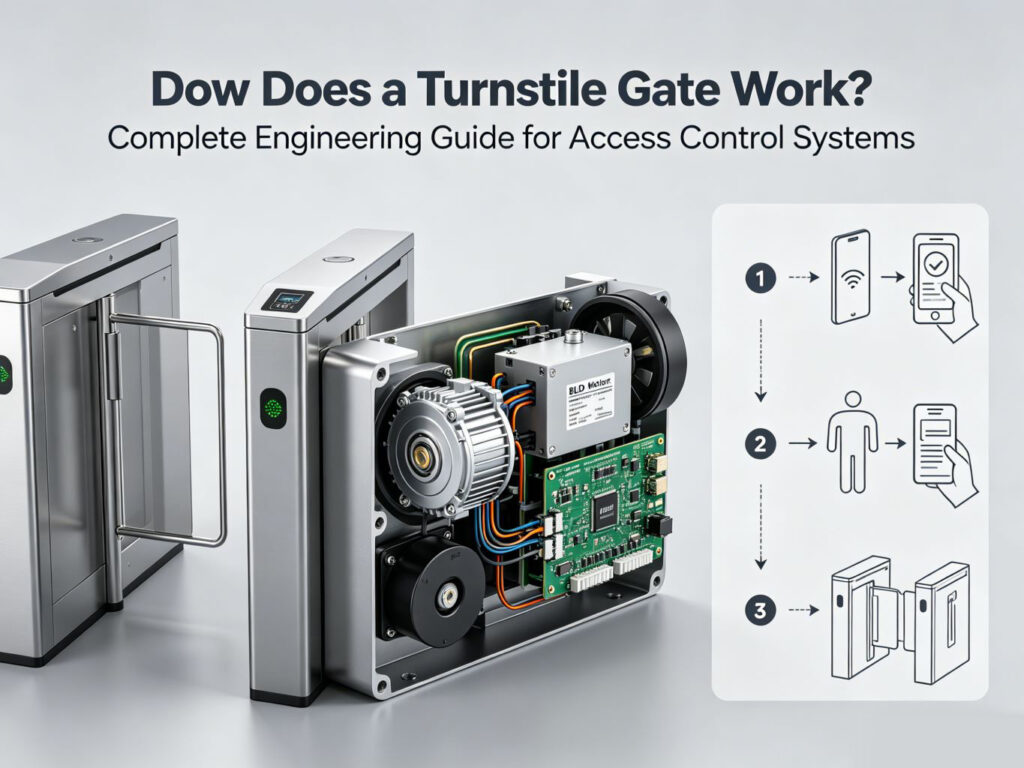
旋轉柵門如何運作? 門禁系統完整工程指南
精選片段:
A turnstile gate works by combining a mechanical barrier system with an electronic control unit and a motor drive system. When a valid authentication signal (such as RFID, QR 圖碼, or biometric input) is received, 控制器啟動電機, allowing controlled rotation or opening of the barrier. Sensors monitor movement and ensure safe passage, while the system automatically resets after each user. Modern turnstiles use BLDC motors and intelligent controllers to deliver smooth operation, 高效率, 和長期可靠性.
理解 how does a turnstile gate work is critical for engineers, OEM廠商, and procurement teams designing access control systems. Turnstiles are no longer simple mechanical devices—they are integrated electromechanical systems combining motors, 控制器, 感應器, and software. Their performance directly affects throughput efficiency, 使用者安全, maintenance costs, 和系統壽命.
This engineering authority guide provides a deep technical breakdown of turnstile operation, including mechanical design, 馬達選型, control logic, efficiency considerations, and OEM-level selection strategies.
What Is a Turnstile Gate?
A turnstile gate is a physical access control device designed to regulate pedestrian movement. It ensures that only authorized individuals can pass through, typically allowing one person per authentication event.
Main Types of Turnstiles
- 三輥閘
- Flap barrier gate
- Swing gate turnstile
- Full-height turnstile
Each type uses different mechanical structures and motor systems depending on application requirements.
👉高效能解決方案, 檢查我們的 閘機用 BLDC 電機
旋轉柵門如何運作: Step-by-Step Process
The operation of a turnstile gate involves multiple subsystems working together.
步 1: 使用者認證
The system receives input from RFID cards, QR 圖碼, fingerprint scanners, or facial recognition systems.
步 2: 信號處理
The controller verifies the authentication data and determines whether to grant access.
步 3: 馬達啟動
If access is granted, 電機 (typically BLDC or servo) is activated to unlock or rotate the barrier.
步 4: Movement and Monitoring
Sensors track barrier movement and detect user passage.
步 5: Automatic Reset
The system returns to the locked position after passage is complete.
This integrated process ensures secure, 高效的, and controlled access.
Core Components of a Turnstile System
1. Motor System
Provides mechanical movement. Common options include BLDC motors and servo motors.
2. Controller Unit
Processes signals and controls motor operation.
3. 感應器
- Infrared sensors
- 位置感測器
- Anti-tailgating sensors
4. Mechanical Structure
Includes arms, flaps, or barriers depending on design.
5. 電源
Typically 24V or 48V DC systems.
Motor Systems in Turnstiles: BLDC vs Servo vs Stepper
| 範圍 | 無刷直流電機 | 伺服電機 | 步進電機 |
|---|---|---|---|
| 效率 | 高的 | 高的 | 低的 |
| 精確 | 高的 | 非常高 | 緩和 |
| 成本 | 緩和 | 高的 | 低的 |
| 維護 | 低的 | 緩和 | 低的 |
BLDC motors are increasingly preferred due to their balance of efficiency, 成本, 和可靠性.
👉 Learn more: BLDC Motor Technology
Control Systems and Logic in Turnstiles
Control systems define how the turnstile responds to user inputs.
Control Features
- Access validation
- Motor control algorithms (FOC)
- Safety logic (anti-pinch, anti-tailgating)
- Communication with external systems
Modern systems integrate with cloud platforms and IoT networks for real-time monitoring.
Efficiency and Energy Consumption in Turnstile Systems
Energy efficiency affects long-term operating cost.
- BLDC motors reduce energy consumption
- Efficient control systems optimize power usage
- Standby modes minimize idle consumption
For large installations, energy savings can be significant.
力矩, 速度, and Mechanical Design Considerations
Proper torque and speed selection ensures smooth operation.
Key Parameters
- 啟動扭矩
- Operating speed
- Load inertia
Incorrect selection can lead to vibration, 噪音, or system failure.
Thermal Management and Reliability
Thermal performance directly impacts system lifespan.
- BLDC 馬達產生的熱量較少
- Proper ventilation improves durability
- Temperature monitoring prevents failures
Reliable thermal design is essential for high-duty-cycle applications.
How to Choose a Turnstile Gate Motor and System
Choosing the right motor and system is critical for OEM success.
Selection Criteria
- 電壓: 24V / 48V
- 力量: 50瓦–500瓦
- 速度: Based on gate type
- 力矩: 根據負載
- 冷卻: 風冷
- 控制器: FOC preferred
Application Matching
- Flap barriers → BLDC motor
- Swing gates → BLDC or servo
- Tripod → stepper or BLDC
👉 取得 OEM 解決方案: 客製化馬達開發
Applications of Turnstile Gates
- Transportation systems
- 辦公大樓
- Factories and industrial facilities
- Stadiums and event venues
Each application requires different performance characteristics.
Cost vs Performance Trade-Off in Turnstile Systems
| 因素 | BLDC System | Traditional System |
|---|---|---|
| 初始成本 | 更高 | 降低 |
| 效率 | 更高 | 降低 |
| 維護 | 低的 | 高的 |
| 生命週期成本 | 降低 | 更高 |
BLDC-based systems provide better long-term value.
Future Trends in Turnstile Gate Technology
- Smart access control integration
- AI-based authentication
- Energy-efficient motor systems
- IoT-enabled monitoring
These trends are shaping the future of access control systems.
常問問題: 旋轉柵門如何運作?
1. How does a turnstile detect a user?
It uses sensors such as infrared beams to detect user presence and movement.
2. What motor is used in turnstiles?
BLDC motors are commonly used due to efficiency and reliability.
3. Why are BLDC motors preferred?
They offer smooth operation, 低噪聲, 和長壽命.
4. What is the typical voltage?
Most systems use 24V or 48V DC power.
5. How to choose a turnstile system?
Consider application, traffic volume, 馬達類型, and control system.
結論: Engineering the Right Turnstile System
理解 how does a turnstile gate work allows engineers and buyers to design systems that are efficient, 可靠的, 且性價比高. Modern turnstiles rely heavily on BLDC motor technology and advanced control systems to meet the demands of high-traffic environments.
Need expert support?
✔ 索取資料表
✔ 取得 OEM 解決方案
✔ 立即聯絡我們的工程師
參考
- IEEE Industrial Electronics Publications
- Access Control System Design Standards
- IEC Motor Efficiency Guidelines