
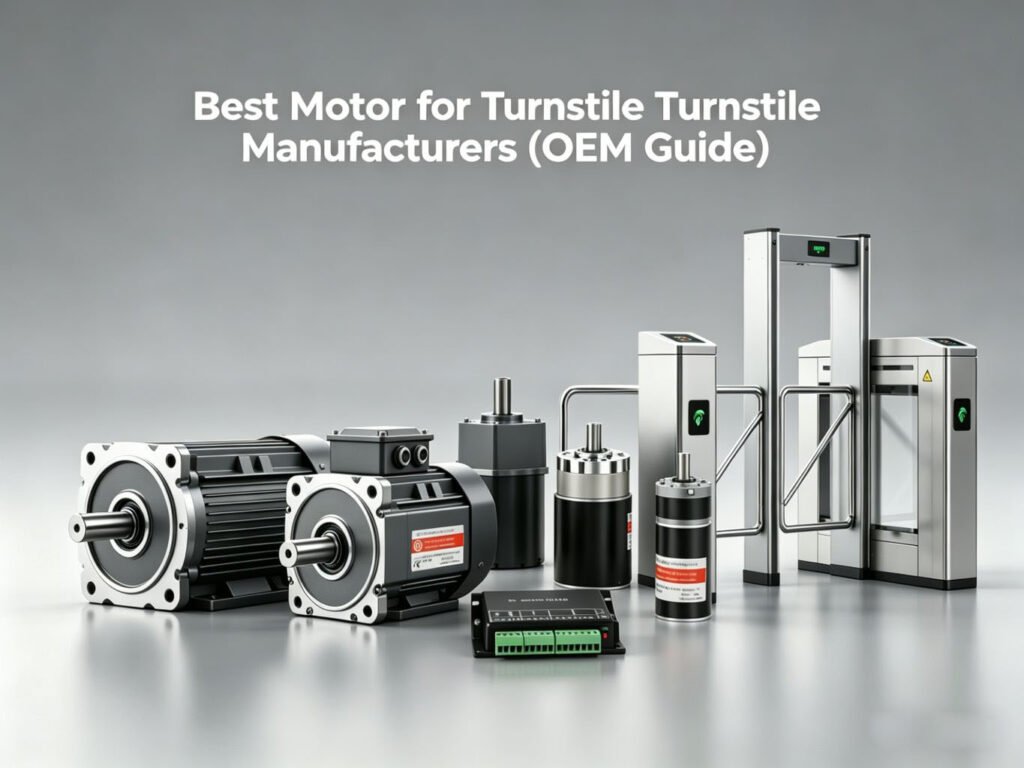
旋轉門製造商的最佳電機 (代工指南)
精選片段:
The best motor for turnstile systems depends on performance, 耐用性, 及控制要求. For modern OEM turnstile manufacturers, BLDC motors are typically the optimal choice due to their high efficiency, 精確控制, 壽命長, 和低維護成本. 然而, brushed DC motors and servo motors are still used in cost-sensitive or high-precision applications. Selecting the right motor requires evaluating torque, 速度, 電壓, 控制方式, and duty cycle to match real-world operating conditions.
What Motor Is Used in Turnstile Systems?
Turnstile systems rely on controlled rotational motion to regulate pedestrian access. The motor serves as the core actuator, converting electrical energy into mechanical torque to drive the barrier arm or gate. The most commonly used motor types include BLDC motors, 有刷直流電機, 和伺服電機, each offering different performance characteristics.
In traditional systems, brushed DC motors were widely used due to their simple structure and low cost. 然而, modern smart turnstiles increasingly adopt BLDC motors because they offer higher efficiency, 更長的壽命, and better integration with electronic control systems.
Servo motors are typically used in high-end applications where precise positioning, 平滑運動, and dynamic control are required, such as speed gates in airports or metro systems.
👉高效能解決方案, 檢查我們的 閘機用 BLDC 電機
Key Motor Functions in Turnstiles
- Drive rotation of arms or panels
- Control opening/closing speed
- Provide torque resistance for safety
- Enable bidirectional motion
Why Motor Selection Matters for Turnstile Manufacturers
馬達選擇直接影響系統性能, 可靠性, 和長期維護成本. 對於 OEM 製造商, choosing the wrong motor can lead to overheating, premature failure, poor user experience, 以及增加的保固索賠.
Turnstiles operate in high-frequency environments such as metro stations, 辦公大樓, 和體育場館. This requires motors capable of continuous duty cycles, 穩定的扭力輸出, and fast response times.
此外, modern turnstiles must integrate with access control systems, requiring motors that support advanced control strategies such as PWM or field-oriented control.
BLDC vs Brushed vs Servo Motor for Turnstiles
| 範圍 | 無刷直流電機 | 有刷直流電機 | 伺服電機 |
|---|---|---|---|
| 效率 | 高的 (85–92%) | 中等的 (70–80%) | 非常高 |
| 維護 | 低的 | 高的 (電刷磨損) | 低的 |
| 控制複雜性 | 中等的 | 低的 | 高的 |
| 成本 | 中等的 | 低的 | 高的 |
| 壽命 | 長的 | 短的 | 很長 |
| 最佳應用 | Modern turnstiles | Budget systems | High-end gates |
從工程角度來看, BLDC motors provide the best balance between performance and cost. Brushed motors may still be viable for low-cost projects, while servo motors are justified when precision and responsiveness are critical.
Advantages of BLDC Motors for Turnstile OEMs
高效率
BLDC motors eliminate brush friction losses, improving efficiency and reducing heat generation. This is critical in turnstiles operating continuously throughout the day.
壽命長
不帶刷子, mechanical wear is minimized, extending operational life and reducing maintenance intervals.
精確控制
BLDC motors support advanced control methods such as FOC, 實現平穩加速, 減速, and positioning.
低噪音運行
Essential for indoor environments like offices and airports.
Typical solutions include 24V–72V BLDC motors integrated with gearboxes for torque amplification. OEM manufacturers often request customized designs for torque output and mounting structure.
Disadvantages of BLDC Motors
Despite their advantages, BLDC motors require electronic controllers, increasing system complexity and cost. 此外, integration requires proper tuning of control algorithms.
然而, for most industrial applications, these challenges are outweighed by performance gains and lifecycle cost savings.
關鍵工程因素: 效率, 扭矩密度 & 熱性能
效率
Higher efficiency reduces power consumption and operating cost. 在人流量大的環境中, even small efficiency improvements significantly impact total energy usage.
扭矩密度
Turnstiles require compact motors capable of delivering sufficient torque. BLDC motors offer higher torque density compared to brushed motors, allowing smaller designs.
熱性能
Heat is a major failure factor. Motors must be designed with proper cooling methods such as natural convection or aluminum housing heat dissipation.
可靠性 & 壽命
Continuous operation demands motors with minimal wear components. BLDC motors excel due to the absence of brushes.
控制系統: Why They Matter in Turnstile Motors
The motor controller determines how effectively the motor performs under real-world conditions. In turnstiles, control systems must ensure smooth motion, quick response, 和安全合規性.
Common Control Methods
- 脈寬調變控制 (basic)
- Hall sensor-based commutation
- 磁場定向控制 (FOC)
FOC control enables precise torque control and smooth rotation, making it ideal for high-end turnstiles.
如何選擇閘機電機 (力矩, 轉速, 電壓指南)
電壓範圍
Most turnstiles use 24V, 48V, or 72V systems. Higher voltage improves efficiency and reduces current losses.
功率範圍
Typical power ranges from 50W to 500W depending on gate size and load.
速度 (轉速)
Turnstile motors usually operate between 30–300 RPM after gearbox reduction.
扭力要求
Torque depends on arm length, 重量, and resistance. Safety margins must be included.
冷卻方式
Passive cooling is common, but high-duty applications may require enhanced heat dissipation.
控制器相容性
Ensure motor matches controller type (霍爾感測器, 編碼器, FOC driver).
特定於應用的注意事項
- Indoor vs outdoor environment
- 工作週期 (連續與間歇)
- Noise requirements
Request OEM motor customization →
Turnstile Applications and Motor Requirements
工業的 & 商業樓宇
Require reliable, low-maintenance motors with moderate torque.
交通系統
High-duty cycles demand efficient and durable BLDC motors.
高階安全系統
Require servo or high-performance BLDC motors for precision control.
EV Integration
Some modern turnstiles integrate battery systems, requiring energy-efficient motors.
Learn about EV motor solutions →
旋轉門馬達技術的未來趨勢
The industry is moving toward intelligent, connected systems. BLDC motors with integrated drivers and IoT capabilities are becoming standard.
- 智慧控制一體化
- Energy-efficient designs
- Compact high-torque motors
- 預測性維護系統
OEM manufacturers increasingly demand customized motor solutions tailored to their specific system architecture.
常問問題: 閘機馬達選型
1. What is the best motor for turnstiles?
BLDC motors are generally the best choice due to their efficiency, 壽命長, 且維護要求低.
2. Why are BLDC motors better than brushed motors?
They eliminate brush wear, improving reliability and reducing maintenance while offering better efficiency.
3. 閘機馬達需要多大扭矩?
It depends on gate design, but typically ranges from 1 NM TO 20 Nm after gearbox reduction.
4. Can servo motors be used in turnstiles?
是的, especially in high-end applications requiring precise motion control and fast response.
5. 閘機馬達的使用壽命是多久?
BLDC motors can last over 20,000 小時, significantly longer than brushed motors.
結論: Which Motor Should Turnstile OEMs Choose?
對於大多數旋轉閘機製造商來說, BLDC motors represent the best balance between performance, 成本, 和可靠性. They enable efficient operation, 精確控制, 使用壽命長, making them ideal for modern access control systems.
Brushed motors remain relevant for low-cost solutions, while servo motors are suitable for premium systems requiring advanced control.
最終, selecting the best motor requires a holistic evaluation of application requirements, operating conditions, and long-term cost considerations.
需要協助選擇合適的電機?
索取數據表, 取得 OEM 解決方案, or contact our engineers for technical consultation.
參考
- IEEE 工業電子學報
- IEC Motor Standards Documentation
- 電動機手冊 – H. 韋恩·比蒂
- Brushless Motor Control Theory – TI Application Notes