
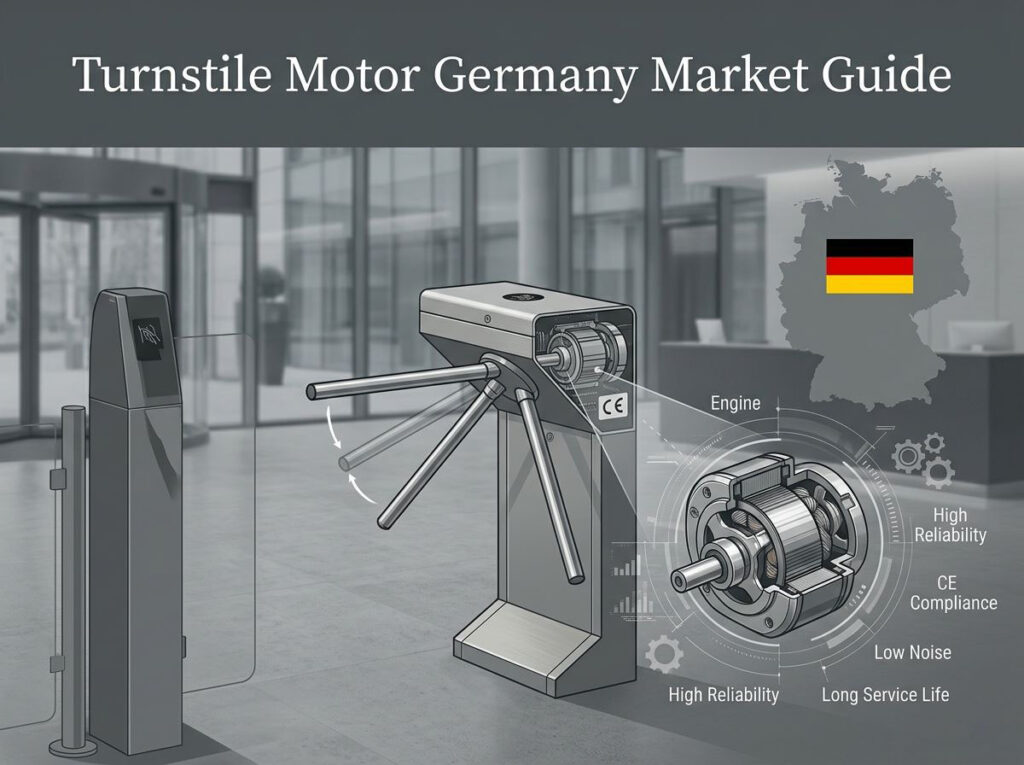
Hướng dẫn thị trường Turnstile Motor Đức
Đoạn trích nổi bật:
Germany is one of the most demanding markets for turnstile motors because access control systems used in transportation hubs, tòa nhà thương mại, factories, and stadiums require high reliability, CE compliance, tiếng ồn thấp, và tuổi thọ dài. Modern German turnstile systems increasingly use BLDC motors instead of traditional brushed DC or AC induction motors due to higher efficiency, kiểm soát mô-men xoắn tốt hơn, bảo trì thấp hơn, and smoother motion profiles. For OEM buyers and system integrators, selecting the correct turnstile motor involves evaluating voltage range, mật độ mô-men xoắn, hiệu suất nhiệt, controller compatibility, chu kỳ nhiệm vụ, and European certification requirements. This guide explains how the German market evaluates turnstile motors and how OEM buyers can select reliable suppliers for long-term projects.
What Is a Turnstile Motor?
A turnstile motor is the core electromechanical drive component used in access control systems such as flap barriers, cổng xoay, tripod turnstiles, and speed gates. The motor converts electrical energy into controlled rotational motion that opens and closes the gate mechanism during authorized entry or exit events.
Ở Đức, turnstile systems are widely deployed in airports, railway stations, office buildings, cơ sở công nghiệp, stadiums, and smart infrastructure projects. Because these installations often operate continuously under heavy pedestrian traffic, the motor must provide precise motion control, high cycle durability, and stable torque output.
Modern German access control manufacturers increasingly prefer BLDC motors due to their superior operational efficiency and intelligent control capabilities. So với động cơ chải truyền thống, BLDC systems eliminate brush wear and significantly reduce maintenance intervals.
Main Components of a Turnstile Motor System
- Động cơ BLDC hoặc động cơ servo
- Motor driver/controller
- Encoder or Hall sensor
- Gearbox or direct drive mechanism
- Emergency release module
- Power supply and communication interface
For OEM projects in Germany, integrated control architecture is becoming more important than standalone motor performance. Buyers increasingly request motors with CAN bus, RS485, or EtherCAT compatibility for smart building integration.
Why the German Market Prefers BLDC Motors for Turnstiles
Germany emphasizes engineering precision, hiệu suất năng lượng, and lifecycle reliability. These priorities strongly favor BLDC motor technology for modern turnstile systems.
Traditional brushed motors suffer from carbon brush wear, electrical arcing, and unstable speed performance during continuous operation. Ngược lại, BLDC motors use electronic commutation, enabling quieter operation, lower heat generation, and smoother acceleration profiles.
German public infrastructure projects often specify low acoustic noise and long MTBF (Mean Time Between Failures). This makes high-efficiency BLDC motors especially attractive for premium turnstile systems used in transportation and commercial applications.
Key Advantages of BLDC Motors in Germany
- Higher efficiency reduces operating costs
- Low noise improves user experience
- Precise torque control improves gate safety
- Long lifespan lowers maintenance requirements
- Compact design supports slim speed gate structures
- Lower thermal stress improves system reliability
Many German integrators now prefer 24V, 36V, 48V, and 72V BLDC motor platforms because these voltages align well with intelligent access control architectures and battery backup systems.
For high-end OEM projects, buyers often request customized motors with integrated encoders, electromagnetic brakes, or customized shaft structures. của Greensky động cơ BLDC công nghiệp platform supports these customization requirements for European projects.
BLDC Motor vs Servo Motor for German Turnstile Systems
One of the most common engineering questions in the German access control industry is whether BLDC motors or servo motors are better for turnstile systems.
The answer depends on required positioning accuracy, traffic intensity, system cost targets, and control complexity.
| Tham số | động cơ BLDC | Động cơ servo |
|---|---|---|
| Hiệu quả | Cao | Rất cao |
| Kiểm soát độ phức tạp | Vừa phải | Cao |
| Chi phí hệ thống | Thấp hơn | Cao hơn |
| Torque Precision | Tốt | Xuất sắc |
| BẢO TRÌ | Rất thấp | Thấp |
| Tiếng ồn | Thấp | Thấp |
| Ứng dụng điển hình | Flap barriers, cổng xoay | Premium speed gates |
| Tích hợp OEM | Dễ dàng hơn | Phức tạp hơn |
For most German commercial projects, BLDC motors offer the best balance between cost, độ tin cậy, and motion quality. Servo motors are typically selected only when ultra-high positioning precision or advanced synchronization is required.
From a procurement perspective, BLDC systems also simplify long-term maintenance and reduce spare part inventory complexity.
How Turnstile Motor Efficiency Impacts System Performance
Motor efficiency directly influences energy consumption, thermal stability, operating reliability, and overall system lifespan.
Ở Đức, building operators increasingly focus on sustainability and energy optimization. Although turnstiles consume relatively low power individually, large installations with dozens or hundreds of access gates can create significant cumulative energy usage.
High-efficiency BLDC motors typically operate at 85–92% efficiency, depending on load conditions and control algorithms. Traditional brushed motors may operate at only 65–75% efficiency under similar conditions.
Why Higher Efficiency Matters
- Reduced energy costs
- Lower operating temperature
- Improved driver reliability
- Longer bearing lifespan
- Reduced enclosure heat buildup
- Better continuous-duty performance
Heat is one of the primary causes of premature motor failure. In compact speed gate systems, poor thermal management can damage controllers, cảm biến, and mechanical components.
Efficient BLDC motors generate less waste heat, which improves reliability in enclosed stainless steel turnstile housings commonly used in German infrastructure projects.
Torque Density and Speed Requirements for Turnstile Motors
German turnstile manufacturers prioritize compact mechanical structures with fast response times. This increases demand for motors with high torque density.
Torque density refers to how much torque a motor can produce relative to its physical size. High torque density allows slimmer gate designs while maintaining strong barrier movement performance.
Typical Speed and Torque Requirements
| Ứng dụng | Điện áp điển hình | Torque Range | Speed Requirement |
|---|---|---|---|
| Rào chắn nắp | 24V–48V | 0.8–3 Nm | High speed opening |
| Swing Gate | 24V–72V | 2–8 Nm | Smooth motion control |
| Speed Gate | 48V–72V | 1.5–5 Nm | Very fast response |
| Tripod Turnstile | 24V | 1–3 Nm | Moderate speed |
Fast opening and closing cycles improve pedestrian throughput in airports, metro systems, and office buildings. Tuy nhiên, excessive speed without adequate torque control can create vibration, impact stress, and safety issues.
Modern German systems therefore prioritize intelligent acceleration and deceleration algorithms rather than simple maximum speed performance.
Thermal Performance and Reliability in Continuous Operation
Many German transportation and industrial facilities operate turnstiles 24/7. This places significant stress on motor windings, vòng bi, bộ điều khiển, and gear systems.
Thermal performance becomes especially important in enclosed installations where airflow is limited.
Major Sources of Motor Heat
- Copper losses
- Iron losses
- Bearing friction
- Controller switching losses
- Overload conditions
Poor thermal management can reduce insulation lifespan and accelerate bearing degradation. High ambient temperatures in outdoor railway stations or industrial factories further increase thermal stress.
German OEM buyers increasingly request:
- High-temperature insulation systems
- Low-loss magnetic materials
- Integrated thermal protection
- IP-rated enclosures
- Advanced cooling path design
Greensky’s industrial BLDC motors are engineered for continuous-duty operation and support customized thermal solutions for high-cycle access control systems.
How to Choose a Turnstile Motor for the German Market
Selecting the correct turnstile motor requires balancing mechanical performance, compliance requirements, lifecycle cost, and system integration complexity.
1. Dải điện áp
Most German access control systems use 24V, 36V, 48V, or 72V architectures. Higher voltages generally improve efficiency and reduce current load.
2. Dãy công suất
Typical turnstile motor power ratings range from 30W to 500W depending on gate size and traffic intensity.
3. Tốc độ và mô-men xoắn
Engineers must evaluate acceleration profile, holding torque, mô-men xoắn cực đại, and continuous torque requirements.
4. Phương pháp làm mát
Compact turnstile systems often rely on passive cooling. Efficient motor design is therefore critical.
5. Khả năng tương thích của bộ điều khiển
German OEMs increasingly require:
- CAN bus communication
- RS485 integration
- EtherCAT support
- Encoder feedback compatibility
- Smart diagnostics
6. Certification Requirements
CE certification is essential for Germany and broader European markets. Buyers should verify EMC compliance, electrical safety, and RoHS compatibility.
7. Chi phí vòng đời
The lowest motor purchase price does not necessarily provide the best long-term value. độ tin cậy, spare parts availability, and maintenance cost strongly affect total ownership cost.
👉 Related guide: Động cơ bldc tùy chỉnh
Applications of Turnstile Motors in Germany
Germany has one of Europe’s largest smart infrastructure and industrial automation markets. Turnstile motors are used across multiple sectors.
Transportation Infrastructure
Railway stations, metro systems, and airports require high-speed access control systems capable of handling continuous pedestrian flow.
Commercial Buildings
Office towers increasingly integrate intelligent speed gates with biometric authentication and building automation systems.
Industrial Facilities
Factories and logistics centers use turnstile systems to improve security and employee tracking.
Stadiums and Public Venues
High-throughput access control systems must withstand heavy cyclic loading and outdoor environmental conditions.
Data Centers
Germany’s expanding data center market increasingly deploys high-security turnstile systems with anti-tailgating functionality.
Germany Turnstile Motor Market Trends in 2026
Several important trends are shaping the German turnstile motor market.
1. Intelligent Access Control
Modern systems increasingly integrate AI-based facial recognition and cloud-based monitoring platforms.
2. Higher Energy Efficiency
European sustainability regulations continue pushing manufacturers toward high-efficiency BLDC solutions.
3. Compact High-Torque Motors
Architectural preferences for slim speed gate systems are driving demand for compact high torque-density motors.
4. Hoạt động có độ ồn thấp
Premium commercial buildings increasingly specify ultra-quiet motion systems.
5. Bảo trì dự đoán
Integrated diagnostics and smart monitoring systems are becoming standard requirements.
OEM suppliers capable of providing intelligent motor-controller integration will gain competitive advantages in the European market.
Why OEM Buyers Need Reliable Turnstile Motor Suppliers
German OEM buyers typically evaluate suppliers based on engineering capability rather than marketing claims.
Key supplier evaluation criteria include:
- Motor efficiency data
- CE certification capability
- Customization flexibility
- Long-term production stability
- Technical support responsiveness
- Controller integration expertise
- Lifecycle reliability testing
Đối với các dự án OEM, supply chain stability is especially important. Delays in motor production can halt entire turnstile assembly operations.
Greensky supports OEM access control manufacturers with:
- Custom BLDC motor design
- 48V and 72V industrial motor platforms
- Tích hợp bộ mã hóa
- Low-noise optimization
- CE-ready engineering support
- High-cycle durability testing
👉 Related guide: Động cơ xe điện
Câu hỏi thường gặp: Hướng dẫn thị trường Turnstile Motor Đức
What motor is best for turnstile systems in Germany?
BLDC motors are generally the preferred solution because they offer high efficiency, bảo trì thấp, precise torque control, and long operating lifespan. They also integrate well with modern intelligent access control systems used in Germany.
Why are CE-certified motors important for European turnstiles?
CE certification demonstrates compliance with European safety and EMC requirements. German buyers typically require CE-certified motors to ensure legal market access and reliable operation in commercial installations.
What voltage is commonly used for turnstile motors?
Most turnstile systems use 24V, 48V, or 72V motor platforms. Higher voltages can improve efficiency and reduce current load, especially in high-speed access control systems.
Are servo motors better than BLDC motors for speed gates?
Servo motors provide higher positioning accuracy, but BLDC motors usually offer better cost-performance balance for most commercial speed gate applications. The correct choice depends on required control precision and budget.
How long does a turnstile BLDC motor last?
High-quality BLDC motors can operate for tens of thousands of hours under proper load and thermal conditions. Lifespan depends heavily on bearing quality, controller tuning, cooling performance, and duty cycle.
What should OEM buyers check before selecting a motor supplier?
OEM buyers should verify certification capability, engineering support, thermal design quality, controller compatibility, production consistency, and long-term supply stability before selecting a motor supplier.
Phần kết luận
Germany remains one of the most technically demanding markets for turnstile motors and intelligent access control systems. Buyers increasingly prioritize high-efficiency BLDC motors because they deliver better reliability, vận hành mượt mà hơn, bảo trì thấp hơn, and improved lifecycle economics compared with traditional motor technologies.
For OEM manufacturers, selecting the correct turnstile motor involves far more than matching basic voltage and torque specifications. Engineers must evaluate thermal behavior, tích hợp bộ điều khiển, certification requirements, noise performance, and long-term durability under continuous operation.
As intelligent buildings, transportation hubs, and industrial security systems continue evolving, demand for compact high-performance BLDC motors will continue growing across Germany and Europe.
If you are developing a new turnstile platform or upgrading an existing access control system, Greensky can support your project with customized BLDC motor solutions, OEM engineering services, and CE-ready industrial motor platforms.
Request datasheet.
Get OEM solution.
Liên hệ với các kỹ sư của chúng tôi.
Tài liệu tham khảo
1. https://ec.europa.eu/growth/single-market/ce-marking_en
2. https://www.ieee.org/
3. https://www.energy.gov/eere/electricvehicles/electric-drive-technologies
4. https://www.siemens.com/global/en/products/buildings/access-control.html
5. https://www.iec.ch/homepage
6. https://www.motioncontroltips.com/
7. https://www.controleng.com/
8. https://www.mdpi.com/journal/energies