
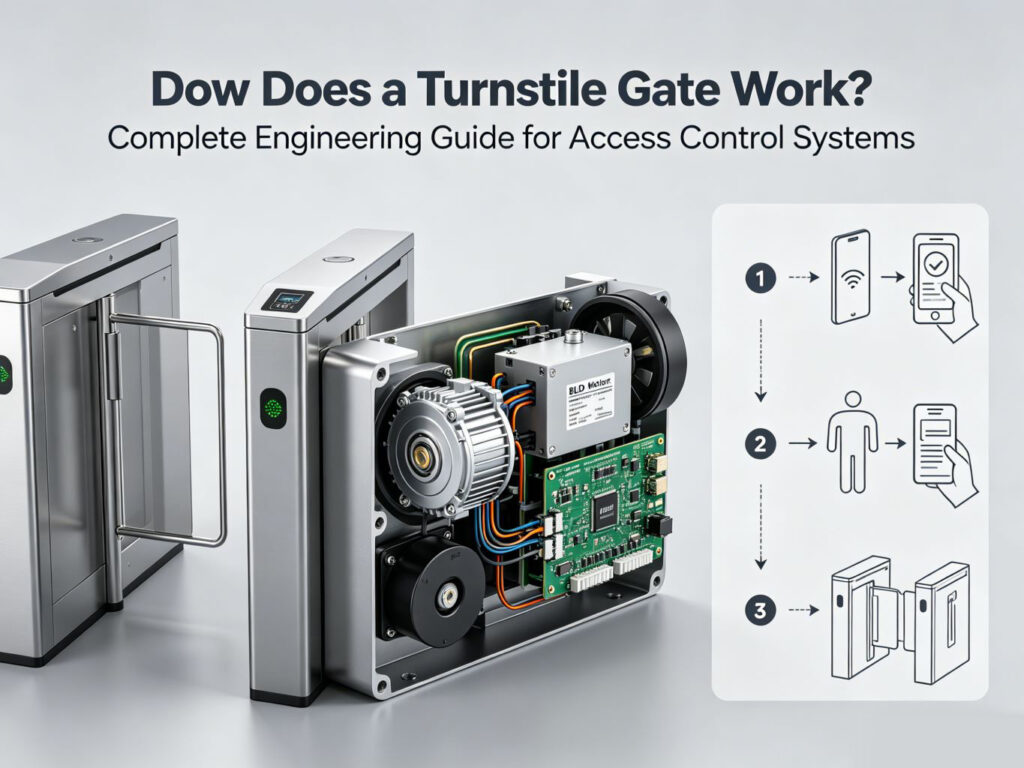
Cổng quay vòng hoạt động như thế nào? Hướng dẫn kỹ thuật hoàn chỉnh cho hệ thống kiểm soát truy cập
Đoạn trích nổi bật:
A turnstile gate works by combining a mechanical barrier system with an electronic control unit and a motor drive system. When a valid authentication signal (such as RFID, QR code, or biometric input) is received, the controller activates the motor, allowing controlled rotation or opening of the barrier. Sensors monitor movement and ensure safe passage, while the system automatically resets after each user. Modern turnstiles use BLDC motors and intelligent controllers to deliver smooth operation, hiệu quả cao, và độ tin cậy lâu dài.
Understanding how does a turnstile gate work is critical for engineers, nhà sản xuất OEM, and procurement teams designing access control systems. Turnstiles are no longer simple mechanical devices—they are integrated electromechanical systems combining motors, bộ điều khiển, cảm biến, and software. Their performance directly affects throughput efficiency, user safety, maintenance costs, and system lifespan.
This engineering authority guide provides a deep technical breakdown of turnstile operation, including mechanical design, lựa chọn động cơ, control logic, efficiency considerations, and OEM-level selection strategies.
What Is a Turnstile Gate?
A turnstile gate is a physical access control device designed to regulate pedestrian movement. It ensures that only authorized individuals can pass through, typically allowing one person per authentication event.
Main Types of Turnstiles
- Tripod turnstile
- Flap barrier gate
- Swing gate turnstile
- Full-height turnstile
Each type uses different mechanical structures and motor systems depending on application requirements.
👉For high-performance solutions, check our BLDC Motor for Turnstile
Cổng quay vòng hoạt động như thế nào: Quy trình từng bước
The operation of a turnstile gate involves multiple subsystems working together.
Bước chân 1: User Authentication
The system receives input from RFID cards, QR codes, fingerprint scanners, or facial recognition systems.
Bước chân 2: Xử lý tín hiệu
The controller verifies the authentication data and determines whether to grant access.
Bước chân 3: Motor Activation
If access is granted, động cơ (typically BLDC or servo) is activated to unlock or rotate the barrier.
Bước chân 4: Movement and Monitoring
Sensors track barrier movement and detect user passage.
Bước chân 5: Automatic Reset
The system returns to the locked position after passage is complete.
This integrated process ensures secure, có hiệu quả, and controlled access.
Core Components of a Turnstile System
1. Motor System
Provides mechanical movement. Common options include BLDC motors and servo motors.
2. Controller Unit
Processes signals and controls motor operation.
3. Cảm biến
- Infrared sensors
- Position sensors
- Anti-tailgating sensors
4. Mechanical Structure
Includes arms, flaps, or barriers depending on design.
5. Nguồn cấp
Typically 24V or 48V DC systems.
Motor Systems in Turnstiles: BLDC vs Servo vs Stepper
| Tham số | động cơ BLDC | Động cơ servo | động cơ bước |
|---|---|---|---|
| Hiệu quả | Cao | Cao | Thấp |
| Độ chính xác | Cao | Rất cao | Vừa phải |
| Trị giá | Vừa phải | Cao | Thấp |
| BẢO TRÌ | Thấp | Vừa phải | Thấp |
BLDC motors are increasingly preferred due to their balance of efficiency, trị giá, và độ tin cậy.
👉 Learn more: BLDC Motor Technology
Control Systems and Logic in Turnstiles
Control systems define how the turnstile responds to user inputs.
Control Features
- Access validation
- Motor control algorithms (FOC)
- Safety logic (anti-pinch, anti-tailgating)
- Communication with external systems
Modern systems integrate with cloud platforms and IoT networks for real-time monitoring.
Efficiency and Energy Consumption in Turnstile Systems
Energy efficiency affects long-term operating cost.
- BLDC motors reduce energy consumption
- Efficient control systems optimize power usage
- Standby modes minimize idle consumption
For large installations, energy savings can be significant.
mô-men xoắn, Tốc độ, and Mechanical Design Considerations
Proper torque and speed selection ensures smooth operation.
Key Parameters
- Bắt đầu mô -men xoắn
- Operating speed
- Load inertia
Incorrect selection can lead to vibration, tiếng ồn, or system failure.
Thermal Management and Reliability
Thermal performance directly impacts system lifespan.
- BLDC motors generate less heat
- Proper ventilation improves durability
- Temperature monitoring prevents failures
Reliable thermal design is essential for high-duty-cycle applications.
How to Choose a Turnstile Gate Motor and System
Choosing the right motor and system is critical for OEM success.
Selection Criteria
- Vôn: 24V / 48V
- Quyền lực: 50W–500W
- Tốc độ: Based on gate type
- mô-men xoắn: Based on load
- làm mát: Làm mát không khí
- Bộ điều khiển: FOC preferred
Application Matching
- Flap barriers → BLDC motor
- Swing gates → BLDC or servo
- Tripod → stepper or BLDC
👉 Get OEM solution: Custom Motor Development
Applications of Turnstile Gates
- Transportation systems
- Office buildings
- Factories and industrial facilities
- Stadiums and event venues
Each application requires different performance characteristics.
Cost vs Performance Trade-Off in Turnstile Systems
| Nhân tố | BLDC System | Traditional System |
|---|---|---|
| Chi phí ban đầu | Cao hơn | Thấp hơn |
| Hiệu quả | Cao hơn | Thấp hơn |
| BẢO TRÌ | Thấp | Cao |
| Chi phí vòng đời | Thấp hơn | Cao hơn |
BLDC-based systems provide better long-term value.
Future Trends in Turnstile Gate Technology
- Smart access control integration
- AI-based authentication
- Energy-efficient motor systems
- IoT-enabled monitoring
These trends are shaping the future of access control systems.
Câu hỏi thường gặp: Cổng quay vòng hoạt động như thế nào?
1. How does a turnstile detect a user?
It uses sensors such as infrared beams to detect user presence and movement.
2. What motor is used in turnstiles?
BLDC motors are commonly used due to efficiency and reliability.
3. Why are BLDC motors preferred?
They offer smooth operation, tiếng ồn thấp, và tuổi thọ dài.
4. What is the typical voltage?
Most systems use 24V or 48V DC power.
5. How to choose a turnstile system?
Consider application, traffic volume, motor type, and control system.
Phần kết luận: Engineering the Right Turnstile System
Understanding how does a turnstile gate work allows engineers and buyers to design systems that are efficient, đáng tin cậy, và tiết kiệm chi phí. Modern turnstiles rely heavily on BLDC motor technology and advanced control systems to meet the demands of high-traffic environments.
Need expert support?
✔ Yêu cầu bảng dữ liệu
✔ Nhận giải pháp OEM
✔ Contact our engineers today
Tài liệu tham khảo
- IEEE Industrial Electronics Publications
- Access Control System Design Standards
- IEC Motor Efficiency Guidelines