
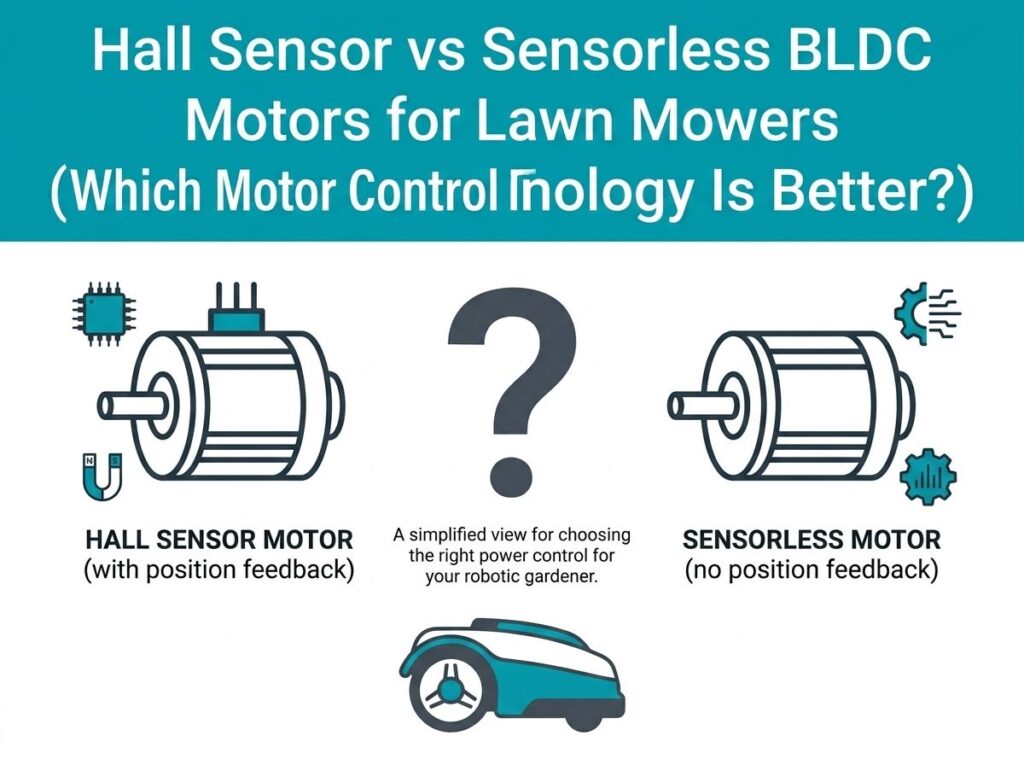
Cảm biến Hall so với Động cơ BLDC không cảm biến cho máy cắt cỏ: Which Technology Is Better?
Trả lời nhanh
Hall sensor and sensorless BLDC motors both offer high efficiency and long service life for electric lawn mowers, but they differ significantly in startup performance, low-speed torque control, độ tin cậy, và chi phí hệ thống. Hall sensor BLDC motors use integrated position sensors to provide precise rotor feedback, making them ideal for robotic lawn mowers, high-torque cutting applications, and challenging terrain. Sensorless BLDC motors eliminate physical sensors, reducing cost and complexity while improving environmental robustness. For most premium robotic lawn mowers, Hall sensor motors provide superior control and startup reliability, whereas sensorless motors are often preferred in cost-sensitive designs with steady operating speeds.
For OEM engineers and procurement teams, selecting between Hall sensor and sensorless BLDC technology requires balancing performance, hiệu quả, Độ bền, controller complexity, and total system cost rather than simply comparing motor prices.
What Is a Hall Sensor BLDC Motor?
A Hall sensor BLDC motor incorporates electronic Hall-effect sensors inside the motor housing to detect rotor position in real time. These sensors continuously provide commutation feedback to the motor controller, allowing accurate switching of current through the stator windings.
In lawn mower applications, Hall sensors enable smooth startup from zero speed, strong low-RPM torque, precise speed regulation, and reliable operation under rapidly changing loads. Robotic lawn mowers frequently encounter situations where the cutting blade experiences sudden resistance from thick grass, wet vegetation, or uneven terrain. Accurate rotor position information allows the controller to react immediately and maintain stable operation.
Because Hall sensors provide direct position feedback, Hall-based BLDC systems are commonly used in:
- Robotic lawn mower drive motors
- Blade cutting motors
- Autonomous outdoor robots
- AGV traction systems
- Electric vehicle auxiliary motors
Although Hall sensors increase component count slightly, they often improve overall machine performance and reliability in demanding outdoor applications.
What Is a Sensorless BLDC Motor?
A sensorless BLDC motor eliminates physical rotor position sensors and instead estimates rotor position using back electromotive force (Back-Emf) generated during motor operation.
Rather than relying on dedicated Hall devices, the controller continuously analyzes voltage waveforms and current behavior to determine when commutation should occur.
The primary advantages of sensorless systems include:
- Lower component count
- Reduced manufacturing cost
- Improved environmental sealing
- Fewer wiring connections
- Simplified motor construction
Tuy nhiên, because Back-EMF only becomes measurable once the motor reaches sufficient rotational speed, sensorless systems typically face challenges during startup and low-speed operation.
For lawn mower manufacturers, this limitation becomes particularly important when cutting blades must start under heavy load or when robotic drive motors operate on steep slopes at low speed.
Why Motor Position Feedback Matters in Lawn Mower Applications
Many engineers initially focus on power rating and efficiency when selecting a lawn mower motor. Trong thực tế, rotor position feedback often has a larger impact on user experience.
Electric lawn mower motors rarely operate under constant load conditions. Thay vì, they encounter:
- Dense grass patches
- Wet vegetation
- Blade impacts
- Uneven terrain
- Sudden acceleration demands
- Battery voltage fluctuations
A Hall sensor system can instantly identify rotor position and optimize torque production during these transient events. Sensorless systems require estimation algorithms, which may introduce delays or reduced accuracy under challenging conditions.
As robotic lawn mowers become more intelligent and autonomous, precise motor feedback increasingly contributes to navigation accuracy, energy management, and obstacle handling.
Hall Sensor vs Sensorless BLDC Motors: Complete Technical Comparison
| Tham số | Hall Sensor BLDC | Sensorless BLDC |
|---|---|---|
| Startup Performance | Xuất sắc | Vừa phải |
| Low-Speed Torque | Xuất sắc | Giới hạn |
| Hiệu quả | 85–93% | 86–94% |
| Độ phức tạp của bộ điều khiển | Thấp hơn | Cao hơn |
| Trị giá | Cao hơn | Thấp hơn |
| Wiring Complexity | Cao hơn | Thấp hơn |
| Environmental Robustness | Tốt | Xuất sắc |
| Torque Stability | Xuất sắc | Tốt |
| Robotic Mower Suitability | Xuất sắc | Vừa phải |
| Commercial Mower Suitability | Xuất sắc | Tốt |
For high-end robotic lawn mowers, the improved controllability of Hall sensor systems often outweighs their slightly higher cost.
So sánh hiệu quả: Does Sensorless Technology Improve Efficiency?
Hall Sensor Motor Efficiency
Modern Hall sensor BLDC motors typically achieve efficiencies between 85% Và 93%. The power consumed by Hall sensors themselves is negligible relative to total motor output.
Sensorless Motor Efficiency
Sensorless motors can achieve marginally higher peak efficiency because sensor losses are eliminated and mechanical design is simplified. Tuy nhiên, actual field performance often depends more heavily on controller algorithms than sensor presence.
Real-World Lawn Mower Perspective
In lawn mower applications, efficiency differences are usually less than 2%. Battery capacity, blade aerodynamics, terrain conditions, and controller tuning generally have greater influence on runtime than Hall sensor selection.
For robotic mowers operating eight or more hours per day, torque optimization frequently delivers greater energy savings than small efficiency improvements.
Torque Density and Low-Speed Performance Analysis
Torque density is one of the most important performance metrics in robotic lawn mowers.
Drive motors must:
- Climb slopes
- Navigate obstacles
- Maintain traction
- Operate efficiently at low speeds
Hall sensor motors provide superior low-speed torque because rotor position is known immediately upon startup.
Sensorless systems often require:
- Open-loop startup sequences
- Rotor alignment procedures
- Speed ramping algorithms
These approaches work well under predictable loads but can become less reliable when heavy grass creates sudden torque spikes.
For robotic lawn mower wheel motors, Hall sensor technology remains the preferred solution for maximizing traction and climbing performance.
Thermal Performance and Reliability Considerations
Sinh nhiệt
Thermal performance affects both motor lifespan and battery efficiency.
Because Hall sensor systems achieve more accurate commutation at low speeds, they often produce less copper loss during startup and transient operation.
Sensor Reliability
Modern Hall sensors are highly reliable and commonly rated for thousands of operating hours under outdoor conditions.
Failure risks can be minimized through:
- IP67 motor sealing
- Potting compounds
- Conformal coating
- Automotive-grade sensors
Sensorless Reliability
Sensorless motors eliminate sensor failure risk entirely. Tuy nhiên, they increase dependency on software algorithms and controller quality.
Cho các OEM, reliability should be evaluated at the complete system level rather than focusing only on motor hardware.
Hall Sensor BLDC vs Sensorless BLDC vs Brushed DC Motors
| Tính năng | Hall BLDC | Sensorless BLDC | chải DC |
|---|---|---|---|
| Hiệu quả | Cao | Rất cao | Vừa phải |
| BẢO TRÌ | Rất thấp | Rất thấp | Cao |
| Startup Torque | Xuất sắc | Vừa phải | Tốt |
| Tuổi thọ | Dài | Dài | ngắn hơn |
| Tiếng ồn | Thấp | Thấp | Cao hơn |
| Outdoor Reliability | Xuất sắc | Xuất sắc | Vừa phải |
| Robotic Mower Suitability | Best | Tốt | Nghèo |
Cách chọn động cơ BLDC cho ứng dụng máy cắt cỏ
Choosing the right motor architecture requires evaluating the complete mower platform rather than focusing solely on motor specifications.
Dải điện áp
- 24V–36V: Entry-level robotic mowers
- 48V: Mainstream residential platforms
- 60V–72V: Commercial robotic mowers
- 72V+: Professional landscaping equipment
Dãy công suất
- Drive motors: 200W–1000W
- Cutting motors: 500W–3000W
- Commercial systems: 3kW+
Yêu cầu về tốc độ và mô-men xoắn
Applications requiring frequent startup, slope climbing, and precision control generally benefit from Hall sensor motors.
Applications operating at stable speeds may use sensorless systems effectively.
Phương pháp làm mát
- Natural convection
- Aluminum housing dissipation
- Integrated heat sinks
- Forced cooling for high-power systems
Khả năng tương thích của bộ điều khiển
Ensure the controller supports:
- Hall sensor inputs
- Kiểm soát FOC
- CAN communication
- Regenerative braking
- Battery management integration
Những cân nhắc dành riêng cho ứng dụng
- Terrain steepness
- Cutting density
- Battery capacity
- Noise requirements
- Target warranty period
- IP protection requirements
For premium robotic mower OEMs, Hall sensor BLDC motors frequently provide the best balance of performance and customer satisfaction.
Request Datasheet | Get OEM Solution | Liên hệ với kỹ sư của chúng tôi
Applications Beyond Lawn Mowers
The same Hall sensor and sensorless BLDC technologies are widely used across industrial sectors.
Ứng dụng công nghiệp
- Agvs
- Warehouse robots
- Conveyor systems
- Agricultural automation
Automotive and EV Applications
- Electric scooters
- Xe đạp điện
- Utility vehicles
- Auxiliary vehicle systems
HVAC và máy bơm
Sensorless motors are especially common in fans and pumps where startup loads remain predictable.
Người máy
Precision robotics often favors Hall sensor feedback due to superior low-speed control and positioning accuracy.
Related guide
- Performance brushless dc motor for lawn mowers
- Waterproof motor design for lawn mowers
- Lawn mower motor torque explained
- Custom BLDC motor
Future Trends in Lawn Mower BLDC Motor Control
The distinction between Hall sensor and sensorless systems is becoming less rigid as advanced control algorithms evolve.
Các xu hướng mới nổi bao gồm:
- Kiểm soát theo định hướng trường (FOC)
- Hybrid sensor-assisted control
- AI-based load prediction
- Integrated motor-controller packages
- Phân tích bảo trì dự đoán
- Higher-voltage robotic mower platforms
Many next-generation robotic lawn mowers will use intelligent controllers capable of switching between sensor-based and sensorless operation depending on operating conditions.
Câu hỏi thường gặp: Cảm biến Hall so với Động cơ BLDC không cảm biến cho máy cắt cỏ
Which is better for robotic lawn mowers, Hall sensor or sensorless BLDC motors?
Hall sensor BLDC motors are generally better for robotic lawn mowers because they provide reliable startup, strong low-speed torque, and accurate control on slopes and uneven terrain.
Are sensorless BLDC motors more efficient?
Sensorless motors can achieve slightly higher peak efficiency, but the difference is usually small. Overall system efficiency depends more on controller tuning and load conditions.
Do Hall sensors reduce motor lifespan?
KHÔNG. Modern Hall sensors are highly reliable and typically last the entire motor service life when protected within properly sealed motor housings.
Why do many robotic mower manufacturers still use Hall sensors?
Because robotic mowers frequently operate at low speed and encounter changing loads. Hall sensors improve startup reliability and torque control under these conditions.
Are sensorless motors cheaper?
Đúng. Eliminating Hall sensors reduces component cost, assembly complexity, and wiring requirements, making sensorless systems attractive for cost-sensitive products.
Can a waterproof lawn mower motor use Hall sensors?
Absolutely. Most premium IP67 robotic mower motors combine Hall sensors with encapsulation, sealing technologies, and waterproof connectors to ensure reliable outdoor operation.
Phần kết luận
The Hall sensor vs sensorless BLDC motor debate is not about identifying a universally superior technology. Thay vì, it is about selecting the optimal solution for specific lawn mower operating conditions.
Hall sensor BLDC motors excel in startup performance, mô-men xoắn tốc độ thấp, and precision control, making them the preferred choice for robotic lawn mowers and premium outdoor equipment. Sensorless BLDC motors offer lower cost, simplified construction, and excellent efficiency for applications operating at stable speeds.
For most OEM robotic lawn mower projects, Hall sensor BLDC motors continue to provide the best combination of performance, độ tin cậy, and customer experience. Tuy nhiên, sensorless solutions remain highly attractive in cost-sensitive platforms where operating conditions are predictable.
Greensky Power develops custom 48V, 60V, and 72V BLDC motor solutions for robotic lawn mowers, autonomous outdoor equipment, and intelligent mobility systems. Our engineering team can assist with motor selection, controller matching, waterproof design, and OEM customization.
Request Datasheet | Get OEM Solution | Liên hệ với kỹ sư của chúng tôi
Tài liệu tham khảo
- https://www.ti.com/lit/an/sprabz3/sprabz3.pdf
- https://www.infineon.com
- https://www.nxp.com
- https://ieeexplore.ieee.org
- https://www.mdpi.com
- https://www.sciencedirect.com
- https://www.motioncontroltips.com
- https://www.maxongroup.com
- https://www.analog.com
- https://www.microchip.com