
Everything to Know About Worm Gears: Các loại, Hiệu quả, Tự khóa & Lựa chọn
Trả lời nhanh
A worm gear (worm drive) is a right-angle gear set that transmits motion between two non-parallel, non-intersecting shafts — usually at 90° — through a helical screw (the worm) that meshes with a toothed wheel (the worm wheel). Its defining traits are a very high single-stage reduction ratio (5:1 ĐẾN 100:1 in one stage), trơn tru, Hoạt động yên tĩnh, and the ability to self-lock so the output cannot back-drive the input when the lead angle is small enough.
Efficiency is lower than other gear types because the mesh is dominated by sliding contact: single-start (tự khóa) units run 40–50%, while multi-start units reach 78–92%. This guide covers how worm gears work, the AGMA 6034 / iso 14521 tiêu chuẩn, the efficiency and self-locking formulas, material pairings (hardened-steel worm + bronze wheel), step-by-step selection, and troubleshooting.
What Is a Worm Gear? (Sự định nghĩa)
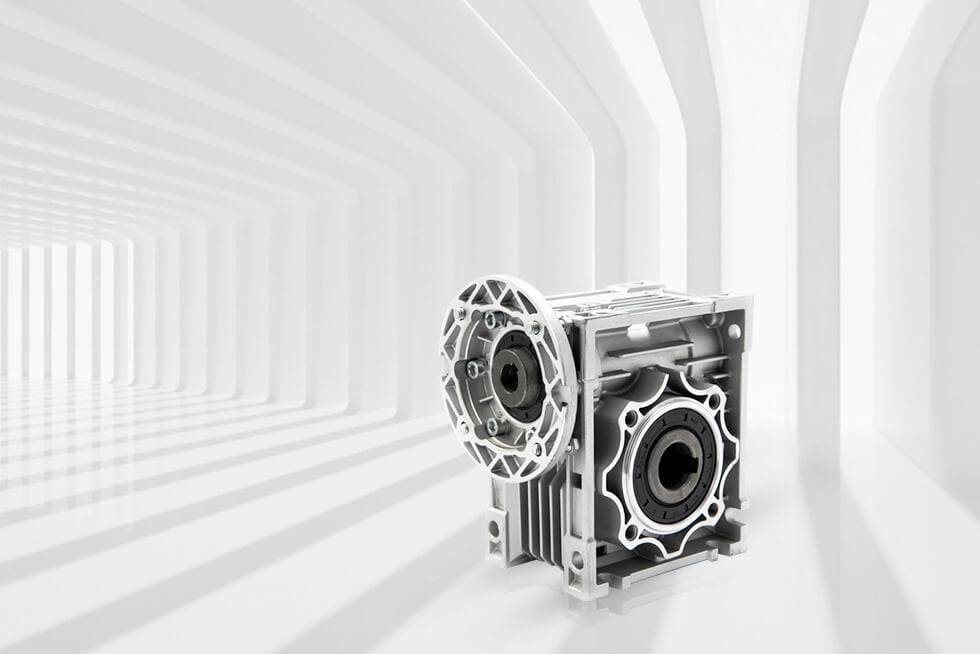
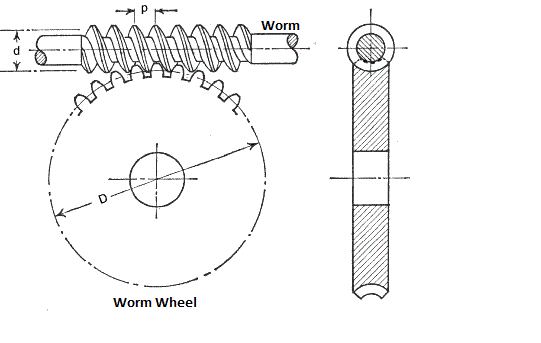
MỘT thiết bị sâu — also called a worm drive hoặc hộp số giun when housed as a reducer — is a gear system that transmits motion and power between two non-parallel, non-intersecting trục, almost always at a 90° right angle. It has two components:
- Con sâu — a shaft with a continuous helical thread, essentially a screw. It is the input member and usually the driving element.
- The worm wheel (thiết bị sâu) — a toothed wheel whose curved teeth are conjugate to the worm’s helical profile. It is the output member. (Ghi chú: some sources use “thiết bị sâu” for the wheel alone; in this article thiết bị sâu means the complete assembly.)
Because the shafts are perpendicular and offset, a worm gear set always changes the direction of rotation by 90° — a geometric property no other một giai đoạn reducer provides in such a compact envelope. The idea is ancient: Archimedes described the screw mechanism around 250 BC, và “Archimedean worm” is still a basic form today.
Three numbers define any worm gearbox at the most fundamental level: các tỉ lệ giảm (how much the output slows), các mô-men xoắn đầu ra (continuous force the output can deliver), và center distance (distance between the two shaft axes, which sets the physical size). Everything else on a spec sheet — thermal rating, yếu tố dịch vụ, phản ứng dữ dội, mounting — flows from these.
Why Engineers Choose Worm Gears
- High single-stage ratio: 5:1 ĐẾN 100:1 in one stage, where spur/helical gears need two or three stages to reach the same ratio.
- Self-locking option: at high ratios the output mechanically locks when the motor stops — no brake needed.
- Im lặng, Chuyển động trơn tru: teeth engage gradually over a large contact area; typical 55–62 dB vs 62–75 dB for helical units.
- Compact right-angle package: small footprint for the torque delivered.
- Shock-load tolerance: the conforming (line/area) contact spreads load well.
The trade-off is efficiency and heat. The mesh is mostly sliding contact, so a large share of transmitted power becomes heat — the single most misunderstood and misspecified parameter in worm-gear selection.
How a Worm Gear Works: Từng bước một
The worm-drive action is best understood as a screw turning a wheel — but the physics is helical-gear meshing, not pure threading.
- The worm rotates as the input. Its helical thread is the driving surface. Rotating it one full turn advances the worm wheel by exactly the number of thread starts.
- The thread pushes the wheel teeth. As the worm turns, its flank contacts a wheel tooth, slides along it, engages fully, and releases — a continuous, progressive meshing. The helix direction and pressure angle of the worm must match the wheel, and the worm’s axial pitch must equal the wheel’s circular pitch, or the set will not mesh.
- Speed is reduced by the tooth count. A single-start worm advances the wheel one tooth per revolution; a 40-tooth wheel therefore gives 40:1. Two starts give 20:1 from the same wheel. The ratio is set purely by geometry: i = Z2 / Z1 (wheel teeth ÷ worm starts).
- Torque is multiplied. By conservation of power (ignoring losses), the slower output carries proportionally more torque: Tout = TTRONG × tôi × n. This is why a small worm can hold a heavy load.
- Sliding dominates the contact. Unlike spur/helical gears that roll, the worm thread slides across the wheel face. That sliding is what creates high friction, hiệu quả thấp hơn, nhiệt, and — at a shallow lead angle — self-locking.
- Self-locking appears when the angle is shallow enough. If the worm’s lead angle (γ) is smaller than the mesh friction angle (ρ′), the wheel cannot push the worm backward; the output locks when the motor de-energizes.
Single vs. Multi-Start Worms
The number of starts (thread heads, Z1) is the primary lever for both ratio and efficiency:
- Single-start (Z1 = 1): shallow lead angle, high ratio, strong self-locking, but low efficiency (40–50%).
- Double-start (Z1 = 2): moderate lead angle, less self-locking, efficiency 50–78%.
- Multi-start (Z1 = 3–4): steep lead angle, hiệu quả cao (78–92%) but generally not self-locking.
Worm Gear Types Compared
Worm sets are classified by how the worm and wheel “wrap” around each other. The enveloping form dictates contact area, load capacity, và chi phí.
| Kiểu | Geometry | Liên hệ | Khả năng chịu tải | Typical use |
|---|---|---|---|---|
| Non-enveloping (non-throated) | Cylindrical worm, plain wheel | Point / small area | Thấp | Small instruments, light duty |
| Single-enveloping (single-throated) | Cylindrical worm, concave wheel | Line contact | Medium–high | Machine tools, băng tải, thiết bị truyền động |
| Double-enveloping (double-throated / hourglass) | Hourglass worm + concave wheel | Largest area | Highest | Metallurgy, heavy presses, precision heavy load |
Enveloping vs. planar double-enveloping: a standard enveloping worm has a cylindrical worm with a throated wheel. MỘT double-enveloping (ví dụ., Cone Drive’s Envex®) throats both members so the teeth maintain uniform contact through the mesh — highest load capacity but the most demanding to machine. For most industrial NMRV-class reducers, single-enveloping is the cost/performance sweet spot.
Worm Gear vs. Other Gear Types
Choosing worm over spur, xoắn ốc, góc xiên, or planetary depends on ratio, hiệu quả, tự khóa, and envelope.
| Tiêu chí | bánh giun | thúc đẩy | Helical | hành tinh |
|---|---|---|---|---|
| Tỷ lệ một giai đoạn | 5:1 - 100:1 | ≤ 6:1 | ≤ 10:1 | 3:1 - 10:1 |
| Hiệu quả (typical) | 40–92% (phụ thuộc vào tỷ lệ) | 96–99% | 95–98% | 90–97% |
| Tự khóa | Đúng (high ratio) | KHÔNG | KHÔNG | KHÔNG |
| Shaft arrangement | Right-angle, non-intersecting | Parallel | Parallel | Coaxial |
| Tiếng ồn | Rất thấp (55–62 dB) | Cao hơn | Low–medium | Low–medium |
| sinh nhiệt | Cao (sliding) | Thấp | Thấp | Low–medium |
| Cost at high ratio | Low–medium | Cao (needs stages) | Cao (needs stages) | Medium–high |
Rule of thumb: pick a worm drive when you need a large right-angle reduction, quiet running, or self-locking in one stage. Pick spur/helical/planetary when efficiency and continuous-duty thermal load dominate (ví dụ., high-speed conveyors, lực kéo). See also our gearbox vs. động cơ bánh răng guide.
Worm Gear Efficiency by Ratio
Efficiency falls monotonically with ratio because a higher ratio forces a shallower lead angle. The table consolidates AGMA / iso 14521 methodology with manufacturer acceptance-test data (run-in unit, ~40°C oil, PAO synthetic — the most favorable normal condition). Cold-start runs 5–10% lower.
| Tỉ lệ (Tôi) | Lead angle γ (approx.) | Efficiency η (mineral) | Efficiency η (PAO synth.) | Tự khóa? |
|---|---|---|---|---|
| 5:1 | 21°–26° | 86–90% | 89–93% | KHÔNG |
| 10:1 | 14°–18° | 80–85% | 84–88% | KHÔNG |
| 20:1 | 8°–11° | 72–78% | 76–82% | Borderline |
| 30:1 | 6°–8° | 68–74% | 73–79% | Typically yes |
| 50:1 | 4°–6° | 64–70% | 69–75% | Đúng |
| 80:1 | 2.8°–4° | 58–64% | 63–69% | Đúng |
| 100:1 | 2.3°–3.5° | 55–61% | 60–67% | Đúng |
Material Pairing: Hardened-Steel Worm + Bronze Wheel
The worm and wheel are deliberately different hardnesses. A hard steel worm against a softer bronze wheel prevents adhesive wear (galling): the bronze sacrifices itself slowly while protecting the more expensive worm. This is why bronze-wheel replacement is the most common major service item (typically 6–10 years of continuous duty).
| Member | Common material | Hardness / spec | Role |
|---|---|---|---|
| Sâu | Case-hardened steel (20CrMnTi, 17CrNiMo6, 16MnCr5) | HRC 58–62 | Hard driver, wear-resistant |
| Worm wheel — general | Phosphor bronze (CuSn12Ni2) | HB 95–115 | Low-friction bearing surface |
| Worm wheel — heavy duty | Aluminum bronze (CuAl10Ni) | High strength | Higher load, wear resistance |
| Worm wheel — light duty | Cast iron | — | Cost-sensitive, low load |
| Nhà ở | ADC12 aluminum die-cast (std) / EN-GJL-250 cast iron (nặng) | — | Contains pair + lubricant |
| Lubricant | ISO VG220 PAO (std) / VG320 (reversing) / PAG (high-temp) | — | EHL film, governs η & life |
Worm Gear Engineering Data: Công thức & Limits
These are the equations an engineer actually uses when specifying a worm drive. All conform to AGMA 6034-B92 (ANSI/AGMA 6034) và ISO 14521 methodology.
1. Tỉ lệ giảm
i = Z2 / Z1 — wheel teeth (Z2) ÷ worm starts (Z1). Keep Z2 > 28 to avoid undercutting.
2. Lead angle
γ = arctan( Z1 · m / d1 ) = arctan( Z1 / q ) — where m is the axial module, d1 the worm pitch diameter, and q = d1/m the diameter factor. The lead angle is the single most important efficiency variable.
3. Hiệu quả (worm driving)
η = tan γ / tan( γ + ρ′ ), where the virtual friction angle ρ′ = arctan( μ / cos αn ), μ is the mesh friction coefficient (set by sliding velocity, lubricant, material, nhiệt độ), and αN is the normal pressure angle (typically 20°, so cos αN ≈ 0.940).
The practical back-drive form is also useful:
ηback = tan( γ − ρ′ ) / tan γ
4. Self-locking condition
Self-locking when γ < ρ′ (equivalently, when λ < φ, the equivalent friction angle). Below roughly 5° lead angle, most sets self-lock. Remember the trade: the same shallow angle that gives self-locking also gives the lowest efficiency (often < 50%).
5. mô-men xoắn đầu ra
Tout = Tin × i × η — always include η; at 50:1/55% you lose 45% of input torque to friction.
6. Center distance
a = m ( q + Z2 + 2x ) / 2 — where x is the addendum-modification coefficient. Center distance sets the unit size and is fixed by the housing; getting it wrong causes misalignment wear.
7. Thermal limit (the rating that actually bites)
The AGMA power rating is based on 10 h of continuous uniform load and is governed by pitting/wear resistance Và by heat dissipation. Keep oil temperature ≤ 80–90°C; above this, lubricant viscosity collapses and the mesh risks scuffing failure. The allowable thermal power is Pth = ks · A · ( Toil − Tambient ).
Worked example — why efficiency is a thermal problem, not a footnote
Hãy xem xét một 3 kW conveyor drive at 50:1, liên tục 18 h/day. Tại 75% hiệu quả, lost power = 3 × 0.25 = 0.75 kW of heat, continuously. Tại 55% hiệu quả (single-start, tự khóa), lost power = 3 × 0.45 = 1.35 kW. Các 0.6 kW difference behaves like a 600 W space heater sealed inside the housing — raising oil temperature 15–20°C, dropping viscosity ~40%, and triggering a self-reinforcing scuffing failure months later. The fix is a multi-start worm (higher γ, higher η) or forced/larger cooling — not a bigger motor.
Best Applications for Worm Gears
Worm drives earn their place wherever a large right-angle reduction, quiet running, or self-locking matters more than peak efficiency.
| Ứng dụng | Why worm gear fits | Typical ratio |
|---|---|---|
| Thang máy & lifting hoists | Self-locking holds the load when power fails | 30:1 - 80:1 |
| Cần cẩu, Tời, anchor windlasses | Mô-men xoắn cao, self-locking safety | 20:1 - 60:1 |
| Conveyor systems | Compact, high ratio, im lặng | 10:1 - 40:1 |
| Automotive power steering | Right-angle, trơn tru, reversible feel | 15:1 - 25:1 |
| Valve actuators & dampers | Self-locking holds position without a brake | 40:1 - 100:1 |
| Solar tracking systems | Holds panel angle against wind, low power | 30:1 - 60:1 |
| Người máy & định vị chính xác | Backlash control, right-angle joints | 20:1 - 100:1 |
| Packaging & máy móc thực phẩm | Im lặng, washdown housings available | 10:1 - 30:1 |
| Stage & theater rigging | Tự khóa, im lặng, safe | 30:1 - 80:1 |
For battery- or efficiency-critical motion where a worm’s losses are unacceptable, của chúng tôi động cơ BLDC paired with hộp số hành tinh are the usual alternative.
How to Select a Worm Gear: Từng bước một
- Define the ratio. From required output speed: i = nTRONG / Nout. Worm sets cover 5:1–100:1 in one stage.
- Define the output torque. Load torque × service factor. Then back-calculate the needed input torque: TTRONG = Tout / ( tôi × n ).
- Pick the start count (Z1). Need self-locking? Use single-start. Need efficiency for continuous duty? Use double/multi-start. This is the key efficiency lever.
- Size the center distance. Choose the smallest standard center distance whose AGMA-rated thermal and pitting capacity exceeds your continuous power at the operating ratio. Đừng size on peak torque alone.
- Select the material pair. Hardened-steel worm + phosphor-bronze wheel for general duty; aluminum bronze for heavy/reversing; cast iron only for light duty.
- Specify lubrication & làm mát. ISO VG220 PAO synthetic as standard; VG320 for high-cycle reversing; PAG for high temperature. For continuous high-load, confirm the housing can shed the lost heat (Pth).
- Confirm self-locking (if required). Verify γ < ρ′ at your operating temperature — note that hot lubricant lowers μ and can break self-locking on borderline designs.
- Verify mounting & alignment. Match the motor flange (IEC B5/B14 or NEMA C-face), then ensure coaxiality, perpendicularity, and the correct center distance at installation to avoid eccentric wear.
Common Worm Gear Engineering Mistakes
- Sizing on peak torque, ignoring thermal rating. The AGMA rating is a 10-hour continuous-duty limit governed by heat. A unit fine for a 2-minute peak will cook under 18-hour continuous load. Always check Pth.
- Assuming high efficiency. Tại 50:1 a self-locking worm is ~55% efficient; you lose ~45% of input torque and ~1.3 kW of 3 kW as heat. Budget motor power and cooling accordingly.
- Assuming it can be back-driven. Self-locking sets (single-start, high ratio) cannot be reversed by the load. Using one where the application needs back-driving motion is a design error — and relying on self-locking as the sole safety brake can fail if the oil warms up.
- Using the wrong lubricant. Worm meshes need EP worm-grade oil (ISO VG220/320), not ordinary engine or gear oil. The wrong oil raises μ, drops efficiency, and causes scuffing.
- Wrong alignment / center distance. Off-center or non-perpendicular mounting creates eccentric load and poor mesh, accelerating wear and noise.
- Choosing the wrong start count. Specifying a single-start when efficiency matters (continuous conveyor) or a multi-start when self-locking is safety-critical. Decide Z1 from the efficiency/self-lock trade first.
Worm Gear Troubleshooting: Vấn đề → Nguyên nhân → Giải pháp
| Vấn đề | Likely cause | Giải pháp |
|---|---|---|
| Housing overheats | Low oil level, wrong lubricant, quá tải, tản nhiệt kém | Top up to correct level, use ISO VG220/320 EP worm oil, reduce load or add forced cooling |
| Excessive noise / rung động | Misalignment, worn wheel, failed bearings | Re-check coaxiality & perpendicularity, replace worm wheel, thay thế vòng bi |
| Self-locking fails (load back-drives) | Multi-start worm (large γ), warm oil lowered μ, advanced wear | Use single-start worm, keep oil cool, add a holding brake for safety-critical lifts |
| Oil leaks | Worn shaft seal (FKM), blocked breather | Replace double-lip Viton seal, clear the breather vent |
| Scuffing / tooth scoring | Oil too hot, boundary lubrication lost, sự ô nhiễm | Improve cooling & bôi trơn, filter oil, reduce duty |
| Premature wheel wear | Wrong center distance, incorrect material pair, abrasives in oil | Re-establish correct center distance, use hardened-steel worm + bronze wheel, filter |
| Output torque below spec | Efficiency over-estimated, unit undersized | Recompute with actual η (bao gồm. tỉ lệ), select larger center distance |
| Input shaft seizes | Foreign object, bearing lock-up, severe overload | Strip & inspect, thay thế vòng bi, verify load vs. AGMA rating |
Câu hỏi thường gặp
What is the difference between a worm gear and a worm wheel?
Các sâu is the screw-shaped input shaft; các worm wheel (or worm gear) is the toothed output wheel that meshes with it. Together they form the worm gear lái xe. Some texts use “thiết bị sâu” for the whole assembly and others for the wheel alone — clarify which when reading a spec sheet.
Are worm gears self-locking?
They can be. Self-locking occurs when the lead angle γ is smaller than the mesh friction angle ρ′ (γ < ρ′), which happens at high ratios with single-start worms (đại khái 30:1 và ở trên). Multi-start worms are generally not self-locking. Note that hot oil lowers μ and can defeat borderline self-locking, so never rely on it as the sole safety brake in a lift.
What is a good efficiency for a worm gear?
It depends entirely on ratio and start count. Single-start self-locking units run 40–50%; double-start 50–78%; multi-start 78–92%. At a fixed ratio, expect efficiency to fall as the ratio rises — a 100:1 worm box is inherently ~55–67%, trong khi một 5:1 can reach 89–93%.
When should I không use a worm gear?
Avoid worm drives for high-speed, continuous-duty, efficiency-critical applications (ví dụ., high-throughput conveyors, lực kéo) where the sliding losses become a thermal and energy penalty. Planetary or helical reducers are better there. Also avoid them where the load must back-drive the input.
What lubrication do worm gears need?
A dedicated extreme-pressure worm-gear oil — typically ISO VG220 synthetic (PAO) as standard, VG320 for high-cycle reversing, PAG for high temperature. Ordinary engine or spur-gear oil is the wrong choice and causes scuffing. Change oil after the first ~400 hours and then about every 4,000 giờ.
How long do worm gearboxes last?
With correct lubrication and load, the bronze wheel typically lasts 6–10 years of continuous service before replacement; the hardened-steel worm usually outlasts several wheels. Bearing and seal life, plus oil cleanliness, dominate the practical service interval.
Why Choose Greensky for Worm Gear Motors & Custom Drives?
When a standard catalog worm reducer fits, the big brands are fine. When you need a động cơ + worm-gear reducer as one engineered assembly, a custom center distance or ratio, or flexible volumes, năng lượng bầu trời xanh is the OEM/ODM partner. Từ 2011 we have built worm-gear reducers (nmrv / WP series), BLDC, chải DC, Và động cơ bước with matched gearheads for customers in 50+ Quốc gia.
- Integrated drivetrains: động cơ + worm reducer supplied as one concentric assembly — no adapter guesswork, correct flange every time (IEC B5/B14 or NEMA C-face).
- Custom ratios & center distances: tailored reduction, self-locking or high-efficiency (multi-start) builds to your load profile.
- Thermal-aware sizing: we size to the AGMA continuous-duty thermal limit, not just peak torque, so your unit does not cook in continuous operation.
- Flexible MOQ & thời gian dẫn: from prototype to mass production.
- Standards practice: được thiết kế theo tiêu chuẩn IEC 60034 / KHÔNG CÓ MG 1 motor practice; ISO and CE certified.
- Hỗ trợ địa phương: engineering help through our North America & Europe channels.
Tài liệu tham khảo
- AGMA 6034-B92 (ANSI/AGMA 6034), Practice for Enclosed Worm Gear Speed Reducers and Gearmotors. https://www.agma.org/standards/
- iso 14521, Worm-gear pairs — Calculation of load capacity. https://www.iso.org/standard/54551.html
- IEC 60034-1, Máy điện quay - Đánh giá và tính năng. https://webstore.iec.ch/publication/60034-1
- KHÔNG CÓ MG 1, Động cơ và máy phát điện. https://www.nema.org/standards/view/motors-and-generators
- iso 6336, Calculation of load capacity of spur and helical gears (strength context). https://www.iso.org/standard/76425.html
- SKF, Bearing rating life (L10), gắn & lubrication guidance. https://www.skf.com/group/support/engineering-tools/bearing-calculator
- Siemens / Flender, Gear unit engineering — worm gear drive technology. https://www.siemens.com/global/en/products/automation/drive-technology/gear-units.html
- IEEE Standard 112, Test Procedure for Polyphase Induction Motors and Generators. https://standards.ieee.org/ieee/112/4703/
- CHÚNG TA. Sở năng lượng, động cơ & Drive Systems — Energy Efficiency. https://www.energy.gov/eere/motors
- Cone Drive (a Regal Rexnord brand), Double-enveloping (Envex®) worm gear technology. https://www.conedrive.com/technology/