
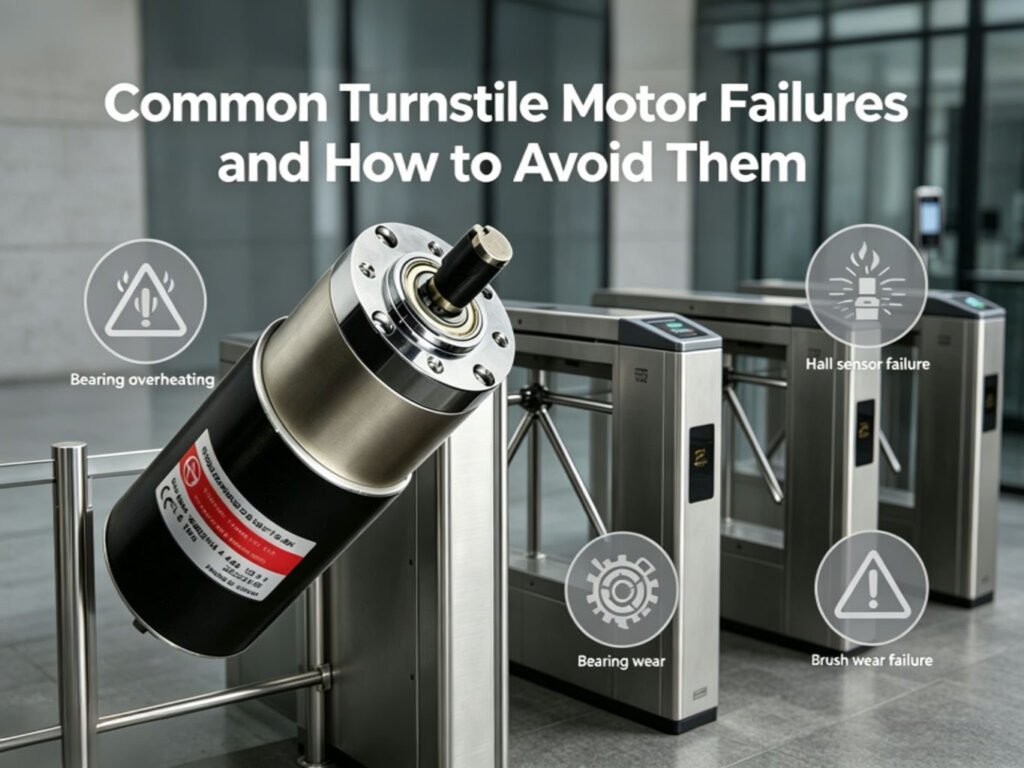
Common Turnstile Motor Failures and How to Avoid Them
Đoạn trích nổi bật:
Common turnstile motor failures include overheating, torque loss, bearing wear, controller faults, and electrical insulation breakdown. These failures are often caused by improper motor sizing, poor thermal management, incorrect control strategies, and lack of maintenance. To avoid them, engineers should select the correct motor type (preferably BLDC), ensure proper torque and voltage matching, implement effective cooling, and adopt preventive maintenance strategies. Proper design and selection significantly improve system reliability and reduce lifecycle costs.
Turnstile systems are designed for continuous operation in high-traffic environments such as metro stations, office buildings, and industrial facilities. The motor is the core component responsible for mechanical motion and directly influences system performance, độ tin cậy, and maintenance cost. Tuy nhiên, many failures in turnstile systems can be traced back to motor-related issues—either due to poor selection, improper control, or environmental stress.
This engineering guide provides a deep analysis of common turnstile motor failures, their root causes, and proven strategies to prevent them. It is specifically designed for engineers, nhà sản xuất OEM, and procurement professionals seeking to optimize system reliability and reduce downtime.
What Are the Most Common Turnstile Motor Failures?
Turnstile motor failures typically result from mechanical wear, electrical stress, or thermal overload. Understanding these failure modes is essential for designing reliable systems.
Typical Failure Types
- Overheating and thermal degradation
- Torque loss or insufficient torque output
- Bearing wear and mechanical friction
- Controller or driver failure
- Electrical insulation breakdown
- Bàn chải mòn (in brushed motors)
Each of these failures has distinct causes and prevention strategies, which will be analyzed in detail below.
👉For high-performance solutions, check our BLDC Motor for Turnstile
Why Do Turnstile Motors Fail? Root Cause Analysis
Motor failures rarely occur randomly. They are usually the result of design flaws or operational mismatches.
Key Root Causes
- Incorrect motor sizing (torque or power mismatch)
- Inadequate cooling or poor thermal design
- Low-quality components or materials
- Improper control algorithms
- Environmental factors (bụi, độ ẩm, nhiệt độ)
Ví dụ, undersized motors operating near maximum load continuously will overheat, leading to insulation degradation and eventual failure.
Quá nóng: Các #1 Cause of Turnstile Motor Failure
Thermal stress is the most common failure mode in turnstile motors, especially in high-duty-cycle environments.
Why Overheating Happens
- Excessive current draw
- Thông gió kém
- High ambient temperature
- Hiệu suất động cơ thấp
Impact on Performance
- Reduced efficiency
- Sự cố cách điện
- Shortened lifespan
BLDC motors significantly reduce overheating due to higher efficiency and lower losses.
Torque Loss and Mechanical Failure
Insufficient torque can cause incomplete barrier movement, leading to system malfunction.
Causes of Torque Loss
- Incorrect torque calculation
- Wear in gears or couplings
- Voltage drops
Engineering Solution
- Áp dụng hệ số an toàn (1.5–2x torque)
- Use high torque density motors (BLDC)
Torque mismatch is one of the most common design mistakes in turnstile systems.
Bearing Wear and Mechanical Degradation
Bearings are critical for smooth rotation and load handling.
Failure Causes
- Continuous operation
- Dust contamination
- Improper lubrication
Prevention Methods
- Use sealed bearings
- Bảo trì thường xuyên
- Proper load distribution
Mechanical wear increases friction, which further accelerates motor failure.
Electrical Failures: Insulation and Wiring Issues
Electrical failures often result from thermal stress and voltage irregularities.
Common Issues
- Sự cố cách điện
- Short circuits
- Loose wiring
Phòng ngừa
- Use high-quality insulation materials
- Ensure stable voltage supply
Electrical reliability is critical for long-term performance.
Control System Failures and Their Impact
The control system plays a crucial role in motor performance.
Common Problems
- Improper tuning of control algorithms
- Controller overheating
- Signal interference
BLDC Advantage
- Advanced FOC control
- Precise current regulation
Modern turnstiles require sophisticated control systems for smooth operation.
BLDC vs Brushed Motor Failure Rates
| Tham số | động cơ BLDC | Động cơ chải |
|---|---|---|
| Failure Rate | Thấp | Cao hơn |
| BẢO TRÌ | Tối thiểu | Thường xuyên |
| Sinh nhiệt | Thấp | Cao |
| Tuổi thọ | Dài | Short |
BLDC motors significantly reduce failure risks due to the absence of brushes and better thermal performance.
Efficiency and Thermal Performance in Failure Prevention
Efficiency directly influences heat generation and reliability.
High Efficiency Benefits
- Lower energy loss
- Reduced heat
- Nhịp cuộc sống dài hơn
Choosing high-efficiency motors is essential for minimizing failure rates.
How to Choose a Reliable Turnstile Motor
Proper motor selection is the most effective way to prevent failures.
Key Parameters
- Vôn: 24V / 48V
- Quyền lực: 50W–500W
- mô-men xoắn: Based on load
- Tốc độ: 10–100 RPM
- làm mát: Làm mát không khí
- Bộ điều khiển: FOC for BLDC
Recommendations
- Use BLDC motors for high reliability
- Avoid undersized motors
👉 Get OEM solution: Custom Motor Development
Applications and Failure Risk by Industry
- Metro systems → high load, high reliability required
- Office buildings → moderate load
- Factories → harsh environments
Each environment requires different design considerations.
Xu hướng tương lai: Smart Monitoring and Predictive Maintenance
- Giám sát dựa trên IoT
- Predictive maintenance algorithms
- Real-time diagnostics
These technologies will significantly reduce failure rates.
Câu hỏi thường gặp: Turnstile Motor Failures
1. What is the most common failure?
Overheating is the most common issue, often caused by improper motor sizing or poor cooling.
2. How to reduce motor failure?
Use BLDC motors, ensure proper torque selection, and implement thermal management.
3. Why do brushed motors fail faster?
Brush wear and friction lead to higher maintenance and shorter lifespan.
4. What role does voltage play?
Proper voltage reduces current and heat, improving reliability.
5. Is maintenance necessary?
Đúng, regular inspection and cleaning are essential for long-term performance.
Phần kết luận: Engineering Strategy for Failure Prevention
Turnstile motor failures can be significantly reduced through proper design, lựa chọn, và bảo trì. BLDC motors offer superior reliability, hiệu quả, and lifespan, making them the preferred choice for modern systems.
Need expert support?
✔ Yêu cầu bảng dữ liệu
✔ Nhận giải pháp OEM
✔ Contact our engineers
Tài liệu tham khảo
- https://ieeexplore.ieee.org
- https://www.sciencedirect.com
- https://www.mdpi.com