
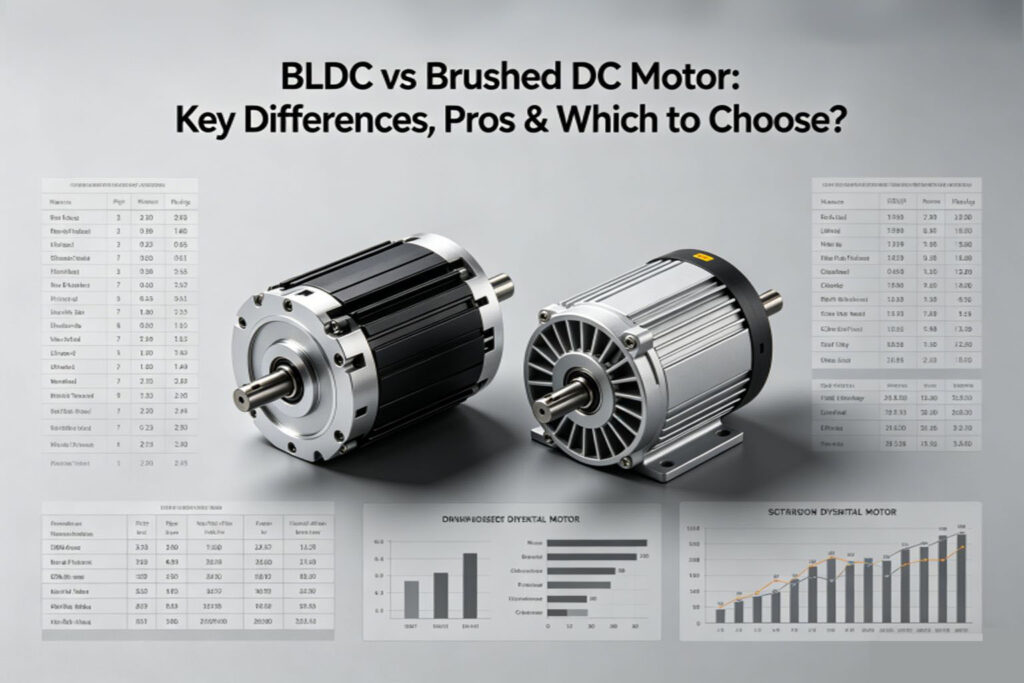
BLDC vs Động cơ DC chải: Sự khác biệt chính, Ưu điểm & Chọn cái nào?
Đoạn trích nổi bật:
động cơ BLDC are more efficient, longer-lasting, and better suited for precision and high-performance applications, while brushed DC motors are simpler, lower-cost, and ideal for basic or cost-sensitive systems. The choice depends on factors such as efficiency requirements, maintenance tolerance, kiểm soát độ phức tạp, and total lifecycle cost. For OEMs and industrial buyers, BLDC motors are typically preferred for modern systems, while brushed DC motors remain relevant in low-cost or intermittent-use applications.
In industrial and OEM motor selection, comparing BLDC vs brushed DC motor is a common decision point that directly affects system performance, độ tin cậy, và chi phí dài hạn. While both motor types operate on direct current, their internal structures and performance characteristics differ significantly. Engineers and procurement managers must evaluate these differences based on real application requirements rather than initial price alone.
Động cơ BLDC là gì?
DC không chổi than (BLDC) motor is an electronically commutated motor that replaces mechanical brushes with an electronic controller. Permanent magnets are embedded in the rotor, while stator windings are energized in a controlled sequence to generate rotation.
Key Engineering Features
- No mechanical brushes → reduced wear and maintenance
- Bộ điều khiển tốc độ điện tử (THOÁT) required
- Hiệu quả cao (85–95%)
- Excellent speed and torque control
BLDC motors are widely used in electric vehicles, người máy, and industrial automation where performance, hiệu quả, and reliability are critical.
👉 Explore: Industrial BLDC Motor Solutions
What Is a Brushed DC Motor?
A brushed DC motor uses mechanical brushes and a commutator to switch current within the motor windings. This design has been widely used for decades due to its simplicity and low cost.
Key Engineering Features
- Mechanical commutation using brushes
- Điều khiển đơn giản (direct DC supply)
- Lower initial cost
- Higher maintenance requirements
Brushed DC motors are commonly used in low-cost devices, automotive accessories, and applications where precision control is not required.
BLDC vs Động cơ DC chải: Core Differences Explained
| Tham số | động cơ BLDC | Động cơ DC chải |
|---|---|---|
| Hiệu quả | 85–95% | 70–80% |
| BẢO TRÌ | Thấp | Cao (mài mòn bàn chải) |
| Điều khiển | điện tử (THOÁT) | Simple DC supply |
| Tuổi thọ | Dài | ngắn hơn |
| Chi phí ban đầu | Cao hơn | Thấp hơn |
| Tiếng ồn | Thấp | Cao hơn |
The primary difference lies in commutation: BLDC motors rely on electronic switching, while brushed motors use physical contact. This leads to differences in efficiency, Độ bền, and system complexity.
Why BLDC Motors Are More Efficient
Efficiency is a critical factor in modern motor selection, especially in energy-intensive or battery-powered systems.
Engineering Reasons
- No friction losses from brushes
- Reduced electrical losses due to optimized control
- Lower heat generation in rotor
In applications such as electric vehicles or HVAC systems, higher efficiency translates directly into energy savings and longer system lifespan.
Torque Density and Performance Comparison
Torque density is a key metric for compact system design. BLDC motors offer higher torque density due to their permanent magnet structure.
BLDC Advantages
- Higher torque-to-weight ratio
- Better dynamic response
- Suitable for compact systems
Brushed Motor Characteristics
- Adequate torque for basic applications
- Performance limited by brush wear and heat
For applications like AGVs or robotics, BLDC motors provide superior performance.
Hiệu suất nhiệt và quản lý nhiệt
Thermal performance affects both reliability and lifespan.
Động cơ BLDC
- Lower heat generation due to higher efficiency
- Heat concentrated in stator → easier cooling
Brushed Motors
- Higher heat due to friction and electrical losses
- Heat generated in rotor → harder to dissipate
This difference significantly impacts motor durability in continuous-duty applications.
Control System Differences
Control complexity is one of the biggest distinctions between BLDC and brushed motors.
BLDC Control
- Requires ESC or driver
- Supports precise speed and torque control
- Enables smart system integration
Brushed Motor Control
- Simple voltage-based control
- No advanced electronics required
For modern automation systems, BLDC motors offer significant advantages.
Reliability and Lifespan Comparison
Lifespan is a major concern for OEM buyers and industrial operators.
- BLDC: No brushes → longer lifespan, fewer failures
- Brushed: Brush wear limits service life
In high-duty-cycle applications, brushed motors may require frequent maintenance, increasing operational costs.
How to Choose BLDC or Brushed DC Motor for Your Application
Selecting the right motor requires a detailed engineering analysis.
Key Selection Criteria
- Vôn: 12V / 24V / 48V / 72V systems
- Dãy công suất: Watts to several kW
- Tốc độ & mô-men xoắn: Match load profile
- làm mát: Air or forced cooling
- Bộ điều khiển: ESC vs direct DC supply
Đề xuất dựa trên ứng dụng
- Electric vehicles → BLDC motor
- Low-cost consumer devices → Brushed motor
- Industrial automation → Động cơ BLDC
- Intermittent-use equipment → Brushed motor
👉 Get expert support: Giải pháp động cơ tùy chỉnh
Industrial Applications of BLDC and Brushed DC Motors
BLDC Applications
- Xe điện (48V / 72V systems)
- Robotics and automation
- Hệ thống HVAC
- Thiết bị y tế
Brushed DC Applications
- Phụ kiện ô tô
- Thiết bị gia dụng
- Dụng cụ điện
👉 Explore EV motors: Giải pháp động cơ EV
So sánh chi phí: BLDC vs Động cơ DC chải
| Yếu tố chi phí | động cơ BLDC | Động cơ DC chải |
|---|---|---|
| Chi phí ban đầu | Cao hơn | Thấp hơn |
| Chi phí vận hành | Thấp hơn | Cao hơn |
| BẢO TRÌ | Tối thiểu | Thường xuyên |
| Tổng chi phí sở hữu | Lower long-term | Higher over time |
While brushed motors are cheaper upfront, BLDC motors often provide better ROI in continuous-use applications.
Xu hướng tương lai: Why BLDC Motors Are Replacing Brushed Motors
The global shift toward energy efficiency and automation is accelerating BLDC adoption.
- Energy regulations favor high-efficiency motors
- Growth of electric mobility
- Increasing demand for smart and connected systems
Brushed motors are gradually being replaced in many applications due to their maintenance limitations.
Câu hỏi thường gặp: BLDC vs Động cơ DC chải
1. Which motor lasts longer, BLDC or brushed?
BLDC motors typically last significantly longer because they do not use brushes, which are subject to wear. This makes them ideal for continuous-duty applications.
2. Why are brushed motors cheaper?
Brushed motors have a simpler design and do not require electronic controllers, reducing manufacturing and system costs.
3. Is BLDC motor better for electric vehicles?
Đúng, BLDC motors offer higher efficiency, better control, và tuổi thọ dài hơn, making them ideal for EV applications.
4. Do BLDC motors require controllers?
Đúng, BLDC motors require an electronic speed controller to operate, which adds complexity but enables precise control.
5. When should I choose a brushed motor?
Brushed motors are suitable for low-cost, đơn giản, or intermittent-use applications where advanced performance is not required.
6. Which is better BLDC or brushed motor?
There is no single “better” option—it depends on your application. Choose based on your priorities: BLDC for performance and longevity; brushed for simplicity and upfront cost savings.
7. Why is BLDC more efficient?
BLDC motors are more efficient mainly because they eliminate brushes and a physical commutator, which reduces Friction and wear.
8. Is brushed motor obsolete?
KHÔNG, brushed DC motors are not obsolete. Brushed motors remain relevant where their simplicity and low system cost outweigh their limitations.
Phần kết luận: Which Motor Is Better?
When comparing BLDC vs brushed DC motor, the answer depends on your application. BLDC motors are better for efficiency, độ tin cậy, và hiệu suất lâu dài, while brushed motors are suitable for low-cost and simple designs.
For most modern industrial and OEM applications, BLDC motors are the preferred choice due to their superior performance and lower lifecycle cost.
Need help choosing the right motor?
✔ Yêu cầu bảng dữ liệu
✔ Get OEM motor solution
✔ Contact our engineers today
Tài liệu tham khảo
- IEEE Motor Design Handbook
- IEC Motor Efficiency Standards
- Industrial Motor Application Reports