
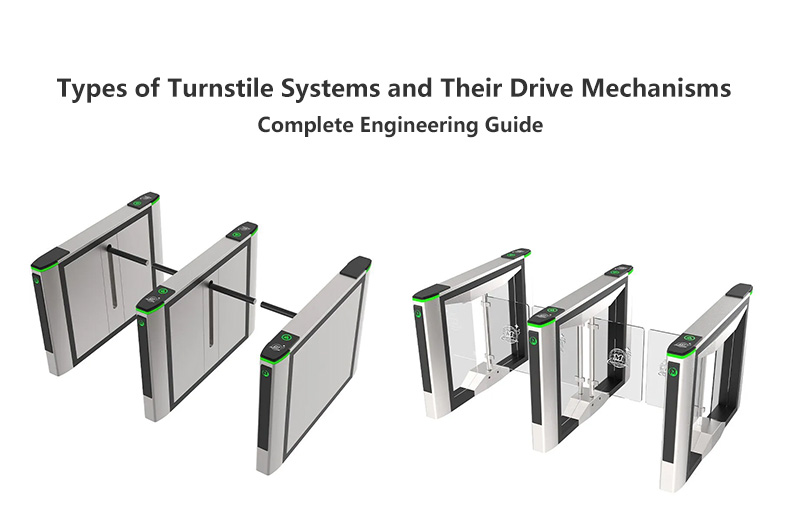
ประเภทของระบบประตูหมุนและกลไกการขับเคลื่อน: คู่มือวิศวกรรมฉบับสมบูรณ์
ตัวอย่างข้อมูลแนะนำ:
Turnstile systems use different mechanical designs and motor drive mechanisms depending on application requirements. The most common types include tripod turnstiles, flap barrier gates, swing gates, and full-height turnstiles. Their drive mechanisms typically rely on BLDC motors, เซอร์โวมอเตอร์, or stepper motors. Modern systems increasingly adopt BLDC motors due to their high efficiency, smooth torque output, เสียงเบา, และอายุการใช้งานยาวนาน. The optimal combination depends on throughput requirements, torque demands, ควบคุมความแม่นยำ, และสภาพแวดล้อม.
สำหรับวิศวกร, OEM manufacturers, and procurement professionals, understanding types of turnstile systems and their drive mechanisms is essential for designing reliable, cost-effective, and high-performance access control solutions. A turnstile is not just a mechanical barrier—it is a complex electromechanical system where motor performance directly impacts user experience, ความปลอดภัย, and lifecycle cost.
This engineering authority guide provides a comprehensive breakdown of turnstile system types, drive mechanisms, กลยุทธ์การควบคุม, and selection criteria, helping you make informed decisions for industrial and commercial applications.
What Are Turnstile Systems and Why Their Drive Mechanisms Matter?
Turnstile systems are access control devices designed to regulate pedestrian flow by allowing one person per authorization event. While their external function appears simple, internally they rely on sophisticated drive mechanisms and control systems.
👉สำหรับโซลูชั่นประสิทธิภาพสูง, ตรวจสอบของเรา มอเตอร์ BLDC สำหรับประตูหมุน
Why Drive Mechanisms Are Critical
- Determine motion smoothness and user experience
- Influence energy efficiency and operating cost
- Impact system reliability and maintenance frequency
- Define control precision and safety features
จากมุมมองทางวิศวกรรม, the drive mechanism is the “core” of the turnstile system, similar to how a motor defines the performance of industrial equipment.
Types of Turnstile Systems Explained
Different turnstile types serve different applications and environments.
1. Tripod Turnstiles
Tripod turnstiles use three rotating arms to control access. They are cost-effective and widely used in public transport systems and factories.
2. Flap Barrier Gates
Flap barriers use retractable panels for fast and smooth operation. They are commonly used in office buildings and metro stations.
3. Swing Gate Turnstiles
Swing gates use motorized doors for wider access, suitable for disabled access or high-end installations.
4. Full-Height Turnstiles
These provide maximum security with a rotating cage-like structure, commonly used in high-security areas.
Drive Mechanisms in Turnstile Systems: Core Technologies
The drive mechanism converts electrical energy into controlled mechanical motion.
1. BLDC Motor Drive
- ประสิทธิภาพสูง (85–92%)
- Smooth torque output
- Low noise and maintenance
2. Servo Motor Drive
- High precision with encoder feedback
- Suitable for premium systems
3. Stepper Motor Drive
- Simple control
- Lower cost but less efficient
4. AC Motor Drive
- Traditional solution
- Robust but less efficient
👉 สำรวจ: โซลูชั่นมอเตอร์ BLDC
BLDC vs Servo vs Stepper Drive Mechanisms
| พารามิเตอร์ | BLDC Drive | Servo Drive | Stepper Drive |
|---|---|---|---|
| ประสิทธิภาพ | สูง | สูง | ต่ำ |
| ความแม่นยำ | สูง | สูงมาก | ปานกลาง |
| ค่าใช้จ่าย | ปานกลาง | สูง | ต่ำ |
| เสียงรบกวน | ต่ำ | ต่ำ | สูงกว่า |
BLDC drives provide the best balance for most turnstile applications.
Efficiency and Energy Consumption Analysis
Efficiency plays a major role in long-term operating costs.
- BLDC motors reduce energy loss
- Servo systems optimize performance but increase cost
- Stepper motors consume constant current
For high-traffic environments, energy savings become significant over time.
Torque Density and Mechanical Design Impact
Torque density determines how compact and powerful the system can be.
ปัจจัยสำคัญ
- Motor torque output
- อัตราทดเกียร์
- Load inertia
BLDC motors enable compact designs without sacrificing performance.
ประสิทธิภาพการระบายความร้อนและการจัดการความร้อน
Thermal performance affects reliability and lifespan.
- มอเตอร์ BLDC สร้างความร้อนน้อยลง
- Proper ventilation improves durability
- Thermal monitoring prevents failure
Efficient thermal design is essential for continuous operation.
Control Systems in Turnstile Drive Mechanisms
Control systems define motion behavior.
Key Functions
- Speed and torque control
- Safety features
- Integration with access systems
Advanced systems use Field-Oriented Control (ฟค) for optimal performance.
Reliability and Lifespan of Turnstile Systems
Turnstiles operate continuously, requiring high reliability.
- BLDC motors offer long lifespan
- Servo systems depend on electronics
- Stepper motors may overheat
Reliability directly impacts maintenance costs and system uptime.
How to Choose Turnstile Systems and Drive Mechanisms
Selection depends on application requirements.
Key Criteria
- แรงดันไฟฟ้า: 24วี / 48วี
- พลัง: 50W–500W
- แรงบิด: Based on load
- ความเร็ว: User throughput
- ระบายความร้อน: ระบายความร้อนด้วยอากาศ
- คอนโทรลเลอร์: FOC recommended
Application Matching
- Flap barrier → BLDC
- Swing gate → BLDC or servo
- Tripod → stepper or BLDC
👉 รับโซลูชั่น OEM: การพัฒนามอเตอร์แบบกำหนดเอง
Applications of Turnstile Systems
- Transportation hubs
- Commercial buildings
- สิ่งอำนวยความสะดวกทางอุตสาหกรรม
- Event venues
Each application requires different drive mechanisms.
Cost vs Performance Trade-Off
| ปัจจัย | BLDC System | Servo System | Stepper System |
|---|---|---|---|
| ต้นทุนเริ่มต้น | ปานกลาง | สูง | ต่ำ |
| ประสิทธิภาพ | สูง | สูง | ต่ำ |
| การซ่อมบำรุง | ต่ำ | ปานกลาง | ต่ำ |
| ต้นทุนตลอดอายุการใช้งาน | Best ROI | สูง | Higher long-term |
BLDC systems provide the best long-term value.
Future Trends in Turnstile Drive Mechanisms
- BLDC dominance
- Smart control integration
- Energy-efficient systems
- IoT connectivity
These trends are shaping next-generation access control systems.
คำถามที่พบบ่อย: ประเภทของระบบประตูหมุนและกลไกการขับเคลื่อน
1. What motor is best for turnstiles?
BLDC motors are generally the best due to efficiency and reliability.
2. Why choose BLDC over stepper?
BLDC offers higher efficiency, การทำงานราบรื่นยิ่งขึ้น, และมีอายุยืนยาวขึ้น.
3. Are servo motors necessary?
Only for high-precision or premium applications.
4. What voltage is used?
Typically 24V or 48V DC systems.
5. How to reduce maintenance costs?
Use BLDC motors and efficient control systems.
บทสรุป: Engineering the Right Turnstile System
ความเข้าใจ types of turnstile systems and their drive mechanisms enables engineers and buyers to design systems that are efficient, เชื่อถือได้, และคุ้มค่า. BLDC motors have become the industry standard due to their superior performance and lifecycle advantages.
Need expert support?
✔ขอเอกสารข้อมูล
✔ Get OEM solution
✔ Contact our engineers
อ้างอิง
- IEEE Industrial Electronics Society
- IEC Motor Standards
- Access Control Engineering Reports